Planning Guides, Style Guide
All in One Wedding Invitations: Complete Suite Packages
Feb
Hey! So you’re looking into all-in-one wedding invitation suites, right? Okay this is honestly one of my favorite topics because I’ve spent like… way too many hours perfecting these packages for couples, and tbh they’re total game-changers when you get them right.
What Actually Goes Into a Complete Suite
So basically, a true all-in-one wedding invitation suite isn’t just the invitation itself—that’s where so many couples get confused. You’re looking at multiple pieces that all work together, and I’m gonna break down what you actually need versus what’s just nice to have.
The core pieces are your main invitation card (obviously), an RSVP card with its own envelope, a details card or insert, and then outer envelopes for everything. That’s your baseline. But then you can add reception cards, accommodation cards, weekend itinerary cards if you’re doing a destination thing, and honestly the list goes on.
I had this bride last spring who wanted to include a card for literally everything—ceremony, cocktail hour, dinner, after-party, brunch the next day. We ended up with like 8 cards in one suite and it was… a lot. Beautiful, but a lot. The postage alone was gonna bankrupt her.
The Main Invitation Card
This is your star player, usually 5×7 inches but sometimes couples go bigger for dramatic effect. I’ve worked with 6×8 and even 7×9 sizes when the design calls for it. The main card needs to include the who, what, where, and when—sounds simple but you’d be surprised how many proofs I get that forget the actual ceremony time, lol.
Material matters here more than people think. I’m talking 110lb cardstock minimum, but honestly 130lb feels more luxurious and doesn’t flop around. If you’re doing letterpress or foil stamping, you might need even thicker stock—like 220lb or cotton paper.
RSVP Cards and Envelopes
Okay so here’s where couples try to cut corners and it drives me nuts. The RSVP card needs its own envelope with your return address printed on it, and yeah, you gotta put stamps on them. Pre-stamped. I know it feels weird to pay for someone else’s postage but trust me, your response rate will tank if people have to find their own stamps.
Size-wise, RSVP cards are typically 4.25×5.5 inches or smaller—they need to fit in an A2 envelope. Some suites do postcard-style RSVPs to save on the envelope cost, which… fine, but it looks less polished imo.
Design Cohesion Across All Pieces
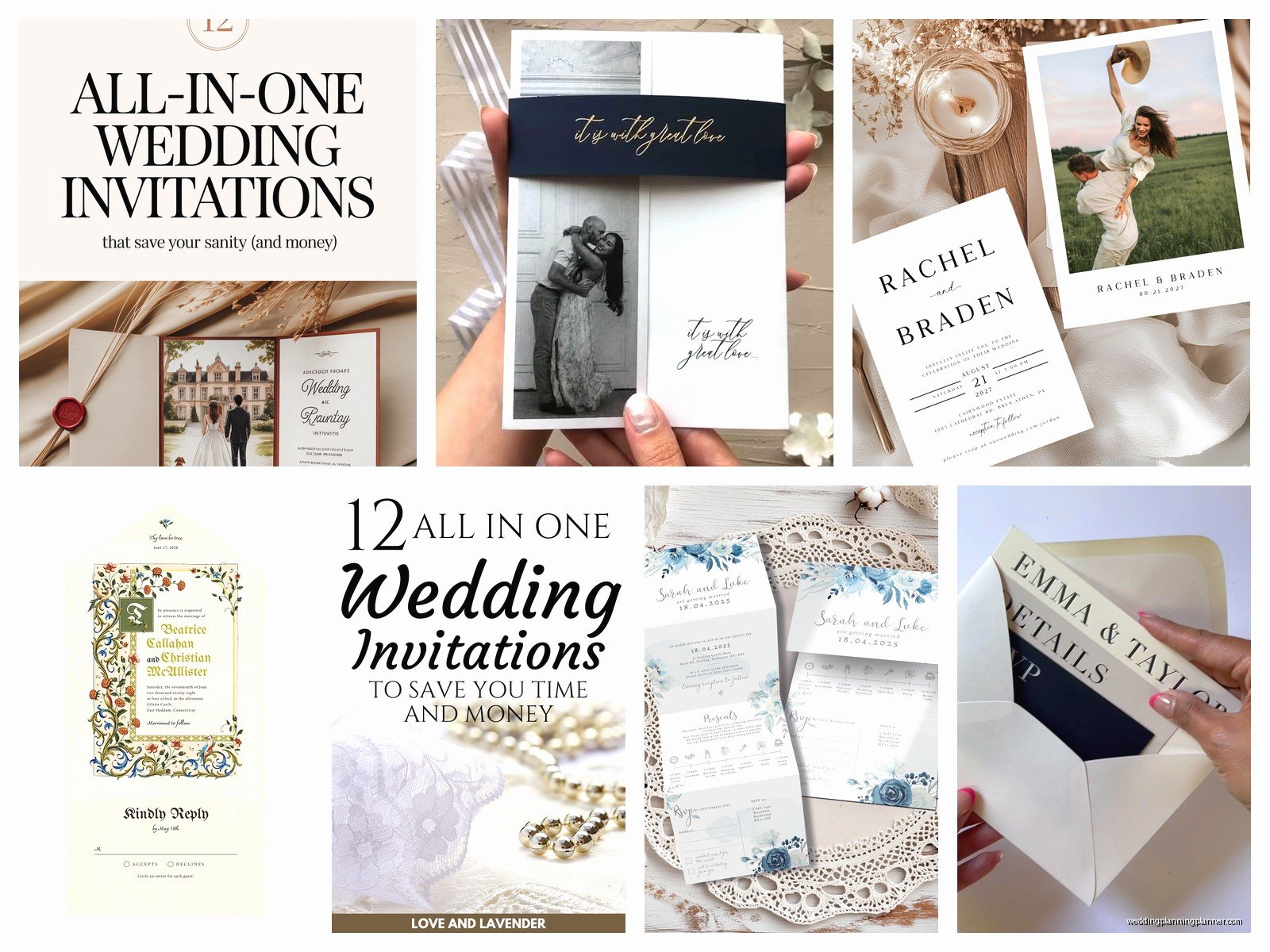
This is where the “all-in-one” concept really shines because everything matches. You’re not trying to DIY part of it and order other parts from different vendors and then realizing the colors don’t match at all (seen this disaster happen more times than I can count).
Your suite should have consistent typography—maybe one fancy script font for names and a clean sans-serif for details. Consistent color palette, obviously. And consistent design elements whether that’s a floral border, geometric lines, a monogram, whatever your vibe is.
I usually tell couples to pick like 2-3 main design elements max. My client last month wanted florals AND geometric frames AND watercolor washes AND a wax seal AND ribbon… it was giving chaotic scrapbook energy. We scaled back to just the florals and geometric corners and it looked so much more elegant.
Details Cards Are Your Best Friend
Honestly this is the most underrated piece of the suite. The details card is where you put your wedding website, hotel blocks, dress code, transportation info—all that stuff that doesn’t belong on the main invitation but people definitely need to know.
Pro tip: don’t cram everything onto one details card if you have a lot of info. Better to do two cards or even make a folded insert. I’ve done accordion-style detail cards for destination weddings that unfold to show the whole weekend timeline, and guests actually keep those as reference.
Envelope Situations
Okay so envelope drama is real. You’ve got your outer envelope which is what the post office sees—this needs recipient names and addresses printed or calligraphed. Then there’s the inner envelope which is optional but adds a layer of formality and protects the actual invitation pieces.
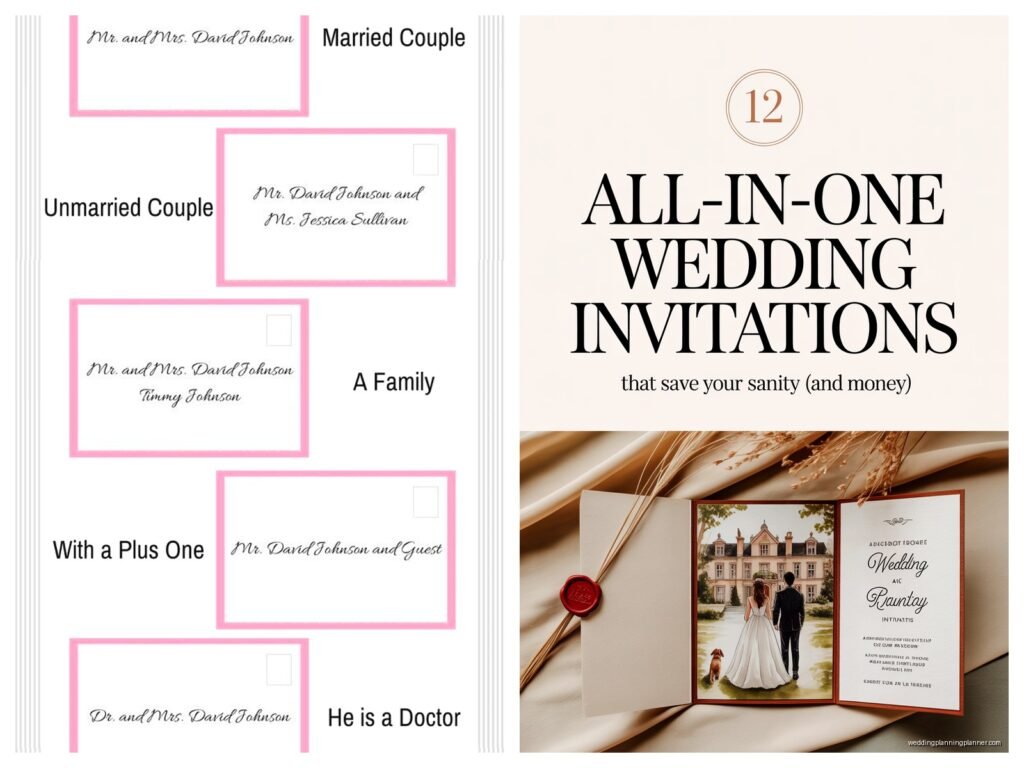
Inner envelopes traditionally just have the guests’ names without addresses, and this is where you’d indicate if kids are invited or plus-ones. Like “Mr. and Mrs. Smith” versus “The Smith Family” tells people whether you meant to include children.
I’m seeing more couples skip inner envelopes lately to save money and honestly… it’s fine for casual weddings but black-tie events really should keep them. They just set a tone, you know?
Liner Game
Envelope liners are that pop of pattern or color inside the envelope flap, and they make such a difference when someone opens your invitation. You can do solid colors, patterns that match your suite design, florals, whatever.
Funny story—I once ordered liners in “dusty rose” and they arrived bright bubblegum pink. Always always always request printed samples before placing full orders, even from vendors you trust. My cat knocked over my coffee on those samples and I had to request new ones but it was still better than ordering 200 wrong ones.
Assembly Order Actually Matters
So when you get all these pieces, there’s a proper way to stack them. Main invitation goes at the bottom facing up. Then your reception card (if separate), then details card, then RSVP card facing up with its envelope tucked behind it or placed on top.
Some people do the RSVP envelope flap tucked under the rest of the cards, some place it on top—honestly both ways work. I prefer tucking it because then you can see all the pretty cards when you first open the envelope.
If you’re adding belly bands, ribbons, or vellum wraps, those go around the whole stack. Wax seals go on the belly band or vellum, not directly on the invitation cards because they’ll break in the mail (learned that the hard way).
Suite Styles and What They Cost
Alright let’s talk real numbers because this stuff adds up fast. A basic all-in-one suite from an online vendor like Minted or Zola—you’re looking at maybe $3-5 per suite. That usually includes the main invite, RSVP card and envelope, and one details card.
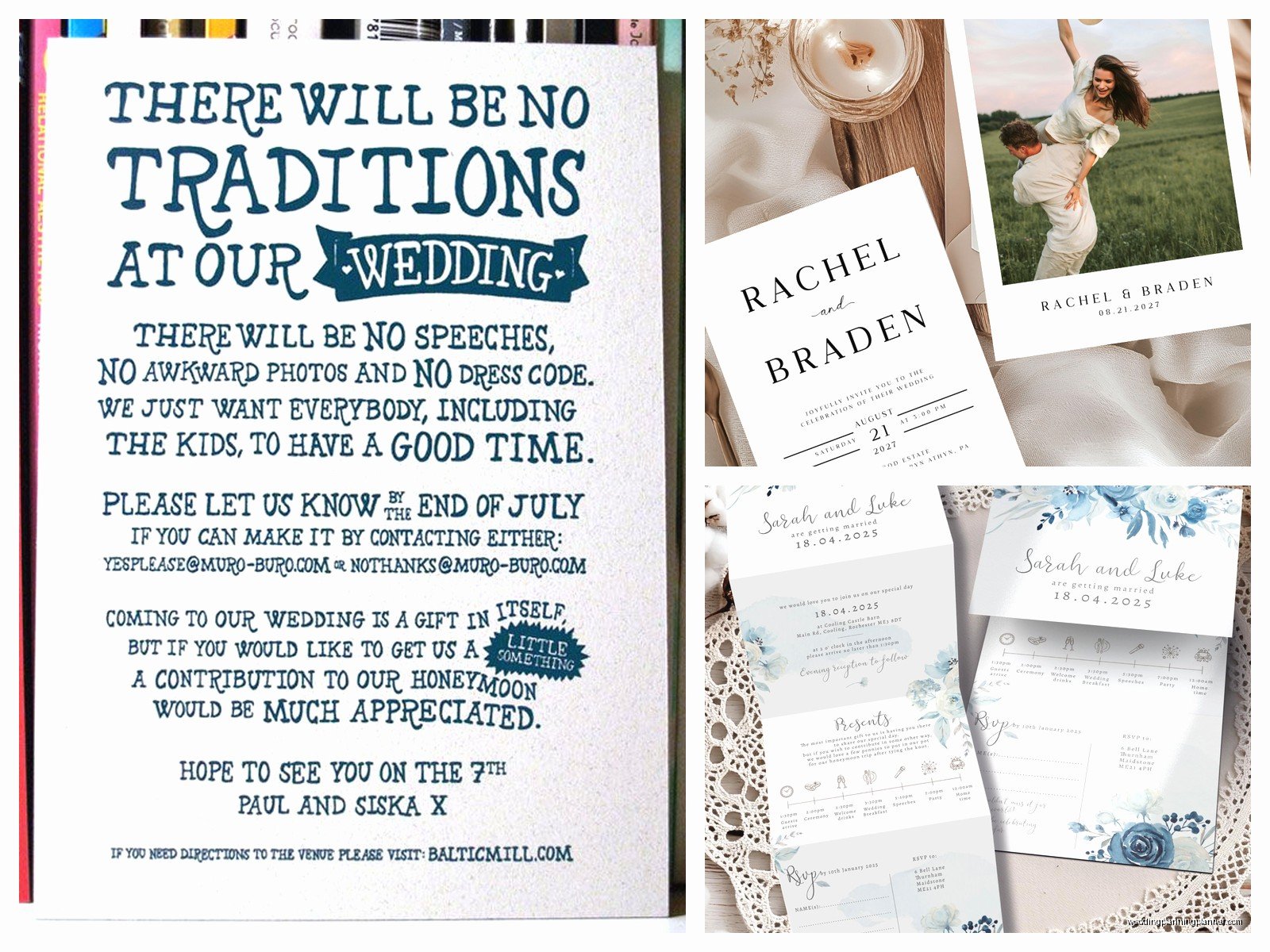
Mid-range custom suites from independent designers or boutique stationery shops run $8-15 per suite. This is where you get more customization, better paper quality, maybe one special printing technique like letterpress or foil.
High-end luxury suites with multiple printing techniques, handmade paper, silk ribbons, custom wax seals, calligraphy addressing—you can easily spend $25-50+ per suite. I’ve worked with couples who spent $100 per invitation for elaborate laser-cut designs with multiple layers. It’s wild but if that’s your priority and you’ve got the budget, the impact is undeniable.
Package Deals vs. Ordering Separately
Here’s why all-in-one packages are usually smarter than piecing things together yourself: bulk pricing, guaranteed design cohesion, and you’re not managing multiple vendors. Also the timing works out better—everything arrives together so you can assemble and mail on your timeline.
I had a couple who ordered invitations from one place, RSVP cards from another trying to save $50 total, and the colors were completely different. They ended up reordering everything and spending way more. Just… don’t do that to yourself.
Digital Components with Physical Suites
Okay so this is kinda becoming standard now—you send the physical suite but also include a QR code or wedding website URL for digital RSVPs and detailed info. Honestly it’s genius because older guests can mail back the card and younger guests can just text you or respond online.
Some all-in-one packages now include matching digital save-the-dates or email templates, which is perfect for sending updates or last-minute changes. I’m seeing lots of couples do physical invitations but digital everything else to cut costs.
Printing Techniques Worth Knowing
Digital printing is your most affordable option—it’s basically high-quality printer work. Looks good, gets the job done, no shame in this game.
Letterpress is when the text is pressed into thick cotton paper, creating this gorgeous texture and slight indentation. It’s expensive but so pretty and very traditional. Works best with simple designs, not photographs.
Foil stamping adds metallic foil to your design—gold, silver, rose gold, copper, even holographic. There’s something about foil that just screams fancy wedding. It does add significant cost though, usually $2-3+ per invitation extra.
Thermography creates raised text that’s shiny and dimensional, kinda like embossing but different. It’s a middle-ground option between flat digital and letterpress price-wise.
Timing Your Order
You wanna order your complete suites about 4-5 months before your wedding. That gives time for design, proofs, printing, delivery, assembly, addressing, and mailing. Invitations should go out 6-8 weeks before your wedding date.
Save-the-dates are different—those go out 6-8 months before, sometimes even earlier for destination weddings. Some all-in-one packages include matching save-the-dates which is super convenient for design consistency.
Rush fees are real and they’re painful. I’ve seen couples pay double for 2-week turnarounds because they didn’t plan ahead. Give yourself buffer time because something always comes up—addresses you’re missing, design tweaks, someone changed their mind about the wording…
Quantity Math That Trips People Up
So here’s the thing about quantities—you don’t need one invitation per guest. You need one per household or family unit. A couple living together gets one invitation, not two. Same with families.
That said, order extras. I tell couples to add 15-20% beyond what they think they need. You’ll mess up addressing some, you’ll want keepsakes for your parents and yourselves, and inevitably you’ll forget about someone and need to send a late invitation.
If your guest list is 150 people, you’re probably looking at like 70-80 invitation suites needed, but order 90-95 to be safe. The cost difference is minimal and running out is way worse than having extras.
What About Destination Weddings
Destination wedding suites need even more pieces honestly. You’re including travel info, accommodation details, maybe a packing list suggestion, local area guide, weekend itinerary with multiple events… it becomes like a welcome packet basically.
I’ve done destination suites that were almost booklet-style with 10+ pages of info. You can do a pocket folder situation where everything tucks into a decorative folder, or a box-style invitation with multiple cards layered inside. These run expensive though—expect $15-30+ per suite minimum for anything elaborate.
Some couples do a simpler main invitation with a “details on our website” approach for destination weddings to control costs. That works too, especially since travel info might change and you don’t want outdated hotel prices printed on your invitations.
Addressing Options
You’ve got a few routes here: DIY with your own printer, hire a calligrapher, use digital calligraphy printing, or go with basic printed addresses from the invitation vendor.
Real calligraphy looks incredible but costs $2-5+ per envelope. Digital calligraphy is printed but mimics hand-lettering for like $0.50-1 per envelope. Basic printed addressing is usually included free or super cheap with all-in-one packages.
If you’re DIYing the addressing, get a template from your stationer so the positioning is right. And please please test your printer with the actual envelope size before printing all 100. I’ve seen so many jammed printers and wasted envelopes, ugh.
Extra Touches That Elevate
Okay so the basics get the info out there, but these extras make your suite feel really special and tied together. Belly bands are paper or vellum wraps that go around the stack of cards—they can have your names, wedding date, a design element, whatever.
Wax seals are having such a moment right now. You can get custom stamps with your initials or monogram. They work on envelope flaps, belly bands, vellum wraps. Fair warning though—they add weight which affects postage, and sometimes they break in mail sorting machines.
Silk or velvet ribbons tied around the suite add texture and luxury. You can get them in literally any color. I prefer tying them in simple knots rather than bows because bows get crushed in the mail.
Vellum overlays are semi-transparent sheets that go over your main invitation, usually with names or a design printed on them. Creates this layered, romantic look. Sometimes the vellum is wrapped around everything instead.
Postage Reality Check
Standard postage is for envelopes up to 1 ounce and basic rectangular shapes. Most wedding invitation suites need extra postage because they’re square, oversized, thick, or heavy. You’re probably looking at $1-2+ per invitation to mail.
Go to the post office with a fully assembled suite and have them weigh it and tell you exact postage before you buy stamps for all of them. Also ask about hand-canceling, which means a person processes your envelopes instead of machines—it’s gentler on fancy invitations with wax seals and stuff.
Vintage stamps are trendy right now for wedding invitations. You can buy old stamps from like the 70s and 80s that add up to the right postage amount. Looks really cool but takes forever to source enough matching ones, ngl.
Suite Styles By Wedding Vibe
For formal black-tie weddings, you want classic elegance—think engraved or letterpress printing, traditional wording, ivory or white paper, maybe gold foil accents. Inner envelopes are basically required here. The whole suite should feel sophisticated.
Romantic garden wedding vibes call for floral illustrations, softer color palettes like blush and sage, maybe a vellum overlay with greenery printed on it. Ribbons work great here too.
Modern minimalist weddings should have clean lines, lots of white space, simple typography, maybe one bold design element like a geometric border or modern monogram. Less is more with these suites.
Rustic or boho weddings can do kraft paper, wildflower designs, more casual wording, maybe twine instead of silk ribbon. These often feel less formal but still pulled-together in a complete package.
Beach or tropical destination weddings—you can incorporate shells, palms, ocean colors, watercolor washes. Just don’t go too theme-y where it looks like a kid’s birthday party invite, you know?
Working With All-in-One Vendors
Big online companies like Minted, Zola, Paperless Post (for digital but they have physical too), Wedding Paper Divas, Shutterfly—they all offer complete suite packages. The upside is convenience, templates you can customize yourself, and competitive pricing. Downside is less uniqueness since thousands of couples use the same designs.
Independent stationery designers on Etsy or through boutiques give you more customization and personality. You’re working directly with the designer to create something more unique. Takes more time and usually costs more but the result feels personal.
Full custom with a stationery studio is the most expensive route but you’re getting something nobody else has. The designer creates everything from scratch based on your vision, wedding colors, venue vibe, whatever. This is where you’d do really elaborate suites with multiple printing techniques and handmade elements.
I alternate between all these depending on my clients’ budgets and timeline. Sometimes Minted is perfect, sometimes we need full custom. There’s no wrong choice as long as it fits your situation.
Common Mistakes I See
Waiting too long to order because you’re still finalizing details—just order when you know your date, venue, and general timeline. You can always include a details card with your website for info that might change.
Not proofreading carefully enough. Get like five people to read your proof. I once had an invitation go out with the wrong date because everyone kept checking the design and nobody verified the actual information. Mortifying.
Choosing a suite that doesn’t match your wedding formality. If you’re having a casual backyard wedding, the ultra-formal engraved suite with inner envelopes feels mismatched. And vice versa—don’t do super casual invites for a ballroom black-tie event.
Forgetting about postage costs in your budget. This sneaks up on people. Budget at least $1.50 per invitation for mailing costs, plus return postage on RSVP envelopes.
Not ordering samples before committing. Most vendors will send you a printed sample for like $5-10. Do this. Colors and paper quality look different in person than on a screen, and you need to see the actual product before ordering 100 of them.