Planning Guides, Style Guide
Formal Wedding Invitation Examples: Traditional Samples
Apr
Traditional Wedding Invitation Wording That Actually Works
Okay so traditional formal wedding invitations are probably the thing I get asked about most, and honestly it makes sense because the wording is kinda specific and you can’t just wing it like you would with a casual backyard thing. The structure matters here and there are actual rules that people still follow even though we’re in 2024.
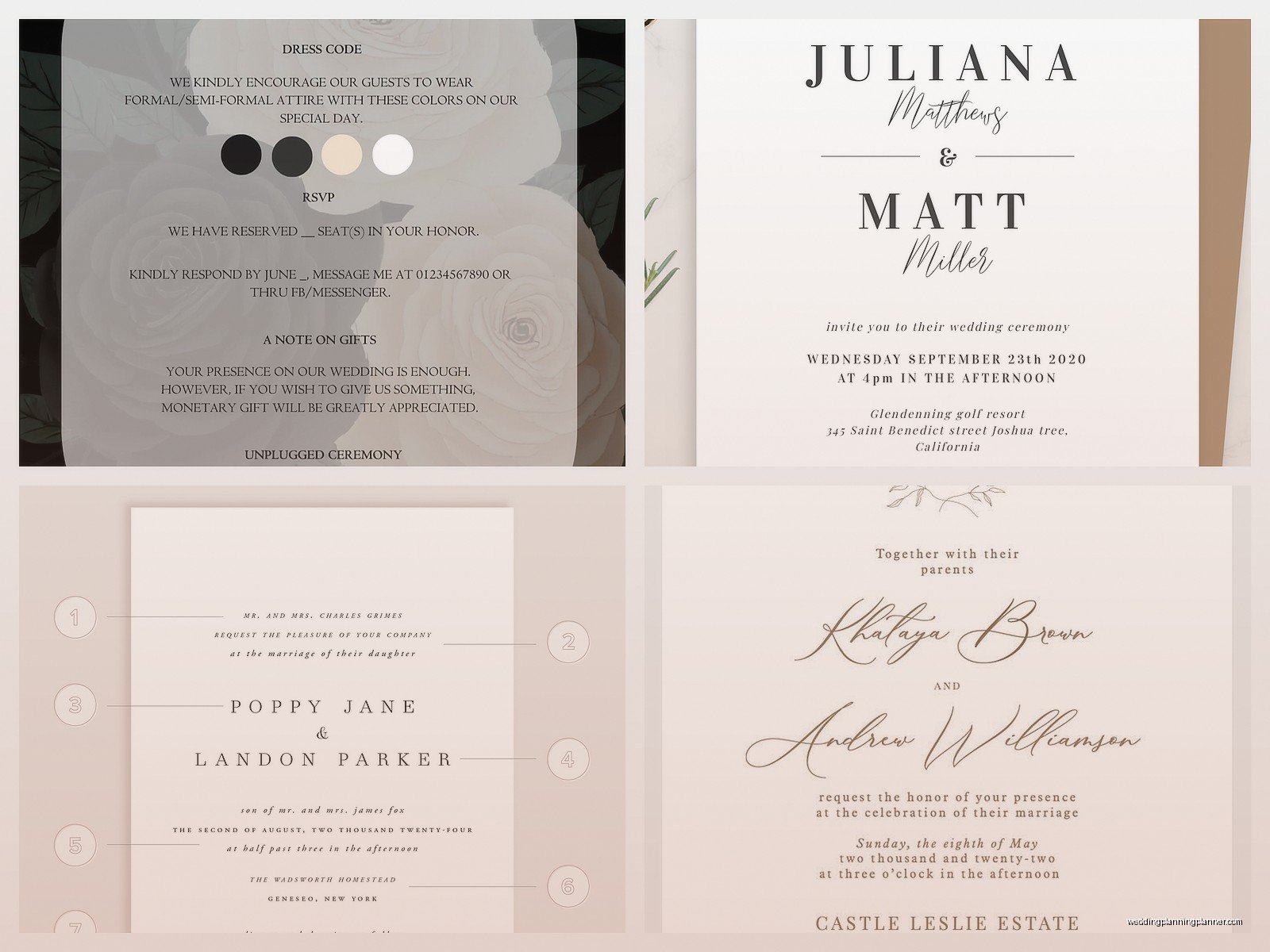
The most traditional format is when the bride’s parents are hosting, which used to be like 99% of weddings back in the day. So it goes like this:
Mr. and Mrs. Robert James Wilson
request the honour of your presence
at the marriage of their daughter
Katherine Anne
to
Mr. Michael David Patterson
Saturday, the fifteenth of June
two thousand twenty-four
at half after four o’clock
Saint Mary’s Catholic Church
Boston, Massachusetts
Notice the “honour” spelling with the U – that’s the British spelling and it’s traditionally used for religious ceremonies. For non-religious venues you’d write “honor” without the U or just say “request the pleasure of your company” instead. I had this bride in spring 2023 who was SO confused about this distinction and kept asking me why we couldn’t just pick whichever spelling looked prettier, and I had to explain that it actually signals something to your guests about the ceremony type.
The thing that annoys me most about traditional invitations though? When people insist on using them but then want to change literally every rule. Like you can’t have “honour of your presence” and then list a beach as the venue – pick a lane, you know?
When Both Sets of Parents Host
This one’s becoming more common and it’s actually really nice because it acknowledges both families equally:
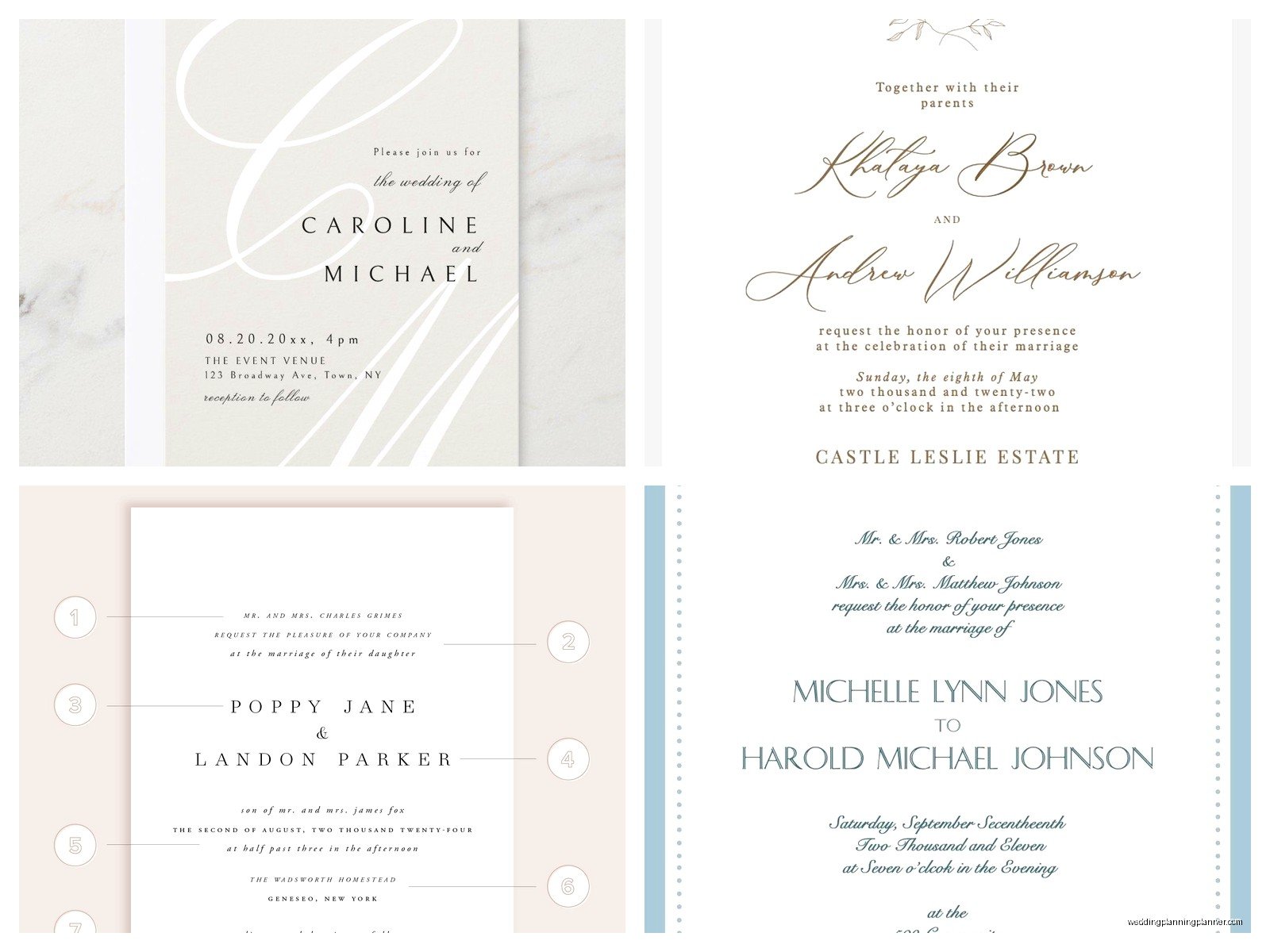
Mr. and Mrs. Robert James Wilson
and
Mr. and Mrs. Charles Edward Patterson
request the honour of your presence
at the marriage of their children
Katherine Anne Wilson
and
Michael David Patterson
Then you’d continue with the date, time, venue info same as before. The key here is that bride’s parents are still listed first – that’s just how it’s done traditionally. You can switch it if you want but then it’s not really following traditional format anymore which is totally fine but just know that’s what you’re doing.
Divorced Parents Hosting
Alright this is where it gets messy and I’ve seen so many variations. The rule is that you list the parent who raised the bride first, and if they’ve remarried you include their new spouse. But you never ever list divorced parents on the same line together. So it looks like:
Mrs. Sarah Wilson Thompson
and
Mr. Robert James Wilson
request the honour of your presence
at the marriage of their daughter
Katherine Anne
If the mom remarried and you want to include the stepfather:
Mrs. Sarah Wilson Thompson and Mr. David Thompson
and
Mr. Robert James Wilson
request the honour of your presence
I remember this one wedding where the bride’s parents had been divorced for like 20 years and they still couldn’t agree on whose name went first and honestly it was exhausting. My cat literally knocked over my coffee during one of those phone calls and I was almost grateful for the distraction.
Couple Hosting Their Own Wedding
When the couple is paying for everything themselves or they’re older or it’s a second marriage, they can host their own invitation:
The honour of your presence is requested
at the marriage of
Miss Katherine Anne Wilson
to
Mr. Michael David Patterson
Or even more casual (but still formal):
Katherine Anne Wilson
and
Michael David Patterson
request the honour of your presence
at their marriage
You drop the “Miss” and “Mr.” in the second version because they’re speaking for themselves. It’s that whole thing where you don’t refer to yourself with an honorific which… I mean the rules are kinda arbitrary when you think about it but they exist for a reason I guess.
The Date and Time Formatting
This is where people mess up constantly and I’m gonna tell you exactly how to do it. For formal invitations you spell out everything – no numerals allowed except for street addresses sometimes.
Saturday, the twenty-first of September
two thousand twenty-four
at half after six o’clock
Some people write “six-thirty o’clock” but that’s actually wrong traditionally. It’s either “half after six” or “half past six” – both work. For times on the hour you just say “six o’clock” and for quarter hours you’d say “quarter past six” or “quarter to seven.”
The year is technically optional on the invitation itself because presumably your guests know what year it is, but most people include it anyway. You don’t need “in the evening” after the time unless it could be ambiguous – like if you’re having a ceremony at six o’clock that’s obviously evening, but “eight o’clock” could theoretically be morning so you’d add “in the evening.”
The Venue Lines
For the location you spell out the full name of the venue, the city, and the state. No abbreviations in traditional format:
The Plaza Hotel
New York, New York
Or if it’s a church:
First Presbyterian Church
Charleston, South Carolina
Street addresses are usually included on the reception card or in a separate enclosure, not on the main invitation. Although if it’s a private residence you would include it… see this is where the rules start getting fuzzy and you kinda have to use your judgment.
Formal Title Usage
Okay this part trips people up because we don’t really use formal titles in everyday life anymore but they matter on traditional invitations. Here’s the breakdown:
Married couple: Mr. and Mrs. Robert Wilson (using his full name, not hers – I know, I know, it’s old-fashioned but that’s literally what traditional means)
Unmarried woman under 18: Miss Katherine Wilson
Unmarried woman over 18: Miss or Ms. Katherine Wilson (Miss is more traditional)
Married woman who kept her name: Mrs. Katherine Wilson or Ms. Katherine Wilson
Divorced woman: Mrs. Katherine Wilson or Ms. Katherine Wilson (using her first name, not her ex’s)
Widowed woman: Mrs. Robert Wilson (she keeps her late husband’s full name traditionally)
For professional titles like Doctor or Reverend or Judge, those take precedence over social titles. So it would be “Doctor Sarah Wilson” not “Mrs. Sarah Wilson” if she’s a physician. And if both people in a couple are doctors you write “Doctors Robert and Sarah Wilson” or “Doctor Sarah Wilson and Doctor Robert Wilson” – both work.
Military titles are used if the person is on active duty. I had this whole thing in summer 2021 with a groom who was a Captain in the Army and we had to figure out exactly how to format it because military formatting has its own rules and…
Religious Officials Officiating
If you want to include the officiant’s name on the invitation (which is optional but nice), it goes after the venue:
Saint Patrick’s Cathedral
New York, New York
Reverend Thomas McCarthy officiating
Or you can make it part of the ceremony line:
at the marriage ceremony officiated by
Reverend Thomas McCarthy
Reception Information
The traditional way is to include a separate reception card in the invitation suite, but if the reception is immediately following at the same location you can just add:
Reception immediately following
Or:
Dinner and dancing to follow
If it’s at a different location you definitely need a separate card that says:
Reception
following the ceremony
The Metropolitan Club
One East Sixtieth Street
New York, New York
Notice here you CAN use the numeral for the street address – that’s actually the correct traditional format which seems inconsistent with spelling out everything else but whatever, I don’t make the rules.
Dress Code Wording
Traditionally the dress code goes in the lower right corner of the invitation. The most formal options are:
White tie (most formal – think tails and gowns)
Black tie (tuxedos and formal gowns)
Black tie optional (tux encouraged but dark suit acceptable)
Formal attire (suits and cocktail dresses)
Cocktail attire (suits and party dresses)
If you don’t specify anything, guests will assume it’s somewhere in the formal to cocktail range based on the venue and time. You don’t need to spell out what these mean – people can Google it if they’re unsure. What annoys me is when couples make up their own dress codes like “garden party chic” or “festive elegance” because then nobody knows what that actually means and you get people showing up in wildly different levels of formality.
Special Situations That Come Up
When one or both parents are deceased, you can still honor them on the invitation:
Mrs. Robert James Wilson
requests the honour of your presence
at the marriage of her daughter
Katherine Anne
daughter of the late Mr. Robert James Wilson
Or if the couple is hosting but wants to honor a deceased parent:
Katherine Anne Wilson
daughter of Mrs. Sarah Wilson and the late Mr. Robert Wilson
and
Michael David Patterson
son of Mr. and Mrs. Charles Patterson
For same-sex weddings the traditional format works exactly the same way, you just list the names in alphabetical order by last name typically, or whoever’s family is hosting first if that applies. The wording is:
at the marriage of their son
David Michael Anderson
to
James Robert Patterson
Or “their daughter” for two brides. Everything else follows the same rules.
Adult Titles for the Couple
Technically if the bride is over 18 and unmarried she’s “Miss Katherine Wilson” and the groom is “Mr. Michael Patterson” on a traditional invitation. But lots of people skip the titles entirely for the couple themselves, especially when they’re hosting their own wedding. Both ways are correct in modern formal usage.
Assembly and Enclosures
Traditional formal invitations usually include several pieces – the main invitation, a reception card, a response card with its own envelope, and sometimes additional cards for hotel information or directions. These all get assembled in size order with the largest on bottom and smallest on top, then the whole stack goes inside the inner envelope.
Oh yeah, traditional invitations have TWO envelopes – an inner and an outer. The outer envelope has the mailing address and gets sealed. The inner envelope has just the names of who’s invited (no address) and isn’t sealed. It’s extra formal and also protected the invitation back when mail handling was rougher. Most people skip the inner envelope now unless they’re going for maximum formality.
The outer envelope is addressed like:
Mr. and Mrs. Robert Wilson
123 Main Street
Boston, Massachusetts 02108
No abbreviations except for Mr., Mrs., Ms., Dr. – you spell out Street, Avenue, Massachusetts, etc. Apartment numbers are written out too: “Apartment Three” not “Apt 3.”
Response Card Wording
The response card (which I know isn’t technically part of the invitation but it goes with it so) should be equally formal:
The favour of a reply is requested
by the twenty-first of May
M_________________
___ accepts with pleasure
___ declines with regret
That M line is where guests write their names with their title – Mr. and Mrs. John Smith or whatever. Some people find it confusing though so you can also do:
Kindly respond by the twenty-first of May
Name(s)_________________
___ joyfully accepts
___ regretfully declines
Number attending ___
The pre-addressed, pre-stamped envelope for the response card should come back to whoever’s handling RSVPs – usually the couple or the wedding planner if there is one.
I’ve been doing this for so long that I can spot a fake traditional invitation from a mile away – like when people use script fonts that are too casual or when they center-align everything when traditional invitations actually have specific alignment rules for different lines. It’s those little details that make it actually look formal versus just looking like you tried to be formal, you know?
