
Planning Guides, Style Guide
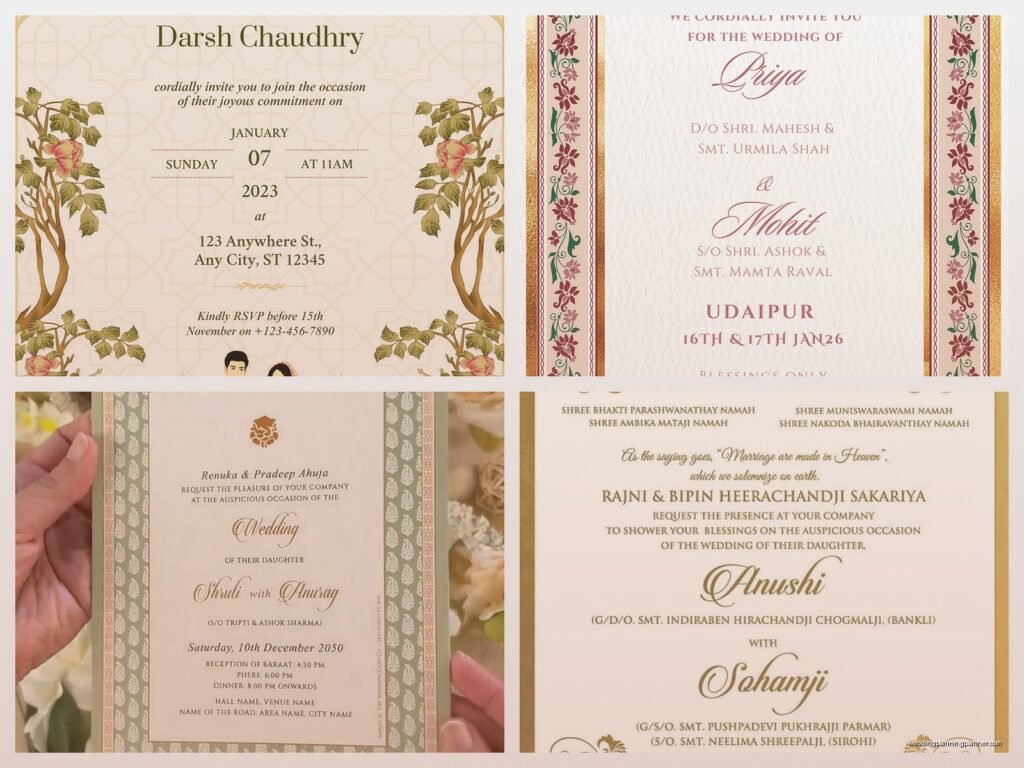
Indian Wedding Card Sample: Sample Ideas & Examples
Apr
Indian Wedding Card Samples That Actually Work
Okay so Indian wedding invitations are literally in a category of their own and if you’re staring at a blank screen wondering where to even start, I totally get it. I’ve been doing wedding planning for like fifteen years now and the sheer variety of Indian wedding cards still surprises me sometimes. There’s just SO much you can do with them.
First thing you gotta know is that Indian wedding invitations aren’t just one card. They’re usually a whole package situation. You’ve got the main invitation, the reception card, sometimes separate cards for mehndi, sangeet, haldi ceremonies… it’s a lot. Back in summer 2021 I had this client who wanted fourteen different insert cards for various events and I was like okay we need to talk about what’s actually necessary here because your guests are gonna need a spreadsheet to keep track.
The Traditional Ganesh Opening
Most Hindu wedding invitations start with a Ganesh symbol or image because he’s the remover of obstacles. You’ll see something like a small Ganesh illustration at the top of the card, sometimes embossed, sometimes printed in gold or red. The wording typically goes:
“Shri Ganeshaya Namah” or just the Ganesh symbol itself
Then you move into the actual invitation text. Some families use Sanskrit shlokas or verses, others keep it simple. I’ve seen cards that open with “With the blessings of Shri Ganesh and the grace of our families…” and honestly that works really well if you want traditional but not overly formal.
Sample Wording For Hindu Weddings
Here’s a pretty standard format that I give clients as a starting point:
Om Shri Ganeshaya Namah
Mr. & Mrs. Rajesh Kumar
request the honor of your presence
at the marriage ceremony of their daughter
Priya
to
Arjun
son of Mr. & Mrs. Vikram Sharma
on Sunday, the 15th of April, 2024
at 10:00 AM
Grand Hyatt, Mumbai
But honestly you can mix this up however you want. Some families prefer “seek your blessings” instead of “request the honor of your presence” which feels more cultural and less Western.
The Parents’ Names Situation
This is where it gets kinda tricky and also where I see people mess up the most. In traditional Indian invitations, both sets of parents are mentioned, and the bride’s parents typically host so their names come first. But modern couples sometimes want to host themselves or do it together with parents, so the wording changes.
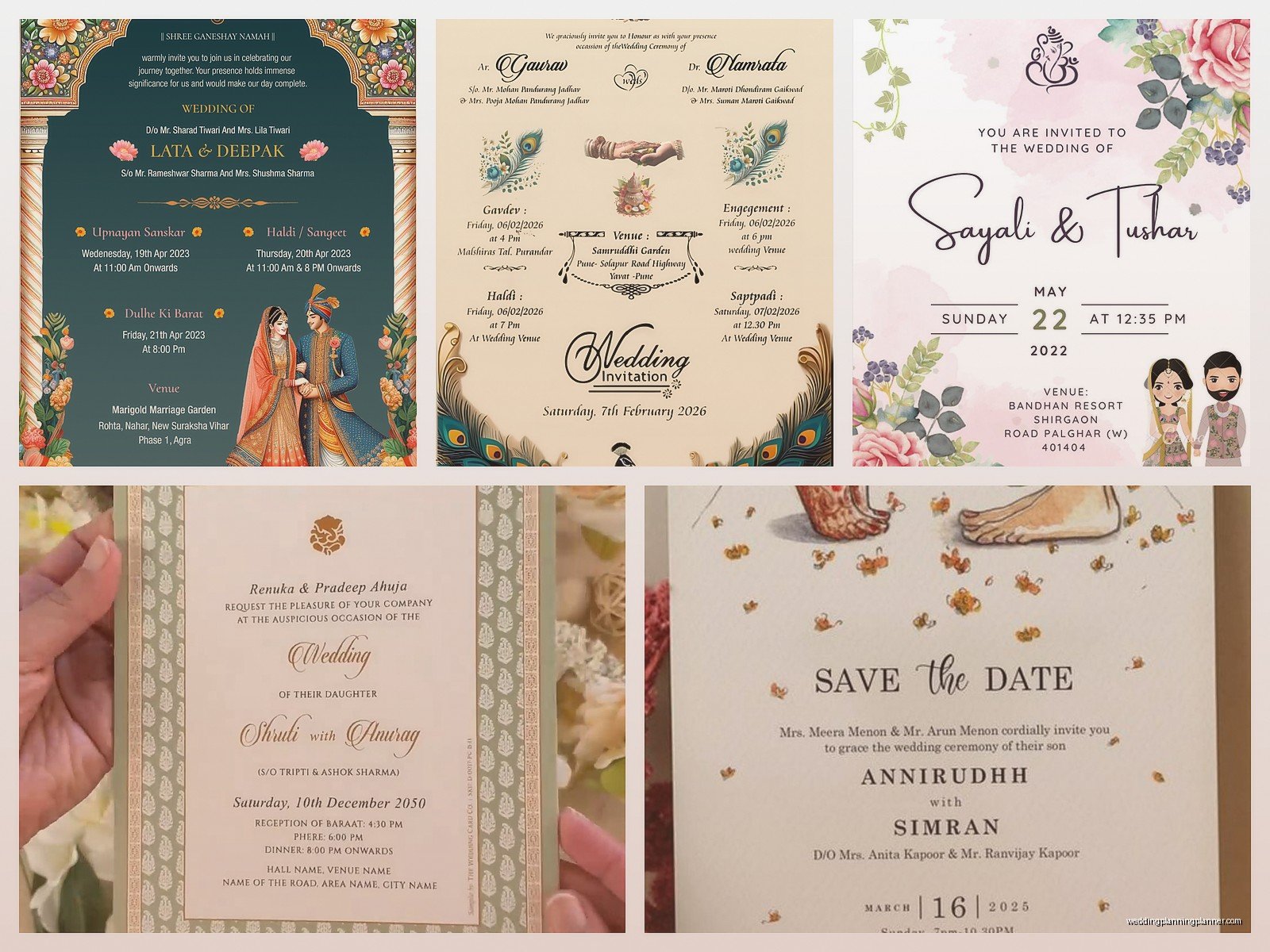
If both parents are hosting together:
Mr. & Mrs. Rajesh Kumar
and
Mr. & Mrs. Vikram Sharma
invite you to celebrate the wedding of their children
Priya & Arjun
If the couple is hosting:
Priya Kumar & Arjun Sharma
together with their families
invite you to share in their joy…
One thing that really annoyed me recently was this trend of couples completely leaving parents off the invitation to seem “modern” but then the parents were actually paying for everything and felt totally disrespected. Like, I get wanting to be independent but maybe have that conversation with your family first? Just a thought.
Muslim Wedding Card Samples
Muslim wedding invitations usually open with “Bismillah-ir-Rahman-ir-Rahim” (In the name of Allah, the Most Gracious, the Most Merciful) or just the bismillah symbol. The wording is different because you’re inviting people to the Nikah ceremony specifically.
Bismillah-ir-Rahman-ir-Rahim
Mr. & Mrs. Ahmed Khan
request the pleasure of your company
at the Nikah ceremony of their daughter
Zara
with
Imran
son of Mr. & Mrs. Khalid Malik
on Friday, 20th May 2024 at 6:00 PM
followed by Walima reception
The Taj Palace, Delhi
I always tell clients to mention if there’s a Walima (the reception after Nikah) on the same card or if it’s on a separate day, you’ll need another card for that. Muslim weddings sometimes have the Nikah and Walima on different days, so clarity is super important.
Sikh Wedding Invitations
Sikh wedding cards often start with “Ik Onkar” (the symbol representing One God) or “Waheguru Ji Ka Khalsa, Waheguru Ji Ki Fateh.” The ceremony is called Anand Karaj, and it takes place in a Gurudwara usually.
Ik Onkar
With the blessings of Waheguru
Mr. & Mrs. Harpreet Singh
invite you to the Anand Karaj of their daughter
Simran Kaur
with
Karan Singh
son of Mr. & Mrs. Jasbir Singh
Saturday, 3rd June 2024 at 11:00 AM
Gurudwara Bangla Sahib, New Delhi
You’ll often see the Khanda symbol (the Sikh religious symbol) somewhere on these cards too.
The Ceremony Details Inserts
Okay so here’s where Indian weddings get really detailed. You need insert cards for each event, and I usually recommend keeping them color-coded or at least visually distinct so guests don’t mix them up. My cat knocked over my entire sample collection last week and I’m still finding mehndi cards under the couch, but that’s beside the point.
Mehndi Ceremony Card:
Join us for an evening of
Music, Dance & Mehndi
Thursday, 18th May 2024
7:00 PM onwards
Residence of Mr. & Mrs. Kumar
Dress Code: Colorful Traditional Attire
Sangeet Night Card:
Let’s celebrate with
Music & Dance
Sangeet Ceremony
Friday, 19th May 2024
8:00 PM
The Grand Ballroom
Dress Code: Festive Indian Wear
I always include dress codes because otherwise you get guests showing up to a mehndi in like… a cocktail dress or something, and they feel out of place. Been there, seen that, trying to prevent it.
Modern vs Traditional Design Elements
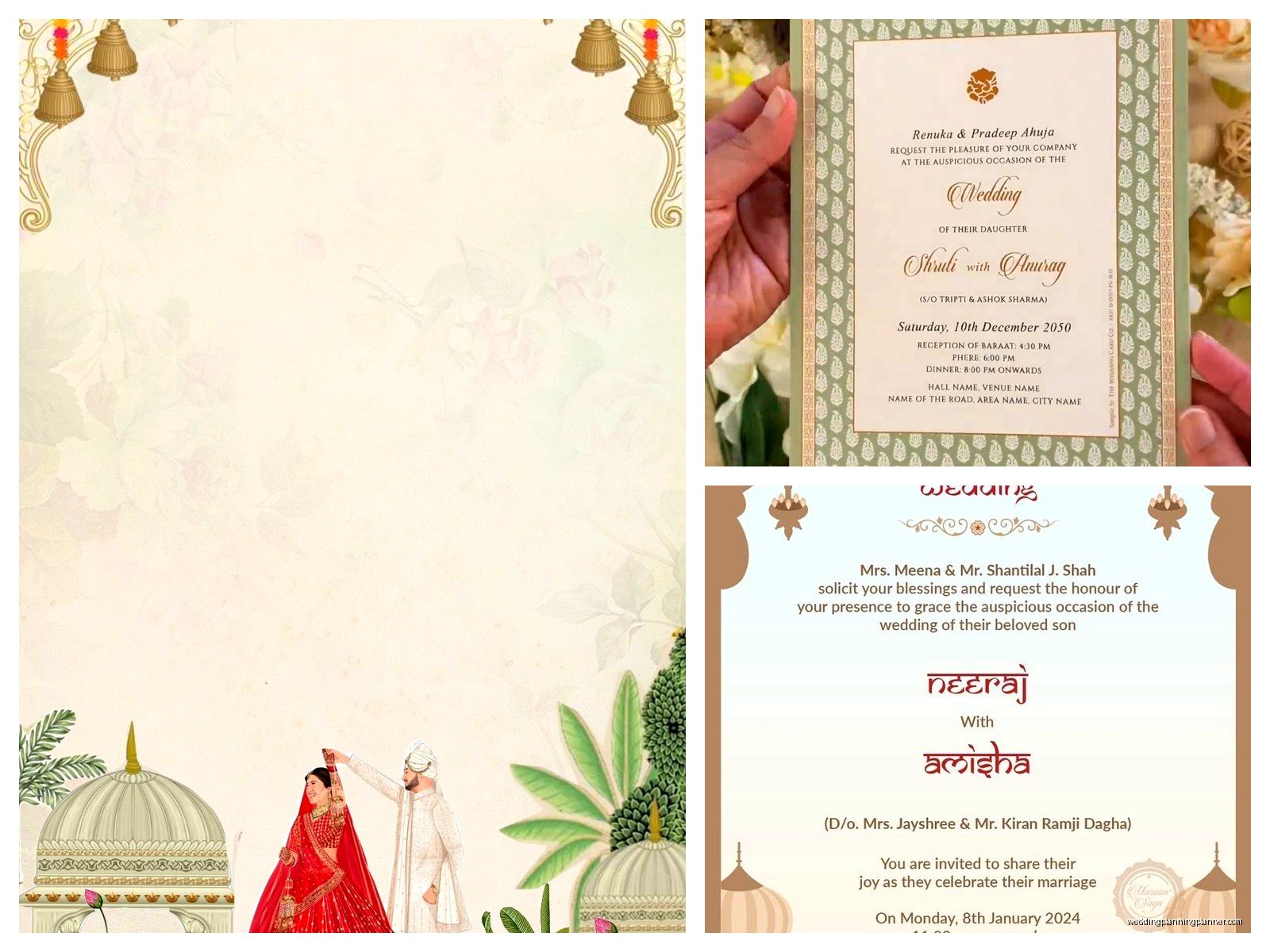
So design-wise, you’ve got traditional cards with elaborate borders, paisley patterns, lotus flowers, peacocks (SO many peacocks), and then you’ve got modern minimalist designs that are just… clean lines and gold foil. Both work. It depends on your wedding vibe.
Traditional elements I see clients using:
- Elephant motifs (representing wisdom and good luck)
- Peacock designs (beauty and grace)
- Lotus flowers (purity and enlightenment)
- Paisley patterns (fertility and life)
- Mandala designs (universe and eternity)
- Temple or palace illustrations
Modern couples are doing like geometric patterns, watercolor effects, minimalist line drawings, or even illustrated portraits of themselves. In spring 2023 I had a couple who did this gorgeous card with a custom illustration of them in traditional outfits but the overall design was super clean and modern. It was perfect because it honored tradition without feeling heavy or outdated.
The Color Palette Thing
Red and gold is classic for Hindu weddings because red symbolizes prosperity and fertility. But I’ve seen beautiful cards in royal blue and gold, emerald green and gold, burgundy and gold… you’re sensing a pattern here with the gold, right? Gold or metallic accents are pretty much standard.
Muslim wedding cards often use green (associated with Islam) combined with gold or ivory. Sikh wedding cards might use orange or saffron with gold accents. But honestly these aren’t hard rules anymore.
Bilingual Invitations
If your family speaks Hindi, Gujarati, Tamil, Punjabi, or any regional language, you might want a bilingual card. I usually recommend English on one side and the regional language on the other, or English as the main text with a few lines in your language at the top. It’s a nice touch that honors your heritage without making the card impossible for non-speakers to read.
Something like having “Shubh Vivah” (auspicious wedding) at the top in Hindi/Devanagari script and then the rest in English works really well.
RSVP Cards For Indian Weddings
Okay this is gonna sound weird but a lot of Indian families don’t do RSVP cards because there’s this cultural thing where like… everyone invited is expected to come? But if you’re having a destination wedding or a limited venue capacity, you absolutely need RSVP cards. Don’t assume people will just text you their response because they won’t and then you’ll have no idea how much food to order.
Keep the RSVP card simple:
Kindly respond by 1st April 2024
Name(s): _______________
___ Joyfully accepts
___ Regretfully declines
Number of guests: ____
I also add a line for meal preferences if you’re doing a seated dinner with options, but for traditional Indian weddings with buffets, you can skip that.
The Actual Physical Card Materials
Indian wedding cards come in every material imaginable. I’ve worked with cards that had:
- Velvet fabric covers
- Laser-cut wooden boxes
- Scroll-style invitations tied with ribbon
- Boxed invitations with dried flowers and sweets inside
- Acrylic or glass invitations (heavy and expensive but wow)
- Handmade paper with embedded flower petals
- Silk-covered cards with tassels
The boxed invitation trend is huge right now. You get a decorative box and inside there’s the invitation card, all your insert cards, maybe some dried flowers or a small gift. It’s gorgeous but also expensive and if you’re mailing them, the postage is gonna hurt. Just warning you now.
Digital Invitations Are Actually Fine Now
I know some aunties will have opinions about this but digital invitations for Indian weddings are totally acceptable now, especially for pre-wedding events or for guests who are overseas. You can do animated designs with music, videos, the whole thing. There are apps specifically for Indian wedding e-invites that have Ganesh animations and traditional motifs.
That said, for the main wedding ceremony, I still recommend physical invitations for close family and elders. It’s a respect thing and also… some people just aren’t gonna open an email or they’ll forget about it.
Addressing Envelopes Properly
Indian wedding invitation envelopes should be addressed formally. Use full names and proper titles:
Mr. and Mrs. Rajesh Kumar
123 Park Avenue
Mumbai, Maharashtra 400001
For unmarried adults living together, list them separately on different lines. For families with children, you can write “The Kumar Family” or list the parents’ names and then “and family” below.
Also umm if you’re inviting someone with a plus-one but you don’t know their partner’s name, just write “and Guest” on the inner envelope. Don’t leave it ambiguous because then people will assume their whole extended family is invited and show up with six people.
Wording For Reception Cards
If your reception is separate from the ceremony or you’re having multiple receptions (common for Indian weddings), you need separate reception cards. The wording can be less formal:
Mr. & Mrs. Rajesh Kumar
and
Mr. & Mrs. Vikram Sharma
request the pleasure of your company
at the wedding reception of
Priya & Arjun
Sunday, 16th April 2024
7:00 PM onwards
The Grand Ballroom, Hotel Taj
Cocktails | Dinner | Dancing
I like adding “Cocktails | Dinner | Dancing” or whatever the actual program is so guests know what to expect and how long to plan for.
When To Send These Things Out
Indian weddings require more advance notice than typical Western weddings because people might need to travel internationally or take time off work for multiple days of events. Send your invitations at least 2-3 months before the wedding, or even 4-6 months if it’s a destination wedding.
Save-the-dates are becoming more common now too, especially for destination Indian weddings. Send those 6-8 months in advance.
Budget Reality Check
Indian wedding invitations can range from like $2 per card to $50+ per card depending on how elaborate you go. The boxed invitations with all the bells and whistles? Yeah those are gonna be $30-50 each easily. A nice traditional card with good printing and some embellishments will run you $5-15 per invitation.
Don’t forget to budget for:
- Printing costs (and reprints because there will be mistakes)
- Envelope addressing (calligraphy if you want it fancy)
- Postage (those heavy boxed invites cost more to mail)
- Extra invitations for keepsakes
Order at least 10-15 extra invitations beyond your guest count. You’ll need them for last-minute additions, keepsakes, and the inevitable “oh we forgot Auntie’s cousin” moment.
Working With A Designer vs Templates
You can find Indian wedding invitation templates online and customize them yourself through sites like Canva or Etsy, or you can work with a designer who specializes in Indian weddings. Templates are obviously cheaper ($20-50 for a template you can edit) but working with a designer means you get something completely custom.
I usually recommend templates for pre-wedding event cards and save your budget for a custom main invitation if you’re trying to balance costs. Or honestly, if you’re not super picky about design, templates are totally fine for everything. No judgment.
The main thing is making sure all your information is clear, the dates and times are correct (please triple-check this because I once had a client who sent out 300 invitations with the wrong month and… it was a whole thing), and that the tone matches your wedding style. Whether you go traditional with Ganesh blessings and paisley borders or modern with minimalist design and foil accents, just make sure it feels like you and gives your guests the information they actually need to show up at the right place at the right time wearing the right thing
