Planning Guides, Style Guide
Muslim Wedding Card Design: Design & Ordering Guide
Apr
Getting Started with Muslim Wedding Card Design
Okay so the first thing you gotta know about Muslim wedding invitations is that they’re not just pretty cards – they’re actually making formal announcements about a really sacred event. I learned this the hard way back in spring 2023 when a client’s family returned my first draft because I’d used imagery that was beautiful but totally inappropriate for their specific tradition. Like, I thought I was being creative with these ornate figurative illustrations and they very politely explained that many Muslim families avoid depicting people or animals on religious items.
The invitation usually needs to include specific elements that might not appear on other wedding cards. You’re looking at the bride and groom’s names (obviously), their parents’ names, the Bismillah if the family wants it, details about the Nikah ceremony, and then separate info about the Walima reception if that’s happening on a different day. Sometimes there’s also a Mehndi event or other pre-wedding celebrations that need their own cards or at least mentions.
Religious Elements and What Actually Matters
The Bismillah – that’s “In the name of Allah, the Most Gracious, the Most Merciful” – often appears at the top of Muslim wedding invitations. But here’s where it gets tricky and honestly kinda annoying: not every Muslim couple wants this on their invitation, and that’s completely their choice. I’ve had vendors question couples about this like it’s mandatory, which… no. You need to ask the couple what they want, not assume based on their religion.
Quranic verses are another common element. Surah Ar-Rum (30:21) is super popular because it talks about marriage and tranquility between spouses. If you’re designing these cards, make absolutely sure you’re working with someone who can verify the Arabic text is correct. I cannot stress this enough. One time I almost sent cards to print with a verse that had a typo and thank god the bride’s brother caught it because that would’ve been a disaster.
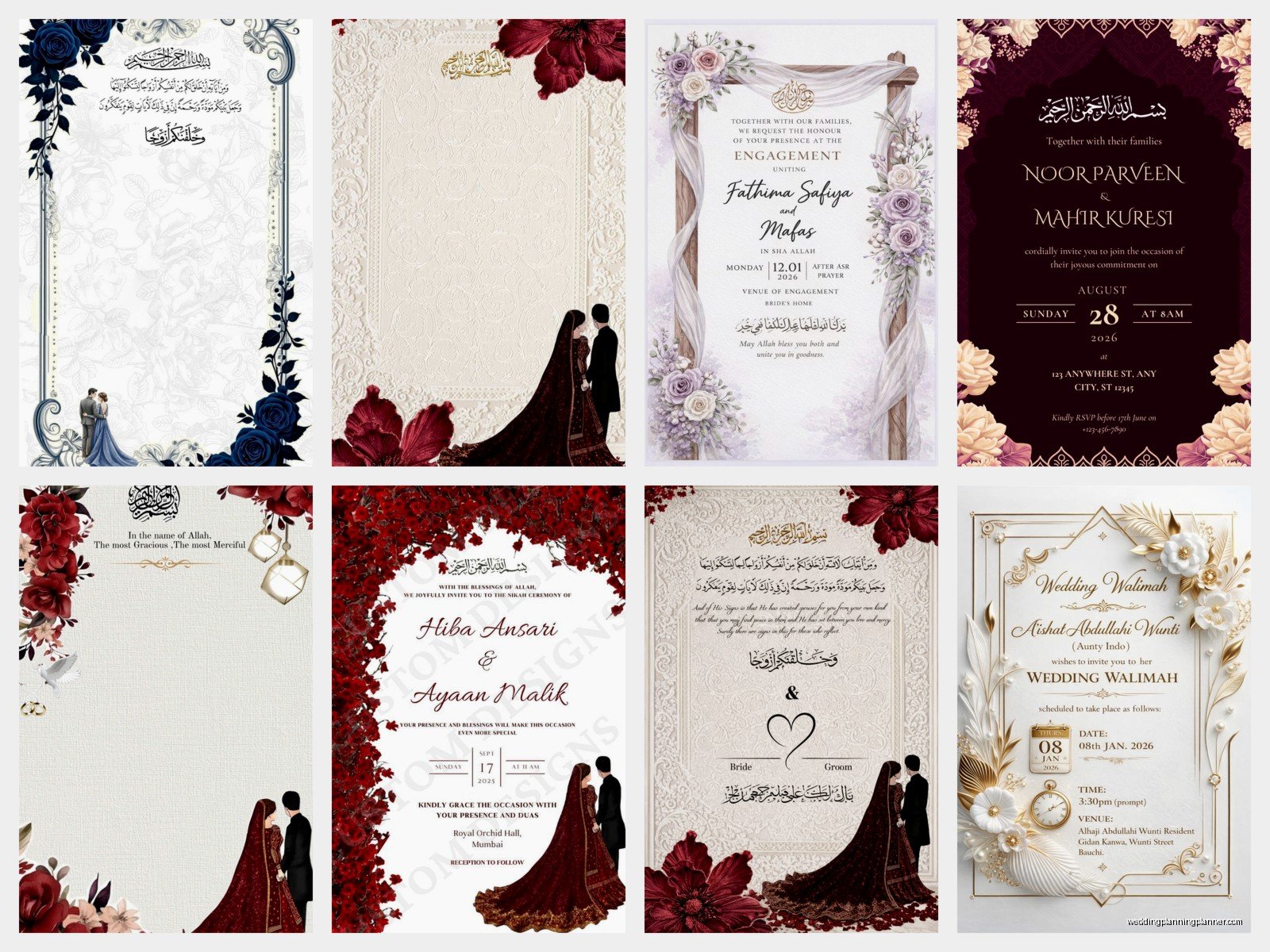
Some families want symbols like the crescent and star, mosque silhouettes, or geometric Islamic patterns. Others prefer to keep it simple with just elegant typography. There’s no single “Muslim wedding invitation look” which is actually what makes this work interesting.
Color Choices That Work
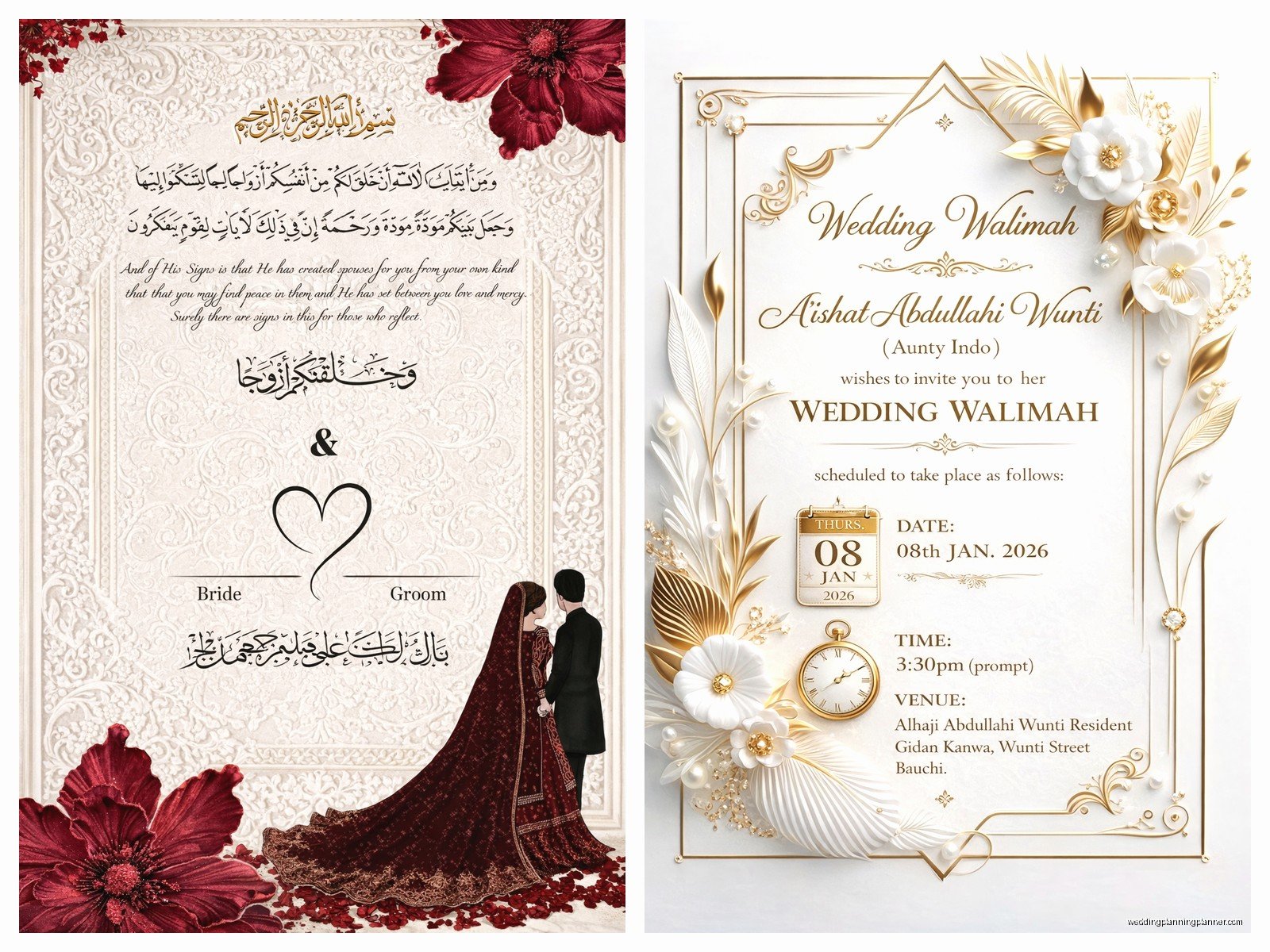
Green is traditional and shows up a lot because of its significance in Islam, but honestly you’ll see every color under the sun. Deep jewel tones – emerald, sapphire, ruby red, amethyst – these are gorgeous and photograph really well. Gold is huge, like massive. Gold foiling, gold ink, gold envelopes, gold everything. My cat actually knocked over a container of gold embossing powder once all over my desk and I’m still finding specks of it two years later, but I digress.
Pastels have become more popular recently especially for daytime events or spring weddings. Blush pink with gold, sage green with cream, dusty blue with silver. If the couple is having a traditional ceremony, deeper colors usually feel more appropriate, but again – ask them what they envision.
Red and gold combinations are common especially in South Asian Muslim weddings, though this overlaps with cultural traditions beyond just religious ones. Which brings me to an important point that I probably should’ve mentioned earlier – Muslim weddings pull from so many different cultural backgrounds. Indonesian Muslim weddings look different from Arab Muslim weddings look different from African Muslim weddings look different from South Asian Muslim weddings. The religion is the same but the cultural expression varies wildly.
Typography and Arabic Calligraphy
If you’re including Arabic text, you need proper Arabic fonts or actual calligraphy. Don’t just grab whatever “exotic-looking” font you find on a free font website because it might not connect letters correctly or might have the wrong letterforms entirely. Arabic is written right-to-left and letters change shape depending on their position in a word, so… yeah, it’s complex.
Hiring a proper calligrapher for the Bismillah or couple’s names in Arabic is worth the investment if the budget allows. It adds this really elegant, handcrafted feel that printed fonts can’t quite match. I worked with this amazing calligrapher during summer 2021 for a client who wanted her grandmother’s favorite prayer written on the invitation and it became the centerpiece of the whole design.
For English text, you’ve got more flexibility. Script fonts are popular for names, but make sure they’re readable. I’ve seen some invitations where the names are so swirly and elaborate that guests literally cannot figure out who’s getting married. Pair decorative fonts with clean, simple fonts for the details – ceremony time, venue address, dress code, all that practical stuff needs to be crystal clear.
Design Styles That Are Working Right Now
Moroccan-inspired designs with intricate geometric patterns and arch shapes are everywhere. These work beautifully with both traditional and modern aesthetics. You can go full-on ornate with detailed mandala-style patterns or keep it minimal with just a simple arch frame around the text.
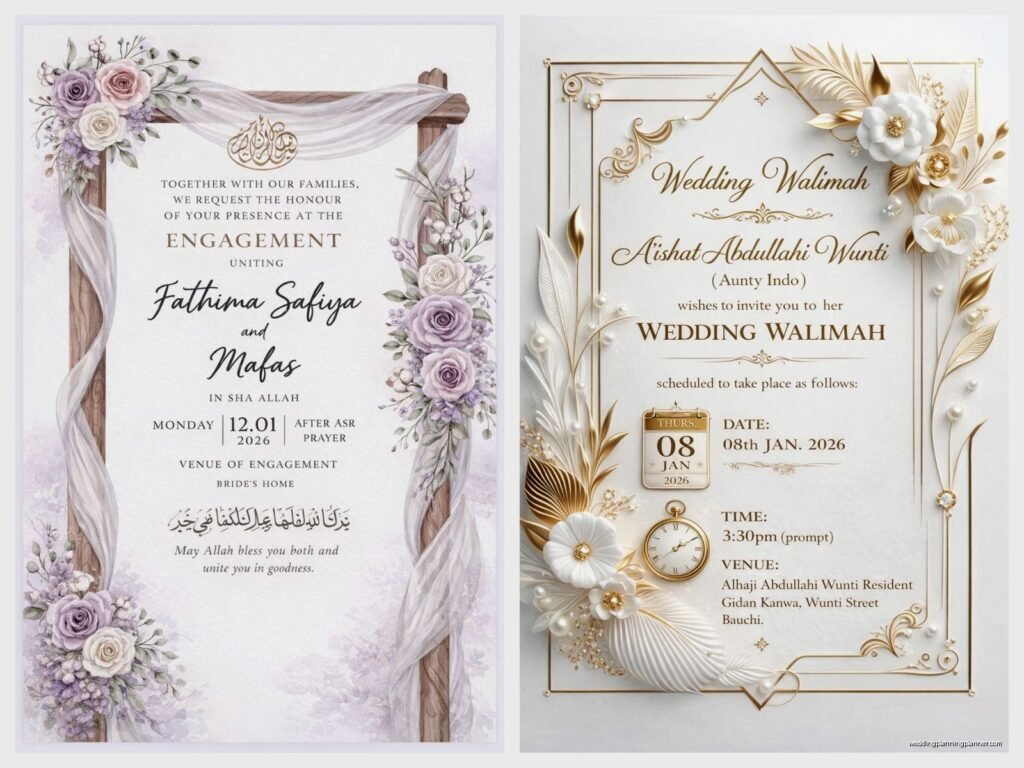
Watercolor backgrounds have been trending, especially with gold foil text over them. Think watercolor washes in jewel tones with elegant typography on top. These feel softer and more romantic than traditional heavily patterned designs.
Minimalist designs are also having a moment – lots of white space, one or two colors max, clean lines, maybe one symbolic element like a simple geometric pattern or a delicate branch illustration. Not every Muslim wedding invitation needs to be ornate and heavily decorated, and some couples really prefer that clean, modern look.
Laser-cut designs are gorgeous but pricey. These are cards with intricate patterns cut into the paper itself, sometimes with a colored layer underneath showing through. They’re stunning and feel really luxurious, but you’re gonna pay for them both in per-unit cost and in design time.
Wording and What to Include
The invitation wording can vary but typically you’ll see something like “request the honor of your presence” or “invite you to share in their joy.” Some families prefer “request the pleasure of your company” for the Walima reception specifically since that’s more of a celebration meal.
You need to be clear about which event you’re inviting people to. The Nikah is the actual marriage ceremony – this is the religious contract signing and it’s the legally binding part. The Walima is the reception dinner that happens after (sometimes the same day, sometimes later). Some families only invite close family to the Nikah and everyone to the Walima, so you might need different invitation lists entirely or at least different wording on different cards.
Include dress code information because guests appreciate knowing expectations. “Traditional attire requested” or “Modest dress appreciated” gives people guidance without being preachy about it. Some couples specify that the ceremony will be gender-segregated if that’s the case, so guests know what to expect.
Venue details need to be super specific – full address, parking information if relevant, and honestly a little map insert is never a bad idea especially if the venue is hard to find. I once had a bride call me in tears because half her guests got lost trying to find the banquet hall because the GPS kept sending them to the wrong entrance of this massive complex.
Printing and Paper Choices
Paper weight matters more than people think. You want at least 100lb cardstock for the main invitation, preferably 110lb or higher. Anything thinner feels flimsy and cheap. Textured papers like linen or felt finishes add a nice tactile quality, but make sure they work with your printing method – some textures don’t play well with certain inks or foiling processes.
Speaking of foiling, metallic foil stamping is absolutely stunning but adds to the cost and timeline. Gold, silver, rose gold, even colored foils are options. Foiling works best on solid colors and simple shapes – super detailed patterns might not foil cleanly. You’ll need to do a test print before committing to the full order because foiling can be temperamental.
Printing methods: digital printing is most affordable and works for most designs. Letterpress is beautiful and creates this amazing impression in the paper but it’s expensive and has color limitations. Thermography creates raised printing that looks similar to engraving but costs less. Actual engraving is the fanciest option and the most expensive – it creates crisp, raised letters by pressing the paper into engraved metal plates.
Envelope and Presentation Details
Don’t cheap out on envelopes after spending money on beautiful invitations. Colored envelopes, lined envelopes, or envelopes with printed patterns on the inside all elevate the presentation. The envelope is literally the first thing guests see, so it sets expectations for what’s inside.
Envelope addressing is its own whole thing. You can print directly on envelopes, use labels (though these feel less formal), or hire a calligrapher to hand-address them. Hand calligraphy is gorgeous but obviously costs more and takes time. If you’re printing addresses, use a nice font and consider printing in a color that matches your invitation design rather than just black.
Wax seals are having a renaissance and they look incredible on Muslim wedding invitations, especially in gold or deep jewel tones. You can get custom wax seals with initials or symbols. Just know that wax seals sometimes get damaged in mail sorting machines, so you might need to hand-cancel these invitations at the post office or add extra postage.
Ordering Timeline and Quantities
Start the design process at least 4-5 months before you need to mail invitations. That gives you time for design revisions, proofs, printing, addressing, and assembly. If you’re doing anything custom like foiling or letterpress, add extra time because these processes can’t be rushed.
Order 15-20% more invitations than you think you need. Seriously. You’ll mess up addressing some envelopes, you’ll remember people you forgot, relatives will ask for extras as keepsakes. It’s way easier to have extras than to try to do a small reprint later which often costs almost as much as the original order because of setup fees.
Get a proof. Always. A physical printed proof if at all possible, not just a PDF. Colors look different on screen versus printed, and you need to see the actual paper quality and how everything comes together. I learned this lesson expensively early in my career and now I’m absolutely militant about proofs.
Budget Real Talk
Muslim wedding invitations can range from like $2 per suite on the low end (simple digital printing, basic paper) to $25+ per suite on the high end (letterpress, foiling, custom calligraphy, fancy paper, the works). Most couples end up somewhere in the $5-12 per suite range for something nice but not wildly extravagant.
A “suite” usually means the main invitation, an RSVP card with envelope, and maybe a details card with hotel information or wedding website. Some couples also include separate cards for different events – Mehndi, Nikah, Walima – which obviously increases the cost.
You can save money by doing some elements yourself. Print your own details cards on nice paper at home. Assemble the invitations yourself rather than paying the stationer to do it. Skip the fancy envelope liners. Use digital calligraphy fonts instead of hiring a calligrapher. But know where to splurge – the main invitation card should be nice quality because that’s what people remember.
Working with Designers and Printers
Find someone who has experience with Muslim weddings or at least takes time to understand what you need. I get so annoyed when designers just slap some “ethnic-looking” patterns on a template and call it a Muslim wedding invitation without actually understanding the significance of what they’re designing or whether their design choices are appropriate.
Bring examples of invitations you like, even if they’re not Muslim wedding invitations. Showing visual references helps designers understand your aesthetic preferences. Create a Pinterest board or save Instagram posts – whatever helps communicate your vision.
Ask about revision policies before you commit. How many rounds of revisions are included? What happens if you want changes after approving the proof? What’s the cancellation policy? These questions feel awkward but they’re important.
Get everything in writing – timeline, costs, what’s included, delivery details, everything. Verbal agreements are great until something goes wrong and then nobody remembers exactly what was said.
Online Ordering vs. Local Stationers
Online printing services like Minted, Zola, or specialty Muslim wedding sites offer convenience and often lower prices. You can design from templates, see mockups instantly, and order from your couch. The downside is you can’t touch paper samples in person and customer service can be hit or miss.
Local stationers give you personal service, paper samples you can actually feel, and someone who can walk you through options. They’re usually more expensive but you’re paying for expertise and hand-holding through the process. For complicated orders or if you’re feeling overwhelmed, the extra cost might be worth it.
Some couples do a hybrid approach – use an online service for the main invitations but work with a local calligrapher for envelope addressing or with a local printer for smaller components like thank you cards.
Common Mistakes to Avoid
Don’t forget postage costs in your budget. Oversized envelopes, heavy invitations, or square envelopes all require extra postage. Take a fully assembled invitation to the post office and have it weighed before you buy stamps.
Don’t make your RSVP deadline too close to the wedding date. You need time to get responses back, follow up with people who don’t respond (and there will be many), finalize your headcount, and give numbers to your caterer. At least 3-4 weeks before the wedding, ideally a month.
Don’t assume everyone will check your wedding website for details. Put important information directly on the invitation or an insert card. Not all guests are tech-savvy, and some people just won’t bother looking up your website even if you include the URL.
Don’t forget to proofread multiple times and have other people proofread too. You’ll be staring at these designs so long that your brain will start auto-correcting mistakes. Fresh eyes catch things you’ll miss. Check dates, times, addresses, names, spelling – everything. Twice. Then once more for good measure because reprinting invitations because of a typo is both expensive and stressful, trust me on this one.
