Planning Guides, Style Guide
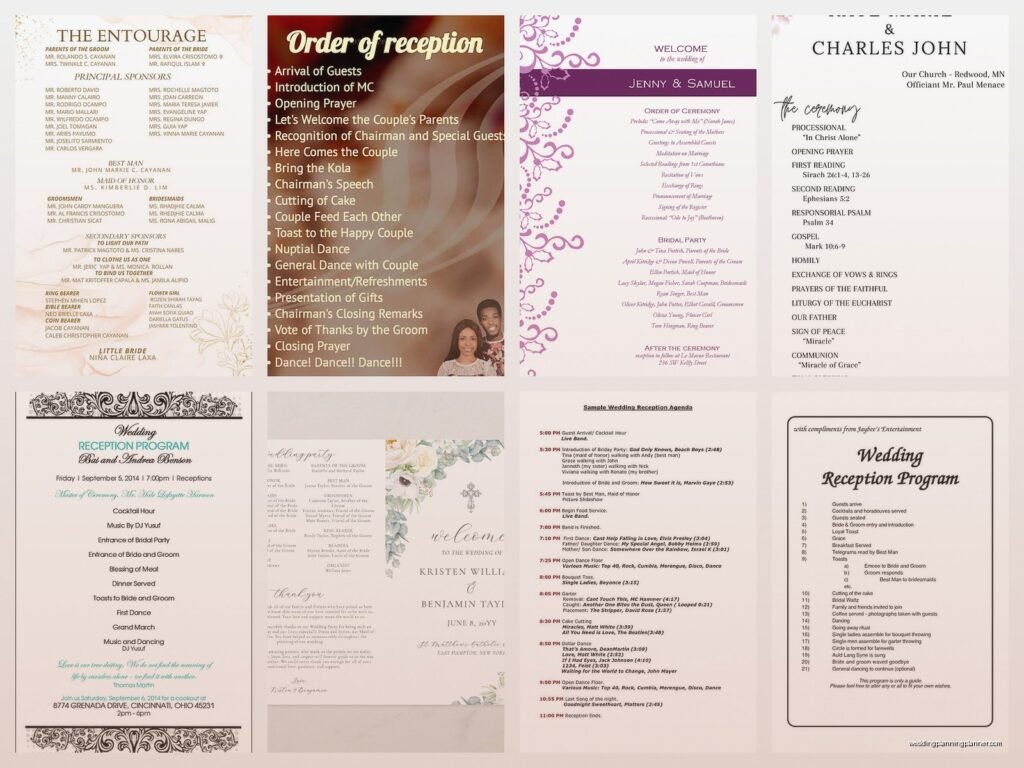
Sample Wedding Ceremony Program: Order Service Examples
Apr
Sample Wedding Ceremony Programs That Actually Work
So you need to put together your ceremony program and you’re staring at a blank template wondering what the heck goes where. I get it. Last spring I had this bride who literally texted me at 11pm three weeks before her wedding asking if the processional order goes before or after the welcome and honestly I was watching The Bachelor and had to pause it to answer her because this is such a common question.
Here’s the thing about ceremony programs – they’re not just pretty paper you hand out. They’re basically your guests’ roadmap for the next 30-45 minutes and trust me, people actually read them. Especially your Aunt Margaret who’s gonna critique everything anyway.
The Basic Traditional Order (Because You Gotta Start Somewhere)
Alright so the most standard traditional ceremony program follows this kind of flow and you can obviously tweak it but this is your baseline:
- Prelude – This is just fancy talk for “music playing while people find their seats”
- Processional – Everyone walks down the aisle in order
- Welcome/Opening Remarks – Your officiant says hi basically
- Invocation or Opening Prayer – If you’re doing the religious thing
- Readings – Poetry, scripture, that one Corinthians passage everyone uses
- Declaration of Intent – The “do you take this person” part
- Vows – The good stuff everyone came for
- Ring Exchange – Self explanatory
- Pronouncement – “I now pronounce you…”
- The Kiss – Crowd goes wild
- Recessional – Exit music and everyone leaves
But here’s what nobody tells you – you don’t have to list every single tiny thing. I see couples trying to put “Moment of Silence” and “Lighting of Unity Candle” and seventeen other micro-moments and it just clutters the whole program. Pick the main beats.
What Actually Needs To Be On There
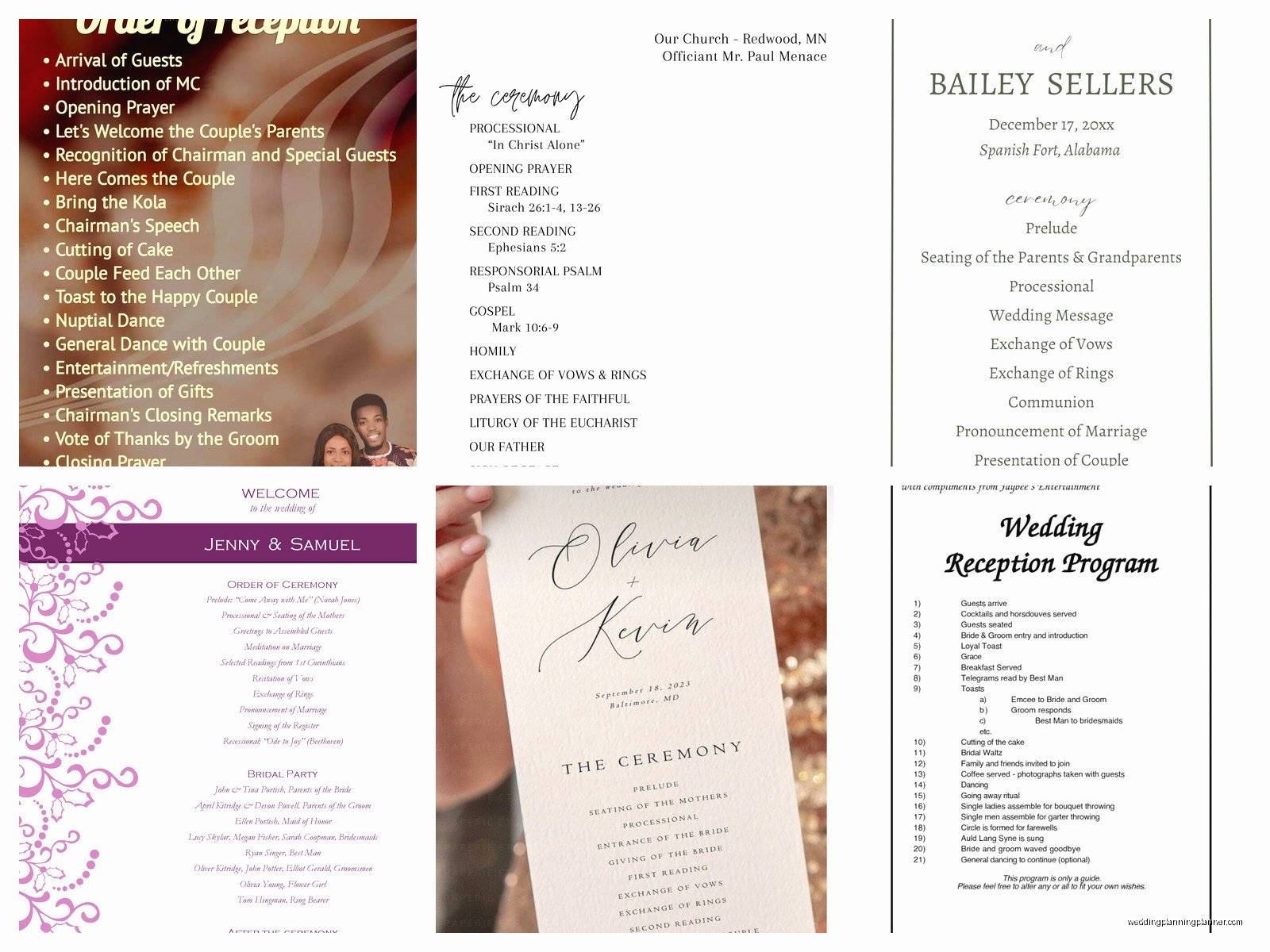
Your program needs your names obviously (you’d be surprised how many drafts I get without this), the date, the location, and then the order of service. That’s the bare minimum. Everything else is kinda extra but nice to have.
I always tell clients to include the wedding party names with their roles because guests are sitting there like “who is that bridesmaid” and it’s nice to know. List them in the order they walked down the aisle or just do it by side – bride’s side, groom’s side, whatever works.
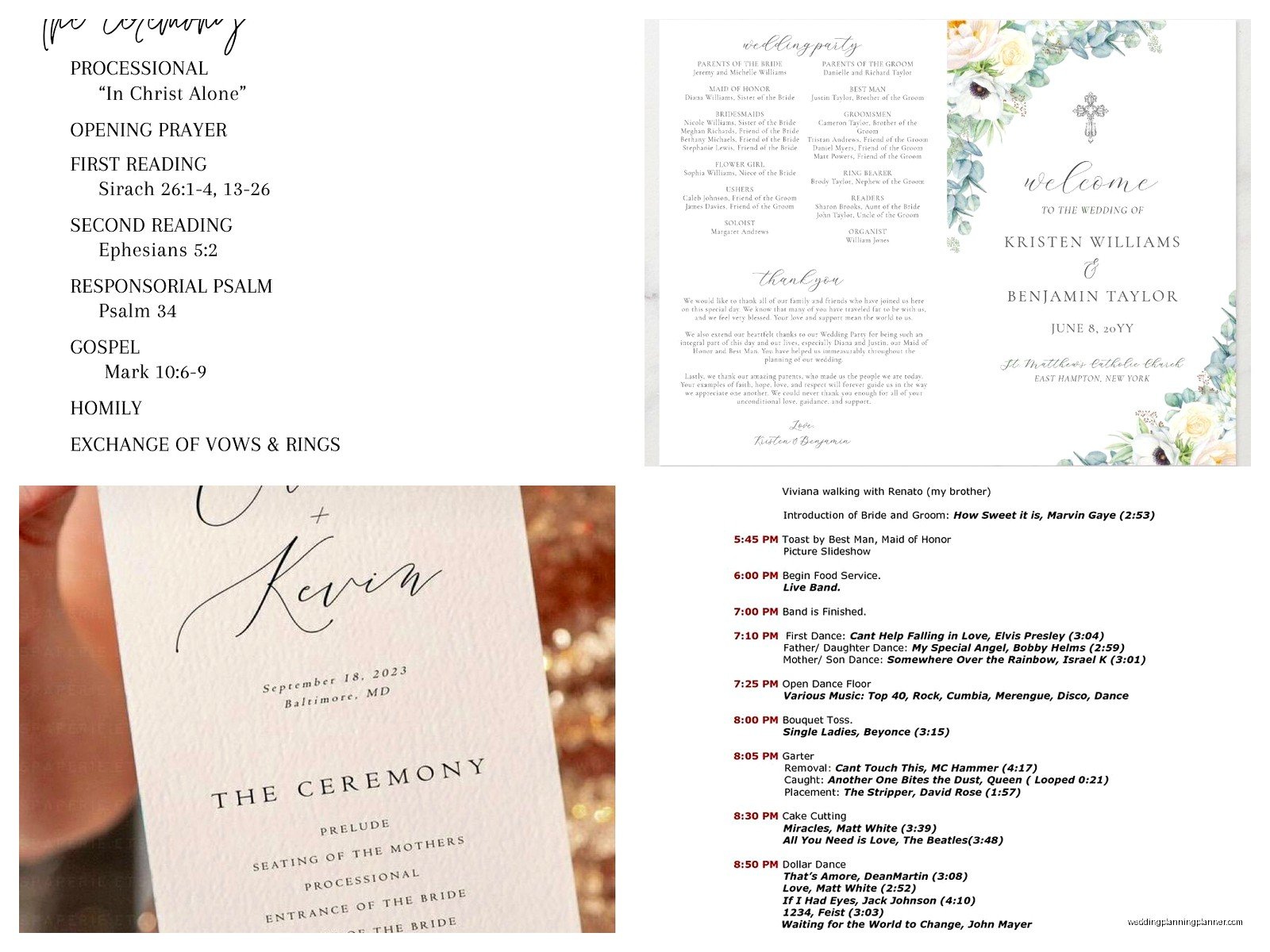
One thing that really annoys me though? When couples put song titles but not the artists. Like you’re gonna write “A Thousand Years” but not mention it’s Christina Perri? Your music-loving guests wanna know! I had this whole situation in summer 2021 where the bride insisted on listing every single song as just the title and her grandmother spent the entire cocktail hour asking people who sang what. Just add the artist name, it takes two seconds.
Sample Traditional Religious Ceremony
Here’s what a Catholic ceremony program might look like (and I’ve done so many of these):
Prelude Music
Canon in D – Pachelbel
Air on the G String – Bach
Processional
Bridal Party and Bride enter to “Trumpet Voluntary” – Jeremiah Clarke
Opening Prayer
Father Michael Rodriguez
First Reading
1 Corinthians 13:4-8
Read by Sarah Martinez, Sister of the Bride
Responsorial Psalm
Psalm 128
Second Reading
Colossians 3:12-17
Read by James Cooper, Brother of the Groom
Gospel Reading
John 15:9-12
Homily
Father Rodriguez
Exchange of Vows
Blessing and Exchange of Rings
Lighting of the Unity Candle
“The Prayer” – Celine Dion and Andrea Bocelli
Lord’s Prayer
Nuptial Blessing
Pronouncement
Recessional
“Ode to Joy” – Beethoven
See how that flows? It’s detailed enough that guests know what’s happening but not so detailed that it’s overwhelming. Catholic ceremonies are longer so you kinda need more structure listed out.
Sample Non-Religious Ceremony
Now if you’re doing a secular ceremony it’s usually shorter and you have way more flexibility. Here’s an example I used for a couple last fall:
Prelude
Selections played by the String Quartet
Processional
Wedding party enters to “At Last” – Etta James
Bride enters to “Marry You” – Bruno Mars (acoustic version)
Welcome
Officiant Maria Stevens
Love Story Reading
“Union” by Robert Fulghum
Read by Best Friend Jessica Wong
Personal Vows
Ring Warming Ceremony
(Rings passed among guests for blessings)
Ring Exchange
Handfasting Ritual
Pronouncement
First Kiss as Married Couple
Recessional
“Signed, Sealed, Delivered” – Stevie Wonder
This couple wanted something upbeat and personal and you can totally tell from their music choices right? The ring warming ceremony was actually really sweet – it gave guests something to do during the ceremony and everyone felt involved.
The Processional Order Thing Everyone Gets Wrong
Okay so if you’re gonna list out who walks when in your program, here’s the traditional order that most people follow. But honestly you can mix this up however you want, tradition is just a suggestion at this point…
Traditional Processional Order:
- Officiant takes their place (sometimes they walk down, sometimes they’re just there)
- Groom and his parents (or groom walks with best man, or groom is already standing there)
- Grandparents of the bride
- Grandparents of the groom
- Mother of the groom
- Mother of the bride
- Groomsmen (either one by one or with bridesmaids)
- Bridesmaids
- Maid/Matron of Honor
- Ring bearer
- Flower girl
- Bride with her father (or both parents, or alone, or with whoever she wants honestly)
You don’t need to put all this detail in your program though. I usually just have couples write something like “The families and wedding party process to [song name]” and then list the wedding party names separately in a different section. Makes it cleaner.
Special Ceremony Elements To Include
If you’re doing any special rituals or cultural traditions, definitely put those in your program with maybe a sentence explaining what it is. Your guests will appreciate understanding what they’re witnessing.
Like if you’re doing a unity ceremony – whether it’s candle lighting, sand ceremony, wine ceremony, whatever – just add a line like:
Unity Sand Ceremony
The bride and groom will each pour different colored sand into one vessel, symbolizing the joining of their lives and families.
I had a couple do a tree planting ceremony once and we put a whole explanation in the program because nobody had seen that before. It was actually really cool – they planted this little oak tree during the ceremony and the plan is to transplant it to their backyard. My cat would probably try to dig it up immediately but that’s beside the point.
Sample Interfaith Ceremony
These are tricky because you’re blending traditions and you want both families to feel represented. Here’s one I did that worked really well:
Prelude
Processional
Welcome and Opening Blessing
Rabbi David Stein and Father Thomas O’Brien
Reading from the Torah
Genesis 2:18-24
Read by the Groom’s Uncle
Reading from the New Testament
1 John 4:7-12
Read by the Bride’s Aunt
Secular Love Reading
“The Art of Marriage” by Wilferd Arlan Peterson
Read by Couple’s Friend
Exchange of Vows
Ring Exchange with Blessings
Blessed by both Rabbi Stein and Father O’Brien
Seven Blessings (Sheva Brachot)
Recited by family members
Breaking of the Glass
Pronouncement
Recessional
The key with interfaith ceremonies is making sure both officiants are clearly credited and both traditions get equal weight in the program. Nobody wants their side to feel like an afterthought.
What About Explanations and Translations
If you’re including anything in another language or doing cultural traditions that might not be familiar to all guests, add brief explanations. You can either put them right under the program item or in a separate section at the bottom.
For example:
Las Arras (Unity Coins)
The groom presents thirteen gold coins to the bride, symbolizing his commitment to support the family. The coins represent Jesus and his 12 apostles.
Or if you’re having readings in Spanish and English, note that in the program so people aren’t confused when they hear both languages.
The Stuff People Always Forget
Here’s what gets left off programs all the time and then I’m scrambling to add it last minute:
- Musicians’ names – if you hired a string quartet or a soloist, credit them!
- Readers’ relationships – don’t just put “Sarah Johnson reads,” put “Sarah Johnson, Bride’s College Roommate”
- Song artists – I mentioned this already but seriously, include them
- Honor attendants if they’re different from best man/maid of honor
- Anyone doing a special role like lighting candles or handing out programs
Also if you’re having an unplugged ceremony (no phones), put that right on the front of the program in a nice way. Something like “We kindly request an unplugged ceremony. Please silence your phones and enjoy this moment with us.” Works way better than having your officiant announce it.
Destination or Outdoor Ceremony Considerations
If you’re getting married somewhere that guests might not be familiar with the customs, your program becomes even more important. Like I did a beach wedding in Mexico and we included a whole section about the Mayan blessing ceremony they were incorporating. Guests loved having that context.
For outdoor ceremonies, you might wanna keep programs shorter since people are dealing with sun, wind, potentially rain… nobody wants to hold a five-page booklet in the breeze. Stick to one page front and back if you can, or do a simple flat card.
Quick Format Tips That Make Programs Actually Readable
Use enough white space. I see so many programs that are just walls of text crammed together and nobody’s reading that. Give each section room to breathe.
Font size matters – minimum 11pt for the body text, larger for section headers. Your older guests will thank you. I learned this the hard way when a groom’s grandmother told me she couldn’t read the program at all because we’d used 9pt font. Oops.
If your ceremony is longer than 30 minutes, consider doing a bi-fold or tri-fold program so you have more space. But honestly most ceremonies don’t need that much room unless you’re doing full Catholic mass or something equally lengthy.
Sample Minimalist Program
Not everyone wants all the details and that’s totally fine. Here’s a super simple version:
Our Ceremony
Processional
Welcome
Readings
Vows
Ring Exchange
Pronouncement
Recessional
Our Wedding Party
[List names and roles]
Thank You
We’re so grateful you’re here to celebrate with us today.
Done. Clean, simple, tells people what’s happening without overwhelming them. Some couples prefer this approach and it’s honestly refreshing sometimes.
When You’re Including Deceased Loved Ones
This is sensitive but important. A lot of couples want to honor family members who’ve passed, and the program is a good place to do that. You can add a section like:
In Loving Memory
We remember and honor those who are with us in spirit:
[Names]
Keep it simple and dignified. You don’t need to list relationships or dates unless you want to. I had a bride in spring 2023 who wanted to include her dad who’d passed away two years earlier, and we put his name with a small note that he was “forever in our hearts.” She got through the ceremony better than expected and later told me seeing his name in the program helped her feel like he was there.
Additional Info People Sometimes Add
You can also use your program to tell guests about what’s happening after the ceremony. Like:
“Immediately following the ceremony, please join us for cocktails and hors d’oeuvres on the terrace while we take photos.”
Or if there’s a receiving line, mention that. If you’re doing a grand exit, you could note what time and where. Some couples put their hashtag on the program too if they want guests posting on social media.
Honestly you can include whatever you want as long as it’s useful to your guests. I’ve seen couples add maps of the venue, timelines for the whole day, even little crossword puzzles for kids. Get creative if that’s your style, or keep it strictly informational. There’s no wrong answer as long as it makes sense for your wedding.
Just remember the main point is helping your guests follow along with your ceremony and understand what’s happening. Everything else is bonus. And please, for the love of all that is holy, proofread the thing before you print 150 copies. I’ve seen so many programs with typos in people’s names and it’s gonna bother someone, probably your mother-in-law who already thinks you’re not organized enough.
