
Planning Guides, Style Guide
Sample Wedding Script: Sample Ideas & Examples
Apr
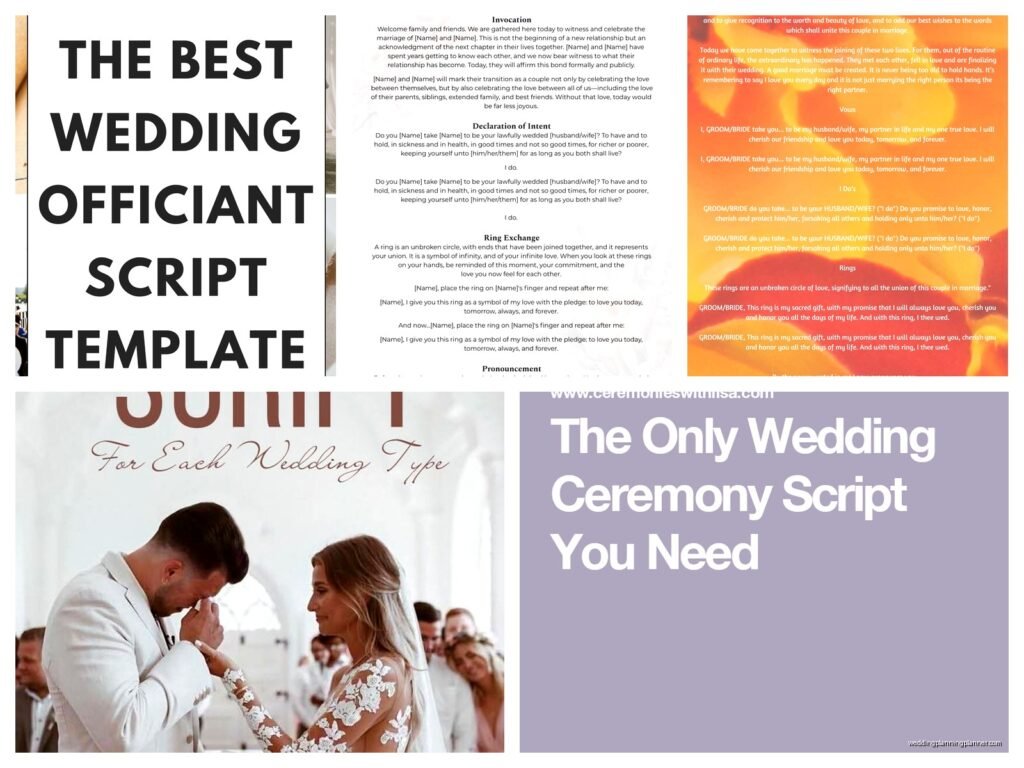
Okay So Wedding Scripts Are Actually Really Important
Look I’m just gonna dive right in because last spring I had this couple who showed up to their ceremony rehearsal and the officiant literally had NOTHING prepared and we all stood there awkwardly for like twenty minutes while he googled “wedding ceremony words” on his phone and honestly that’s when I realized how many people just wing this part. Don’t do that.
A wedding script is basically your ceremony blueprint. It’s what the officiant says, when you say your vows, when rings get exchanged, all that stuff. And yeah you can totally customize it but you need something to work from or you’ll end up with dead air and confused guests.
The Basic Structure Everyone Uses
So most wedding ceremonies follow this kinda formula and you can mix it up but here’s the skeleton:
- Processional (that’s when everyone walks down the aisle)
- Welcome and opening remarks from the officiant
- Reading or two if you want them
- The actual marriage bit with the legal words
- Vows (personal or traditional)
- Ring exchange
- Pronouncement (the “I now pronounce you” part)
- The kiss
- Recessional (walking back up the aisle as a married couple)
That’s it. Everything else is optional. You don’t need unity candles or sand ceremonies or whatever unless you actually want them. I’ve seen people add like six different symbolic gestures and the ceremony drags on for 45 minutes and everyone’s feet hurt.
Sample Opening Words
The officiant usually starts with something welcoming. Here’s what actually works in real life:
“Good afternoon everyone. We’re gathered here today to celebrate the marriage of [Name] and [Name]. Thank you all for being here to witness and support this commitment. Your presence means the world to them.”
Or if you want something less formal:
“Welcome everyone! We’re here because [Name] and [Name] found something pretty special, and they want to make it official with all of you as witnesses. So let’s get these two married.”
You can go religious if that’s your thing, or spiritual, or completely secular. I had a couple in summer 2021 who opened with a quote from The Office and honestly it was perfect for them because they met at a Dunder Mifflin trivia night. Know your audience I guess.
The Legal Bit Nobody Thinks About
Okay so depending on where you live, your officiant might need to say specific legal words for the marriage to count. This is super important and what annoys me is that people forget to check their state or country requirements. In some places the officiant has to literally ask “Do you take this person” and get a verbal “I do” response. In other places you just need to declare intent.
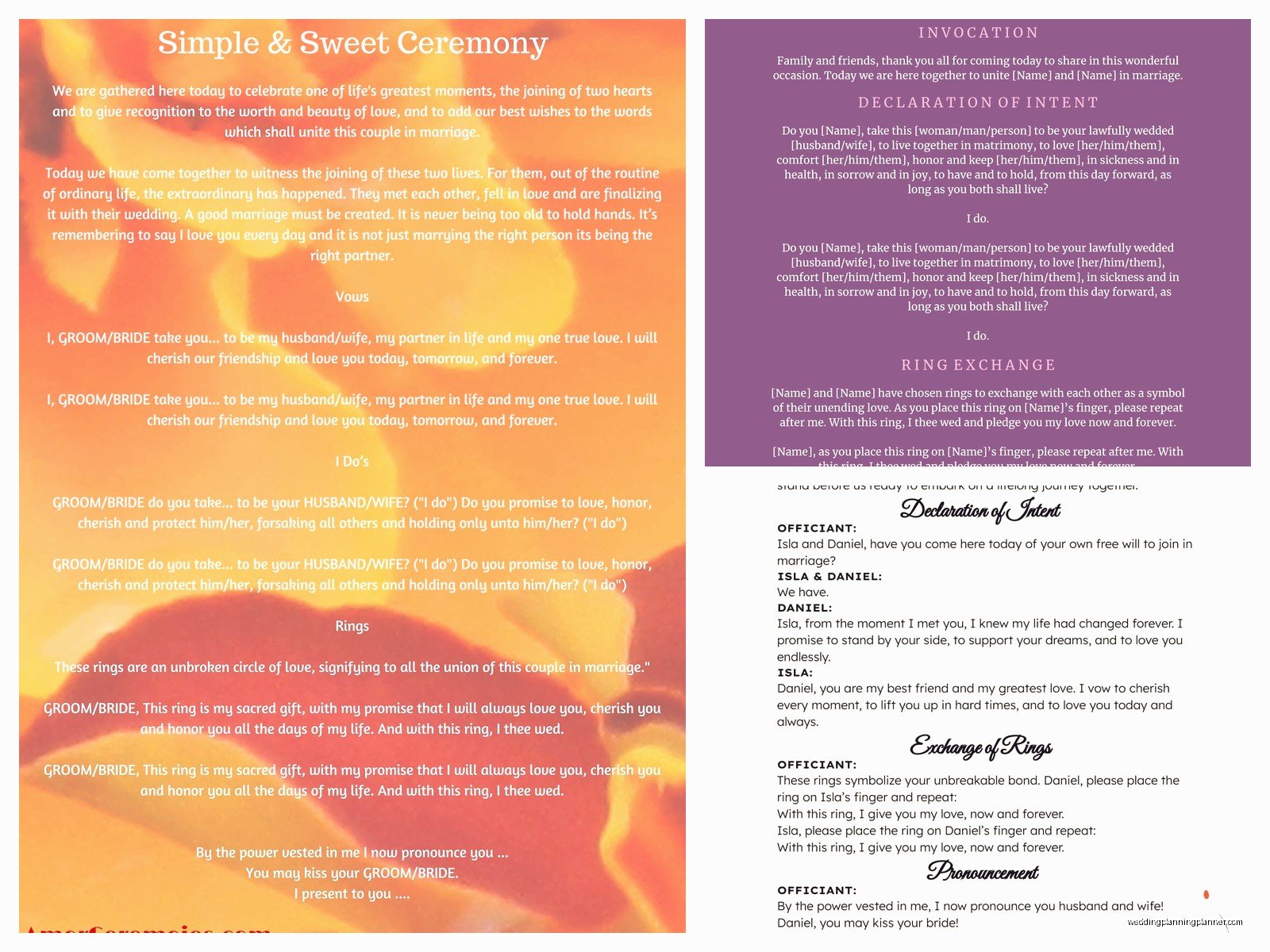
Standard declaration of intent sounds like:
“[Name], do you take [Name] to be your lawfully wedded spouse, to have and to hold from this day forward, for better or worse, for richer or poorer, in sickness and in health, to love and to cherish, till death do you part?”
Then they say “I do” and you repeat for the other person.
Or the shorter version:
“[Name] and [Name], do you come here freely and without reservation to give yourselves to each other in marriage?”
Make sure your officiant knows what’s legally required. I’m not a lawyer obviously but your marriage license paperwork usually explains this or you can call the county clerk’s office.
Vow Examples That Don’t Sound Cheesy
Vows are where people either nail it or make everyone cringe. You’ve got options here and honestly I think personal vows are better than traditional ones but that’s just me.
Traditional vows go like:
“I, [Name], take you, [Name], to be my wedded spouse. I promise to love you, comfort you, honor and keep you, in sickness and in health, in sorrow and in joy, and to be faithful to you as long as we both shall live.”
But personal vows are where you actually say what you mean. Keep them between one and two minutes when you read them out loud. Here’s a structure that works:
- Start with what you love about them or a meaningful moment
- Make 3-5 specific promises
- End with your commitment statement
Like: “Sarah, from the moment you laughed at my terrible joke about spreadsheets, I knew you were… wait no that’s actually a real example from a wedding I did and it was adorable. Anyway, structure your vows so they’re specific to YOUR relationship, not generic romance novel stuff.
Ring Exchange Scripts
The ring part is pretty straightforward. The officiant usually says something about what rings symbolize, then each person puts the ring on while saying a short phrase.
“These rings represent your unbroken commitment to one another. As you place them on each other’s fingers, repeat after me: With this ring, I thee wed.”
Or you can have them say their own thing while putting the ring on:
“I give you this ring as a symbol of my love and commitment. Wear it as a reminder that you are loved.”
My cat knocked over my coffee while I’m writing this sorry, anyway—rings can be super simple. You don’t need a whole speech about circles and eternity unless that’s your vibe.
Readings If You Want Them
Readings are optional but nice if you have someone you want to include in the ceremony who isn’t in the wedding party. Pick something that actually means something to you though. I cannot tell you how many times I’ve heard “Love is patient, love is kind” from Corinthians at non-religious weddings and it’s like… do you even know what else is in that passage or did you just google “wedding readings.”
Better options:
- A poem you both actually like
- Lyrics from a meaningful song
- A passage from a book that matters to you
- Something one of you wrote
- A reading from your cultural or religious tradition if that’s important
Keep readings under two minutes. People’s attention spans aren’t great during ceremonies.
The Pronouncement and Kiss
This is the big moment. The officiant has already made sure you’re legally married (with the declaration of intent part earlier), so now they’re announcing it to everyone.
“By the power vested in me by the state of [State], I now pronounce you married! You may kiss.”
Or the classic:
“I now pronounce you husband and wife” / “I now pronounce you married” / “I now pronounce you spouses for life”
Use whatever language fits your relationship. The “you may kiss” part is where everyone cheers so make sure your photographer is ready.
Optional Add-Ins People Actually Do
Some couples want extra stuff in their ceremony. Here’s what I see that actually works:
Unity Ceremony: Lighting a candle together, pouring sand into one container, mixing cocktails (yes really), painting something together. These take 2-3 minutes and go after the vows usually.
Family Inclusion: If you’ve got kids from previous relationships or you’re blending families, you can do a family vow or give them a small gift during the ceremony. Just keep it brief or the focus shifts away from the couple.
Cultural Traditions: Jumping the broom, breaking the glass, handfasting, tea ceremony, whatever is meaningful to your background. Just make sure the officiant explains it briefly so guests understand what’s happening.
Moment of Remembrance: A short acknowledgment of loved ones who have passed. Keep it like 30 seconds max or it gets really sad and heavy.
Putting It All Together Sample Script
Alright so here’s a full sample that’s like medium-formal, not religious, pretty standard:
OFFICIANT: Welcome, everyone. We’re gathered here today to witness and celebrate the marriage of Jordan and Alex. Marriage is a commitment to life, to the best that two people can find and bring out in each other. Jordan and Alex, your marriage today is the public and legal joining of your souls that have already been united.
OFFICIANT: Before we proceed, I’d like to share a short reading that Jordan and Alex selected. [Reading happens here]
OFFICIANT: Jordan and Alex have chosen to write their own vows. Jordan, please begin.
JORDAN: [Personal vows]
ALEX: [Personal vows]
OFFICIANT: Now for the exchange of rings. These rings are a physical symbol of the promises you’ve just made. Jordan, please place the ring on Alex’s finger and repeat after me: “I give you this ring as a symbol of my love and commitment.”
JORDAN: I give you this ring as a symbol of my love and commitment.
[Repeat with Alex]OFFICIANT: Jordan and Alex, you have declared your love and commitment before your family and friends. By the power vested in me by the State of California, I now pronounce you married. You may kiss!
[Kiss and applause]OFFICIANT: Ladies and gentlemen, I present to you the newlyweds!
That whole thing takes like 15-20 minutes depending on how long the vows are.
Timing Stuff You Gotta Know
Ceremonies should be between 15 and 30 minutes. Shorter is honestly better unless you’re doing a full religious service. People get uncomfortable standing or sitting that long, it’s hot or cold outside, someone’s baby is gonna start crying… just get to the point, say meaningful things, and move on to the party.
Personal vows: 1-2 minutes each
Readings: 1-2 minutes each, maximum two readings
Unity ceremony: 2-3 minutes
Everything else: 10-15 minutes
Tips From Someone Who’s Seen A Lot Of These
Have your officiant use a microphone even if you think the space is small enough. Trust me. The people in the back can’t hear and they’ll be annoyed.
Print the script in a nice binder or folder. I saw an officiant lose their papers in the wind once and it was chaos.
Do a rehearsal. Even if it’s just 20 minutes the day before. Walk through the blocking (who stands where, when people sit and stand, when the rings get handed over).
Have someone be in charge of the rings. Usually the best man and maid of honor but I’ve seen ring bearers, parents, even the officiant hold them beforehand. Just designate someone or you’ll have that awkward moment of “wait where are the rings.”
Write it in the script when people should stand or sit. Your guests don’t know when to do this unless the officiant tells them. “Please be seated” after the processional and “Please stand” for the pronouncement is standard.
Religious vs Secular Scripts
If you want a religious ceremony, you’ll probably work with your priest/rabbi/imam/whatever and they’ll have their own script requirements. Catholic ceremonies are like a whole mass situation. Jewish ceremonies have the ketubah signing and the chuppah and breaking the glass. Hindu ceremonies are elaborate and beautiful and long.
If you’re doing secular (no religious elements), you have way more flexibility. You can pull from poetry, literature, philosophy, your own words, whatever feels right. Just make sure it’s still a ceremony and not just you reading stuff at each other. There should be a flow and a structure.
Working With Your Officiant
Here’s the thing—some officiants will write everything for you, some will ask what you want and customize it, and some (like that disaster I mentioned earlier) will show up with nothing. Have a conversation early about expectations.
Questions to ask your officiant:
- Do you have a standard script we can customize?
- How do you handle personal vows vs traditional vows?
- What’s required legally in our location?
- Can we include [specific cultural or religious element]?
- Will you do a rehearsal with us?
- Do you bring your own microphone or do we need to provide one?
Get the final script at least two weeks before the wedding so you can review it. Make sure names are spelled right and pronounced right. I had an officiant call someone “Kara” instead of “Cara” through the whole ceremony once and you could feel the bride dying inside.
What Not To Do
Don’t make it too long. Seriously. No matter how meaningful everything feels to you, your guests are thinking about the cocktail hour.
Don’t surprise your partner with your vows. You should both know generally what tone you’re going for (funny vs serious, short vs long, etc).
Don’t include inside jokes that require explanation. If the officiant has to stop and explain why something is funny, it’s not gonna land.
Don’t forget to tell your officiant about any family drama. If someone’s parents are divorced and hate each other, or if there’s a complicated family situation, give them a heads up so they don’t say something awkward.
Don’t write your vows the morning of the wedding. You’ll be stressed and rushed and they won’t be good.
Actual Real Examples I’ve Used
I’m gonna give you a few more specific examples because sometimes you just need to see the actual words…
Super Short Ceremony Script
For couples who want like a 10-minute ceremony:
OFFICIANT: Welcome everyone. [Names] have brought you here to witness their commitment to each other. Marriage is about partnership, support, and choosing each other every day. [Name], do you take [Name] as your spouse?
PARTNER 1: I do.
OFFICIANT: [Name], do you take [Name] as your spouse?
PARTNER 2: I do.
OFFICIANT: Please exchange rings. [Ring exchange] By the power vested in me, I pronounce you married. Kiss already!
Done. Quick and to the point.
Ceremony With Kids Included
If you’re blending a family:
[After the couple’s vows] OFFICIANT: [Names of children], please come forward. Today isn’t just about [Parent] and [Parent] marrying each other. It’s about all of you becoming a family. [Parent] and [Parent], do you promise to love, support, and care for [children’s names] as you build your life together?COUPLE: We do.
OFFICIANT: [To children] And do you accept [parent] into your family with open hearts?
[Kids respond however they’re comfortable—some say “yes,” some just nod, some are too shy and that’s fine] [Parents give kids a small gift or medallion or whatever you’ve planned]
This adds maybe three minutes but makes the kids feel included.
Anyway that’s basically everything I know about wedding ceremony scripts after doing this for way too many years. The main thing is just make sure someone has something written down, practice it at least once, and don’t stress too much about making it perfect because on the actual day you’ll be so nervous and happy that you won’t remember half of it anyway. Your photographer will capture the important moments and that’s what matters. Oh and make sure your officiant knows to speak slowly and clearly because everyone rushes through these when they’re nervous and then nobody can understand what’s being said and that’s just awkward for everyone involved.
