Planning Guides, Style Guide
Wedding Cards: Complete Invitation & Stationery Guide
Mar
Paper Stock Matters More Than You Think
So you’re gonna need to understand paper weight first because nobody talks about this enough and then couples are shocked when their invitations feel like printer paper. GSM (grams per square meter) or pound weight in the US – these numbers actually mean something. Standard cardstock is around 80lb cover weight or 216 GSM. For wedding invitations you want minimum 100lb cover (270 GSM) but honestly I push clients toward 110-130lb because it just feels substantial in your hand.
I had this couple in spring 2022 who insisted on going with 65lb paper because their designer friend said it was fine and I’m telling you, when those invites arrived they looked like something you’d print at Staples for a birthday party. The bride actually cried. Not the good kind of crying either. We ended up rush ordering replacements and eating half the cost which was… anyway that’s not the point here.
Cotton paper versus wood pulp makes a difference too. 100% cotton has this texture that people notice even if they don’t know what they’re noticing. Crane’s Lettra is the standard everyone wants but it’s expensive. Like really expensive. Alternatives include Neenah’s cotton line or even a good quality linen finish can give you that elevated feel without the Crane price tag.
Timing Your Stationery Suite
Alright so the timeline is where people mess up constantly. Save the dates go out 6-8 months before the wedding. Invitations mail 8-10 weeks before. RSVP deadline should be 3-4 weeks before your wedding date because you need final counts for catering.
But here’s what actually happens – you need to work backwards from these dates. If invitations mail 8 weeks before, you need them delivered to you 10 weeks before minimum. That means design finalized 14 weeks before. Which means starting the process 16-18 weeks before your wedding.
I cannot tell you how many couples contact me 12 weeks out thinking we have plenty of time and I’m like… deep breath… we’re already behind. Especially if you want letterpress or foil stamping because those printing methods have longer production times.
The Save The Date Situation
Save the dates are technically optional but if you have a destination wedding or you’re getting married during a holiday weekend just send them. Your guests need to book flights and hotels and people’s calendars fill up fast.
What needs to be on a save the date:
- Your names obviously
- Wedding date
- City and state (you don’t need the venue yet if you haven’t locked it down)
- Wedding website URL if you have one
- That’s literally it
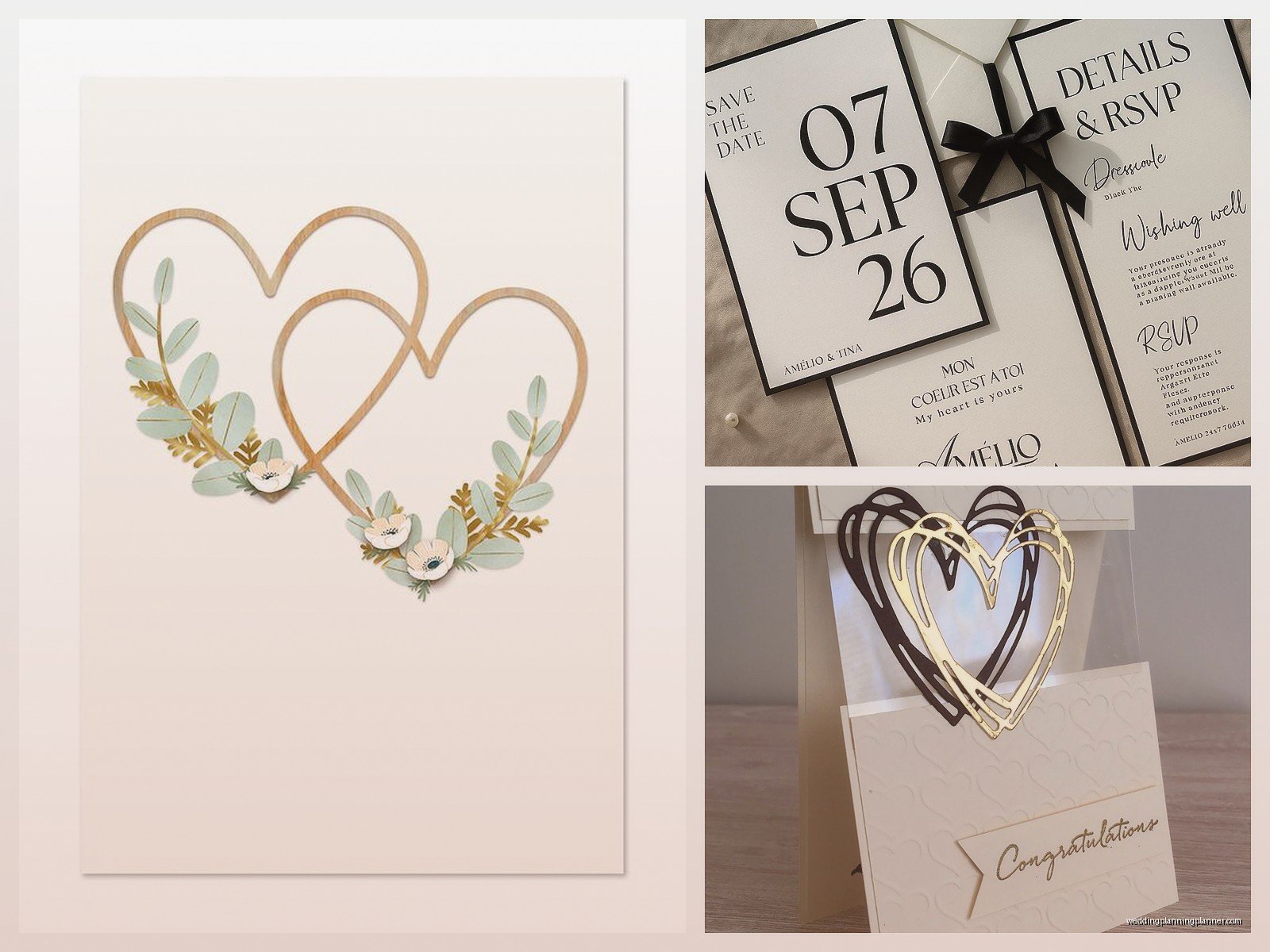
People try to cram too much information on there. You don’t need your color scheme showcased or engagement photos or a poem about your love story. It’s a save the date. Give people the critical info and move on.
Magnets are popular and I get why – they stay on the fridge so people don’t lose them. But they cost more to mail because of weight and thickness. Postcards are cheaper for postage but people lose them immediately. Standard cards with envelopes feel more formal but again, lost within days. Pick your priority.
Invitation Components Breakdown
A full invitation suite has like six different pieces and you don’t need all of them but let me explain what they are so you can decide.
Main Invitation Card
This is the big one with all the important information. Size wise you’ve got options – 5×7 is most common and fits standard invitation envelopes. 4×6 works if you want something more compact and cheaper to mail. Square invitations (5.5×5.5 or 6×6) look cool but USPS charges extra for square envelopes because they can’t go through standard sorting machines and this annoys me so much like why does the shape matter to a machine but whatever that’s the rule.
Wording is where people freeze up. There are traditional formats and modern formats and it depends on who’s hosting.
Traditional (parents hosting):
Mr. and Mrs. John Smith
request the honour of your presence
at the marriage of their daughter
Sarah Elizabeth
to
Michael James Rodriguez
son of Mr. and Mrs. Carlos Rodriguez
Modern (couple hosting):
Sarah Smith and Michael Rodriguez
invite you to celebrate their marriage
You can mix it up. Honour versus honor – the British spelling (honour) is traditional for religious ceremonies, American spelling (honor) for secular. Both are fine. The “request the honour of your presence” is for religious ceremonies and “request the pleasure of your company” is for non-religious but honestly most people don’t know this distinction anymore so use what sounds good to you.
Reception Card
If your ceremony and reception are in different locations or at different times, you need a separate reception card. If everything’s in one place you can include reception details on the main invitation.
Reception card includes:
- Time (if different from ceremony)
- Location name and address
- Dress code if you want to specify
- Maybe a line like “Dinner and dancing to follow”
__
accepts with pleasure / declines with regret
the kind invitation for Saturday the fifteenth of June
That M is for guests to write Mr. or Mrs. or Ms. before their name. Most people under 60 don’t understand this anymore so you might want to just write “Name(s)” instead.
Modern RSVP cards are more direct:
Please respond by May 15th
Will attendWill celebrate from afar
Number of guests attending
Include a line for meal choices if you’re doing plated dinner with options. “Beef
Chicken
Vegetarian
” or whatever your caterer is serving. This saves you so much time later because otherwise you’re contacting every single guest about their meal preference.
My cat just knocked over my coffee while I’m writing this and it almost hit my laptop which would’ve been a disaster but we’re good, everything’s fine.
Details Card
This is where you put all the extra stuff that doesn’t fit elsewhere:
- Hotel room block information with booking codes
- Transportation details if you’re providing shuttles
- Weekend itinerary for destination weddings
- Dress code specifications
- Registry information (though I usually recommend putting this only on your website)
You can skip the details card entirely and put everything on your wedding website then just include a website card with your URL. This is cheaper and easier to update if things change.
Inner Envelope vs Outer Envelope
Traditional formal invitations have two envelopes. The outer envelope has the mailing address and gets beat up in the mail. The inner envelope stays pristine and has just the guests’ names without the address. When you open the outer envelope you pull out this perfect inner envelope with your invitation tucked inside.
It’s beautiful and formal and also completely unnecessary unless you’re having a black-tie wedding at a country club or something very traditional. Double envelopes add cost for the envelopes themselves plus assembly time. Most couples skip the inner envelope now.
Belly Bands and Envelope Liners
Belly bands are those paper or ribbon strips that wrap around all your invitation pieces to keep them together. They look nice but they’re extra cost and extra assembly. If you have multiple cards in your suite you kinda need something to hold them together though – belly band, ribbon, vellum wrap, wax seal, whatever.
Envelope liners are decorative paper that lines the inside of your envelope. You see them when you open the flap. They add a pop of color or pattern and make the invitation feel more luxurious. But they also add cost and they’re annoying to install if you’re DIY-ing because you need a template and scoring tool and… it’s a whole thing.
Printing Methods Explained
This is where budget meets aesthetics and you gotta figure out your priorities.
Digital Printing
This is what most invitations are now. It’s printing from a computer straight onto paper. Good quality digital printing looks great and costs the least. You can do full color, photos, gradients, whatever you want design-wise.
The downside is it doesn’t have texture or dimension. It’s flat ink on paper. Which is fine! Most invitations are digital printing and they’re beautiful. But if you want that tactile fancy feeling, digital isn’t gonna get you there.
Cost range: $2-6 per suite depending on design complexity and paper quality.
Letterpress
Letterpress is where designs are pressed into the paper leaving an impression you can feel. It’s gorgeous and super traditional and expensive. The setup costs alone are high because they create custom plates for your design.
You’re limited on colors because each color requires a separate plate and pass through the press. Most letterpress invitations are one or two colors. You also can’t do fine details or small fonts as well as digital.
But that impression in the paper… people notice. It feels special. If your budget allows and you want that traditional luxury feel, letterpress is it.
Cost range: $15-30+ per suite. Yeah. I know.
Foil Stamping
Foil stamping uses heat to apply metallic or colored foil to paper. It’s shiny and eye-catching and photographs beautifully. Popular colors are gold, rose gold, silver, and copper.
Like letterpress, it requires custom plates so setup costs are high. You typically do foil as an accent – names, borders, monograms – not entire blocks of text because it gets expensive and can be hard to read.
You can combine foil with digital printing which is what a lot of couples do now. Digital print for most of the invitation and foil for specific elements.
Cost range: $10-20 per suite depending on how much foil coverage.
Thermography
Thermography creates raised printing that mimics engraving but costs way less. Powder is applied to wet ink and heated to create a raised effect. It looks nice and has texture but it’s not as crisp as letterpress or engraving.
The raised areas can crack if bent and they shouldn’t go through laser printers (so you can’t print guest addresses on thermography envelopes). But it’s a good middle-ground option for budget-conscious couples who want some dimension.
Cost range: $6-12 per suite.
Engraving
True engraving is the most expensive and most formal printing method. The design is etched into a metal plate, ink is applied, and the plate is pressed against paper from behind so the design is raised on the front and you can feel an indentation on the back.
It’s what high-end wedding invitations used historically. It’s permanent and crisp and absolutely beautiful. It’s also completely unnecessary unless you’re having a very formal wedding or you just really want it.
Cost range: $25-40+ per suite.
Design Elements and Aesthetics
Your invitation design should reflect your wedding vibe but it doesn’t have to match your decor exactly. Like if your wedding colors are dusty blue and terracotta you don’t have to have dusty blue and terracotta invitations. You can do cream and gold with a subtle nod to your colors.
Color Psychology Kind Of Matters
White and cream are classic and formal. Navy and gold feel traditional and elegant. Blush and gold are romantic. Sage green feels organic and natural. Terracotta and rust are boho. Black and white is modern and dramatic.
You probably already know what aesthetic you want. Modern minimalist couples go for clean lines, lots of white space, simple sans-serif fonts. Traditional couples want script fonts, borders, formal wording. Rustic couples do kraft paper, twine, florals. Beach weddings get watercolors and blues.
Just don’t do something totally off-brand. If you’re having a formal ballroom wedding, don’t send invitations with mason jars on them. If you’re getting married barefoot on a beach, maybe skip the black tie formal script invitation.
Typography Choices
Font selection matters more than you think. You typically want two fonts maximum – one for names/headers and one for details/body text.
Script fonts are beautiful for names but hard to read in long sentences. Use them for:
- Couple’s names
- Key phrases like “Save the Date”
- Accent elements
Serif or sans-serif fonts work for details and addresses. Make sure your font size is readable – nothing smaller than 9pt for body text. I’ve seen invitations with 6pt font for hotel information and it’s like why even include it if nobody can read it.
Layout and Hierarchy
Your eye should move naturally down the invitation. Most important information should be most prominent. Usually that’s:
- Couple’s names (biggest)
- Date and time (second biggest)
- Location (third)
- Everything else (smallest)
Center alignment is most traditional. Left alignment feels more modern. Justified alignment can look nice but creates weird spacing issues. Don’t right-align anything, it’s hard to read.
Wording Scenarios For Different Family Situations
This is where etiquette gets complicated and honestly the rules have relaxed so much that you can basically do whatever feels right for your family situation.
Both Sets of Parents Hosting
Mr. and Mrs. Thomas Anderson
and
Mr. and Mrs. Robert Chen
request the honour of your presence
at the marriage of their children
Emily Grace Anderson
and
David Michael Chen
Divorced Parents Hosting
List them separately, mom first traditionally:
Mrs. Patricia Anderson
and
Mr. Thomas Anderson
request the honour of your presence
at the marriage of their daughter
If a parent is remarried:
Mrs. Patricia Anderson-Williams and Mr. James Williams
and
Mr. Thomas Anderson
request the honour of your presence
One Deceased Parent
You can honor a deceased parent without listing them as a host:
Jennifer Marie Thompson
daughter of Mrs. Carol Thompson and the late Mr. Richard Thompson
and
Marcus Anthony Davis
son of Mr. and Mrs. Anthony Davis
request the honour of your presence at their marriage
Couple Hosting Themselves
Sarah Elizabeth Martinez
and
Christopher John O’Brien
invite you to share in their joy
as they exchange marriage vows
Or even simpler:
Sarah Martinez & Christopher O’Brien
request the pleasure of your company
at their wedding
Same-Sex Couples
List names alphabetically by last name or however you prefer:
Rachel Ann Foster
and
Emily Claire Williams
invite you to celebrate their marriage
There’s no rules here. Do what feels right.
Addressing Envelopes Properly
Envelope addressing has the most etiquette rules and also nobody really cares anymore but here’s how it’s supposed to work and then you can decide what to follow.
Formal Addressing
Married couple, same last name:
Mr. and Mrs. John Smith
Married couple, different last names:
Ms. Sarah Johnson and Mr. Michael Rodriguez
(List alphabetically or woman first, both are acceptable)
Married couple, one hyphenated name:
Mr. Michael Rodriguez and Ms. Sarah Johnson-Rodriguez
Unmarried couple living together:
Ms. Ashley Chen
Mr. David Park
(Two lines, alphabetically)
Single person with plus one:
Ms. Jennifer Martinez and Guest
Family with children under 18:
Mr. and Mrs. Robert Williams
Emma, Joshua, and Lily
(Children’s names on second line)
Using First Names vs Formal Titles
The traditional way uses titles (Mr., Mrs., Ms., Dr., etc.) always. The modern casual way uses first and last names without titles. Both are fine. Just be consistent – don’t use titles for some guests and not others.
One thing that really annoys me is when couples want to use formal titles but then don’t bother finding out if someone uses Mrs. or Ms. or if they’ve changed their name. If you’re going formal, do it right. If you don’t want to research everyone’s title preferences, just use first and last names.
Doctor, Military, Judge Titles
If someone has earned a title, use it. Doctor outranks Mr. or Mrs. in formal addressing.
One doctor:
Dr. Susan Park and Mr. James Park
(Doctor is listed first regardless of gender)
Both doctors, same last name:
Drs. Susan and James Park
or
The Doctors Park
Military titles follow similar rules – rank is listed first. Judges are “The Honorable.” Clergy are “The Reverend.”
Inner Envelope Addressing
If you’re using inner envelopes, they’re less formal. Just first names or titles and last names without addresses.
Outer: Mr. and Mrs. Robert Williams
Inner: Robert and Susan
or: Mr. and Mrs. Williams
Guest List Management Through Invitations
Your invitation wording controls who’s invited. This is important because people will try to add extra guests if you’re not clear.
Adults Only Weddings
If you don’t want children at your wedding, address invitations to adults only. Don’t write “Adults Only Reception” on the invitation because it’s considered rude. The envelope addressing indicates who’s invited.
Address to: Mr. and Mrs. Smith (not “The Smith Family”)
If people RSVP with their kids’ names added, you have to contact them and explain it’s adults only. Awkward? Yes. Necessary? Also yes. Had a wedding in summer 2024 where a guest brought three kids despite the invitation clearly addressed to just the couple and we didn’t have
