
Planning Guides, Style Guide
Wedding Reception Invitations: Post-Ceremony Party Cards
Mar
So You’re Doing a Separate Reception Thing
Okay so reception-only invitations are actually way more common than people think. Like, I had this couple back in spring 2022 who got legally married at city hall because of visa timing issues, and then they wanted the big party six months later. The bride was SO stressed about how to word everything without making it weird, and honestly that’s when I really started paying attention to how many different scenarios need these cards.
The main thing is that reception invitations are for when the ceremony already happened or is happening separately with like, barely anyone there. Maybe you eloped. Maybe you’re doing a tiny family-only ceremony and then a big party. Maybe you had a destination wedding and now you’re doing a hometown celebration. Or – and this happens more than you’d think – you got married during COVID restrictions and now you actually want to celebrate properly.
When You Actually Need These
Let me break down the situations because they’re all slightly different:
- You eloped and want to throw a party after
- You’re having an intimate ceremony (like 20 people max) and a larger reception
- You had a destination wedding and you’re doing a second reception back home
- You got legally married for paperwork reasons and the “real” wedding is later
- You’re having a religious ceremony that’s private and a secular celebration
- You got married during a pandemic or emergency and you’re finally celebrating
Each one needs slightly different wording but the basic format stays pretty similar. The key is being clear about what already happened versus what’s happening at the event you’re inviting people to.
The Wording Thing That Everyone Overthinks
Alright so this is where people get really in their heads about it. They’re worried about sounding too formal or too casual or like they’re asking for gifts or whatever. Here’s what I tell everyone: just be clear and don’t apologize for your choices.
If you eloped, you can say something like:
Sarah Chen and Michael Roberts were married on August 15, 2024, in a private ceremony. Please join them for a reception celebration on [date]
Or if you’re going more casual:
We got married! Now let’s party. Join us as we celebrate our marriage on [date]
For the intimate-ceremony-plus-big-reception situation, you could do:
Following their private wedding ceremony, Sarah Chen and Michael Roberts request the pleasure of your company at a reception in celebration of their marriage
I had a bride once who was so worried about the word “private” because she thought it sounded exclusionary? But like…it’s literally just describing what happened. You gotta just own your decisions here.
The Gift Thing Nobody Wants To Talk About
Okay umm so this is gonna sound cynical but people WILL wonder about gifts. Some guests will think “oh they already got married so maybe I don’t need to bring anything?” And honestly? That’s their choice. You can’t control it and you shouldn’t try to.
What really annoys me is when couples try to address this ON the invitation. Like they’ll want to add “no gifts please” or “your presence is present enough” (ugh) or even worse, they want to explain their registry situation. Nah. That stuff doesn’t go on the invitation itself. It can go on your wedding website, it can be spread through word-of-mouth, but the invitation should just be about inviting people to celebrate with you.
If you genuinely don’t want gifts, tell your parents and wedding party to spread the word. Put it on your website. But I’m gonna be real with you – some people will bring gifts anyway because that’s how they express celebration, and you just gotta gracefully accept them.
Design Considerations That Actually Matter
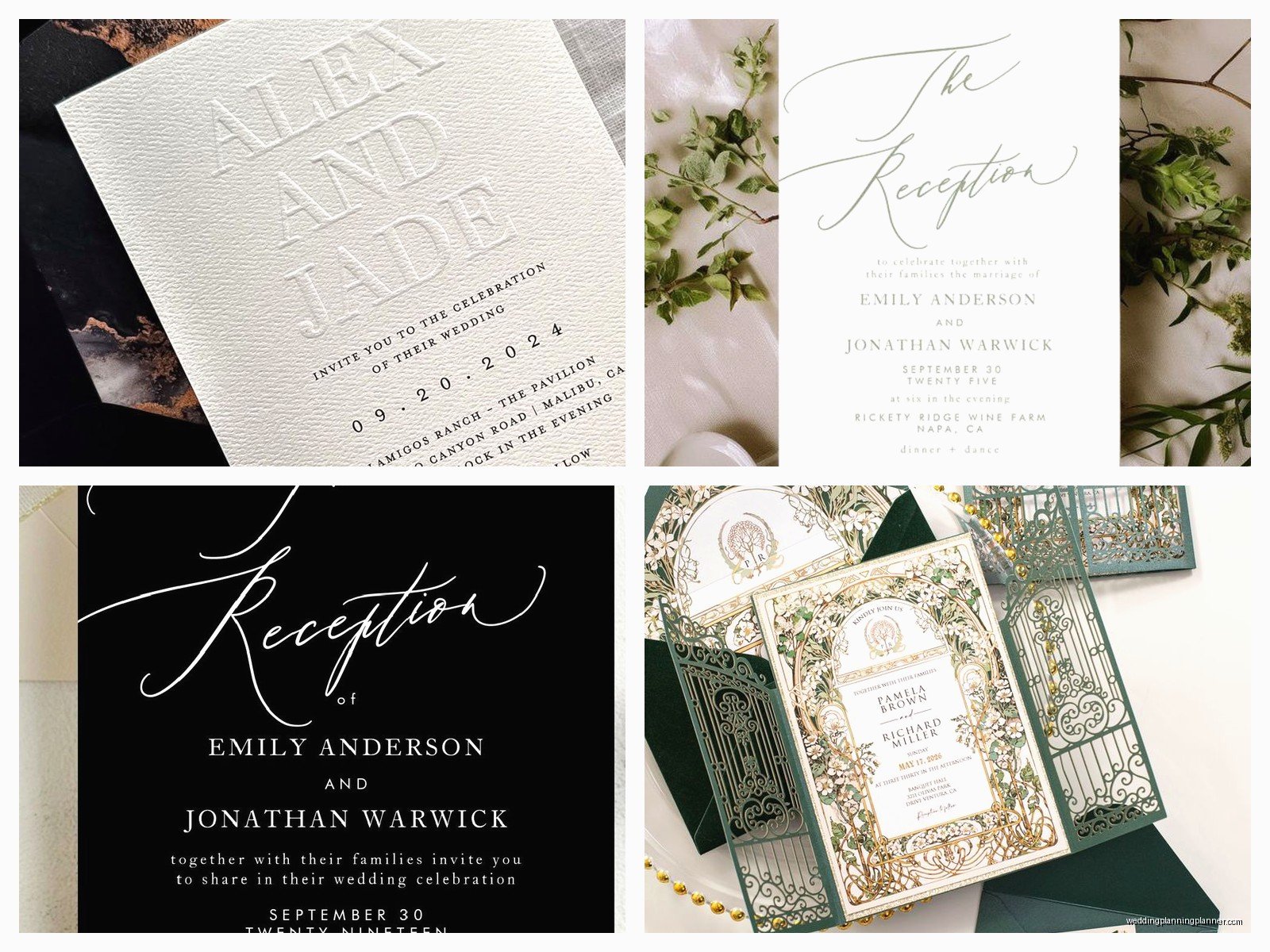
So here’s where my stationery consultant brain kicks in. Reception invitations can honestly be more fun design-wise than traditional wedding invites because you’re not locked into all those formal conventions.
You can do:
- Photo cards with a picture from your ceremony or engagement
- Postcards instead of full invitation suites
- More casual cardstock and printing methods
- Fun colors that aren’t traditional wedding palette colors
- Modern typography that you might not use on ceremony invitations
That said, if your reception is going to be black-tie or very formal, your invitation should still reflect that. The formality level of the invitation should match the formality level of the event, regardless of whether it’s a reception-only situation.
The Photo Debate
Including a wedding photo on your reception invitation is totally acceptable and actually pretty popular. I personally think it’s nice because it immediately signals “hey we already got married, this is a celebration” without having to be super explicit about it in the wording.
But – and this is important – if you’re sending these invitations out before your ceremony has actually happened (like you’re sending them in March but you’re getting married in a private ceremony in May and the reception is in June), you obviously won’t have wedding photos yet. In that case, engagement photos work fine, or just go with a design-focused invitation without photos.
Summer 2024 I had a couple who did the cutest thing where they used a photo of them at the courthouse steps right after they signed the papers, both holding up the marriage certificate and making silly faces. It was perfect for the vibe of their party which was basically a backyard barbecue situation. Not everyone’s style but it worked for them.
Timing And When To Send These Out
Okay so if your reception is happening like, more than a month after your actual wedding, treat it like a regular party invitation. Send them out 6-8 weeks before the event. You don’t need the same lead time as a traditional wedding invitation because presumably you’re not asking people to witness a ceremony, save a specific date a year in advance, book hotels, etc.
Exception: if your reception is destination or requires travel, give people more notice. Like 3-4 months at least.
If your ceremony and reception are on the same day but the ceremony is private, this gets trickier. You kinda have to send the reception invitations out on a traditional timeline (like 8-10 weeks before, or longer for destination situations) because for your guests, this IS the main event even though technically it’s “just” the reception.
The RSVP Situation
You still need RSVPs. I know it’s tempting to think “oh it’s just a party, people can just show up” but NO. You need headcounts for catering, seating, all of it. Set an RSVP deadline and actually enforce it.
You can do:
- Traditional RSVP cards with stamped return envelopes
- Online RSVPs through your wedding website
- Email RSVPs (if your event is very casual)
- Phone RSVPs (usually just for very small gatherings)
My cat just knocked over my coffee all over my desk so sorry if this gets scattered but anyway – online RSVPs are honestly the easiest for reception-only situations because you can include more details there about what the event actually is, the schedule, dress code, all that stuff that guests might be confused about.
What Info Needs To Be On There
Beyond the basic wording about it being a reception celebration, you need all the standard invitation info:
- Date (spell it out formally or write it casually depending on your vibe)
- Time (include both start and end time if it’s not an all-evening thing)
- Location with full address
- Dress code (more on this in a sec)
- RSVP method and deadline
- Your wedding website if you have one
One thing that drives me nuts is when couples assume everyone knows where “The Pavilion” is or whatever venue. Even if it’s a well-known local place, include the full address. People use GPS now, they need the actual address.
Dress Code Clarity
This is SO important for reception-only events because guests literally cannot tell what vibe you’re going for. With a traditional wedding invitation, there are context clues – church ceremony at 2pm probably means semi-formal at least. But a reception at 7pm at a venue could be anything from jeans-and-cocktails to black-tie.
Just tell people what to wear. Options:
- Casual
- Dressy Casual
- Cocktail Attire
- Semi-Formal
- Black-Tie Optional
- Black-Tie
Or you can describe it more specifically like “Garden Party Attire” or “Festive and Fun” but honestly those cutesy descriptions confuse people. Better to just be direct.
The Invitation Suite Components
You don’t need as many insert cards as a traditional wedding invitation suite. Like, you don’t need a ceremony card because…there’s no ceremony for guests to attend. But you might want:
- Main invitation
- RSVP card (if not doing online RSVPs)
- Details card with hotel info, website, directions, whatever
- Weekend events card if you’re doing multiple events
Honestly most reception-only invitations I design are either a single card or a card plus RSVP. You don’t need to go crazy with it. Save the elaborate suites for the couples who are doing traditional weddings with ceremonies and multiple events and all that.
The Envelope Addressing Thing
This hasn’t changed just because it’s a reception-only situation. You still need to properly address your envelopes with actual names and correct titles and all that formal stuff…or you can go casual if that matches your vibe.
Inner and outer envelopes are honestly pretty old-fashioned at this point. Unless you’re doing a very formal event, just use outer envelopes. It’s fine. No one will judge you except maybe your grandmother and she’s gonna find something to critique anyway.
Digital addressing (like printing directly on envelopes) is totally acceptable now. Calligraphy is beautiful if you want to invest in it, but it’s not required. I had my envelopes printed for my own wedding and exactly zero people cared.
Wording Examples For Different Scenarios
Let me give you some actual examples because this is easier to understand when you see it written out.
For An Elopement Followed By A Party
Jessica Martinez and Ryan O’Connor eloped to Ireland on March 15, 2024. Join us for a celebration of our marriage on Saturday, the twenty-eighth of September, two thousand twenty-four, at six o’clock in the evening. [venue name and address]
For A Private Ceremony Same-Day Reception
Please join us for a reception celebrating the marriage of Amanda Lee and Christopher Davis. Following a private family ceremony, we invite you to dinner and dancing at seven o’clock in the evening. [date and location]
For A Destination Wedding Hometown Reception
Amanda Lee and Christopher Davis were married in Cabo San Lucas, Mexico, on May 10, 2024. Please celebrate with us at a reception in their honor on [date and details]
Super Casual Backyard Party Vibe
We tied the knot! Come help us celebrate. Amanda and Chris invite you to eat, drink, and dance at their backyard reception. Saturday, September 28th, 5pm. [address] Casual attire, lawn games, and good vibes.
See how the formality level changes with the wording? Match it to your actual event.
The Registry Question Everyone Asks
Where do you put registry info? NOT on the invitation. Seriously, never on the invitation itself. This rule applies to all wedding invitations but people seem to think reception-only situations are different. They’re not.
Registry info goes on:
- Your wedding website
- A separate registry card IF you must, but honestly I don’t love these
- Word-of-mouth through your wedding party and family
The wedding website is really the best solution because you can include all kinds of info there – your registry, hotel blocks, schedule of events, your love story, photos, whatever you want – without cluttering up your actual invitation.
Special Considerations For Different Types
The Post-COVID Wedding Situation
A lot of couples got married in 2020-2021 with like, tiny guest lists or just parents present, and now they’re finally doing the reception they originally planned. The wording for this can acknowledge the timing if you want:
After saying “I do” in 2020 with just immediate family present, Sarah and Michael are ready to celebrate with everyone! Join us for a reception honoring their marriage on [details]
Or you can just not mention it and do standard reception-only wording. It’s really up to you and how much you want to reference what happened.
