Planning Guides, Style Guide
Average Wedding Budget: Complete Guide
Apr
What People Are Actually Spending on Weddings Right Now
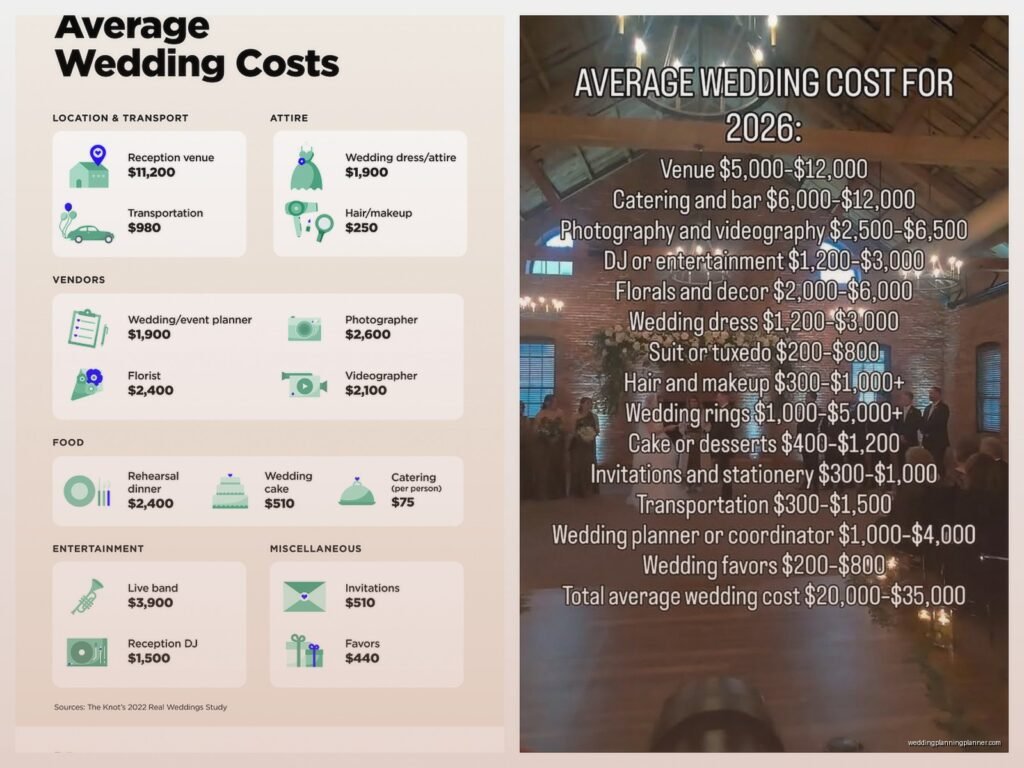
So the average wedding in the US costs around $30,000 to $35,000 right now. But honestly that number is kinda misleading because it depends SO much on where you live. Like a wedding in Manhattan or San Francisco? You’re looking at $50,000+ easy. Rural Kentucky or Iowa? Maybe $15,000 to $20,000 gets you a really nice celebration.
I had this bride in spring 2023 who came to me absolutely panicked because she’d read that “average” number online and thought she was doing something wrong by only having $18,000 to work with. We planned an absolutely gorgeous wedding for her budget and honestly it was one of my favorites that year. The “average” is just… it’s not a goal you need to hit, it’s just math.
Breaking Down Where the Money Actually Goes
Alright so here’s the typical breakdown that I see across most weddings, regardless of total budget:
- Venue and catering: 45-50% of your total budget
- Photography and videography: 10-15%
- Flowers and décor: 8-10%
- Entertainment (band or DJ): 8-10%
- Wedding attire: 5-8%
- Invitations and stationery: 2-3%
- Hair and makeup: 2-3%
- Transportation: 2-3%
- Wedding cake: 2%
- Favors and gifts: 2%
- Miscellaneous: 5-10%
That venue and catering percentage really drives me crazy sometimes because venues KNOW they’re the biggest line item and some of them are just… anyway. The point is that nearly half your budget disappears into feeding people and having a place to do it.
Cost By Guest Count Because That’s What Really Matters
The guest list is honestly the biggest factor in your budget. Not the fancy napkins, not the chair covers, not whether you have peonies or roses. It’s how many people you’re feeding.
Here’s what I typically see:
50 guests or fewer: You can do something really nice for $8,000 to $15,000. This is that sweet spot where you can splurge on the details because you’re not multiplying everything by 150.
75-100 guests: Budget around $15,000 to $25,000. This is where most of my clients land actually, and it’s a good size where the room feels full but you’re not gonna bankrupt yourself.
125-150 guests: Now you’re looking at $25,000 to $40,000 depending on your location. The per-person costs start adding up fast.
200+ guests: Yeah this is $50,000+ territory unless you’re getting major family help or doing something super creative with the venue.
Every time you add another table of 10 people, you’re adding like $800 to $1,500 to your budget when you factor in food, drinks, rentals, favors, invitations, all of it.
Regional Differences That’ll Shock You
I work with planners all over the country and the price differences are wild. A venue that costs $3,000 in Nashville might be $12,000 in Boston for the same date. Same season, same amenities, just different zip codes.
Most expensive cities for weddings:
- New York City: $50,000-$80,000 average
- San Francisco: $45,000-$70,000
- Los Angeles: $40,000-$65,000
- Chicago: $38,000-$55,000
- Boston: $38,000-$50,000
More affordable regions:
- Most of the South: $18,000-$28,000
- Midwest (excluding Chicago): $20,000-$30,000
- Mountain states: $20,000-$32,000
My cat just knocked over my coffee while I’m writing this, great. Anyway, the point is don’t compare your Alabama wedding budget to someone getting married in Manhattan because it’s apples and oranges.
The Real Costs of Major Vendors
Let me give you actual numbers I’m seeing in 2024 because those “average cost” articles online are often outdated or just wrong.
Catering per person: This is typically $75 to $150 per guest for a plated dinner with appetizers and drinks. Buffet style might save you like $10-15 per person. Open bar adds another $25-50 per person depending on what you’re serving. Cash bar… nah, just don’t do a cash bar, but that’s a whole other conversation.
Photography: A good photographer is gonna cost you $2,500 to $5,000 for 8-10 hours of coverage. Yes you can find cheaper, but I’ve seen too many couples regret going with the $800 photographer because those photos are forever. Videography adds another $2,000 to $4,000 if you want it.
Flowers: This one always surprises people. A bridal bouquet alone is $150-300. Bridesmaids bouquets are $75-100 each. Centerpieces run $80-200 per table depending on size and flower choices. A full floral package for a 100-person wedding? You’re looking at $2,000 to $4,000 easily.
DJ or Band: DJs typically run $1,000 to $2,500 for 5-6 hours. Bands are $3,000 to $8,000+ depending on how many musicians. Live music is amazing but it’s definitely a splurge category.
What Drives Costs Up (Besides Guest Count)
Okay so there are some specific things that make weddings more expensive and some of them aren’t obvious:
Saturday evening in peak season: Getting married on a Saturday night in June, September, or October? Every vendor charges premium rates. I literally had a venue quote a couple $8,000 for a Friday and $12,000 for the Saturday of the same weekend. Same space, same everything.
Weekday or Sunday weddings can save you 20-30% across the board because vendors want to book those dates.
The Pinterest effect: When you want everything to look like it came from a styled shoot, costs go up. Those installations, the specialty rentals, the custom signage… it adds up so fast. One bride showed me her inspiration board and I had to gently tell her that her $20,000 budget wasn’t gonna cover the $8,000 worth of florals she’d pinned.
Destination weddings: Everyone thinks destination weddings are cheaper but they’re often not when you factor in travel, accommodations, shipping costs for décor, and the fact that you can’t just pop over to the venue to check on things.
Extra events: Welcome party, rehearsal dinner, day-after brunch. Each event is basically its own mini-budget.
Where People Overspend Without Realizing It
The little stuff adds up SO fast and this is what catches couples off guard:
Invitations seem innocent at like $4 per invite but then you need save-the-dates, programs, menus, place cards, thank you cards, and suddenly you’ve spent $1,200 on paper. As a stationery consultant this is my world and I get it, beautiful paper is beautiful, but you can absolutely save here by doing digital save-the-dates or printing some items yourself.
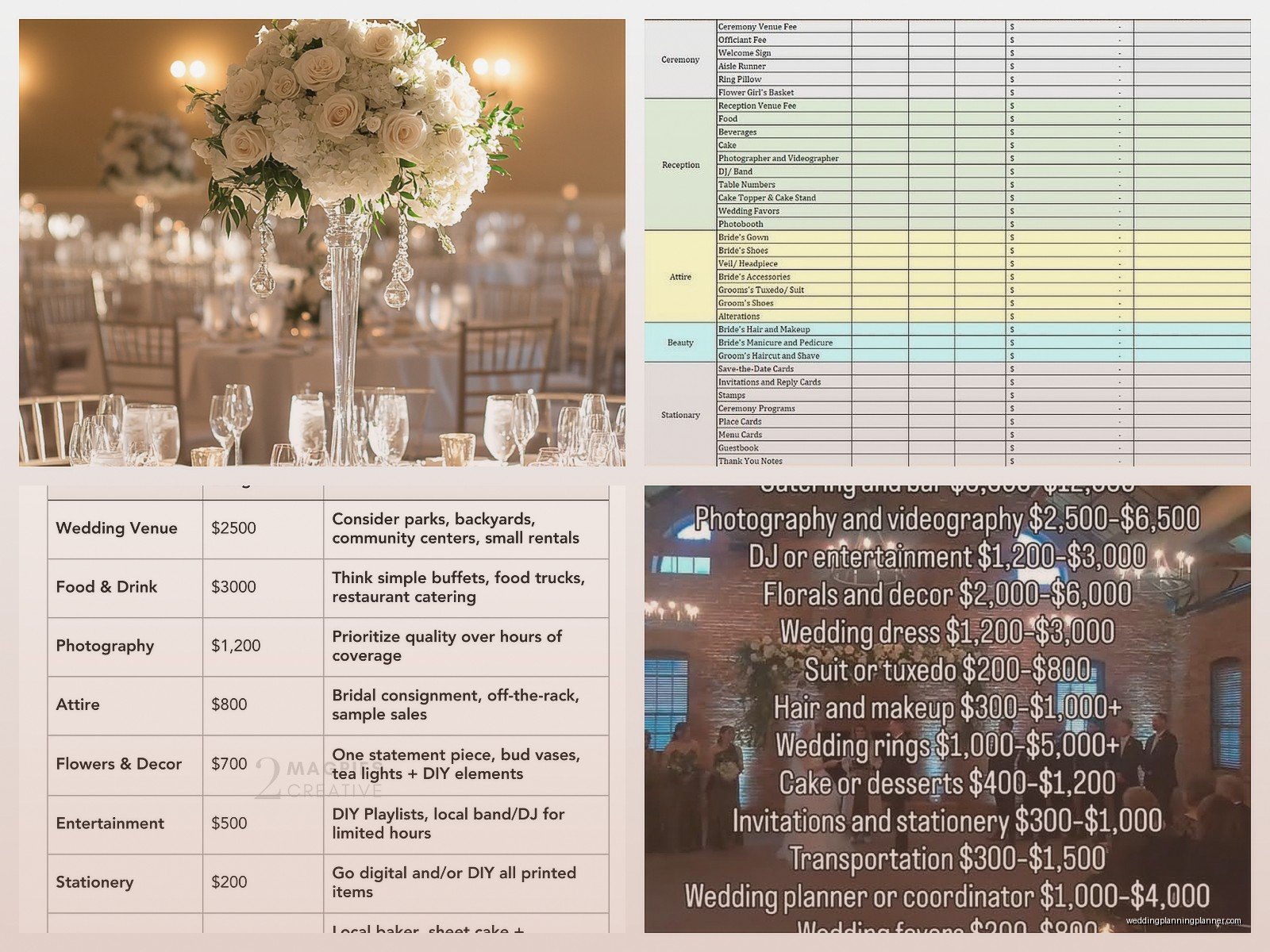
Alterations on wedding dresses can cost $300-800. Just… budget for this because it’s gonna happen.
Stamps. I know this sounds ridiculous but when you need 150 wedding invitation stamps plus RSVP stamps, you’re spending $150+ at the post office. And if your invitations are heavy or oversized? Extra postage.
Linens and rentals add up faster than you think. Want a specific color tablecloth? That’s $15-25 per table rental. Charger plates? $3-5 each. Specialty chairs? $8-12 each instead of $2 for basics.
Service charges and taxes that vendors add at the end. A $5,000 catering quote becomes $6,500 after the 18% service charge, 7% tax, and 3% admin fee. Always ask for the final total including all fees.
How to Actually Set Your Budget
Start with what you can actually afford, not what you think weddings “should” cost. Sit down and figure out:
- How much do you have saved right now?
- How much can you realistically save between now and the wedding?
- Are parents or family contributing? Get specific numbers, not vague “we’ll help”
- Are you willing to take on any debt for this? (I usually advise against it but that’s your call)
Then add those numbers up and that’s your budget. Not the average, not what your friend spent, not what some wedding magazine says you need.
I always tell couples to build in a 10% cushion because something will cost more than expected or you’ll decide you really do want that upgrade or… life happens.
Budget Priorities: The Guest List Decision
You basically have three options and you gotta pick one because you can’t have all three:
- Big guest list + lower budget per person = simple wedding with lots of people
- Small guest list + higher budget per person = fancy intimate wedding
- Medium guest list + medium budget per person = traditional balanced wedding
There’s no wrong choice but you have to actually choose. I had this couple in summer 2021 who kept trying to have the 200-person wedding with the $200-per-person experience on a $25,000 budget and the math just… it doesn’t work. We eventually got their guest list down to 110 and they were so much happier because they could afford the details they really wanted.
What You Can Actually DIY to Save Money
Some things are worth DIYing, some absolutely are not:
Good DIY projects:
- Welcome signs and directional signage
- Simple centerpieces if you’re crafty
- Favors (though honestly skip favors, no one cares)
- Playlist for cocktail hour if you’re not hiring a DJ for that part
- Programs and menus if you have design skills
Don’t DIY these:
- Your wedding cake unless you’re literally a baker
- Photography (just don’t, please)
- Complex floral arrangements
- Hair and makeup on the day-of
- Anything you’ll be working on the week of the wedding
The week before your wedding is NOT the time to be hot-gluing 150 anything. Your time and stress levels matter.
Sneaky Ways to Stretch Your Budget
Okay here’s some stuff that actually works:
Book vendors who are newer to the industry: Someone who’s been shooting weddings for 2 years charges less than someone with 10 years experience, but their work might be just as good. Check portfolios, not just price tags.
Get married in the off-season: November through March (except holidays) can save you serious money. Yeah it might be cold but you can work with that aesthetically.
Brunch or lunch receptions: People expect less food and definitely less alcohol at 11am than at 7pm. A brunch wedding can cost 30% less than dinner.
Limit the bar: Instead of full open bar, do beer, wine, and one signature cocktail. Or open bar for cocktail hour then switch to beer and wine only. Most people don’t actually care that much.
Use seasonal flowers: Peonies in December cost a fortune because they’re imported. Peonies in May when they’re in season? Much more reasonable. Work with what’s local and seasonal.
Friday or Sunday: I mentioned this already but seriously, this one change can save you thousands across all your vendors.
Skip the extras: Do you really need a photobooth? Sparkler exit? Custom dance floor decal? Uplighting? These add $500-2000 each and they’re nice but not necessary.
When to Splurge vs Save
If I had to tell you where to put your money, it’d be:
Worth splurging on:
- Photography because those last forever
- Food because hungry guests are unhappy guests
- Music/entertainment because this makes or breaks the reception vibe
- Your dress if that matters to you (but only if it matters to YOU)
Safe to save on:
- Invitations – digital options are beautiful now
- Favors – seriously most get left behind
- Over-the-top florals
- Designer bridesmaid dresses
- Elaborate cake (most people prefer dessert bars anyway)
The Hidden Costs Nobody Warns You About
There’s always surprise expenses and I’m just gonna list them so you’re prepared:
- Vendor meals: You gotta feed your photographer, DJ, planner, etc. That’s 5-10 extra meals
- Marriage license: $30-100 depending on your state
- Parking or valet if your venue doesn’t include it
- Overtime fees if your reception runs long
- Tips for vendors: Budget 15-20% extra for gratuities
- Preserving your dress after: $200-500
- Hotel rooms for out-of-town guests you’re covering
- Gifts for parents and wedding party
- Beauty trials before the wedding day
That miscellaneous category in your budget? Make it bigger than you think you need because this is where all this stuff comes from.
Real Budget Examples
Let me show you what different budget levels actually look like:
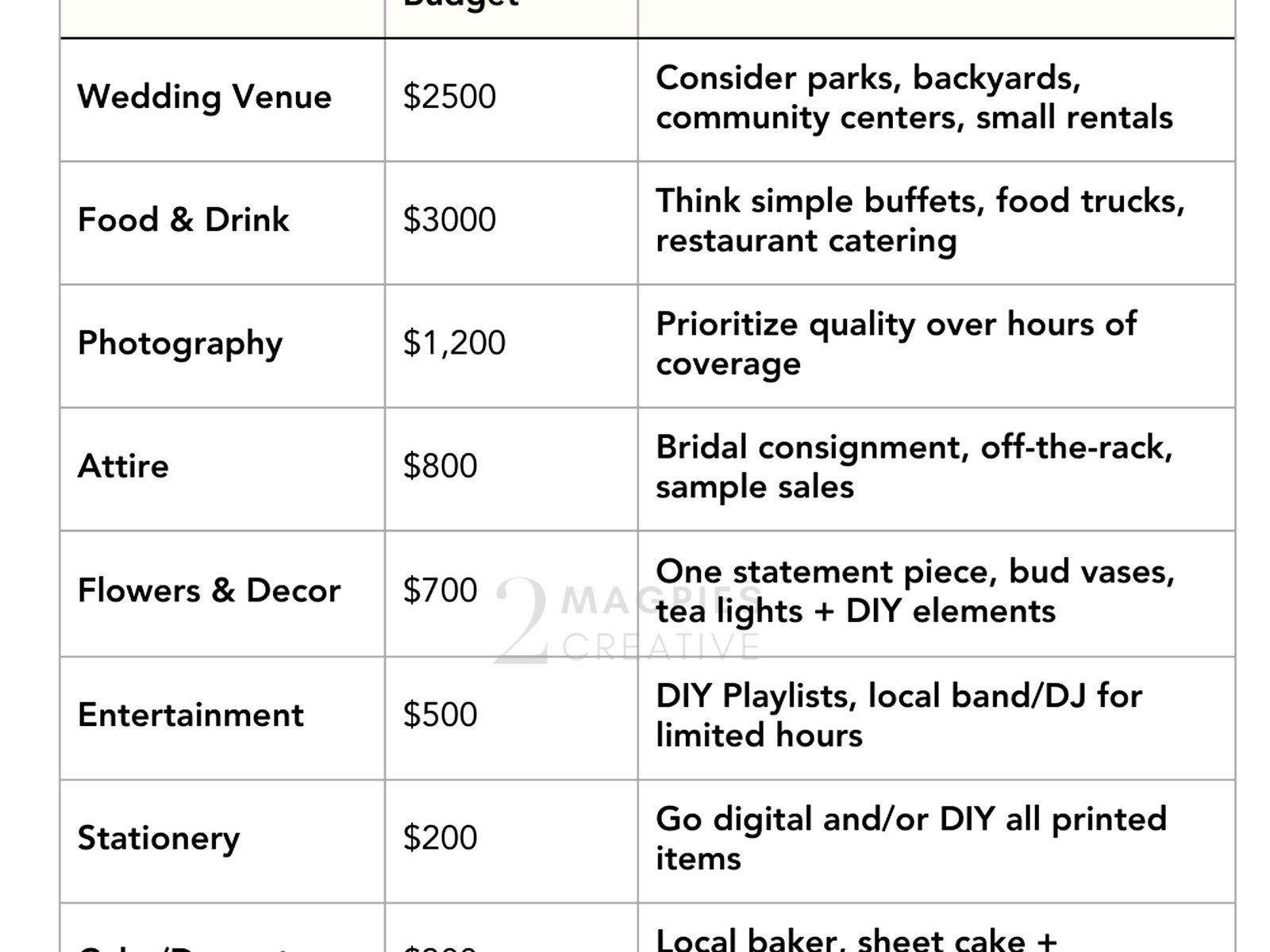
$10,000 wedding (50 guests): Restaurant or brewery venue with in-house catering ($4,000), photographer for 6 hours ($1,800), simple flowers ($600), DJ ($1,000), dress and alterations ($1,200), invitations ($300), hair and makeup ($400), miscellaneous ($700). It’s totally doable and can be really beautiful.
$25,000 wedding (100 guests): Nicer venue ($3,000), catering and bar ($10,000), photographer ($3,000), flowers ($2,000), DJ ($1,500), dress and attire ($2,000), invitations ($500), hair and makeup ($600), cake ($500), miscellaneous and tips ($2,000). This is that comfortable middle ground where you’re not stressing about every line item.
$50,000 wedding (150 guests): Premium venue ($8,000), high-end catering and bar ($20,000), photographer and videographer ($6,000), elaborate florals ($5,000), band ($4,000), designer dress ($3,000), full stationery suite ($1,200), professional hair and makeup for party ($1,500), fancy cake ($800), miscellaneous ($4,000). This is where you can get most of those Pinterest-worthy details.
Payment Schedules and When Money’s Due
Most vendors want deposits to book (usually 25-50% of total cost) and then the balance is due anywhere from 2 weeks to 2 months before the wedding. Some venues want payment in installments throughout your engagement.
You need to have most of your budget actually in hand about 2 months before the wedding because that’s when everyone wants their final payments. Don’t book vendors assuming you’ll have the money by then – only book what you can actually afford with money you have or know is coming for sure.
Credit card points can be a nice bonus if you’re paying for everything, but only if you’re paying it off immediately. Wedding debt is not fun debt, trust me on this.
What Actually Matters vs What Doesn’t
After planning hundreds of weddings, here’s what I’ve learned: your guests will remember if they had fun, if the food was good, and if they felt welcomed. They won’t remember the specific shade of blush you chose for napkins or whether you had calligraphy or digital printing on the place cards or… you get the idea.
The stuff that matters is the stuff that affects