Planning Guides, Style Guide
Mass Wedding Program Template: Catholic Ceremony Order
Jul
Getting the Catholic Mass Wedding Program Order Right
So you’re planning a Catholic wedding ceremony and need to figure out the program template situation. First thing – Catholic weddings are basically a full Mass if both people are Catholic and they choose that option, or a shorter ceremony without Communion if one person isn’t Catholic or they just don’t want the full thing. This matters SO much for your program because the order is completely different.
I had this couple back in spring 2023 who printed like 150 programs before realizing they’d mixed up the Mass version with the ceremony-only version and honestly it was a mess. We caught it two days before the wedding and I was running around town trying to find a print shop that could do a rush order. My cat knocked over my coffee that morning too, so it was just one of those days.
The Full Catholic Wedding Mass Structure
Alright so if you’re doing the full Mass, here’s the basic order you gotta include in your program:
- Processional/Entrance Rite
- Greeting and Opening Prayer
- Liturgy of the Word (readings and such)
- Rite of Marriage (the actual vows part)
- Liturgy of the Eucharist
- Nuptial Blessing
- Concluding Rite
- Recessional
The thing that annoyed me for YEARS about Catholic wedding programs is that nobody tells couples they need to check with their specific priest because some parishes have their own preferences about wording or which prayers get included. I’ve seen priests who insist on specific translations of prayers and others who are super flexible.
Breaking Down Each Section for Your Template
Processional is pretty straightforward – you’ll list who’s walking down the aisle and in what order. Usually it goes: officiant and servers, groom with his parents (or just his mom), wedding party, flower girl/ring bearer, bride with her parents (or dad, or whoever). Some families do it differently though. You can include the song title here if you want people to know what they’re listening to.
Greeting and Opening Prayer – this is where the priest welcomes everyone. In your program you might just write “Welcome and Opening Prayer” or you can include the actual text if you want. I usually tell couples to keep it simple here because people kinda know what’s happening.
Liturgy of the Word Details
This is where it gets specific and you actually NEED detail in your program. The Church lets you pick from approved readings, so you’ll have:
- First Reading (usually Old Testament) – include the citation like “Genesis 1:26-28, 31a”
- Responsorial Psalm – you can print the response that everyone repeats
- Second Reading (usually from New Testament letters) – again, cite it properly
- Gospel Acclamation
- Gospel Reading – this is the big one, cite it like “John 2:1-11”
- Homily
For the readings, you’ve got options. Some couples print the ENTIRE reading in the program which… look, it’s a lot of text and makes your program super long. I usually suggest just printing the citation and maybe the first line so people can follow along if they want. You’re not writing a Bible here.
The Responsorial Psalm though – definitely include the response line that the congregation repeats. It helps people participate and they won’t feel lost.
The Rite of Marriage Section
This is the part everyone’s actually there for, right? Your program should outline:
Questions Before Consent – the priest asks if you’re freely choosing this, will honor each other, will accept children. You don’t need to print the questions in full, just note “Questions Before Consent” or “Statement of Intentions”
Exchange of Vows – here’s where you can include the actual vow text if you want. Catholic weddings use approved vow formats, not custom vows (which annoys some couples but that’s the rules). The most common ones are the “I, [name], take you, [name], to be my wife/husband…” version or the question-and-response format where the priest asks and you say “I do.”
Blessing and Exchange of Rings – same deal, you can include the words or just note what’s happening
Unity Candle or Other Symbolic Action – if you’re doing this, note it here. Though honestly not all Catholic churches allow unity candles during Mass because technically it’s not part of the official liturgy but some priests are cool with it
Prayer of the Faithful (General Intercessions) – this is where you pray for the Church, the world, the couple, etc. You can list out each intention or just note “Prayer of the Faithful”
Liturgy of the Eucharist
If you’re having a full Mass, this is where Communion happens. Your program should include:
- Preparation of the Gifts/Offertory – note if someone’s bringing up the gifts and what the music is
- Eucharistic Prayer
- The Lord’s Prayer – you can print this out since everyone says it together
- Nuptial Blessing – this is specifically for the couple
- Sign of Peace
- Communion – here’s where you might wanna include a note about who can receive (only Catholics in a state of grace) and that others are welcome to come forward for a blessing with arms crossed
- Communion meditation/song
- Prayer after Communion
That Communion note is kinda important because you’ll likely have non-Catholic guests who don’t know the etiquette and you don’t want them feeling awkward or accidentally doing something they shouldn’t.
Wrapping It Up
The Concluding Rite includes the final blessing and dismissal. Pretty simple. Then the Recessional where everyone processes back out – list the recessional song and you’re done with the ceremony part.
The Ceremony Without Mass Version
If you’re doing the ceremony without the full Mass (no Communion), the structure is way shorter and honestly easier to program. It goes:
- Processional
- Greeting and Opening Prayer
- Liturgy of the Word (same reading structure as above)
- Rite of Marriage (vows, rings, all that)
- Nuptial Blessing
- Prayer of the Faithful
- The Lord’s Prayer
- Final Blessing
- Recessional
See? Much more straightforward. No Eucharist section to worry about.
Design and Format Tips for Your Actual Program
Okay so beyond just the order of service, let me tell you what actually works for program layouts because I’ve seen some disasters…
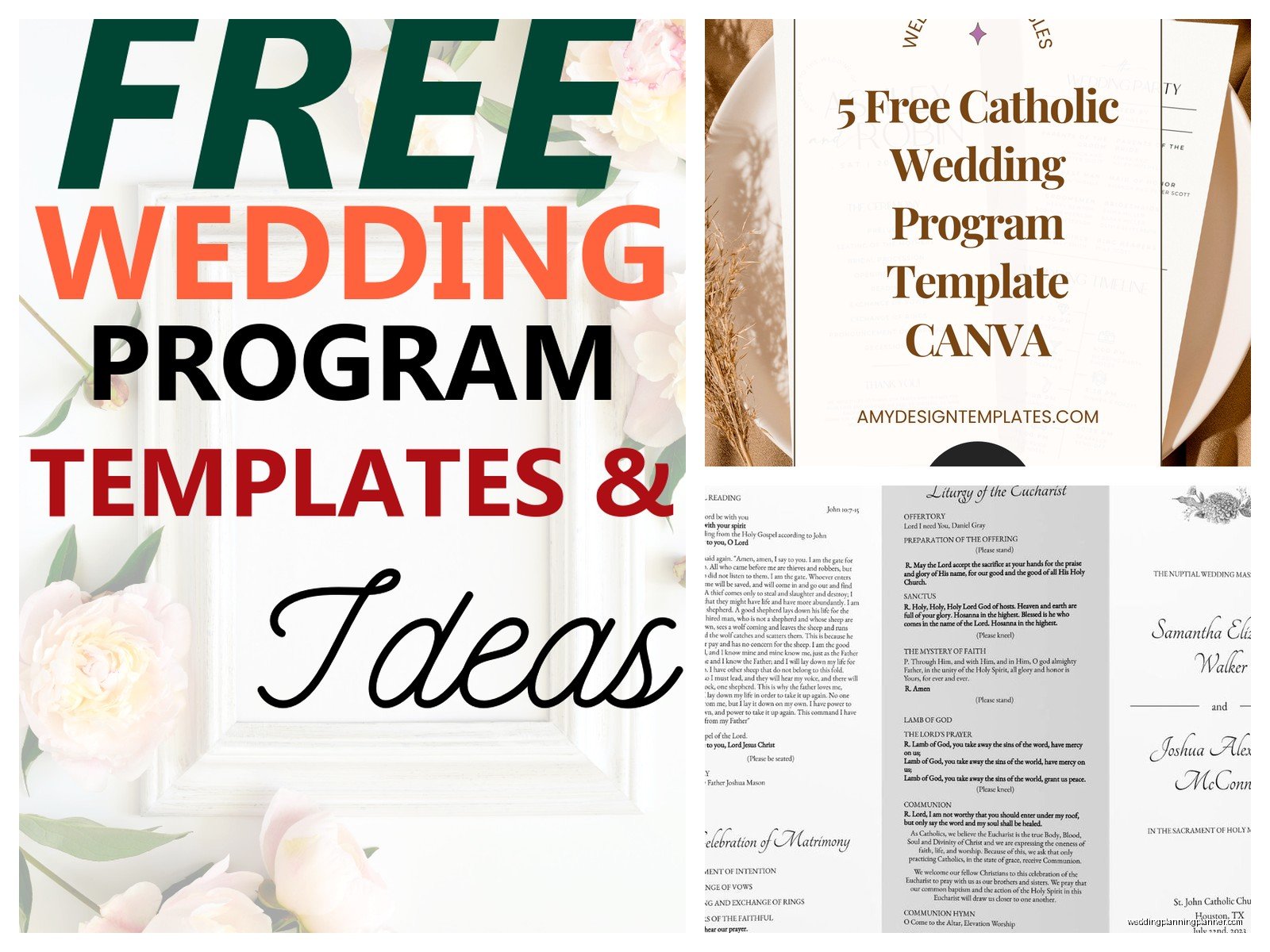
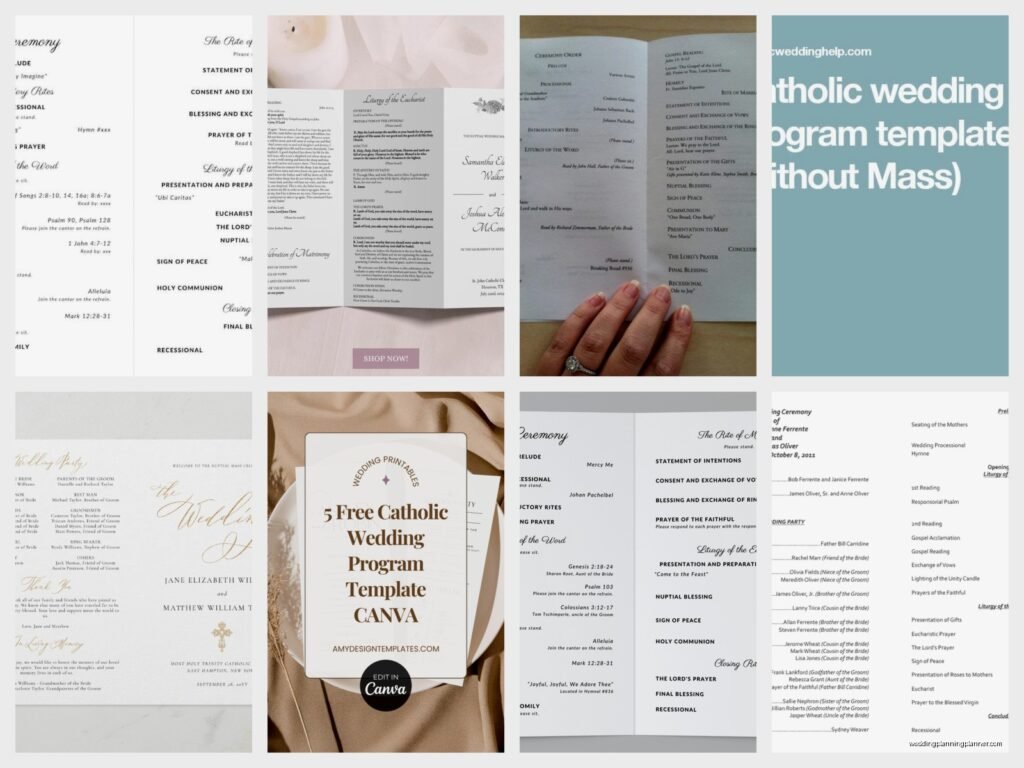
Keep it to 4 pages max if you can – that’s one sheet folded in half. Front cover has the couple’s names, date, church name, maybe a pretty design. Inside left starts with the processional, inside right and back cover finish up the ceremony order. If you need more space, go to 8 pages (two sheets nested) but honestly that’s gonna be thick and expensive to print.
Font size matters more than you think – I always say nothing smaller than 11pt for the main text because churches can be dim and your older guests are gonna struggle. Also your program might get read by candlelight if you’re doing an evening ceremony.
Don’t forget to include the wedding party names somewhere! Usually on the back cover you’ll list out your bridesmaids, groomsmen, parents, officiant, musicians, readers. People wanna know who everyone is.
What You Can Customize vs What You Can’t
So here’s the thing about Catholic ceremonies – there’s required elements and then there’s stuff you can personalize. You HAVE to use approved readings from the Lectionary (the Church gives you like dozens of options though). You HAVE to use one of the approved vow formats. You HAVE to include certain prayers.
What you CAN choose: which readings from the approved list, music selections (though it should be sacred music, not like… your favorite pop song, check with your priest), whether to have a unity candle or not, who does the readings, flower arrangements, and all the aesthetic stuff.
In your program, you’re basically documenting what you’ve chosen within those guidelines.
Common Things People Forget
I’m gonna list these out because I swear every other wedding I work on forgets at least one:
- Song titles and artists – if you picked beautiful music, tell people what it is!
- A note about the receiving line or where guests should go after (especially if cocktail hour is at a different location)
- Memorial section if you’re honoring deceased family members
- Translation if you have a bilingual ceremony
- Instructions for Communion if you’re having a full Mass
- Pronunciation guide for the wedding party if you have tricky names
That last one saved me during a wedding where the best man’s name was Saoirse and literally nobody knew how to say it except the couple.
Working With Your Priest
Before you finalize and print anything, and I mean ANYTHING, get your program draft approved by your priest. Seriously. Different parishes have different preferences and you don’t wanna assume. Some priests want specific prayer translations, some have requirements about how you word things, some won’t allow certain elements you thought were standard.
Most priests are super helpful about this if you ask early enough. Don’t email them your program template the week before the wedding expecting quick approval – try to get it sorted like a month out at least.
Practical Production Stuff
Paper weight matters – go for at least 80lb cardstock for the cover if you’re doing a folded program. The inside pages can be regular 28lb paper. If you’re doing a single-sheet program, use something sturdy enough that it won’t flop around.
Print a test copy before you order 200 of them. Check the colors, check that everything’s readable, check that it folds correctly if it’s a folded design. I cannot stress this enough because I’ve seen couples receive their programs and the fold is in the wrong place cutting through text.
Timeline for printing – if you’re using an online service, give yourself at least 2-3 weeks. Local print shops might be faster but they’ll cost more. If you’re DIYing it at home… umm, good luck and may the printer gods be with you. Buy extra paper and ink.
Sample Wording and Phrasing
When you’re actually writing out each section, keep the language clear and simple. You don’t need to be super formal or flowery. Here’s kind of how I structure things:
For readings: “First Reading: 1 Corinthians 13:4-13, read by Sarah Johnson”
For music: “Processional: Canon in D by Pachelbel” or just “Processional Music: Canon in D”
For the vows section: “Exchange of Marriage Vows” followed by the text if you want to include it, or just leave it as the header
You can include little explanatory notes too if something might be unfamiliar to guests. Like after “Sign of Peace” you could add in italics “The priest will invite you to greet those around you” so people aren’t confused when everyone starts shaking hands.
Digital vs Printed Programs
Okay so lately I’ve had couples ask about digital programs instead of printed ones and… it’s complicated. Some older Catholic churches aren’t gonna love people staring at their phones during Mass. But if you have a tech-savvy crowd and a more relaxed parish, you could do a QR code at each seat that links to a digital program.
Personally I still think printed programs are the way to go for Catholic weddings specifically because there’s so much participation required and people need to follow along. But you could do both – print some for older guests and people who want them, have a digital option as backup.
Bilingual Ceremonies
If you’re having a bilingual ceremony (like English and Spanish, which I see a lot), your program gets trickier. You can either do side-by-side columns with both languages, or do alternating sections. Side-by-side is cleaner but takes more space. Make sure you’re consistent about which language goes on which side.
The readings especially should be in both languages if you’re going bilingual, since those are the parts where everyone’s really listening and following along.
Extra Touches That Are Actually Useful
Some additions to your program that guests actually appreciate:
A small map or directions to the reception venue if it’s not obvious or nearby. A timeline of the evening if there’s gonna be a gap between ceremony and reception. Thank you note from the couple to the guests for coming. Explanation of any cultural traditions you’re incorporating that might not be familiar to everyone.
What’s NOT useful: a super long story about how you met, poems that take up a full page, too many decorative elements that make the actual information hard to find. Keep it functional first, pretty second.