
Planning Guides, Style Guide
Licensed Wedding Coordinator: Complete Guide

Oct
So You Wanna Be a Licensed Wedding Coordinator
Okay so the first thing you need to know is that “licensed” wedding coordinator isn’t actually a thing in most states. Like, there’s no universal license board for wedding planners the way there is for cosmetologists or real estate agents. This drove me absolutely NUTS when I was starting out in 2015 because I kept searching for “how to get licensed” and getting nowhere. What people usually mean when they say licensed is either certified (through a program) or having your business license and insurance sorted out.
Let me break down what you actually need because it’s kinda all over the place depending where you live.
The Business License Situation
You’re gonna need a business license to operate legally. This is just a basic thing for any business. I registered mine as an LLC in my state, which cost me like $150 at the time, and then I had to get a local business license from my city for another $75 or something. The process was honestly less complicated than I thought it would be – you basically fill out forms, pay fees, and boom, you’re a legitimate business entity.
Some coordinators operate as sole proprietors which is simpler but doesn’t give you the same liability protection. After I had a bride threaten to sue me in spring 2023 because her florist (not even someone I recommended!) delivered the wrong flowers, I was SO grateful I had that LLC barrier. The lawsuit never happened but still.
Check with your county clerk’s office or your state’s business registration website. Most of this can be done online now which is nice.
Certification Programs (The “Licensed” Part People Talk About)
There are several certification programs out there and honestly some are better than others. The main ones I see people doing are:
- Association of Bridal Consultants (ABC) – they offer different levels
- Wedding Planning Institute
- Lovegevity Wedding Planning Institute
- QC Event School
- US Institute of Wedding and Event Planning
I did the ABC certification back in 2016 and it was… fine? It gave me credibility when I was starting out and didn’t have a portfolio yet. Cost me about $350 for the professional level plus study materials. You take an exam, submit proof of events you’ve worked on, and they certify you. It looks good on your website and sometimes venues take you more seriously.
But here’s the thing – clients don’t really care about certifications as much as you think they will. They care about your portfolio, your personality, whether they trust you, and if you seem like you know what you’re doing. I’ve never had a single bride ask me which certification I have or even if I’m certified at all.
What Actually Matters More
Insurance. Get insurance. Like yesterday. You need general liability insurance at minimum, and I’d also recommend getting professional liability insurance (errors and omissions). This protects you if something goes wrong – and something WILL go wrong eventually because weddings are chaos barely held together by timelines and bobby pins.
My insurance runs me about $800 a year through a company that specializes in event insurance. Most venues require proof of insurance before they’ll let you coordinate there anyway, so this isn’t optional if you want to work at actual nice venues.
Oh and you’ll need a contract. A really good contract that covers everything – your services, payment terms, cancellation policy, what happens if there’s bad weather, all of it. I learned this the hard way when a couple tried to get out of paying me two weeks before their wedding because they “decided to elope instead” but actually just hired a cheaper coordinator. My contract saved me because it clearly stated the cancellation terms.
The Skills You Actually Need
Okay so beyond the paperwork and certifications, let me tell you what you actually need to know how to do or you’re gonna struggle…
You gotta be stupid organized. Like, color-coded spreadsheet organized. I use a combination of Aisle Planner (software specifically for wedding planners) and good old Google Sheets. Every wedding has approximately 847 moving parts and if you lose track of even one vendor’s arrival time, everything can fall apart.
Crisis management is huge. During a wedding in summer 2021, the groom passed out during the ceremony – just straight up fainted from locking his knees. While everyone was panicking, I had to simultaneously make sure he was okay (he was, just embarrassed), signal to the DJ to play some music to fill the awkward silence, get the coordinator from the venue to bring water, AND figure out if we needed to call 911 or if we could continue. We took a 10-minute break, he recovered, and the ceremony continued. But you have to be able to think on your feet like that.
Vendor management is probably 60% of the job honestly. You’re herding cats – very talented, creative cats who all have their own schedules and opinions. You need to know how to communicate clearly, follow up without being annoying, and mediate when the photographer and videographer are fighting over ceremony positioning (this happens ALL THE TIME and it’s so annoying).
Timeline Creation
This is an art form. A good timeline accounts for everything – hair and makeup running late (they always do), traffic, the fact that family formal photos always take twice as long as planned, cocktail hour flow, when the cake gets cut, when grandma needs to leave because she has an early bedtime.
I have templates now but when I was starting out I’d spend like 6 hours creating a single timeline. You get faster but it’s still one of the most important documents you’ll create for each wedding.
Build in buffer time. If you think something will take 30 minutes, schedule 45. Your couples will thank you when they’re not stressed and rushing through their own wedding day.
Money Stuff Nobody Talks About
You need to figure out your pricing and stick to it. I undercharged for YEARS because I felt weird asking for money. My day-of coordination package is now $1,800 and my full planning is $4,500+ depending on the wedding size, but when I started? I was charging like $600 for full planning. Ridiculous.
Research what coordinators in your area charge. You can’t charge Manhattan prices in rural Idaho, but you also can’t work for peanuts or you’ll burn out. Factor in all your time – not just the wedding day but the meetings, emails, phone calls, timeline creation, all of it.
Payment structure matters too. I do 50% retainer to book, 25% two months before the wedding, and final 25% two weeks before. This protects you from people who try to bail or from having to chase payment after the wedding when couples are on their honeymoon and ignoring your invoices.
You’ll also need accounting software or at least a really good spreadsheet system. I use QuickBooks Self-Employed which costs like $15/month and makes tax time so much easier. Speaking of taxes, set aside about 30% of everything you make for taxes because self-employment tax is brutal and will sneak up on you.
Building Your Business
In the beginning you’re gonna have to do some weddings for cheap or maybe even free to build your portfolio. I know, it sucks, but that’s reality. I did three weddings for just $200 each (basically covering my gas and time on the wedding day) so I could get photos and testimonials.
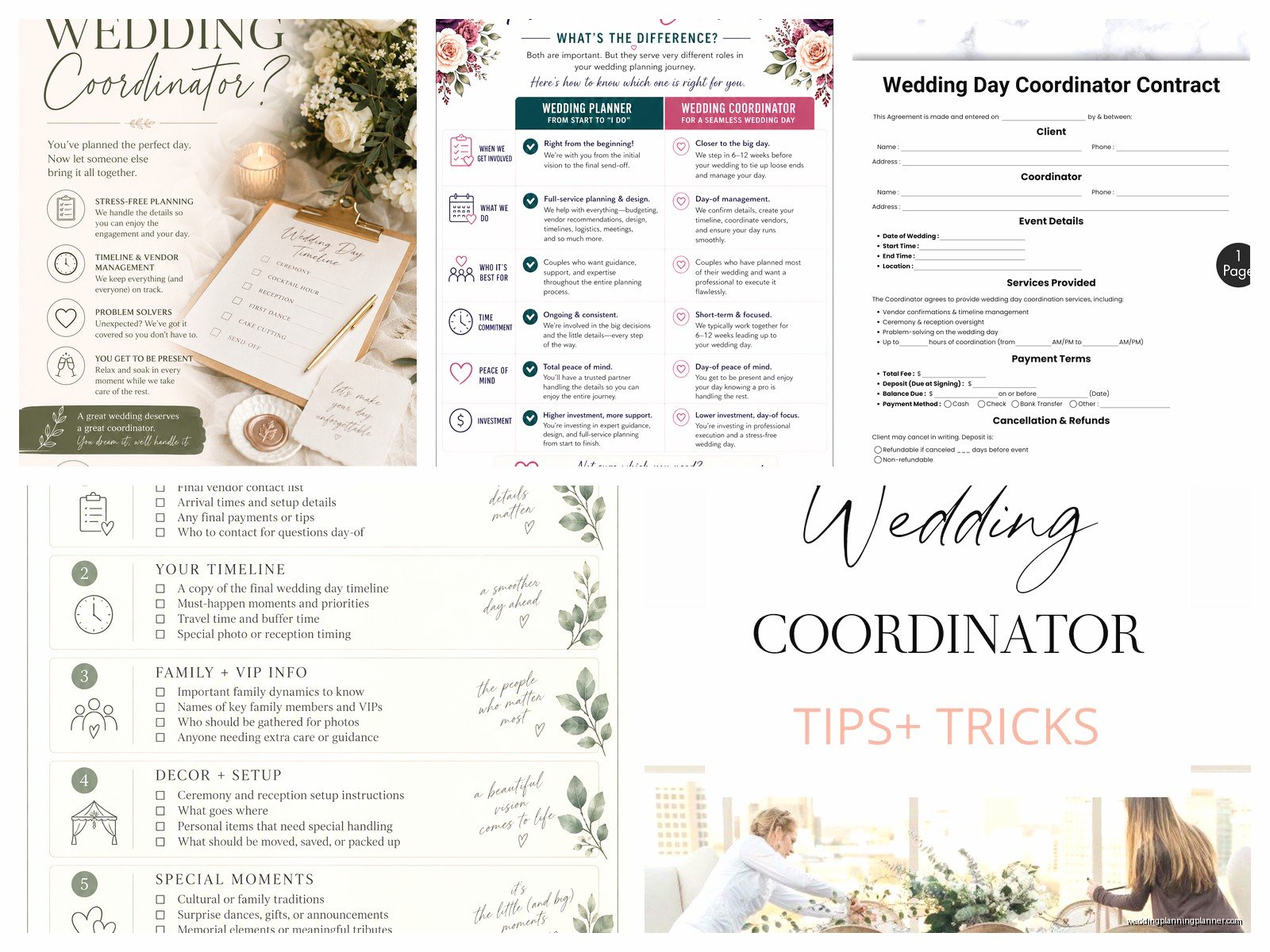
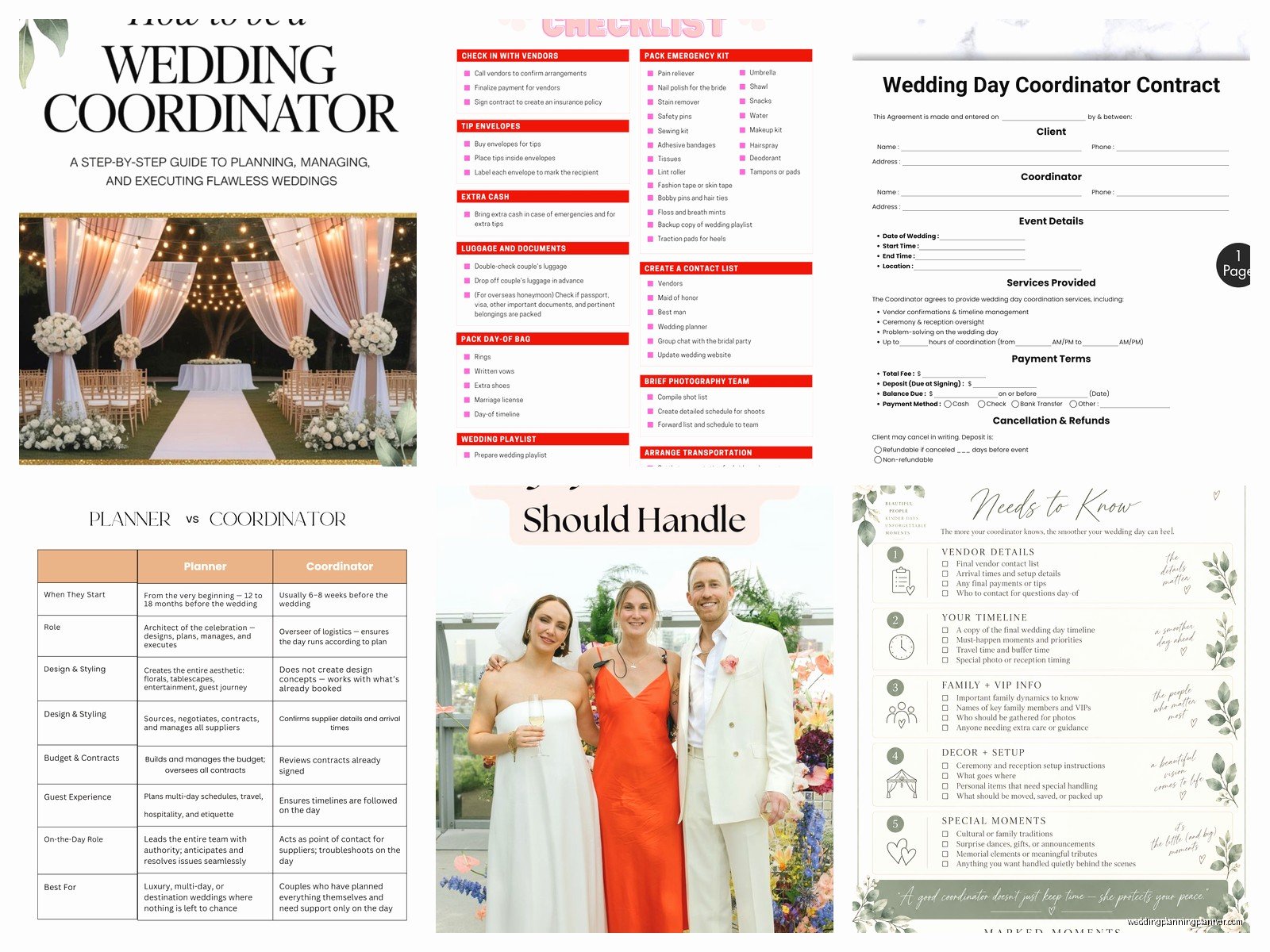
Your website needs to show real weddings, have clear pricing (or at least starting prices), and explain exactly what you do. Because here’s something that annoyed me SO MUCH when I was starting – people don’t know what a wedding coordinator actually does. They think you’re just there to hold the bouquet and tell people where to stand. You need to educate them that you’re managing vendors, creating timelines, handling crises, setting up details, keeping everything on schedule… or they’ll think you’re not worth the investment.
Social media is kinda necessary now unfortunately. I post on Instagram a few times a week – real weddings, tips, behind-the-scenes stuff. It’s not my favorite part of the job (I’d rather be actually planning weddings than posting about planning weddings) but it brings in clients, so.
Working With Venues and Vendors
Build relationships with venues in your area. Like, actually go visit them, introduce yourself to their coordinators, learn their spaces and rules. Some venues have in-house coordinators and won’t let you do much, while others require couples to hire outside coordinators. You need to know which is which.
Create a preferred vendor list but don’t be weird about it. I have vendors I love working with and recommend, but I never require couples to use specific vendors or take kickbacks for referrals. That’s shady and couples can smell it from a mile away. Just genuinely recommend people who are good at their jobs and easy to work with.
The relationship with photographers is especially important because you’ll be working closely together on the wedding day. A good photographer will make your job easier by sticking to the timeline and being flexible. A difficult photographer will… well, they’ll make you want to quit the industry, honestly.
What a Typical Wedding Day Looks Like
I usually arrive at the venue about 4-5 hours before the ceremony. First thing is checking in with the venue coordinator, making sure the space is set up correctly, and starting to place any personal details the couple is bringing – table numbers, favors, guest book, card box, all that stuff.
Then vendors start arriving and you’re basically directing traffic. The florist needs to know where centerpieces go, the DJ needs to do sound check, the caterer is setting up, the photographer wants to know the timeline. You’re answering questions, solving problems, and making sure everyone has what they need.
Once the ceremony starts, you’re making sure the processional happens in the right order, cueing the music, having tissues ready (someone always cries), and dealing with any last-minute issues. My cat jumped onto my lap while I was typing this sorry – anyway, during the reception you’re cueing events, making sure food service runs smoothly, keeping an eye on the bar situation, and generally just making sure everything flows.
The day usually ends with you helping make sure the couple gets all their gifts and personal items, that the venue is cleaned up properly, and that any rentals are ready for pickup the next day. I’m usually there for like 10-12 hours total.
The Stuff They Don’t Tell You
You’re gonna deal with family drama. So much family drama. Divorced parents who won’t speak to each other, mothers-in-law with opinions about everything, siblings who feel left out… it’s like being a therapist sometimes except you’re not qualified for that and it’s not in your job description but here you are anyway.
Peak season (May through October usually) is gonna consume your life. I barely saw my friends last summer because I had weddings almost every weekend. You make most of your money during these months though, so you kinda have to just accept it.
Some weddings will make you question why you do this job. The ones where nothing goes right, where the couple is difficult, where you’re dealing with impossible family members and vendor drama and bad weather all at once. But then you’ll have a wedding where everything is perfect and the couple thanks you with tears in their eyes and you remember why you love it.
You need thick skin. Brides (and grooms) can be… intense when they’re stressed. You’ll get emails at 11pm, calls during your dinner, and sometimes people will blame you for things that aren’t your fault. Learning to set boundaries while still providing good service is tricky but necessary or you’ll burn out fast.
The physical aspect is real too – you’re on your feet all day, carrying stuff, setting up, running around. I wear my Apple Watch during weddings and I usually hit like 15,000+ steps. Comfortable shoes are non-negotiable even if they’re not cute.
Continuing Education and Growth
The industry changes and you gotta keep up. New trends, new planning software, new ways couples are doing weddings. I try to attend at least one conference or workshop a year, follow industry blogs and podcasts, and network with other planners.
Join Facebook groups for wedding planners in your area – they’re goldmine for vendor recommendations, advice on tricky situations, and sometimes you can even find assistants or coordinators to help you when you have multiple weddings on one weekend.
Consider specializing eventually. Some coordinators focus on luxury weddings, others do budget weddings, some specialize in cultural weddings or LGBTQ+ weddings or destination weddings. You don’t have to specialize right away but as you grow you might find a niche that works for you and… wait I’m getting off track.
The point is this isn’t a “get certified and you’re done” kind of job. You’re always learning, always adapting, always figuring out new solutions to problems you’ve never encountered before. That’s part of what makes it interesting though – no two weddings are exactly the same even when you’ve done hundreds of them.
