Planning Guides, Style Guide
Starting a Wedding Planning Business: Launch Guide
Mar
Getting Your Business Legally Set Up
So first thing you gotta do is figure out what kind of business structure you want. I went with an LLC back in spring 2019 because my accountant basically scared me into it—he was like “Olivia, if a vendor lawsuit happens you don’t want them coming after your house.” Which honestly annoyed me at the time because I was just trying to plan my friend’s sister’s wedding for free and suddenly I’m thinking about lawsuits? But yeah, he was right.
You’ll probably choose between sole proprietorship, LLC, or maybe S-corp if you’re feeling fancy. Most wedding planners I know go LLC route because it protects your personal assets if something goes sideways. The paperwork isn’t that bad—you file with your state, pay whatever fee they want (mine was like $125 but it varies), and then you need an EIN from the IRS which is free and takes maybe 10 minutes online.
Don’t forget business insurance. I know, I know, it’s boring and feels like throwing money away until you actually need it. Get general liability at minimum—covers you if someone trips over your ceremony programs or whatever. Professional liability is smart too because if you book the wrong venue date or something, that covers the “oops I made a professional mistake” situations.
Money Stuff and Pricing Yourself
This is where everyone gets weird and awkward. You’re gonna have to decide what to charge and it feels super uncomfortable at first. I undercharged SO much my first year because I didn’t want to seem greedy or whatever, and then I realized I was making like $8/hour after expenses and that’s just… no.
Open a separate business bank account immediately. Mixing personal and business money is a nightmare come tax time—my cat knocked over my coffee on a stack of receipts in summer 2021 and I literally cried trying to figure out which Starbucks charges were client meetings vs just me being tired. Keep it separate from day one.
For pricing, look at what other planners in your area charge but don’t just copy them. Figure out your actual costs first: your time, software subscriptions, travel, phone, internet, marketing, insurance, taxes (set aside like 25-30% of everything for taxes trust me). Then add your desired profit. My packages now range from $2,500 for day-of coordination to $8,500 for full planning, but I’m in a mid-size city. Your market might be totally different.
I do flat fees instead of hourly because couples hate seeing an hourly clock running, and honestly tracking hours for every email and phone call drove me insane. Some planners do percentage of wedding budget but that always felt weird to me—why should I make more money just because they picked expensive flowers?
The Actual Services You’ll Offer
You don’t have to offer everything right away. I started with just day-of coordination because it felt less scary than being responsible for someone’s entire year of planning. Then I added partial planning, then full service, then destination weddings.
Common packages are:
- Day-of/Month-of coordination (you come in the last 4-6 weeks, finalize everything, run the wedding day)
- Partial planning (they do some research, you take over at a certain point, guide major decisions)
- Full service planning (you’re there from engagement to send-off, handling everything or guiding every choice)
- Destination wedding planning (if you’re into travel—I did one in Mexico and spent half the time dealing with my phone not working, so…)
- À la carte services (some planners do vendor referrals only, or design consultations, or whatever)
Be clear about what’s included in each package. Like, is the rehearsal included or extra? How many hours on wedding day? How many in-person meetings? Do you handle vendor payments or just coordinate? I learned this the hard way when a couple assumed I was paying their vendors directly and I was like umm no that’s not… we hadn’t clarified it in the contract and it got awkward.
Contracts and Legal Protection
GET. A. CONTRACT. For every single client, even if it’s your best friend’s wedding. Especially if it’s your best friend’s wedding actually because that’s when things get messy.
You can buy contract templates online from places like The Contract Shop or HoneyBook—I think I paid like $150 for mine and then had a lawyer look it over for another $300. Worth every penny. Your contract should cover:
- Exactly what services you’re providing
- Payment schedule (I do 25% to book, 50% at six months out, final 25% two weeks before wedding)
- Cancellation and postponement policies (hello 2020, thanks for teaching us all about this)
- What happens if you get sick or have an emergency (you should have a backup planner arrangement)
- Client responsibilities—like they have to give you final guest count by a certain date
- Liability limitations
Also get clients to sign off on final timelines and floor plans. I had this one situation in fall 2022 where the venue setup was different than what we’d planned and the mother of the bride insisted I’d told her something completely different, but I had her signature on the timeline so… documentation saves you.
Tools and Software You Actually Need
Don’t go crazy buying every software subscription that exists. You’ll see people recommending like 47 different tools and you don’t need all that at first. Here’s what I actually use:
- HoneyBook or Dubsado for CRM, contracts, invoicing, questionnaires (I use HoneyBook, it’s like $40/month)
- Google Workspace for professional email and storage (yourname@yourbusinessname.com looks way better than yourname47@gmail.com)
- A wedding planning software—I use Aisle Planner but there’s also Planning Pod, AllSeated, others (these run like $30-50/month)
- Canva Pro for quick graphics and proposals ($13/month and honestly I use this constantly)
- QuickBooks or similar for accounting (or just spreadsheets if you’re organized, which I’m not)
You’ll also need the physical stuff: a good laptop, portable phone charger, emergency kit for weddings (safety pins, tide pen, band-aids, all that), nice clipboard, comfortable shoes you can stand in for 12 hours, professional-looking tote or bag for hauling stuff around.
Building Your Vendor Network
This is gonna sound obvious but you can’t plan weddings without knowing vendors. Like, you need to have florists, photographers, caterers, DJs, venues, rental companies, hair and makeup artists, officiants, bakers… the list goes on.
Start by reaching out to vendors in your area. Ask to meet for coffee (your treat). Tell them you’re starting a planning business and want to learn about their services. Most vendors are actually really nice about this because they want planners to refer them. I met with probably 30 vendors before I even had my first client.
Go to open houses at venues. Attend local wedding networking events—search for NACE or WIPA chapters in your area, or just local wedding pro groups on Facebook. Styled shoots are good for this too, even though they’re kinda cheesy sometimes. I did one with a “celestial theme” that involved way too much gold spray paint, but I met my favorite florist there so whatever.
Build a preferred vendor list but don’t take kickbacks or commissions from vendors without disclosing it to clients. Some planners do this and it’s legal if you’re transparent, but it always felt icky to me personally. I want couples to trust that I’m recommending vendors because they’re good, not because I get $200 for every referral or… anyway, your choice, just be honest about it.
Marketing Yourself When You Have Zero Weddings
The chicken and egg problem: you need a portfolio to get clients, but you need clients to build a portfolio. Here’s what worked for me:
- Offer to assist an established planner for free or cheap for a few weddings—you learn AND get portfolio photos
- Plan a friend or family wedding at cost or discounted (with a real contract still)
- Participate in styled shoots to get pretty photos even though they’re not real weddings
- Join vendor teams for open houses and show people what a planner actually does
- Create content showing your process, even without client weddings—like “how I would plan a micro wedding” or timeline templates
For actual marketing channels, you’re gonna want:
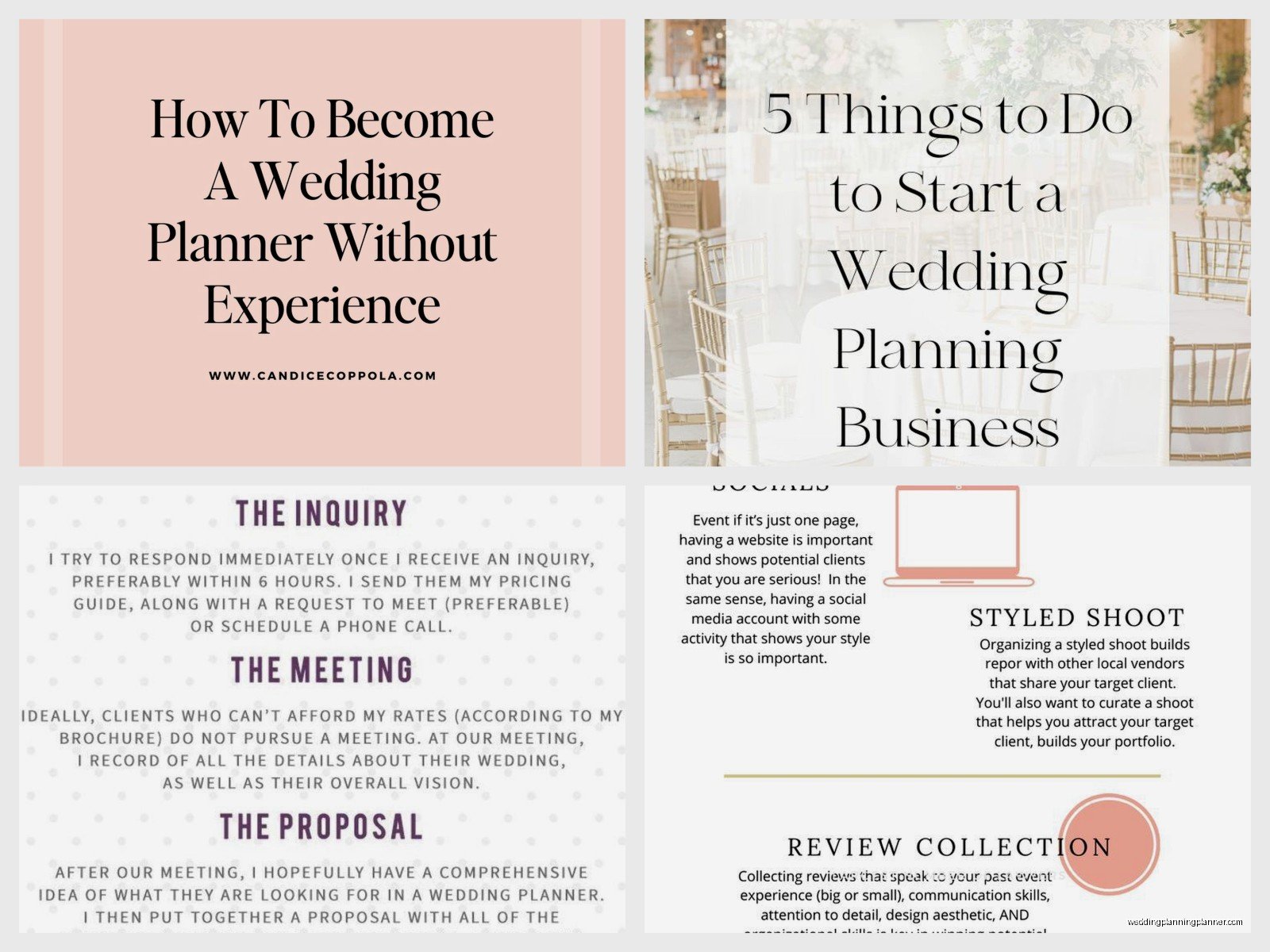
A website—doesn’t have to be fancy at first. I used Squarespace because I’m not a web developer and it looks professional enough. Include your services, pricing (or starting prices), about you, contact form, and any photos you have.
Instagram is pretty much required in the wedding industry unfortunately. I say unfortunately because the algorithm changes every 5 minutes and it’s annoying trying to keep up, but couples do look for planners there. Post real content though—not just those generic quote graphics that every wedding vendor posts. Show your actual work, share tips, give people a reason to follow you.
Wedding vendor directories like The Knot, WeddingWire, Zola—these cost money but can generate leads. I got my first three clients from The Knot actually. They’re expensive though, so maybe start with one and see if it works in your market.
Google Business Profile is free and important for local SEO. When someone googles “wedding planner near me” you want to show up.
Managing Client Relationships
Set boundaries from the beginning. I learned this too late and had clients texting me at 10pm about napkin colors. Now my contract specifies business hours and response times. I usually respond within 24 business hours unless it’s an actual emergency (and no, forgetting the florist’s name is not an emergency, Sarah).
Have a clear communication process. I do an initial consultation (free or $150 depending on my mood and schedule), then if they book we have a kickoff meeting, then regular check-ins based on their package. Everything important goes in email so there’s a record—I’ll have a phone call but then send a recap email like “just to confirm, you decided on the chicken entrée and we’re skipping the champagne toast.”
Some couples are gonna be difficult. That’s just reality. I had one bride who changed her mind about her color scheme four times and then got mad that vendors needed more notice for changes. You can’t save everyone from themselves, you just have to document everything and do your best. Also it’s totally fine to fire a client if they’re abusive or violate your contract—your mental health matters.
The Day-Of Coordination Reality
Your first wedding day as the planner is gonna be chaotic no matter how prepared you are. I thought I was SO ready for my first one and then the ceremony musician didn’t show up and I had to find someone to play Spotify from their phone through a portable speaker in like 15 minutes. You just problem-solve and keep smiling.
Bring backups of everything: timeline, vendor contact list, floor plan, extra phone charger, snacks for yourself (you will forget to eat), water bottle, the emergency kit I mentioned earlier. Wear comfortable shoes. I cannot stress this enough—you’ll be standing and walking for hours.
Do a final venue walkthrough the day before if possible. Check where outlets are, where the restrooms are, how the lighting works, all of it. The wedding day is not the time to figure out that the DJ needs a different kind of power adapter or that the venue’s sound system doesn’t actually work.
Communicate with vendors clearly. I send a final email to all vendors three days before with the timeline, their arrival time, contact person, parking info, everything they need. Then I do a group text day-of for any real-time updates. Most vendors are professionals who know what they’re doing, but coordination still matters—like making sure the caterer knows the photographer needs 15 minutes for food photos before service starts.
Growing Beyond Your First Year
Once you’ve done a few weddings, you’ll figure out what you like and what you hate. I realized I love the design and logistics parts but really don’t enjoy the family drama management, so I’ve gotten better at setting expectations around that. Some planners love being therapists for stressed families—I’m not one of them.
Think about whether you want to stay solo or build a team eventually. I brought on an assistant in 2023 because I was turning down weddings and that felt stupid. She handles a lot of the admin work and assists on wedding days, which lets me take more clients. But managing someone else adds complexity—payroll, training, trusting them with your reputation, all that.
Raise your prices regularly. I increase my rates every year or every 10-15 weddings, whichever comes first. If you’re booking up fast, you’re probably undercharging. If no one’s booking, maybe your marketing needs work or… actually it might not be the price, could be how you’re presenting yourself or where you’re advertising.
Keep learning. The wedding industry changes—new trends, new vendors, new couple expectations. I take at least one course or workshop per year, whether it’s about SEO, design, business stuff, whatever. Also just talking to other planners helps. We’re not all competing for the same couples, and most planners I know are pretty generous with advice.
The Stuff No One Tells You
Wedding season is real and it’s exhausting. Like May through October you might have weddings every single weekend, which sounds great for income but also you have no life. I missed my nephew’s birthday party two years in a row because of weddings and I’m still kinda sad about that.
You’ll work weekends and evenings because that’s when weddings happen and when couples are free to meet. If you need a traditional Monday-Friday 9-5 schedule, this isn’t gonna work for you.
The income is feast or famine, especially at first. You might book three weddings in one month and then nothing for two months. Having savings or another income source while you build up is smart. I kept my part-time stationery consulting gig for the first year and a half.
Couples will ghost you sometimes. You’ll have a great consultation, send a proposal, and then never hear from them again. Don’t take it personally—they might have budget issues, family drama, or just decided to DIY it. Follow up once or twice then move on.
You’re gonna compare yourself to other planners on Instagram who seem to only work on $100k+ weddings at gorgeous venues. Remember that’s their highlight reel. Everyone starts somewhere, and honestly some of my favorite weddings were the smaller budget ones where we had to get creative. There was this backyard wedding in summer 2023 where we used the couple’s grandma’s garden and it was absolutely beautiful and cost maybe a quarter of what the fancy venue weddings cost.