
Planning Guides, Style Guide
Chinese Wedding Invitation Template: Cultural Downloads
Jul
Finding Actual Good Chinese Wedding Invitation Templates
So Chinese wedding invitations are this whole thing that people don’t realize until they’re neck-deep in planning and suddenly the groom’s mother is asking why the template doesn’t have double happiness symbols and you’re like… wait, what now? I had this couple back in spring 2023 who downloaded what they thought was a “traditional Chinese invitation” from some generic template site and it had cherry blossoms everywhere which, fine, pretty, but totally Japanese aesthetic and the family was NOT pleased.
The thing about Chinese wedding invitation templates is they’re not just red paper with gold writing. There’s actual cultural significance to basically every element, and if you’re gonna use a template, you gotta make sure it’s not just someone’s idea of what “looks Asian” but actually respects the symbolism.
Where to Actually Download Templates That Won’t Embarrass You
Okay so first off, avoid those massive template sites that have like 50,000 options for everything. They usually have maybe three Chinese wedding templates and they’re all kinda terrible or they mix up different Asian cultures which… ugh. What really annoyed me was finding templates that used the wrong Chinese characters or had them upside down. Like how does that even happen?
Better options:
- Minted – They actually work with Asian designers and you can filter specifically for Chinese wedding invitations. Not free, but the cultural elements are correct.
- Zazzle – Hit or miss but they have independent designers who create proper traditional templates. Read the reviews from other Chinese couples.
- Etsy – This is where I send most of my clients now. Search for “Chinese wedding invitation template” and look for sellers who are actually Chinese or have clear cultural knowledge. You can usually tell from their shop descriptions.
- Creative Market – Professional designers, usually better quality files, and you can message sellers to ask about customization.
For free options, Canva has started adding more culturally specific templates but double-check everything because their user-generated content can be iffy.
What Makes a Template Actually Chinese vs Just Red
This is where it gets specific. Traditional Chinese wedding invitations have certain elements that matter, and a good template should include or accommodate these:
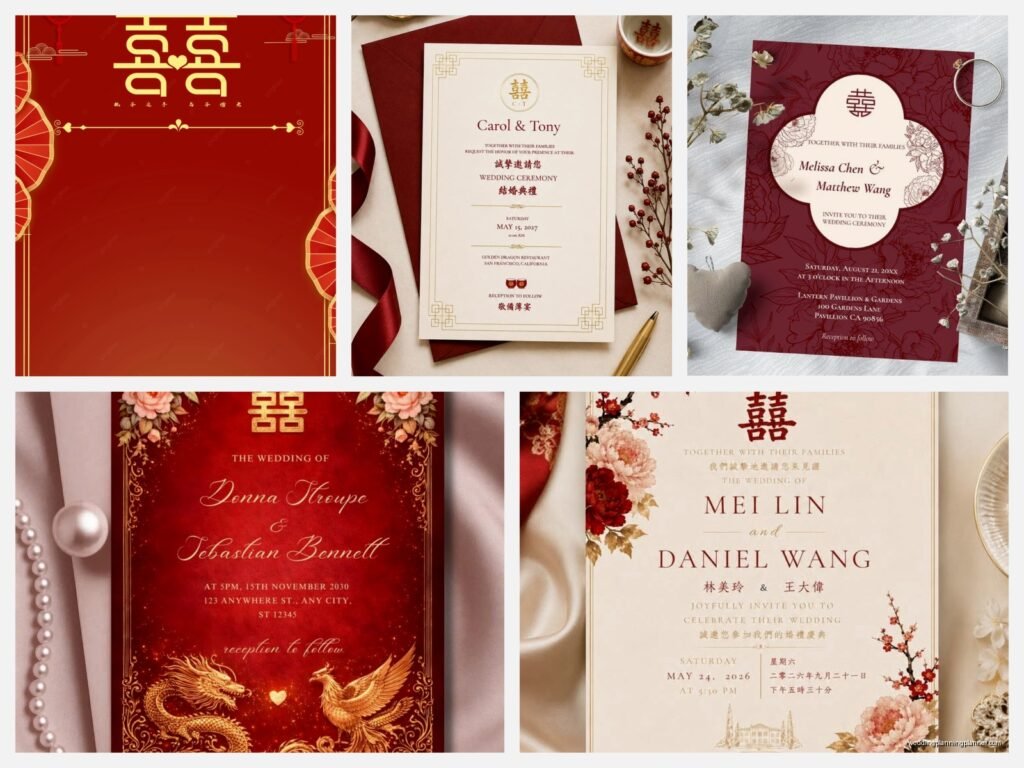
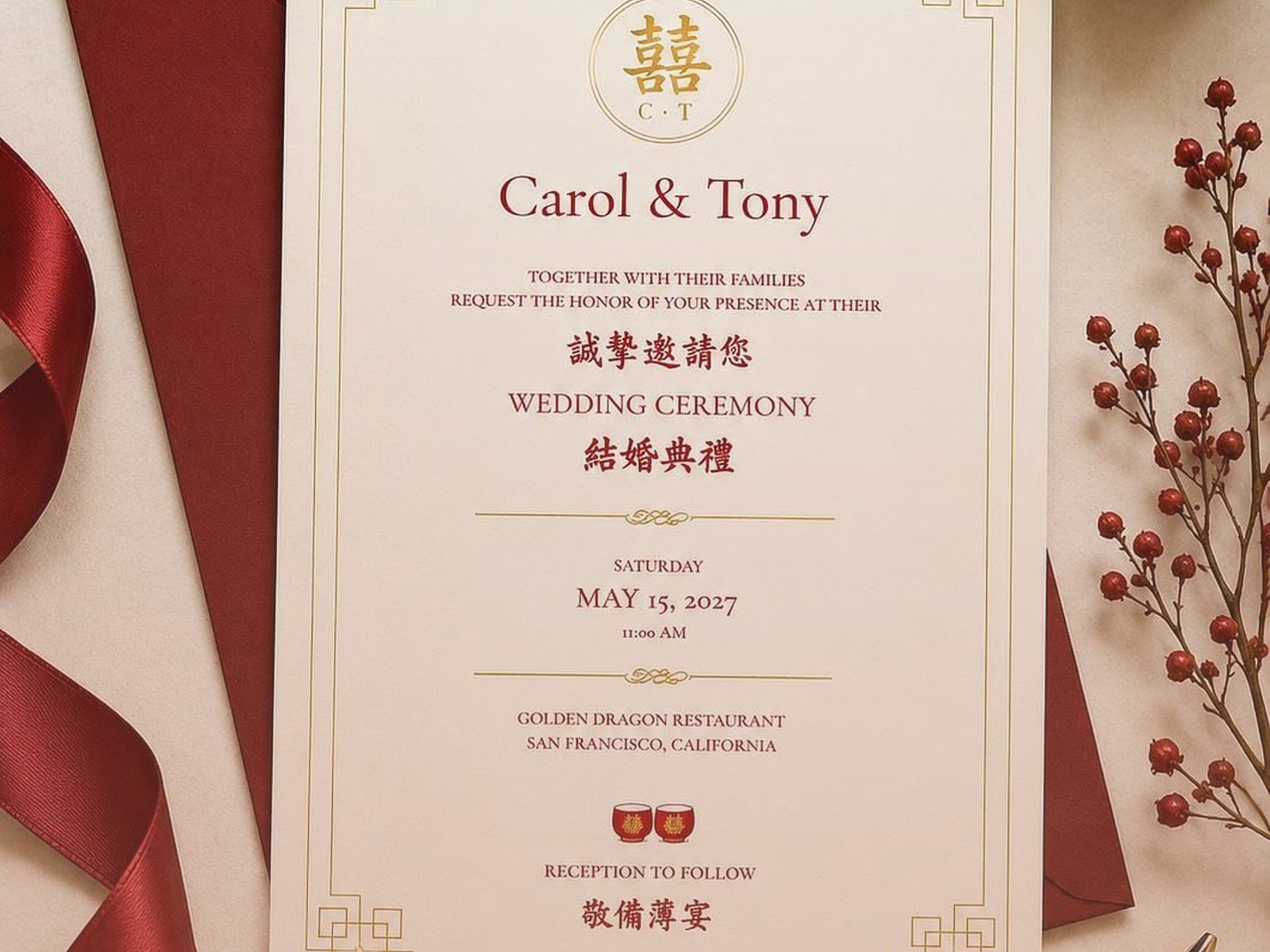
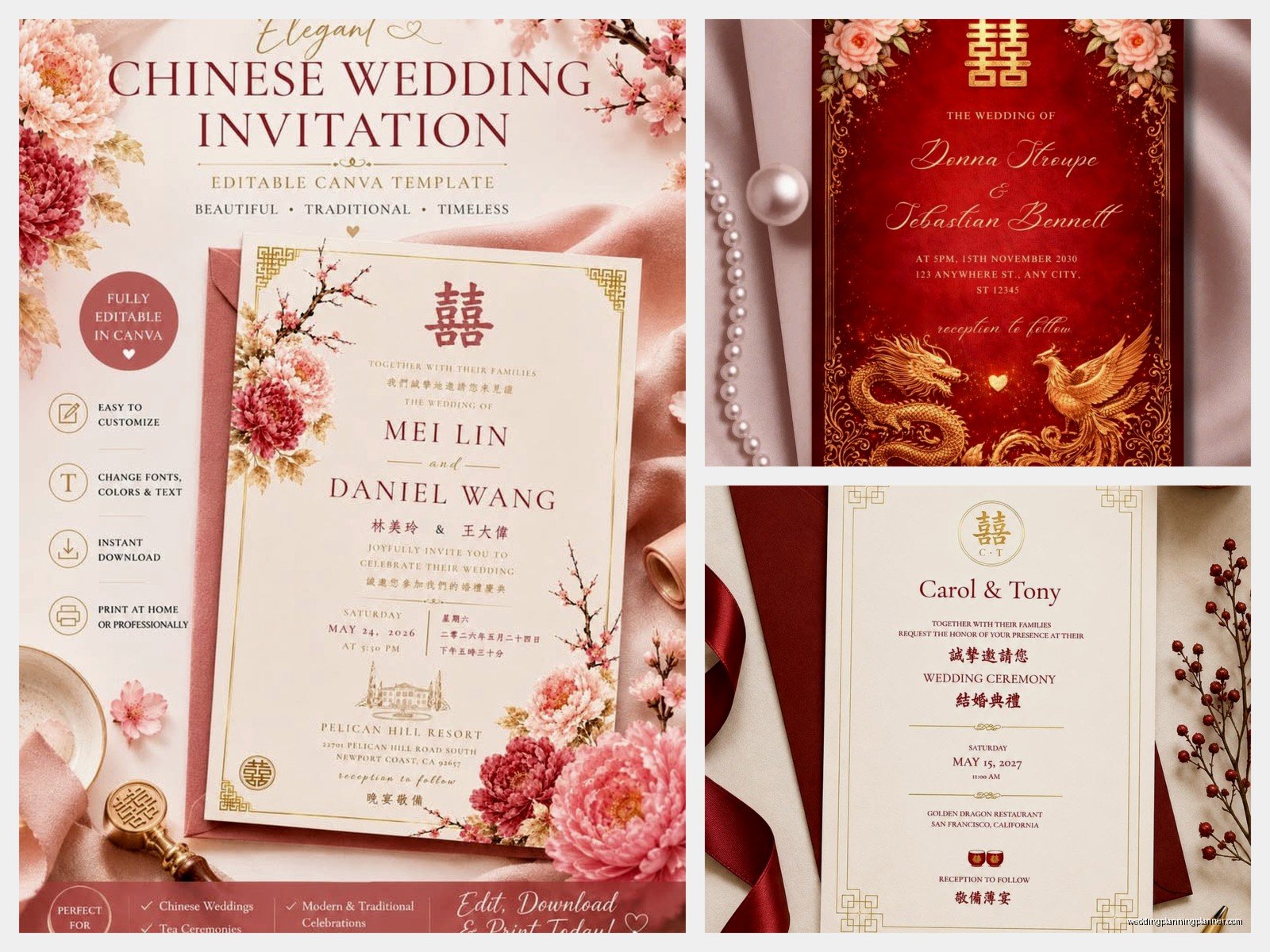
Double Happiness Symbol (囍) – This is the big one. It should be prominent but not obnoxious. The character should be correct, not some weird stylized version that doesn’t actually mean anything. I’ve seen templates where it’s basically decorative squiggles.
Color Palette – Red and gold are traditional, yes, but there’s also room for pink, peach, and even burgundy. Modern Chinese invitations sometimes use navy or emerald as accent colors. What you DON’T want is a template that’s trying to be “exotic” with random color combinations that have no cultural basis.
Dragon and Phoenix Imagery – These represent the groom and bride respectively. If your template includes them, make sure they’re done respectfully and not in some cartoonish way. The dragon should have five claws if you wanna be traditional about it (though honestly most people won’t notice).
Peony Flowers – These are the actual traditional Chinese wedding flower, not cherry blossoms. If you see cherry blossoms, that’s Japanese influence which might be fine if you’re going for fusion, but know what you’re choosing.
Knot Designs – Chinese knotwork is gorgeous and appropriate. Good templates incorporate this as borders or decorative elements.
File Formats and Technical Stuff You Need to Know
So here’s something nobody tells you until you’ve already downloaded the wrong format – Chinese characters need specific font support and if your template doesn’t have embedded fonts, you’re gonna have a bad time.
Look for templates that come in:
- PDF format with embedded fonts – safest option
- PSD files if you know Photoshop or have a designer who does
- AI files for Adobe Illustrator – these are professional-grade
- Canva links – easiest for DIY but less control
Avoid templates that are just JPG images unless they’re meant as inspiration. You can’t edit those properly without losing quality.
Bilingual Templates Are Tricky
Most Chinese wedding invitations in the US or other Western countries need both Chinese and English text. This is where templates can really fail you because the layout needs to accommodate both scripts without looking cramped or awkward.
Good bilingual templates have:
- Separate clear sections for each language
- Proper font pairings (a traditional Chinese font with a complementary English serif or script)
- Enough white space so nothing feels cluttered
I worked with this couple where the groom’s family wanted traditional vertical Chinese text and the bride’s family wanted standard English horizontal text and finding a template that could do both elegantly was… okay it took three weeks and I may have stress-eaten an entire package of Oreos while my cat judged me from the counter.
Traditional vs Modern Templates
You gotta decide which direction you’re going because the templates are completely different.
Traditional templates usually feature:
- Vertical text orientation for Chinese characters
- Classical imagery (dragons, phoenixes, peonies)
- Red or gold backgrounds
- Formal, ornate borders
- Traditional character forms (sometimes繁體字 traditional rather than simplified)
Modern templates might have:
- Minimalist designs with just the double happiness symbol
- Contemporary color palettes (blush pink, rose gold, navy)
- Clean lines and lots of white space
- Simplified characters and horizontal text
- Subtle nods to culture rather than obvious symbolism
Neither is wrong, but make sure your families are on board with whichever direction you choose. I’ve seen families get really upset about “too modern” invitations because they felt it disrespected tradition.
Customizing Your Downloaded Template
Okay so you’ve downloaded a template, now what? Most templates need customization beyond just plugging in your names and date.
The Text You Actually Need
Chinese wedding invitations typically include different information than Western ones, or present it differently:
Parents’ Names – Traditional Chinese invitations are issued by the parents, not the couple. So the parents’ names come first, usually in a format like “Mr. and Mrs. [Surname] request the honor of your presence at the marriage of their daughter [Name]…”
Formal Titles – There are specific ways to address people formally in Chinese. If you’re including Chinese text, make sure you’re using the right terms. Templates should have placeholders that indicate this.
Multiple Events – Chinese weddings often have a tea ceremony, banquet, and sometimes a Western ceremony too. Your template needs to accommodate multiple events with different times and possibly locations, or you need separate inserts.
Gift Registry Info – This is handled differently in Chinese culture. Instead of registry info, there’s often an expectation of monetary gifts in red envelopes, but you don’t typically mention this on the invitation itself.
Working with Chinese Fonts
If your template doesn’t come with embedded Chinese fonts, you’ll need to install them. Some good free options are Noto Sans CJK or Source Han Sans. For more traditional looks, there are fonts that mimic brush calligraphy.
Make sure whatever font you choose supports both simplified and traditional characters depending on what your families prefer. Mainland China uses simplified, while Taiwan, Hong Kong, and older generations often prefer traditional.
What About DIY vs Professional Printing
So you’ve got your template customized… now you gotta actually produce physical invitations.
For DIY printing, you need:
- High-quality cardstock (110lb minimum)
- A printer that can handle specialty paper (most home printers can’t)
- Time to cut, assemble, and troubleshoot when colors don’t print right
Honestly? I usually steer people toward professional printing unless they’re really crafty and have tons of time. Chinese wedding invitations often have special finishes – gold foiling, embossing, that sort of thing – that you can’t DIY.
Professional printing services that understand Chinese invitations:
- Local Chinese print shops in your area (ask around in Chinese communities)
- Minted, Zola, or Shutterfly (upload your customized template)
- Specialist Asian wedding stationers (more expensive but they get it)
Envelope Addressing Gets Complicated
Traditional Chinese invitations have specific envelope protocols. The outer envelope is formal with full names and titles, inner envelope is less formal. If you’re doing bilingual invitations, you might need to address envelopes in both languages too, which… yeah, that’s a whole project.
Some templates come with matching envelope designs, which is helpful. Make sure the envelope template can fit your actual invitation size – I’ve seen people design beautiful invitations that literally didn’t fit in standard envelopes and had to custom-order them.
Common Template Mistakes to Avoid
Things I’ve seen go wrong that you can prevent:
Wrong character usage – Using Japanese kanji instead of Chinese characters, or using characters that have negative connotations. The number 4 (四) sounds like death, so avoid it in dates or table numbers if possible.
Cultural mixing – Cherry blossoms with Chinese text, or using Korean hanbok colors with Chinese symbols. Pick a cultural lane unless you’re intentionally doing fusion.
Bad color symbolism – White is a funeral color in Chinese culture, black can be negative. If you’re doing modern invitations with these colors, make sure they’re accents, not dominant.
Google Translate fails – Don’t use Google Translate for your Chinese text. Get a native speaker to check it or hire a translator. I’ve seen some truly hilarious (and embarrassing) translation errors on invitations.
Ignoring orientation – Traditional Chinese text reads top to bottom, right to left. Some templates get this backwards or mix orientations in confusing ways.
Timeline Stuff
Chinese wedding invitations traditionally go out earlier than Western ones – like 2-3 months before the wedding instead of 6-8 weeks. This is partly because there might be multiple events and people need more planning time. Make sure your template is ready to order at least 4 months before your wedding so you have time for proofing, printing, and mailing.
Also, lucky dates matter in Chinese culture. Your wedding date might be chosen based on the Chinese calendar, and you’ll want that reflected correctly on your invitation. Some templates have spaces to include both Western and Chinese calendar dates.
Digital Templates and E-vitations
Okay so not everyone wants physical invitations anymore, and there are Chinese wedding e-vitation templates too. These work well for save-the-dates or pre-wedding events.
Digital template considerations:
- They need to display correctly on both phones and computers
- Animated elements can be cool but make sure they’re culturally appropriate (floating lanterns yes, random sparkles maybe not)
- Chinese characters need to render properly across different devices
- Include downloadable calendar files with the correct dates
Some families are traditional and won’t accept e-vitations for the actual wedding, so know your audience. I usually suggest physical invitations for older relatives and the formal banquet, digital options for younger guests or pre-events.
Accessibility and Printing Bleed
Technical stuff that matters: your template should have proper bleed areas (usually 0.125 inches) if you’re doing print. This means the design extends slightly beyond where the cut will be, so you don’t end up with white edges.
Also think about readability – if you’re using ornate Chinese calligraphy fonts, make sure they’re still legible. I’ve seen gorgeous templates that were basically unreadable, which defeats the whole purpose of an invitation.
For guests with vision issues or who don’t read Chinese, consider including a simple text version of the key info (date, time, location) in clear English in addition to the decorative elements. You can put this on an insert card if you don’t wanna mess with your main design.
The whole template thing can feel overwhelming but honestly once you find the right one and customize it properly, it’s so worth it to have invitations that actually represent both of you and respect the cultural traditions that matter to your families. Just start looking early, don’t settle for the first red-and-gold thing you see, and get family input before you commit to printing 200 copies of something that’s gonna make grandma unhappy. Trust me on that last one – learned it the hard way in summer 2021 and I still kinda cringe thinking about that conversation.