
Planning Guides, Style Guide
Marriage Reception Card: Design & Ordering Guide
Jun
Okay so reception cards are basically the thing everyone forgets about until like 6 weeks before the wedding
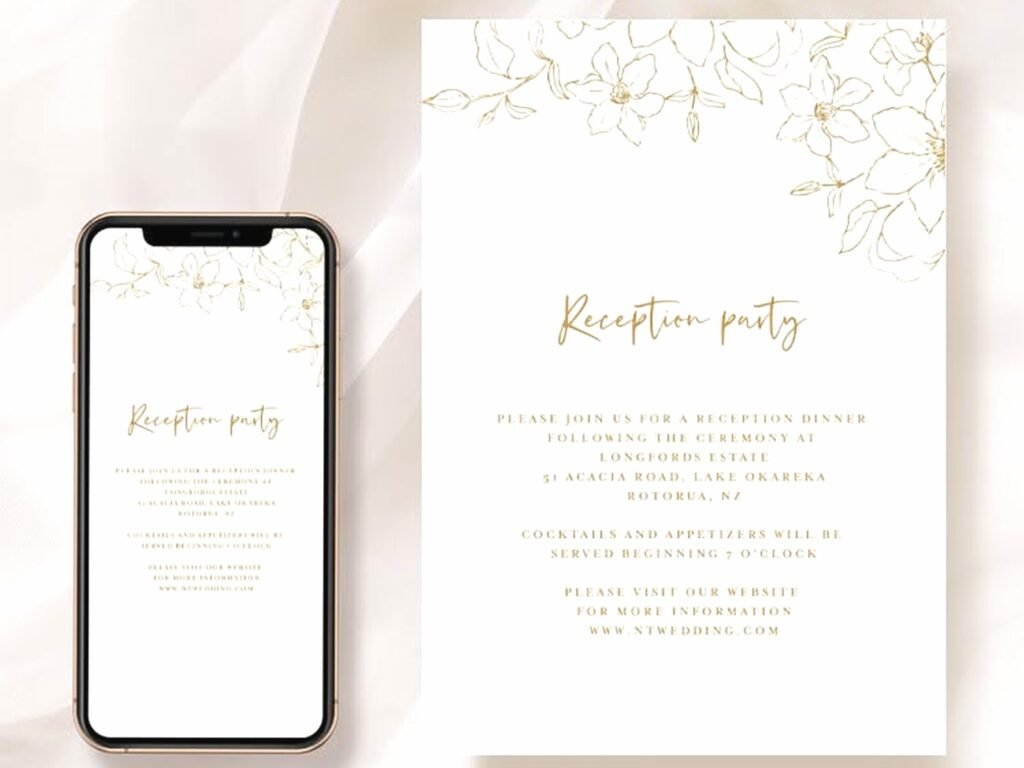
Reception cards are those separate insert cards that go with your wedding invitation to tell guests where the party’s actually happening after the ceremony. And honestly, they’re kinda necessary if your reception is at a different location than your ceremony, which like, most weddings are nowadays unless you’re doing everything at one venue.
I had this bride back in spring 2023 who completely skipped ordering reception cards because she thought “everyone will just follow us to the venue” and I’m still recovering from that disaster. Guests ended up scattered across three different restaurants in downtown because they googled the couple’s names and found the rehearsal dinner location instead. So yeah, don’t skip these.
When you actually need reception cards vs when you don’t
You need them if your ceremony and reception are at different places. That’s it, that’s the main rule. If you’re getting married at a church and then heading to a country club three miles away, you need reception cards. If everything’s happening at the same venue, you can usually just put the reception details on the main invitation.
Some couples also use them when the reception is like, significantly later than the ceremony. Like if you’re doing a 2pm ceremony and then an 7pm reception, that gap is gonna confuse people and you want a separate card spelling it out.
Also if you’re doing adults-only reception but all-ages ceremony? Reception card can subtly indicate that without you having to write “no kids allowed” on your main invitation which always sounds harsh.
What information actually goes on these things
Keep it simple. You need the venue name, the address, and the time. That’s literally the minimum. Most reception cards I design are pretty sparse compared to the main invitation because you don’t wanna overwhelm people with text.
Here’s what I typically include:
- The word “Reception” or “Dinner and Dancing” or whatever you wanna call it
- Time (if different from ceremony or if there’s a gap)
- Venue name
- Full address including city and state
- Sometimes “to follow” if reception immediately follows ceremony
You don’t need to put directions on the card itself because everyone’s gonna use their phone anyway. What really annoyed me for years was couples who insisted on printing detailed driving directions on reception cards like it’s 1997 and MapQuest doesn’t exist, it takes up so much space and looks cluttered.
Wording examples that actually work
Formal version: “Reception immediately following at The Grand Ballroom, 450 Park Avenue, Chicago, Illinois”
Casual version: “Dinner, drinks and dancing to follow at Riverside Barn, 28 Mill Road, Cooperstown”
With time gap: “Join us for cocktails and celebration at seven o’clock in the evening, The Boathouse at Harbor Point, 1892 Lakeside Drive”
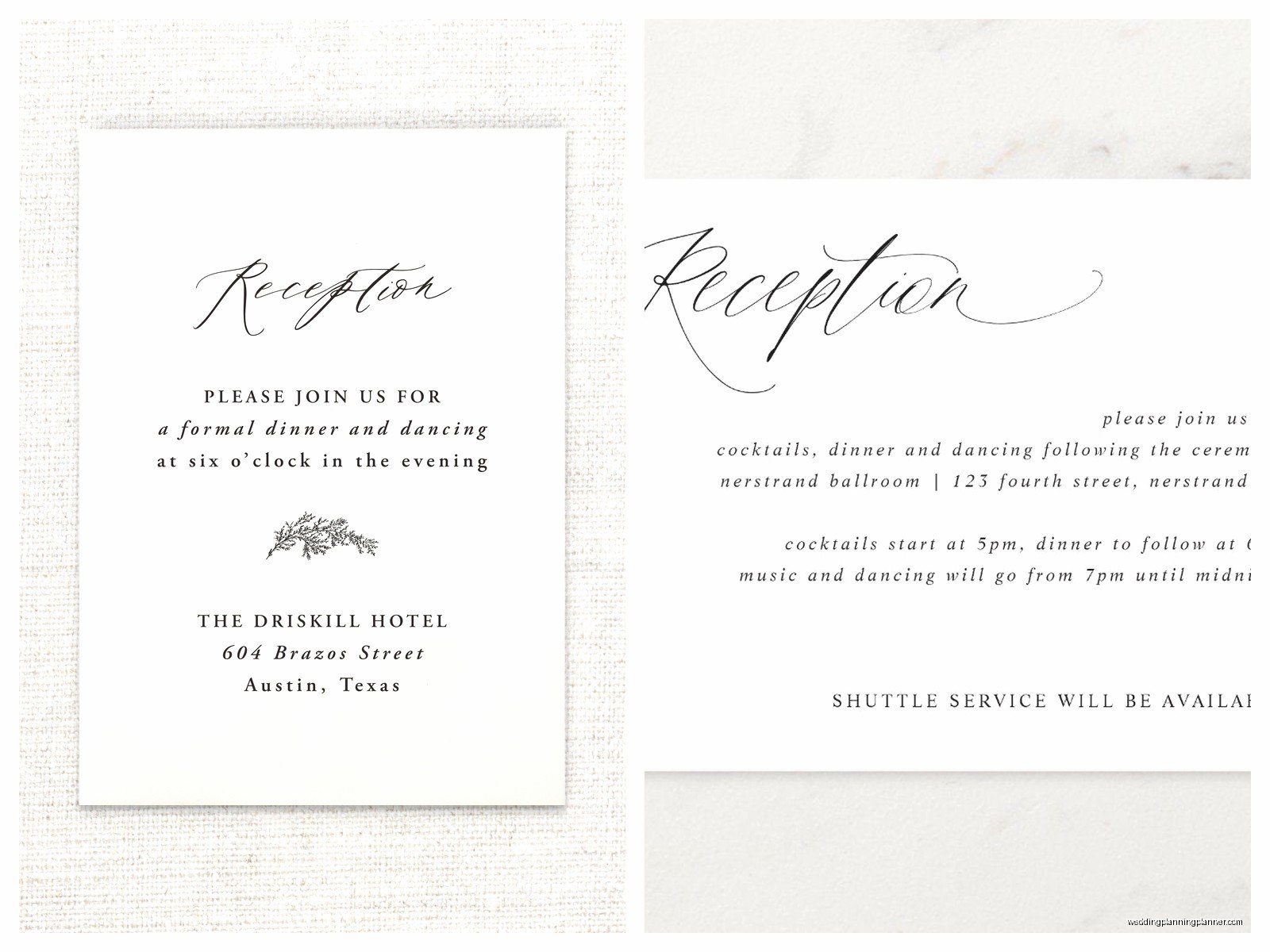
I usually tell couples to match the formality level of their main invitation, but honestly some of the best reception cards I’ve seen are slightly more relaxed than the invitation because… it’s the party part, you know?
Design stuff that matters more than you think
Your reception card should obviously coordinate with your invitation suite, but it doesn’t have to be identical. I see couples stress about this constantly and like, it’s fine if the reception card is simpler or uses less color or whatever.
Size-wise, most reception cards are either 4×6 inches or 4.5×6 inches. Sometimes 5×7 if you’ve got a lot of info to include, but honestly that’s kinda big for an insert card. The standard is to go smaller than your main invitation so there’s a visual hierarchy when people open the envelope.
Font size matters here because you’re fitting information into a smaller space. I never go below 10pt font, and honestly 11pt or 12pt is better for addresses. Your grandma’s gotta be able to read this without her reading glasses.
Color and paper choices
Match your paper stock to your invitation or it looks weird. If your invitation is on cotton paper, your reception card should be too. If you went with shimmer cardstock, same deal. The weight can be slightly lighter though – like if your invitation is 120lb, your reception card can be 100lb or 110lb.
Color-wise, you can do white/cream to match your invitation, or you can pick up an accent color from your design. I did this suite last fall where the invitation was ivory with navy text, and we made the reception card navy with ivory text – it looked really sharp and helped it stand out in the envelope so people didn’t miss it.
My cat just knocked over my coffee while I’m writing this, but anyway—
Where to actually order these from
You’ve got options ranging from expensive to budget-friendly, and honestly the quality difference isn’t always that dramatic.
High-end stationery boutiques and custom designers (like, ahem, hiring someone like me): You’re looking at $3-8 per card depending on printing method and paper. Letterpress is gonna be on the higher end, digital printing on the lower end. The benefit is complete customization and someone holding your hand through the process.
Online wedding stationery sites like Minted, Zola, Paperless Post’s print service: Usually $1-3 per card. They have templates you can customize, decent paper quality, and you can usually order matching pieces. I actually don’t hate these for couples on a budget.
Print shops like Vistaprint or Costco Photo Center: Under $1 per card usually. The paper quality is fine, not amazing. Design options are more limited. But if you’ve got a simple design and you’re watching costs, they work perfectly fine.
Local print shops: This is sorta the middle ground, pricing varies a lot but you can bring in your own design file and they’ll print it. Quality depends entirely on the shop.
Printing methods and why you might care
Digital printing is the most common and most affordable. It’s what most online sites use. Looks good, prints clean, totally acceptable for wedding stationery.
Letterpress is that pressed-into-the-paper look that’s really popular right now. It’s gorgeous but expensive, usually $5+ per card minimum. And you need soft paper for it to work properly, so like cotton or bamboo stock.
Thermography is that raised printing that’s slightly shiny. It’s less common now but some couples love it for formal weddings. Mid-range price point.
Foil stamping is pretty and fancy but adds significant cost. We’re talking $4-6 per card usually. Looks incredible though if it’s in your budget.
For reception cards specifically, I usually recommend digital printing unless you’re doing letterpress for your whole suite. The reception card is functional information and doesn’t need to be as fancy as your invitation… though obviously do whatever makes you happy.
Ordering timeline and quantities
Order your reception cards at the same time as your invitations, like this should be one order. You want everything to arrive together so you can assemble your invitation suites all at once. Plus you’ll probably get a discount for ordering multiple pieces.
Timeline-wise, start designing 4-6 months before your wedding. Place your order 3-4 months out. That gives you time for printing, shipping, and addressing before you mail invitations 6-8 weeks before the wedding.
Quantity: order the exact same number as your invitations. Don’t try to save money by ordering fewer reception cards thinking some guests won’t need them – you need one per invitation, period. Actually I usually tell couples to order 10-15 extras because someone’s gonna lose theirs or you’ll need it for a keepsake or whatever.
Proofing is not optional
I cannot stress this enough – check your proof like your life depends on it. I had a couple in summer 2021 who approved their proof without really looking and we printed 150 reception cards with the wrong venue address. The venue had moved locations six months earlier and they gave me the old address. It was technically their error but we had to rush reprint everything and it was a whole thing.
Check the spelling of the venue name, verify the address on Google Maps, make sure the time is correct, confirm the date if you included it. Then check again. Then have your mom check it. Then check one more time.
Assembly and envelope situation
Your reception card goes inside the invitation envelope with your invitation and any other insert cards. Standard assembly order from bottom to top: invitation (face up), then reception card, then any other details cards, then RSVP card and envelope on top.
Some people use belly bands or ribbon to hold everything together, some people use envelope liners to add color, some people just stack everything and call it a day. All of these are fine. Do what matches your vibe and your budget.
You don’t need a separate envelope for the reception card unless you’re doing like, a very formal multi-envelope situation which honestly is kinda outdated now. Just include it as a loose insert.
Digital alternatives if you’re going that route
Okay so some couples are doing digital invitations now and wondering about reception cards. If you’re sending everything electronically, you can either include the reception info on the main invitation page or create a separate “details” page on your wedding website.
I’m gonna be honest, for digital invites I usually just put everything on one page because clicking through multiple pages on a phone is annoying for guests. But if you want to maintain that traditional separation between ceremony and reception info, you can design separate digital cards that appear in sequence.
The benefit of digital is you can embed a Google Maps link directly to the reception venue, which is actually more helpful than a printed address. But that’s a whole different conversation about digital vs print that I won’t get into here because…
Common mistakes I see constantly
Not including the full address – just putting the venue name doesn’t cut it, especially if it’s a common name or in a big city
Making the text too small to read comfortably
Using a super decorative font that’s hard to read for the address
Forgetting to specify “immediately following” vs an actual time when there’s a gap
Not ordering enough extras
Assuming everyone knows where the venue is because it’s “famous” in your town – nah, your out-of-town guests have no idea
Waiting too long to order and then paying rush fees
The thing about maps and directions
Some couples want to include a custom map on their reception card and honestly, it can look really cute if done well. But it takes up a lot of space and it’s not really necessary anymore. If you’re set on including a map, consider putting it on a separate details card instead of cramming it onto your reception card with the address.
Or just… put directions on your wedding website and include your website URL on a separate card in the invitation suite. That’s what most couples do now and it works fine.
Matching your other insert cards
If you’re including other cards like an accommodations card, details card, or weekend events card, they should all match in size and design. Usually these are all the same dimensions and use the same fonts and colors. It creates a cohesive look when guests open the envelope.
I typically design these all at once as a suite, even if they’re printed separately. The reception card is usually the most important insert after the invitation itself, so it can be slightly larger or more prominent than the other detail cards if you want to create hierarchy.
But honestly don’t overthink it. As long as everything coordinates and the information is clear, you’re good. Guests aren’t gonna judge your wedding based on whether your reception card perfectly matches your accommodations card, they just need to know where to show up and when.