
Planning Guides, Style Guide
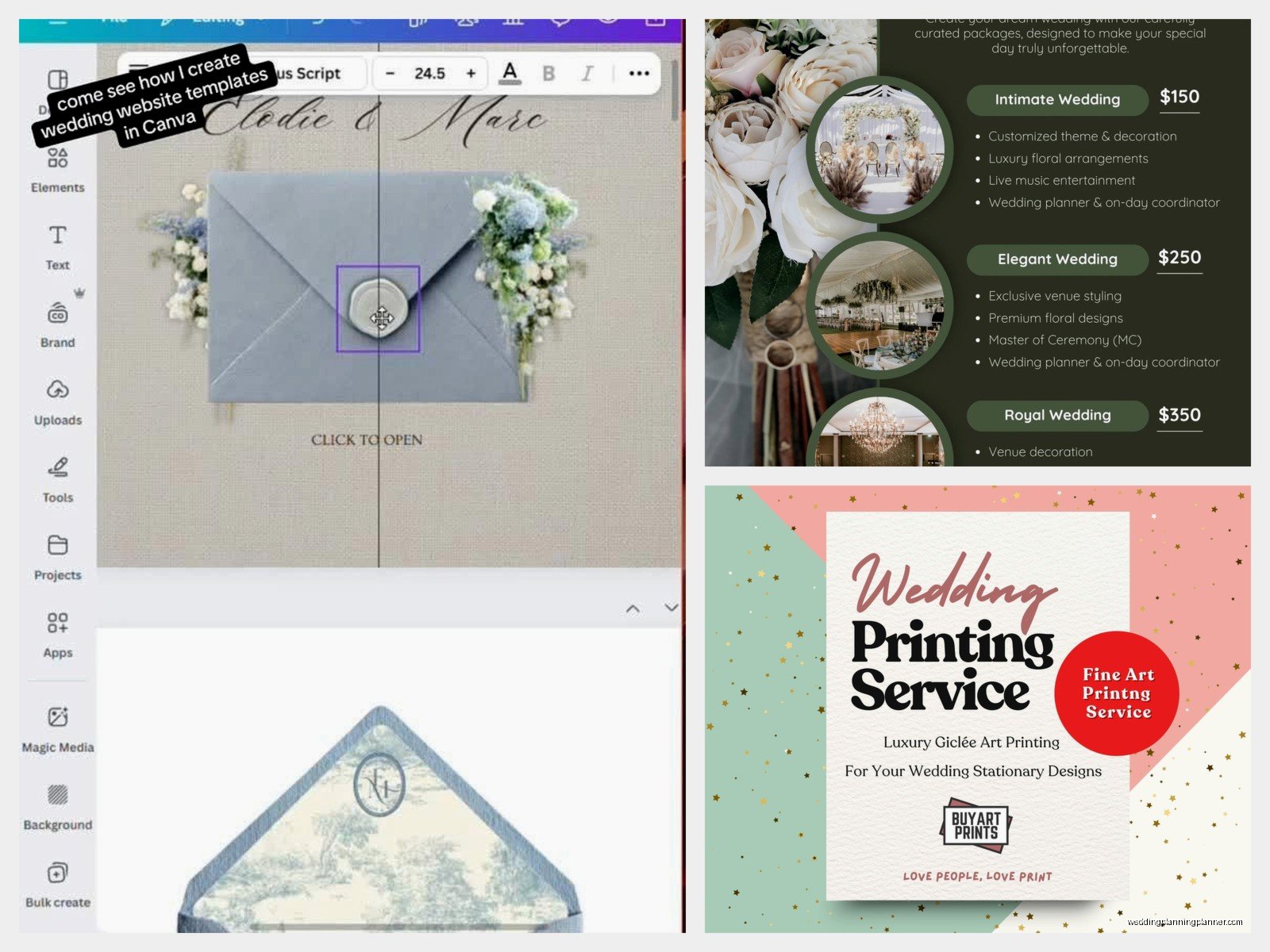
Wedding Printing Services: Professional Stationery Printers
Sep
Finding the Right Wedding Stationery Printer
So you’re looking for a professional printer for your wedding stationery and honestly, this is where SO many couples get overwhelmed because there are like a million options and they all sound the same until you actually start working with them. I learned this the hard way back in summer 2021 when I had three brides all needing invitations printed within the same two-week window and one of my “reliable” printers just… completely dropped the ball on quality control.
First thing you gotta know is that not all wedding printers are created equal. There are big online companies, local print shops, specialty letterpress studios, and then those weird in-between places that do everything from business cards to billboards. Each has pros and cons depending on what you actually need.
Types of Professional Printing Services
The online giants like Minted, Zola, Shutterfly – they’re convenient and usually affordable. You pick a template, customize it online, and boom, done. They’re great if you want something pretty standard and you’re not super picky about paper weight or custom details. But here’s what annoys me about these services: their customer service is basically nonexistent when something goes wrong. You’re dealing with chat bots and email tickets instead of an actual human who can fix your order.
Local print shops are my usual go-to for most clients. You can walk in, touch paper samples, see printing examples, and talk to someone face-to-face. They’re usually faster for rush orders too since you’re not dealing with shipping times. I have this one printer in my area, Mike’s Print House, and Mike himself will text me photos of proofs at like 9pm because he knows wedding timelines are tight.
Specialty letterpress and foil stamping studios are where you go when budget isn’t the main concern and you want something that feels really luxurious. These places are artists, basically. They’re doing custom work, mixing inks by hand, using vintage presses. Beautiful stuff but you’re gonna pay for it – usually starting around $1500-2000 for a full invitation suite for 100 guests.
What You Actually Need to Print
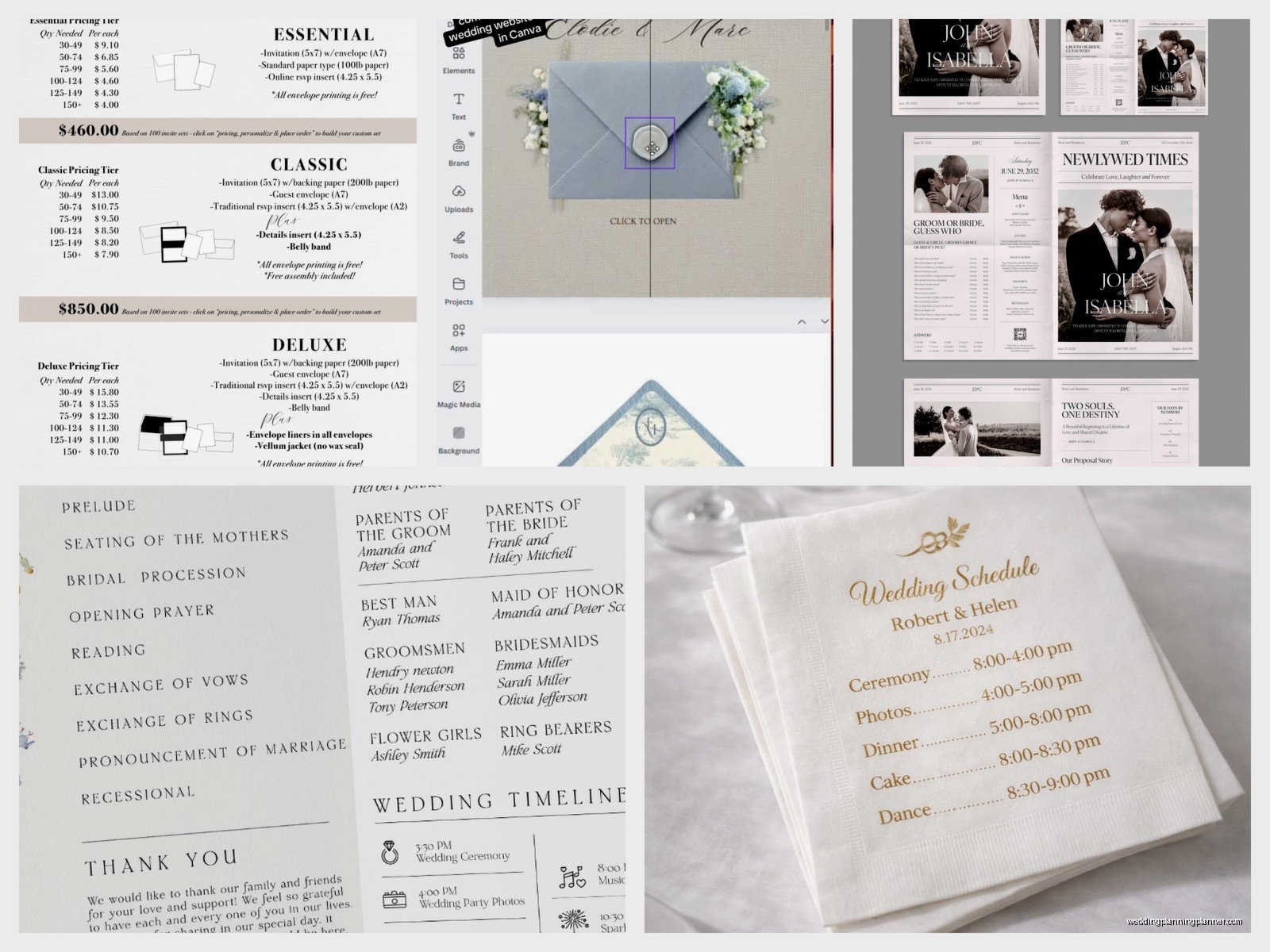
Okay so most couples think “wedding invitations” and that’s it, but there’s actually a whole list of stationery items you might need printed depending on your wedding style:
- Save-the-dates (sent 6-8 months before)
- Formal invitations (sent 8-12 weeks before)
- RSVP cards and envelopes
- Details cards (accommodation info, website, dress code)
- Reception cards (if ceremony and reception are different locations)
- Envelope addressing or printed labels
- Programs for the ceremony
- Menu cards
- Place cards and escort cards
- Table numbers
- Signage (welcome signs, bar menus, etc)
- Thank you cards
You don’t need all of these, but you should figure out your list before you start getting quotes because many printers offer package deals if you’re ordering multiple items together.
How to Actually Choose a Printer
I always tell my couples to get quotes from at least three different printers. Not just price quotes either – you want to see samples of their actual work. Like, real printed samples they send you in the mail, not just photos on their website because photos can be deceiving with color and paper quality.
Questions to Ask Every Printer
When you’re talking to potential printers, here’s what you need to nail down:
Turnaround time: How long from final approval to delivery? Standard is usually 2-3 weeks but some places are faster or slower. If you need a rush order, ask what that costs extra – usually 25-50% more.
Proof process: Do they send you a digital proof? A physical printed proof? How many rounds of revisions are included? Some printers charge after the second revision which can add up if you’re indecisive.
Minimum quantities: A lot of professional printers have minimums, usually 25 or 50 pieces. If you’re having a tiny wedding, this might mean you’re paying for invitations you don’t need.
Paper options: What weights and textures do they offer? Standard is 110lb cardstock but I prefer 130lb for invitations because it feels more substantial. Ask about cotton paper vs regular cardstock too.
Printing methods: Digital printing, offset printing, letterpress, foil stamping, thermography – they all look and feel different. Digital is cheapest and fine for most people. Letterpress is that pressed-into-the-paper look that’s really popular right now.
Color matching: If you have specific wedding colors, ask about their color matching process. Pantone matching is more precise but costs more. Regular CMYK printing can vary slightly from what you see on your screen.
The Paper Thing Everyone Forgets
Paper quality makes SUCH a difference and it’s something you can’t really judge until you hold it. I had a bride in spring 2023 who ordered invitations from a cheap online place without requesting samples first and when they arrived she literally cried because they felt like regular printer paper. We had to rush order replacements from a real printer and it cost her an extra $600.
Ask for paper sample packs. Most professional printers will send you these for free or like $10-15. You want to feel the weight, see how the ink looks on different textures, check if envelopes are included or separate.
Cotton paper is amazing – it’s got this soft texture and holds ink really well. It’s more expensive but worth it if you’re doing letterpress because the impression shows up better. Regular cardstock is totally fine for digital printing though, don’t let anyone make you feel like you need to upgrade everything.
Budgeting for Professional Printing
Alright so here’s the money talk. Wedding stationery printing can range from like $200 to $5000+ depending on what you’re doing. I know, huge range, but that’s why it’s important to set your budget first before you fall in love with a $15-per-invitation letterpress suite.
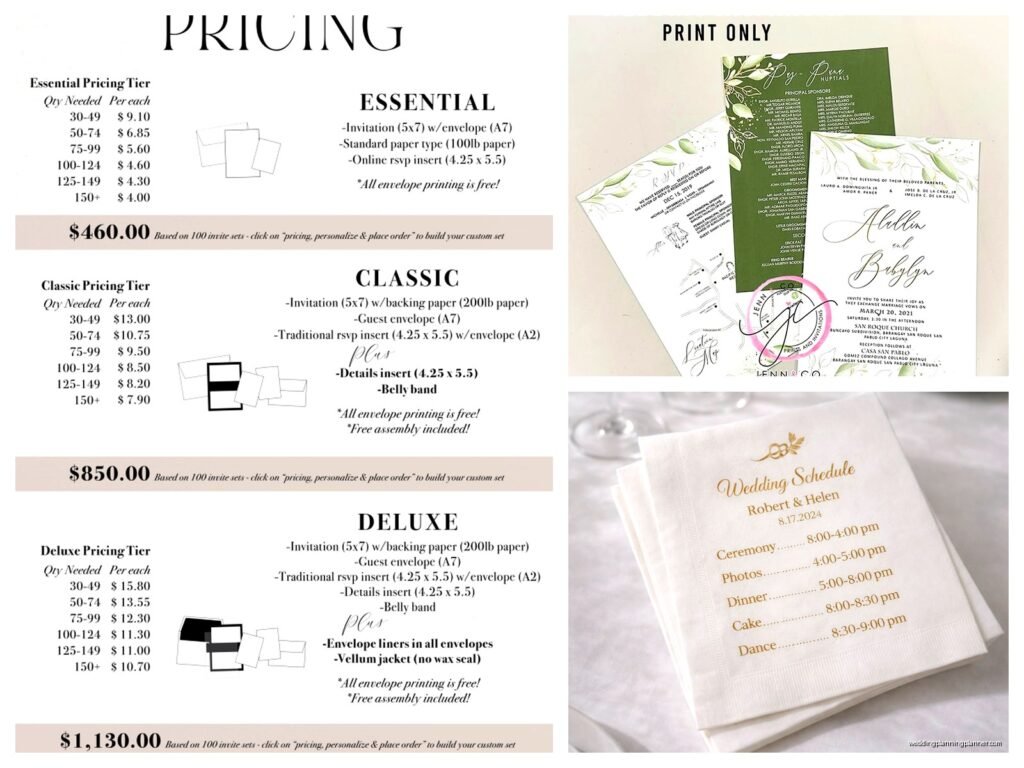
For a standard digital printing package (invitations, RSVP cards, details card) for 100 guests, expect to pay around $300-600. That’s middle-of-the-road quality, nothing fancy but nice.
Letterpress or foil stamping bumps you up to $1500-3000 for the same quantity. Thermography (that raised printing technique) is sorta in between at $600-1000.
Don’t forget about envelopes and addressing. If you want your envelopes printed with guest addresses instead of handwriting them or using labels, that’s usually an extra $1-2 per envelope. Calligraphy addressing is even more, like $3-5 per envelope.
Where People Waste Money
Okay I’m gonna be real with you – some printing upgrades are worth it and some are just… not. Edge painting (where they paint the edges of your cards in a color) looks cool but costs like $2 extra per invitation and most people barely notice it. Wax seals are gorgeous but if you’re mailing invitations, the post office sometimes charges extra postage for the thickness and they can break off in transit.
Belly bands and ribbon ties? Super pretty, adds like $300-500 to your order for 100 invitations, and half your guests will just throw them away without really looking. I’m not saying don’t do them if you love them, but like… maybe that money could go toward better food at your reception or something.
What IS worth spending on: good quality paper, clear printing (invest in proofs!), and enough time in your timeline so you’re not paying rush fees. Rush fees will kill your budget – I’ve seen people pay double for printing just because they waited too long.
Working With Your Printer
Once you’ve chosen a printer, here’s how to make the process smooth. Send them your design or let them know which template you want if they provide designs. Most professional printers have in-house designers who can create custom designs for you, usually included in the price or for like $100-200 extra.
You’ll get a digital proof first – READ IT CAREFULLY. Check every single name, date, time, address. Read it forwards, then backwards. Have someone else read it too. I once had a couple approve a proof that said “Cocktail Attire” when they meant “Black Tie Optional” and they didn’t catch it until 200 invitations were printed. The printer wouldn’t reprint for free because they’d approved the proof.
If you’re doing custom colors or designs, ask for a physical printed proof before they print the whole order. It costs extra (usually $25-50) but it’s worth it to make sure the colors look right in person and not just on your screen.
Timeline for Printing
Here’s a realistic timeline for getting stationery printed professionally:
- 12 months before wedding: Start looking at designs and printer options
- 10 months before: Order save-the-dates
- 8 months before: Mail save-the-dates
- 4-5 months before: Finalize invitation design and wording
- 3-4 months before: Order invitations
- 10-12 weeks before: Mail invitations
- 6-8 weeks before: Order programs, menu cards, signage
- 2-3 weeks before: Pick up or receive delivery of day-of items
My cat just knocked over my coffee while I’m writing this and now I’m realizing how many times coffee stains have been an issue with paper samples in my office, but anyway…
Day-of Printing Items
Programs, menu cards, place cards, and signage often get forgotten until the last minute and then couples panic. You can usually order these from the same printer who did your invitations and they’ll match everything perfectly. Some printers even store your design files and can quickly produce these items when you’re ready.
For programs, you don’t need them for every guest. I usually recommend one per couple or family, so if you have 150 guests, order 75-80 programs. Menu cards are similar – one per place setting if you want individual ones, or one per table if you’re doing larger display menus.
Place cards and escort cards are different things (escort cards tell people which table, place cards tell them which specific seat) and honestly most weddings only need escort cards unless you’re doing a really formal seated dinner with specific seating arrangements at each table.
Signage Options
Professional printers can do signage but it’s often cheaper to have your invitations printed professionally and then do signage through a different vendor or DIY it. Unless you want everything to match exactly, in which case go ahead and order it all together.
Foam board printing is standard for welcome signs and costs like $30-80 depending on size. Acrylic signs are trendy right now and run $100-200. Wood signs are even more but they’re reusable if you want to keep them as decor after.
Digital vs Offset vs Letterpress
I should probably explain the actual printing methods better because this is where people get confused and sometimes overpay for something they don’t actually need.
Digital printing is what most modern printers use. It’s basically a really high-quality version of your home printer. The machine prints directly onto paper using toner or ink. It’s fast, affordable, and perfect for orders under 500 pieces. Colors are bright, you can do full-color images and photos easily, and there’s almost no setup cost. The downside is that it can look a tiny bit flat compared to other methods and you can’t do special effects like metallic inks or white ink on dark paper (well, you can with special digital printers but it costs more).
Offset printing is the traditional method where ink is transferred from plates onto rubber blankets and then onto paper. It’s what commercial printers use for magazines and books. The quality is slightly better than digital with more accurate color reproduction, and it’s actually cheaper per unit for large quantities (like 500+). But there’s a setup cost because they have to create plates, so it’s not worth it for small orders. Most wedding invitations don’t need offset printing unless you’re doing a huge wedding or want that specific look.
Letterpress is the fancy option everyone sees on Pinterest. It’s an old technique where metal or polymer plates press into paper, creating an impression. It looks amazing – you can literally feel the text pressed into the paper – but it’s expensive and time-consuming. Each color requires a separate plate and press run, so multi-color letterpress invitations can get crazy expensive. It only works with simple designs too, no photographs or gradients or… you get the idea. But for classic elegant text-based invitations, nothing beats letterpress.
Foil stamping uses heat and pressure to apply metallic or colored foil to paper. It’s gorgeous, catches the light beautifully, and feels luxurious. It’s also expensive, similar pricing to letterpress. Great for adding metallic accents to digitally printed invitations if you want that wow factor without going full letterpress.
Thermography is kinda like fake letterpress? It creates raised printing using a powder that’s heat-set onto wet ink. It gives you that dimensional look without the letterpress price tag. It’s a good middle-ground option but some people think it looks dated now. I personally think it’s fine if you like the look and it fits your budget.
Common Printing Problems
Things that can go wrong: color matching issues (what looks purple on your screen might print more blue), text that’s too small to read clearly (anything under 8pt font is risky), designs that don’t account for bleed (images need to extend past the cut line), and envelopes that don’t fit the invitations properly.
Also, and this drives me nuts, printers sometimes have different color calibrations on their proofing printers vs their production printers, so your proof might look perfect and then the final order is slightly off. This is why working with experienced wedding stationery printers matters – they know how to account for this stuff.
Paper grain direction is something most people don’t think about but it affects how invitations fold and how envelopes seal. Professional printers know to print with the grain running the right direction. Cheap printers don’t always pay attention to this and you end up with invitations that won’t fold cleanly or envelopes that pop open.
Eco-Friendly Printing Options
If you care about environmental impact, ask printers about recycled paper options and soy-based inks. Some printers are certified by organizations like the Forest Stewardship Council. Recycled paper has come a long way – it doesn’t look cheap or brown anymore, there are beautiful cotton-blend recycled papers that feel luxurious.
You can also reduce waste by printing only what you need. Order 10-15 extra invitations for mistakes and keepsakes, but don’t go overboard. Skip the extra inserts if you can put information on your wedding website instead. Do digital RSVPs instead of printed RSVP cards.
