Planning Guides, Style Guide
Wedding Ceremony Script Examples: Sample Ideas & Examples
Apr
Okay so wedding ceremony scripts
Right so you need actual script examples because staring at a blank page when you’re trying to write your ceremony is literally the worst. I had this couple back in spring 2023 who waited until THREE WEEKS before their wedding to even think about their script and then panicked because they didn’t know where to start. Like, I get it, there’s a million other things happening, but also… you gotta have words for the actual ceremony part.
The thing that drives me absolutely nuts is when people think there’s like one “correct” script they have to follow. Unless you’re having a religious ceremony with specific requirements, you can literally say whatever you want. It’s your wedding. I’ve seen couples include poetry about their dog, references to inside jokes, readings from fantasy novels… one couple even worked in a quote from The Office and honestly it was perfect for them.
Basic Structure You Can Steal
Most ceremonies follow this general flow even if the actual words are different:
- Processional (people walking in, obviously)
- Opening words from the officiant
- Welcome and maybe a reading or two
- The actual vows
- Ring exchange
- Pronouncement (the “I now pronounce you” bit)
- Kiss
- Recessional (everyone walks back out)
You don’t have to do it in this exact order but it’s a pretty solid framework. Some people add in unity ceremonies like candle lighting or sand pouring, some skip readings entirely, whatever works.
Opening Words Examples
The officiant usually starts with something to set the tone. Here’s a super traditional option:
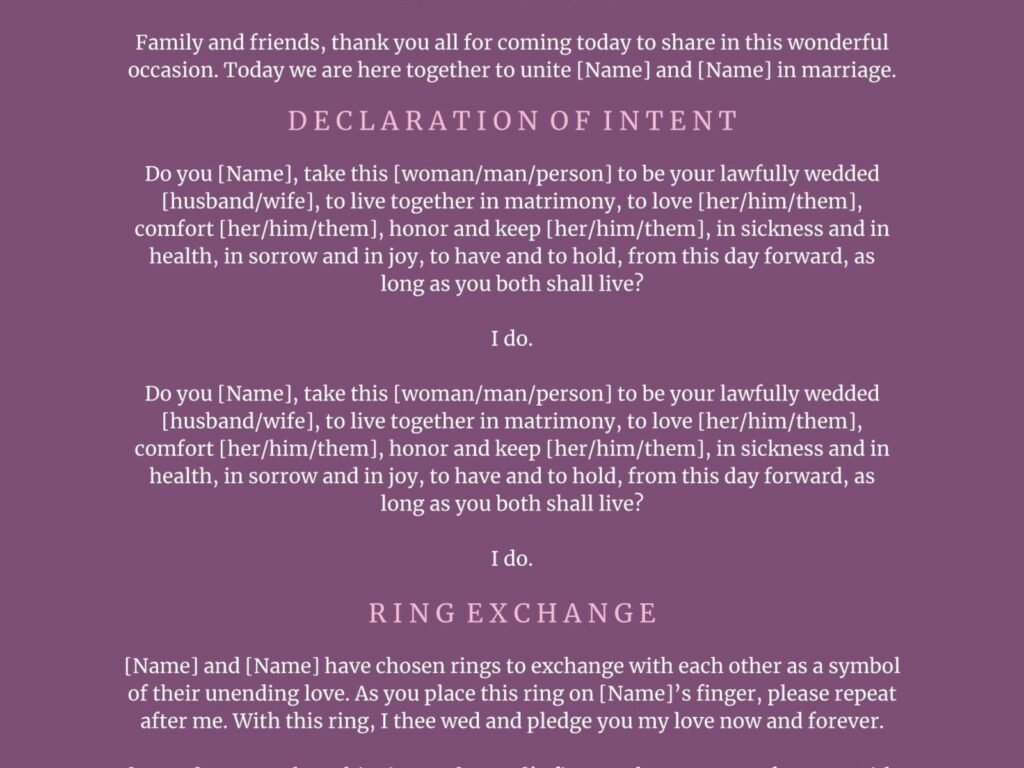
“Dearly beloved, we are gathered here today to witness the union of [Name] and [Name] in holy matrimony. Marriage is a sacred commitment, not to be entered into lightly, but with reverence and joy.”
But honestly that’s kinda stuffy for a lot of people. Here’s something more casual:
“Welcome everyone! We’re here today because [Name] and [Name] fell in love and decided they wanted to make it official. And also because they promised us cake later. But mostly the love thing.”
Or something in between:
“Thank you all for being here to celebrate [Name] and [Name]. Your presence means the world to them. Today isn’t just about two people making promises to each other—it’s about the community of family and friends who will support them through those promises.”
I usually tell couples to think about what they want people to feel right at the start. Emotional? Relaxed? Joyful? The opening sets that up.
Reading Ideas That Actually Work
Okay so readings are optional but they can fill time and add different voices to your ceremony. You can have family members or friends do them. Classic options include:
1 Corinthians 13:4-8 – The “love is patient, love is kind” one. It’s used constantly but there’s a reason for that.
Apache Wedding Blessing – “Now you will feel no rain, for each of you will be shelter to the other…” It’s beautiful and not overly religious.
Excerpt from “The Velveteen Rabbit” – Sounds weird but the part about becoming real through love actually works great.
My personal favorite non-traditional reading is from “Union” by Robert Fulghum. It starts with “You have known each other from the first glance of acquaintance to this point of commitment.” The whole thing is like five minutes long but it really captures the journey of a relationship.
Or you can skip readings entirely. Nah really, you can. Your ceremony doesn’t need to be a certain length. I’ve done 10-minute ceremonies that felt complete and meaningful.
Vow Examples Because This Is The Hard Part
So vows are where people really freeze up. Do you write your own? Use traditional ones? Mix both? There’s no wrong answer but you both need to be on the same page about which route you’re taking. Nothing worse than one person showing up with three handwritten pages and the other person expecting to just repeat after the officiant.
Traditional vows you’ve heard a million times:
“I, [Name], take you, [Name], to be my lawfully wedded [husband/wife/spouse], to have and to hold from this day forward, for better or for worse, for richer or for poorer, in sickness and in health, to love and to cherish, till death do us part.”
These work. They’re time-tested. Nobody will judge you for using them.
Modified traditional vows:
“I, [Name], choose you, [Name], to be my partner in life. I promise to love you, respect you, and support you. I promise to laugh with you in joy and comfort you in sorrow. I promise to grow alongside you, to be patient with you, and to always make you coffee in the morning because you’re grumpy without it.”
See how that last bit makes it personal? You can take a traditional structure and add your own details.
Fully personalized vows:
“Sarah, I promise to always be your partner in adventure, whether that’s traveling the world or just trying new restaurants in our neighborhood. I promise to support your dreams even when they scare me a little. I promise to never finish the last episode of a show without you, to always laugh at your jokes even the bad ones, and to love you more tomorrow than I do today.”
When you’re writing your own vows, I usually suggest this structure: Start with why you love them or what they mean to you. Then make specific promises. Keep it under two minutes when you read it out loud or people’s attention will wander and also you’ll probably cry and need to pause.
Ring Exchange Scripts
The ring exchange can be simple or you can add meaning to it. Simple version:
Officiant: “Do you have rings to exchange as a symbol of your promises?”
Couple: “We do.”
Officiant: “[Name], please place the ring on [Name]’s finger and repeat after me: With this ring, I thee wed.”
Or you can have the officiant say something about the rings first:
“These rings are a symbol of your unending love. They are circles with no beginning and no end, representing the eternal nature of your commitment. As you place these rings on each other’s fingers, you mark this moment as the beginning of your married life together.”
Then the couple can either repeat words or just exchange rings silently. Both work fine.
The Pronouncement Part
This is the “I now pronounce you” moment. Traditional version:
“By the power vested in me by the state of [State], I now pronounce you husband and wife. You may kiss your bride.”
But you can change the language to fit you:
“By the power vested in me, and more importantly by the power of your love for each other, I now pronounce you married! You may seal your promises with a kiss.”
Or:
“[Name] and [Name], you have declared your love and commitment before your family and friends. You have made promises to each other and sealed them with rings. I now pronounce you legally married. Kiss already!”
That last one always gets a laugh.
Full Script Example For A Casual Ceremony
Okay so here’s how it all comes together. This is something I helped put together for a couple who wanted relaxed and personal but still… I dunno, still ceremonial enough that it felt like a wedding:
Officiant: “Good afternoon everyone! Thank you for being here to celebrate Emma and Jake. For those who don’t know me, I’m Rachel, Emma’s college roommate and the person who introduced these two at that disastrous karaoke night in 2019. You’re welcome.
We’re here because Emma and Jake decided that loving each other wasn’t enough—they wanted to stand up in front of all of you and make it official. Marriage is a big deal. It’s promising to choose each other every single day, even on the days when someone forgets to take out the trash or leaves wet towels on the bed.
Emma’s mom is going to read something that Emma picked out.”
[Reading happens here]
Officiant: “Now for the important part. Emma and Jake have written their own vows.
Emma, you’re up first.”
Emma: “Jake, I promise to always be your biggest cheerleader and your honest critic when you need one. I promise to make you laugh, to adventure with you, and to build a life that we’re both proud of. I promise to love you on easy days and hard days, and to never stop choosing you.”
Officiant: “Jake?”
Jake: “Emma, you make me better. You make me braver. I promise to support your dreams, to be patient when you need space, and to always save you the last slice of pizza. I promise to grow with you, to communicate even when it’s hard, and to love you completely for the rest of my life.”
Officiant: “Beautiful. Now the rings. These rings represent your commitment—no beginning, no end, just continuous love and partnership. Emma, place the ring on Jake’s finger.”
Emma: “With this ring, I marry you.”
Officiant: “Jake, your turn.”
Jake: “With this ring, I marry you.”
Officiant: “Emma and Jake, you’ve made promises to each other in front of everyone who matters most to you. You’ve exchanged rings as symbols of those promises. By the power vested in me by the state of California, I now pronounce you married! Kiss each other!”
See? Not complicated. The whole thing would take maybe 12 minutes.
Full Script Example For A More Formal Ceremony
If you want something that feels more traditional, here’s a framework:
Officiant: “Welcome, family and friends. We are gathered here today to witness and celebrate the marriage of Katherine and Michael. Marriage is one of life’s greatest relationships, a union that requires love, respect, trust, and commitment.
Katherine and Michael, you have chosen to join your lives together. The promises you make today are sacred—they will serve as the foundation for your marriage and your family.
Let us hear a reading from Corinthians.”
[Reading: 1 Corinthians 13:4-8]
Officiant: “Katherine and Michael will now exchange vows. Katherine?”
Katherine: “I, Katherine, take you, Michael, to be my husband. I promise to stand by your side through all of life’s joys and challenges. I promise to respect you, encourage you, and love you unconditionally for all the days of my life.”
Michael: “I, Michael, take you, Katherine, to be my wife. I promise to honor you, cherish you, and support you in all that you do. I promise to be your partner, your friend, and your love for as long as we both shall live.”
Officiant: “May we have the rings? These rings are an outward sign of an inward bond. As you place them on each other’s fingers, you seal the promises you have made.
Katherine, repeat after me: With this ring, I thee wed.”
Katherine: “With this ring, I thee wed.”
Officiant: “Michael, repeat after me: With this ring, I thee wed.”
Michael: “With this ring, I thee wed.”
Officiant: “By the power vested in me, I now pronounce you husband and wife. You may kiss.”
That one’s more structured but still doesn’t take forever. Maybe 15 minutes with the reading.
Things To Actually Consider When Writing Your Script
Length matters. I know I keep saying this but seriously, most people can only stay focused for about 20 minutes max. Unless you’re having a full religious service with communion or whatever, aim for 15-20 minutes total. That’s processional, ceremony, and recessional.
Practice reading your vows out loud before the wedding day. What looks good on paper might feel weird to say. Also you’ll cry less if you’ve already cried during practice. Maybe. I still cry during my own practice readings sometimes and my cat judges me for it.
Make sure your officiant has a printed copy of the full script. And like, maybe email them a backup copy too. I’ve seen too many officiants show up with crumpled papers or try to wing it because they “basically remember” what you discussed. Nope. Everyone needs the same script.
Sound system considerations—if you’re outside or in a big space, people need to actually hear you. This seems obvious but I’ve been to ceremonies where the couple basically whispered their vows and half the guests missed it. Either use a microphone or project your voice.
The script should reflect both of you, not just the person who’s better at writing. I see this a lot where one partner writes the whole thing and the other just goes along with it, but then on the wedding day it feels lopsided or… I dunno, it just doesn’t feel like both people are equally present in the moment.
What About Religious Elements
If you’re incorporating religious traditions, you’ll probably have less flexibility because there are specific requirements. Catholic ceremonies have a whole structure. Jewish ceremonies have the ketubah signing and the breaking of the glass. Hindu ceremonies can last for hours with multiple rituals.
But even within religious frameworks, there’s usually some room for personalization. You can often choose specific readings, write your own vows within certain parameters, or add elements that reflect your relationship. Talk to your officiant about what’s required versus what’s flexible.
Unity Ceremony Scripts If You’re Doing Those
Some couples add unity ceremonies—candle lighting, sand pouring, wine blending, handfasting, whatever. If you’re doing one, the officiant needs to explain what’s happening. Example for candle lighting:
“[Name] and [Name] will now light a unity candle together. The two outside candles represent their individual lives, families, and experiences. As they light the center candle together, they symbolize the joining of their lives into one partnership while still maintaining their individual identities.”
Honestly though, unity ceremonies are totally optional and they add time to your ceremony, so only include them if they actually mean something to you, not because you saw it on Pinterest and thought it looked pretty.
Working With Your Officiant
Your officiant can be a friend who got ordained online, a professional celebrant, or a religious figure. Whoever it is, they should help you write the script or at least review what you’ve written. They’re gonna be the one actually saying most of it, so they need to be comfortable with the words.
Some officiants have their own style and preferred scripts. Others will literally say whatever you want them to say. Have this conversation early so you’re not scrambling to rewrite everything two days before the wedding.
Also make sure your officiant knows how to pronounce everyone’s names. Seems basic but I’ve watched officiants butcher names during the ceremony and it’s awkward for everyone.
Random Tips That Don’t Fit Anywhere Else
Have tissues nearby. Somebody’s gonna cry. Probably you.
If kids are in your wedding party, keep their parts short and simple. Like really short. A five-year-old isn’t gonna stand still for a 25-minute ceremony.
Consider the weather if you’re outside. Wind makes it hard to read from paper—maybe put your script on a tablet or have your officiant hold your papers. Also, sun in your eyes during vows is miserable, so think about where everyone’s standing.
You can change the traditional pronouncement if you want. “Husband and wife” can become “married couple” or “life partners” or whatever fits you. It’s your ceremony and language matters to some people.
Don’t stress about making it perfect. I’ve seen ceremonies where someone forgot their line, where the rings got dropped, where someone’s phone went off during the vows… and you know what? The couple still got married and everyone still had a good time. The point is the commitment you’re making, not performing a flawless ceremony.