Planning Guides, Style Guide
Traditional Wedding Program Examples: Sample Ideas & Examples
Apr
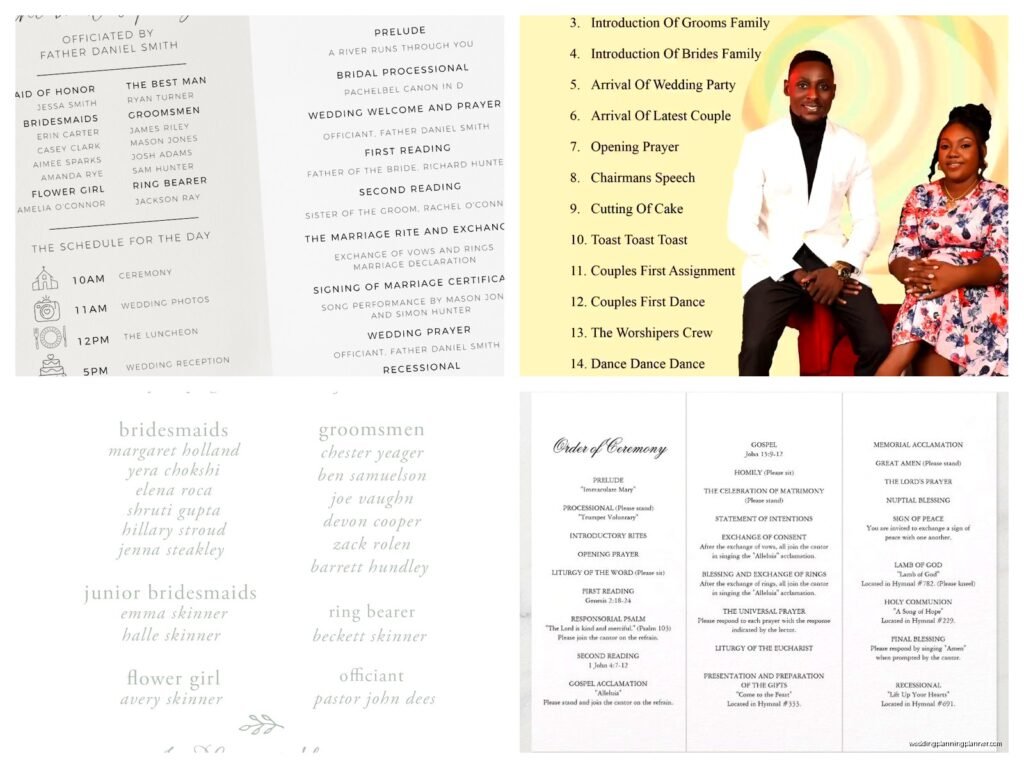
The Basic Traditional Ceremony Program Structure
So traditional wedding programs are basically your ceremony roadmap and honestly they’re one of those things couples stress about way more than they need to. The standard format is pretty straightforward – you’ve got the ceremony order, the wedding party names, maybe some thank yous, and that’s kinda it. I had this bride back in spring 2023 who wanted to reinvent the entire program concept and we spent like three hours discussing it when really she just needed the basics.
The cover usually has your names, the date, the location, and maybe a nice quote or something. Inside you’re listing everything that happens during the ceremony in order. That’s it. That’s the whole thing.
Cover Page Elements You Actually Need
Alright so the cover needs:
- Both your full names (or however you want them displayed)
- Wedding date
- Ceremony location – city and state at minimum
- Optional: time of ceremony
- Optional: a meaningful quote or scripture
I’ve seen couples get really creative here but honestly the traditional route is just elegant script fonts with your names biggest, then the other details smaller below. You don’t need to overthink this part.
Sample Ceremony Order Section
This is where you list what’s actually gonna happen during your ceremony. For a traditional Christian ceremony it usually looks something like:
Order of Ceremony
- Processional
- Welcome and Opening Prayer
- Giving Away of the Bride (or Declaration of Support)
- Scripture Readings
- Homily or Message
- Exchange of Vows
- Exchange of Rings
- Lighting of Unity Candle (if applicable)
- Pronouncement of Marriage
- The Kiss
- Introduction of the Couple
- Recessional
For a Catholic ceremony you’d add in the Rite of Marriage, the Lord’s Prayer, Nuptial Blessing, and Holy Communion. Jewish ceremonies would include the Seven Blessings, breaking of the glass, that whole structure. You get the idea – it depends on your tradition.
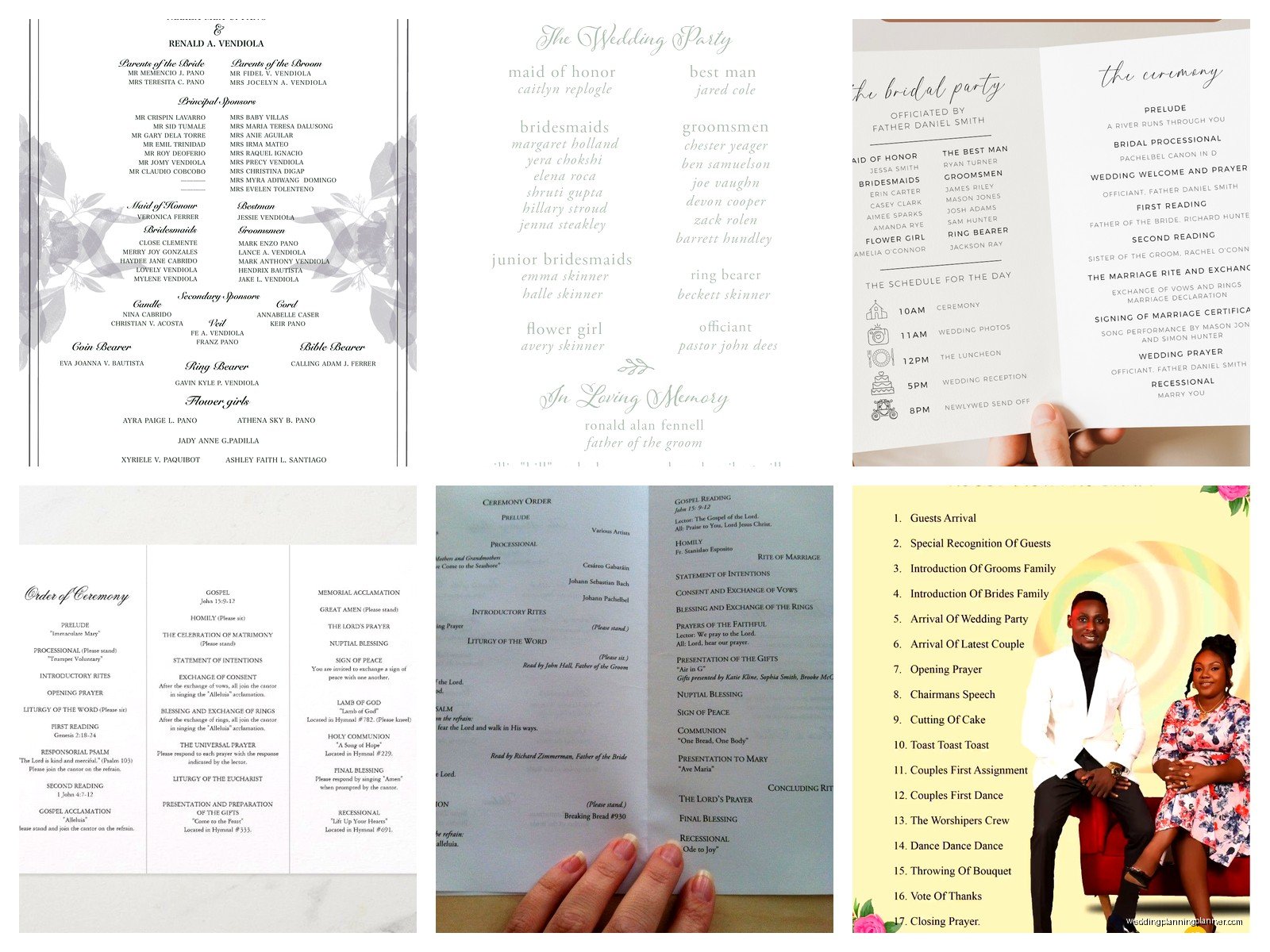
What really annoyed me about programs for a while was when couples would list like fifteen different songs by full title and artist in the ceremony order section and it made everything so cluttered. Like I get you want to credit your musicians but there’s a better place for that.
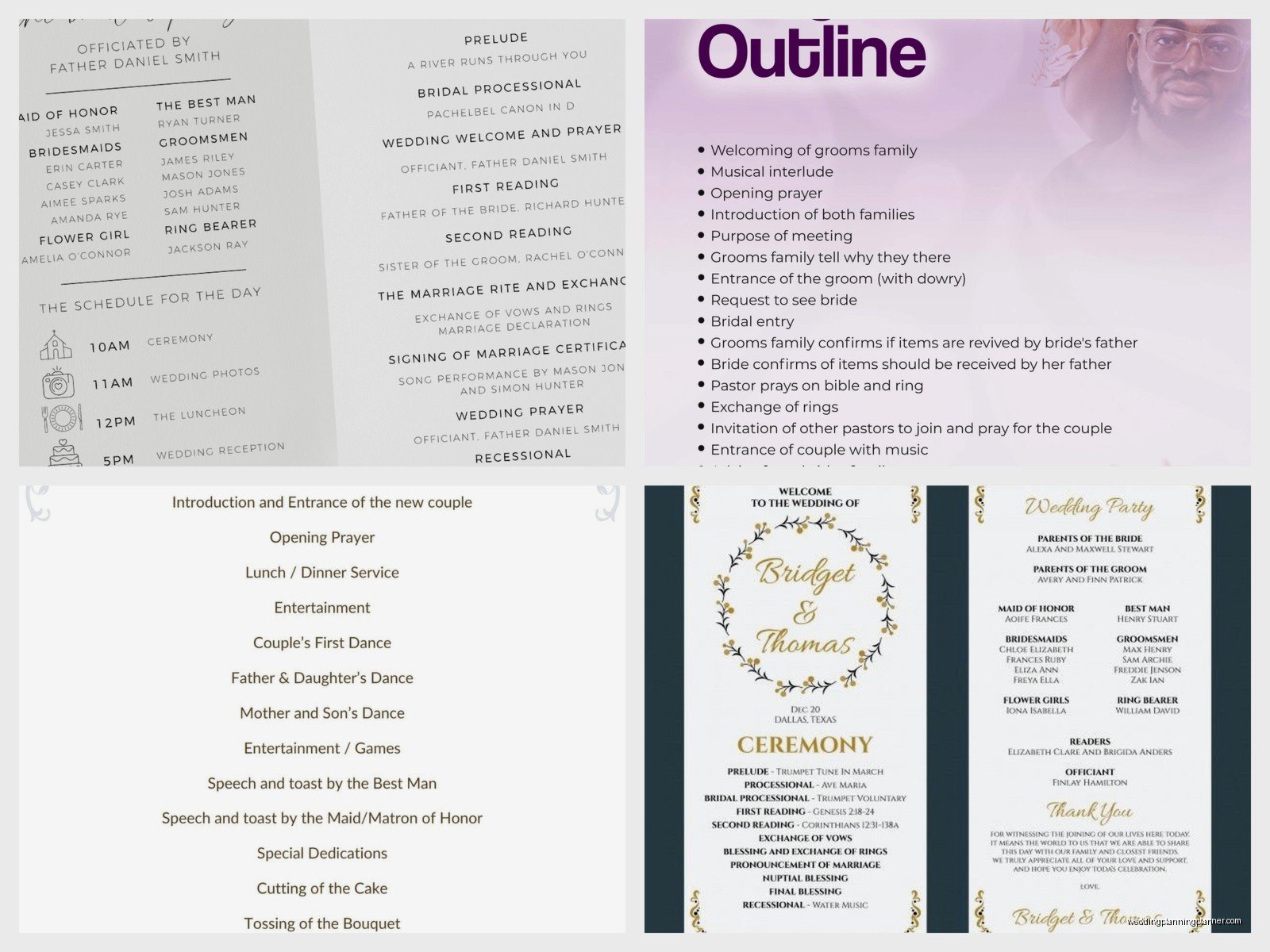
The Wedding Party Section
This is where you list everyone standing up there with you. Traditional format goes:
Wedding Party
Maid/Matron of Honor: [Full Name]
Best Man: [Full Name]
Bridesmaids: [list all names]
Groomsmen: [list all names]
Flower Girl: [name]
Ring Bearer: [name]
You can also include:
- Officiant name and title
- Readers
- Musicians/Soloists
- Ushers if they’re not already listed as groomsmen
- Junior bridesmaids/groomsmen
- Parents’ names
Some couples do a whole “Our Families” section that lists parents, grandparents, siblings. I think this is nice for smaller families but can get really long if you’ve got a lot of people.
Traditional Catholic Wedding Program Example
Catholic ceremonies are longer and have more specific elements so the program needs to be more detailed. Here’s what I usually recommend:
The Entrance Rite
- Processional: [song name]
- Greeting
- Opening Prayer
The Liturgy of the Word
- First Reading: [book, chapter, verses] read by [name]
- Responsorial Psalm: [psalm number]
- Second Reading: [book, chapter, verses] read by [name]
- Gospel Acclamation
- Gospel: [book, chapter, verses]
- Homily
The Rite of Marriage
- Questions Before the Consent
- Consent (Exchange of Vows)
- Blessing and Exchange of Rings
- Prayer of the Faithful
The Liturgy of the Eucharist
- Preparation of the Gifts
- Prayer Over the Gifts
- Eucharistic Prayer
- The Lord’s Prayer
- Nuptial Blessing
- Sign of Peace
- Holy Communion
- Prayer After Communion
The Conclusion
- Final Blessing
- Dismissal
- Recessional: [song name]
Yeah it’s long. Catholic weddings are no joke when it comes to the program because there’s so much happening. You want your guests to be able to follow along especially if they’re not Catholic and don’t know when to stand or sit or kneel or whatever.
Jewish Wedding Program Sample
Jewish ceremonies have their own beautiful structure and honestly I love how meaningful every element is. A traditional program might look like:
Ceremony Outline
- Processional
- Welcome and Introduction
- Circling (Hakafot) – the bride circles the groom seven times
- Betrothal Blessings (Birchot Erusin)
- Ring Ceremony and Vows
- Reading of the Ketubah (marriage contract)
- Seven Blessings (Sheva Brachot)
- Sharing of Wine
- Breaking of the Glass
- Yichud (seclusion of bride and groom)
- Recessional
A lot of couples include English translations of the Hebrew blessings right in the program which I think is really helpful. You can also explain what each element symbolizes – like the chuppah representing the home you’re building together, or the breaking of the glass remembering the destruction of the Temple.
Protestant/Non-Denominational Examples
These tend to be simpler and more flexible. You’ve got more freedom to customize while still keeping traditional elements. Here’s a sample structure:
Prelude Music
Seating of the Mothers
Processional
- Entrance of the Wedding Party
- Entrance of the Bride
Welcome and Invocation
Declaration of Intent
Giving of the Bride (or Blessing of the Families)
Scripture Readings
- [First reading] by [name]
- [Second reading] by [name]
Message from the Officiant
Exchange of Vows
Exchange of Rings
Unity Ceremony (candle, sand, wine, etc.)
Prayer and Blessing
Pronouncement of Marriage
First Kiss
Introduction of the Newlyweds
Recessional
What About Music Listings?
So this is where you can include all those song details I mentioned earlier. Create a separate section called “Musical Selections” or “Ceremony Music” and list:
- Prelude music (if it’s specific songs)
- Processional song with artist/composer
- Any special music during the ceremony (solos, hymns)
- Unity ceremony song if you have one
- Recessional song
You can also add a “Special Thanks” section here for your musicians, vocalists, organist, whoever.
The Thank You Section
This goes at the end usually and it’s where you acknowledge people who helped make your day possible. Traditional wording is pretty simple:
With Gratitude
We would like to thank our parents for their endless love and support, our wedding party for standing beside us today, and all of our family and friends for traveling to celebrate with us. Your presence means the world to us.
Or you can get more specific:
Thank You
To our parents, [names], thank you for your unconditional love, guidance, and support.
To our wedding party, thank you for your friendship and for being part of our special day.
To [officiant name], thank you for leading us through this sacred ceremony.
To our family and friends, thank you for surrounding us with love today.
I had a groom once who wanted to individually thank like 40 people in the program and I was like… maybe we just do a general thank you because this is turning into a novel. He didn’t listen and the program was eight pages. Eight pages! My cat could’ve edited that down, honestly.
Memory Honors
If you want to honor deceased family members, there’s usually a small section for that. Keep it simple and tasteful:
In Loving Memory
We remember and honor those who are with us in spirit:
- [Name], grandfather of the bride
- [Name], grandmother of the groom
Some couples include a quote here like “Those we love don’t go away, they walk beside us every day” or something similar but honestly you don’t have to. Just their names is enough.
Format and Design Considerations
Traditional programs are usually single-sheet folded (so four pages total when you fold a standard 8.5×11 sheet) or a flat card. The folded version gives you more space which you need for Catholic or Jewish ceremonies or if you’re including a lot of… wait I’m getting off track.
Standard sizes:
- 5×7 inches (flat or folded)
- 5.5×8.5 inches (half of standard letter, folded)
- 4.25×11 inches (folded to 4.25×5.5)
- 8.5×11 inches folded in half
You want readable fonts – nothing too scripty for the body text. Save the fancy calligraphy for names and headers. And please, please use adequate spacing. I’ve seen programs that were so crammed with text that guests couldn’t read them and what’s even the point then?
Paper and Printing
Traditional doesn’t mean boring. You can use:
- Cardstock (80lb or heavier)
- Linen or textured paper
- Vellum overlays for a elegant look
- Letterpress printing (pricey but gorgeous)
- Foil stamping for names or borders
Most couples go with digital printing because it’s affordable and looks professional. You’re gonna need one program per couple or family, not per person. So if you’re expecting 150 guests, order like 75-80 programs.
Real Example From My Files
Let me share what I did for a wedding in summer 2021 because it was pretty traditionally structured but still personal. The couple wanted classic elegance, nothing too modern.
Cover:
The Marriage of
Katherine Elizabeth Morrison
and
James Michael Patterson
Saturday, the Twenty-Eighth of August
Two Thousand Twenty-One
Four O’Clock in the Afternoon
St. Mary’s Catholic Church
Greenwich, Connecticut
Inside left panel had the ceremony order (similar to the Catholic example I gave earlier)
Inside right panel:
Officiant: Father Robert O’Brien
Parents of the Bride:
Mr. and Mrs. Thomas Morrison
Parents of the Groom:
Mr. and Mrs. Richard Patterson
Maid of Honor: Sarah Morrison (sister of the bride)
Best Man: Christopher Patterson (brother of the groom)
[Listed all bridesmaids and groomsmen]Readers:
Mrs. Patricia Morrison, grandmother of the bride
Mr. David Chen, friend of the couple
Musicians:
St. Mary’s Choir
Margaret Williams, Organist
Thomas Grant, Soloist
Back panel had thank yous and memory honors
Simple, traditional, elegant. Nobody was confused about what was happening during the ceremony and that’s really the whole point of having a program anyway.
Wording Alternatives
If you don’t like the traditional “giving away” language, you can use:
- “Blessing of the Union” or “Blessing of the Families”
- “Family Blessing and Support”
- “Declaration of Family Support”
- Or just skip it entirely in the program
For the pronouncement section, you might see:
- “Pronouncement of Marriage”
- “Declaration of Marriage”
- “Announcement of Marriage”
All mean the same thing basically – it’s when the officiant says you’re officially married.
Bilingual Programs
If you’ve got guests who speak different languages, you can do a bilingual program. Usually this means either side-by-side columns (English on left, Spanish on right, for example) or you do the ceremony order in one language and then repeat it in the other language.
This obviously makes your program longer so you might need to go with a larger format or a booklet style instead of a single fold. I’ve done several English/Spanish programs and a few English/Korean ones and they always turn out really meaningful for families.
What You Can Skip
Honestly you don’t need programs at all if your ceremony is short and straightforward. But if you’re having one, you can skip:
- Song titles (just note “Processional” without the specific song)
- Extended thank yous (save it for the reception)
- Your “love story” (that’s not traditional anyway)
- Detailed explanations of every ceremony element
- Photos of you two
Keep it focused on helping guests follow the ceremony and knowing who everyone is. That’s the traditional purpose and it still works.
The biggest mistake I see is couples trying to cram too much information into the program. You’ve got your whole lives to tell people your story – the program just needs to get everyone through the next 30-60 minutes without confusion. Print them a week before the wedding, have someone distribute them as guests arrive, and you’re good to go.