Planning Guides, Style Guide
Laser Cut Wedding Invitations: Intricate Die-Cut Designs
May
Okay so laser cut invitations are gorgeous but here’s what you actually need to know
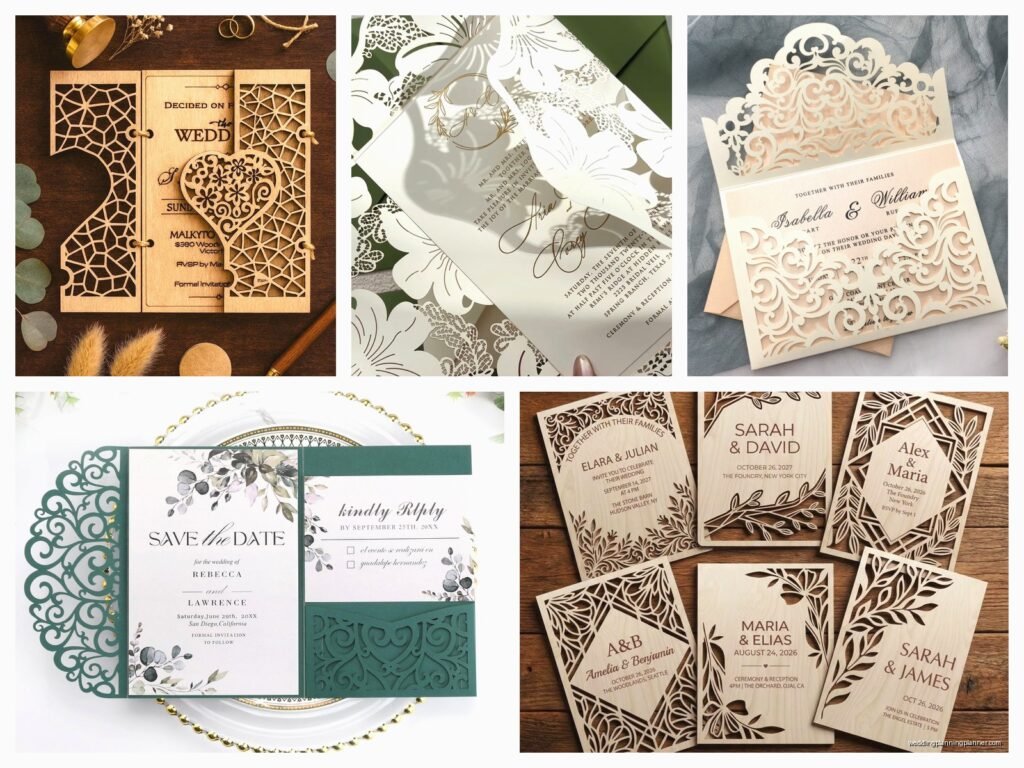
Laser cut wedding invitations are basically invitations where a machine uses a laser to cut intricate patterns into paper or cardstock. The result is these super detailed designs that look way more expensive than they sometimes are. Think lace patterns, floral cutouts, geometric shapes, mandala designs – anything that has that delicate, fancy look that makes your guests go “wow they spent money on THIS.”
I’ve been working with these since like 2018 and honestly they’ve gotten so much more accessible. Used to be only the couples with massive budgets could afford them but now you can find options at different price points which is… well it’s changed the game completely.
The different types you’re gonna see
There are basically three main styles and I wish someone had explained this to me clearly when I started because I made some embarrassing mistakes with a client in spring 2023 where I ordered the wrong type and had to eat the cost myself.
Wrap-around laser cuts
These are where the laser cut design wraps around your actual invitation like a sleeve or belly band. You slide the invitation card into the decorative laser cut layer. Super popular for formal weddings because they look really elaborate. The laser cut part is usually a different color than the invitation inside – like a burgundy laser cut sleeve with a cream invitation, or a navy wrap with white inside.
Single-layer with cutouts
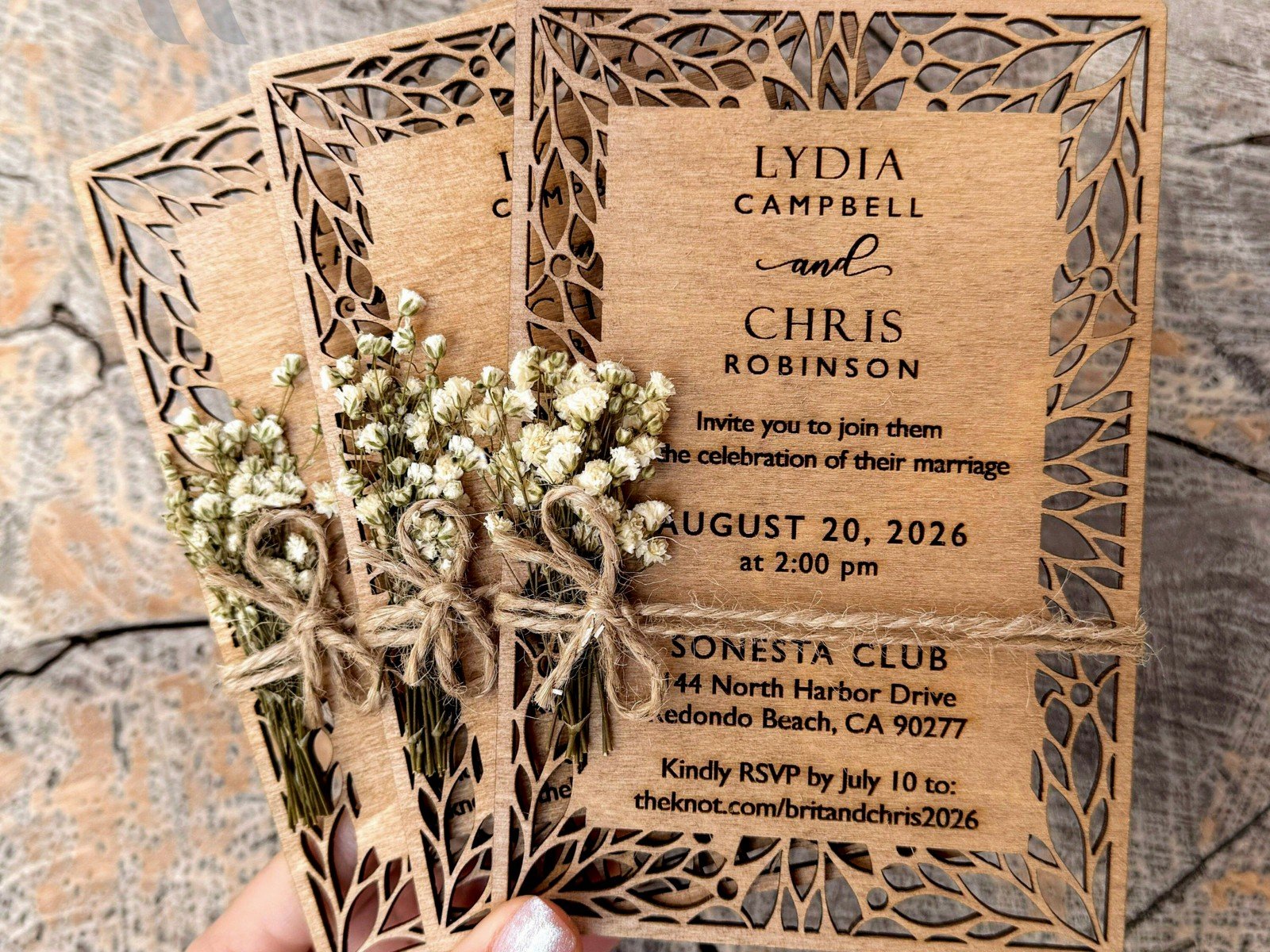
This is where your invitation itself IS the laser cut piece. The text sits on a card that has the design cut directly into it. You usually need a backing layer in a contrasting color so the cutouts show up properly. Like if you have white with laser cuts, you’d put a gold or blush backing behind it so when light hits it or you look at it, the design really pops.
Gate-fold or tri-fold designs
These open like little doors or fold out in sections, with laser cut patterns on the panels. They’re the most dramatic option and also the most expensive usually. I had a bride spend $3,200 on 150 of these once and they were STUNNING but also she cried when she saw the invoice so… budget accordingly.
What actually affects the price
This is where couples get confused and I gotta be real with you, the pricing structure is kinda all over the place depending on where you’re ordering from.
Intricacy of the design: More cuts = more laser time = more money. A simple geometric border will cost less than an elaborate floral pattern with 500 tiny cuts. Some companies charge by the minute of laser cutting time which sounds weird but makes sense when you think about it.
Paper weight and type: You can’t just use any paper. Needs to be thick enough to hold the design without falling apart but not so thick the laser can’t cut it cleanly. Most laser cuts work best with 250-350 GSM cardstock. Anything with metallic coating, foil, or shimmer costs more because it’s harder to cut precisely.
Number of layers: If you’re doing a wrap with an insert plus a backing card plus an RSVP card, that’s multiple pieces that all need to be cut, assembled, and… yeah the price adds up fast.
Assembly: Some places send you flat pieces and you assemble them yourself (please don’t unless you have a LOT of free time and patience). Professional assembly usually adds $1-3 per invitation but saves your sanity.
Where to actually order these things
I’ve ordered from probably 15 different companies over the years and here’s my honest breakdown.
Etsy sellers
Tons of options, prices range from $2-15 per invitation depending on complexity. Quality is really variable though – I’ve gotten some that were absolutely perfect and others where the cuts were rough or the paper smelled weird (that was annoying as hell, by the way, having to tell a bride her invitations smelled like burnt plastic). Always order samples first. Always. Even if the seller has great reviews.
Print-on-demand sites like Cards & Pockets, Invitations by Dawn
More standardized quality, usually $3-8 per invite. Less customization but you know what you’re getting. Good if you want something pretty but don’t need it to be completely unique.
High-end stationery designers
Think Bella Figura, Atelier Isabey, places like that. You’re looking at $15-40+ per invitation easily. The quality is insane though – like the paper feels luxurious, the cuts are impossibly precise, everything is perfect. Worth it if budget allows.
Local print shops with laser cutters
This is actually my favorite option when possible because you can see samples in person and work directly with someone. Prices vary wildly by location. I have a print shop I work with here and they’re fantastic but they’re also always backed up during wedding season so you gotta plan ahead.
Design considerations that actually matter
Okay so here’s where I see couples make mistakes constantly and it drives me a little crazy.
Readability is still important: I don’t care how pretty the laser cut pattern is, if guests can’t easily read your ceremony time or venue name, you’ve failed. The cutouts should frame or enhance the text, not compete with it. I once had an invitation where the laser cut was so intricate that it literally looked like the text was behind a lace curtain and you had to squint to read anything.
Your wedding vibe needs to match: Laser cuts have a definite aesthetic – they’re elegant, detailed, often traditional or romantic. If you’re having a casual backyard BBQ wedding or a minimalist modern wedding, these might not be your best choice. Not saying you CAN’T but… you’re gonna need to find the right style or it’ll feel off.
Consider the weight for mailing: These invitations can get heavy especially with multiple layers. You might need extra postage. Also they’re bulky so they can get damaged in mail processing. I always recommend hand-canceling at the post office (where they manually process them instead of sending through machines) or using inner and outer envelopes for protection.
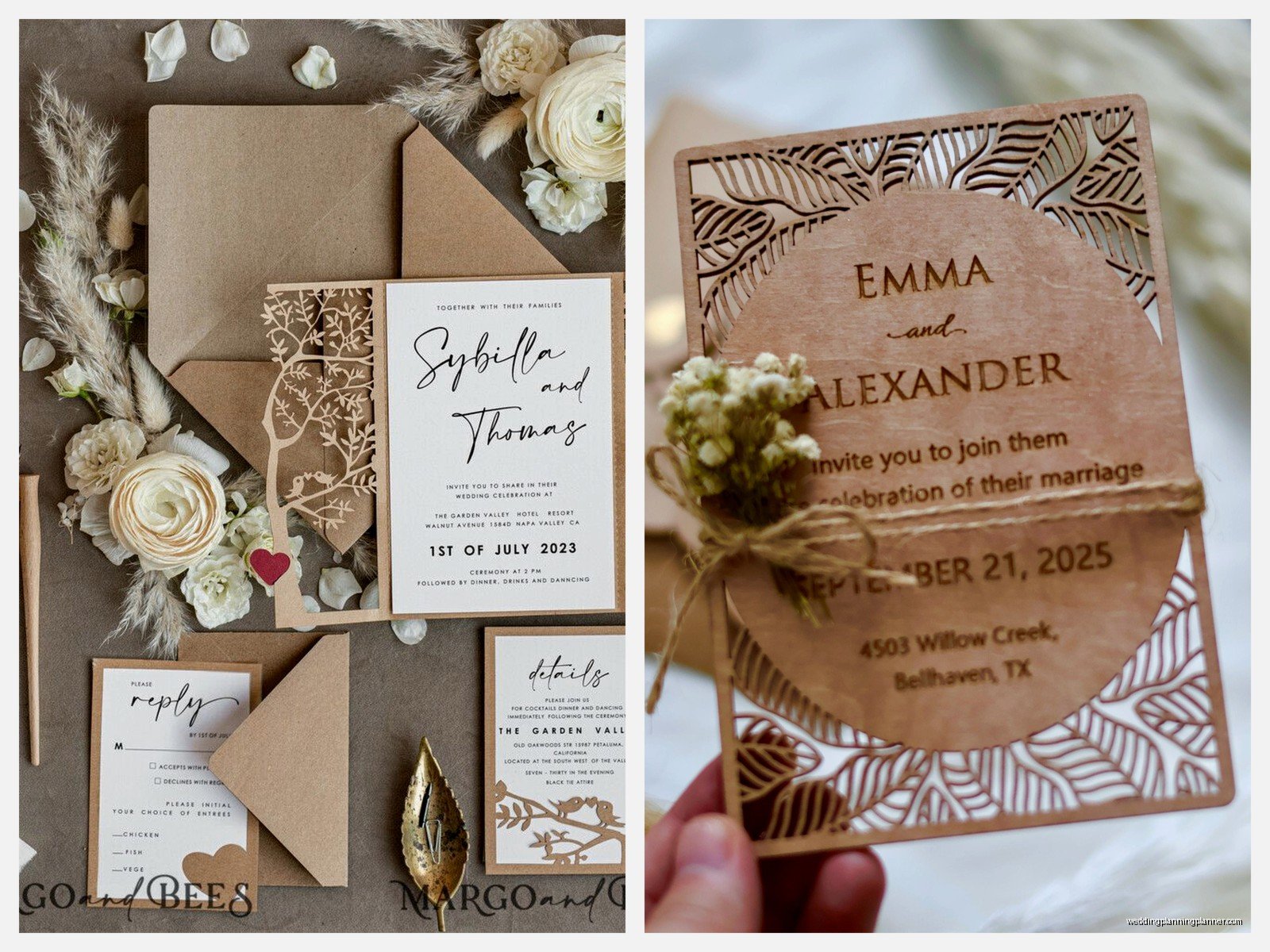
Colors and contrast: This is huge. Your backing layer color needs to contrast enough with your laser cut layer that the design shows up. White on ivory? Nah that’s gonna look muddy. White on navy blue? Perfect. Gold on burgundy? Chef’s kiss. You want people to actually SEE the intricate work you paid for.
Timeline stuff you need to know
Laser cut invitations take longer than regular printed invitations and this is where couples panic when they realize they should’ve ordered earlier.
Design phase: 2-4 weeks if you’re doing custom design. Less if you’re choosing from existing templates.
Production: 3-6 weeks typically. Rush orders are possible but expensive and not all companies offer them.
Assembly: If you’re DIYing this, add another 2-3 weeks depending on your quantity and how much time you can dedicate. My cat knocked over an entire box of partially assembled invitations once during a work session at home and I wanted to cry… actually I did cry a little.
Addressing and mailing: Another 1-2 weeks.
So you’re looking at 8-15 weeks total from start to finish. I tell clients to order 4 months before they want to mail them out, which is about 6 months before the wedding.
DIY vs professional and what that actually means
Some couples want to DIY laser cuts and look, I’m not gonna tell you not to, but understand what you’re getting into.
You’d need access to a laser cutter (libraries and makerspaces sometimes have them) or you’d order pre-cut pieces and just assemble them yourself. If you’re just assembling, it’s tedious but doable. Each invitation might take 5-10 minutes to put together properly – inserting cards into wraps, adhering backing layers, adding belly bands or ribbons. For 100 invitations that’s 8-16 hours of work.
I had a bride in summer 2021 who insisted she’d assemble 200 laser cut invitations herself because she wanted to “save money” and then called me three weeks before mail date sobbing because she’d only finished 30 and her hands hurt and she was behind on everything else. We ended up hiring it out last minute which cost MORE than if she’d just paid for assembly from the beginning. Just… think about your actual available time and energy, not your theoretical available time.
What to include in your laser cut suite
The main invitation is obvious but you’ve got other pieces to think about and this is where the cost can really explode if you’re not careful.
The main invitation: Ceremony details, this is your showcase piece with the laser cutting.
RSVP card: Some people do a matching laser cut RSVP but honestly I think that’s overkill and a waste of money. A coordinating printed card is fine.
Details card: Reception info, hotel blocks, website, etc. Again, doesn’t need to be laser cut.
Envelopes: Inner and outer if you’re fancy. The outer envelope sometimes has a laser cut liner which looks amazing but adds cost.
Belly band, ribbon, or wax seal: These are optional finishing touches that tie everything together literally and figuratively.
Common problems and how to avoid them
Rough edges on cuts: This happens with cheap laser cutting or when the laser settings are wrong. Should feel smooth when you run your finger along the cuts. If they’re rough or have burn marks, that’s poor quality.
Colors looking different than expected: Always always ALWAYS order a physical sample. Colors on screens are not accurate especially for specialty papers. What looks like dusty rose on your monitor might be straight-up pink in person.
Cards not fitting properly into wraps: This is a measurement issue. The invitation card should slide smoothly into the laser cut wrap without forcing but also not be so loose it falls out. Quality companies get this right but budget options sometimes have tolerance issues.
Text placement issues: Make sure your text isn’t too close to the laser cut edges or it’ll get lost in the design. Needs proper margins and breathing room.
Matching the rest of your stationery
If you’re doing laser cut invitations, you’ll probably want to coordinate your other paper goods but you don’t need to go full laser cut on everything (please don’t, it’s unnecessary spending).
Programs can have a simplified version of your laser cut pattern as a printed border. Same with menus, table numbers, place cards. You’re echoing the design without literally laser cutting every single piece which would be insane and expensive.
Some couples do laser cut table numbers or escort cards as a splurge item since you need fewer of those. That can be a nice way to bring the detail into your reception without going overboard.
Wording and layout specific to laser cuts
The layout needs to work with your laser cut design which sometimes means adjusting traditional invitation wording or formatting. If you have a vertical laser cut pattern on the sides, your text needs to be centered and narrow. If you have a border design, your text sits in the middle.
Some laser cut styles have specific areas where text MUST go based on where the cutouts are. You can’t just plop any wording layout onto any laser cut design – they need to work together. This is where working with a designer helps because they understand how to make the text and design complement each other rather than fight.
Sustainability and laser cuts
Real talk: laser cut invitations are not the most eco-friendly option. You’re using more paper (multiple layers), more energy (laser cutting process), and they’re harder to recycle because of adhesives and mixed materials.
If sustainability is important to you, look for companies using recycled paper, soy-based adhesives, and efficient laser cutting processes. Or consider digital invitations with a laser cut save-the-date as your only physical piece. Some couples do a simple laser cut invitation but skip all the extra inserts and direct people to their website for details.
Proofing is critical do not skip this
You need to proof everything multiple times before approving production. Check spelling, dates, times, addresses, website URLs, everything. But with laser cuts you ALSO need to check the design layout – is everything positioned correctly, is text readable, do the colors work, is the size right.
I recommend having at least three people proof your invitation. You’ll be staring at it so much you’ll stop seeing errors. Fresh eyes catch stuff you’ve missed five times already.
And get a physical proof if at all possible, not just a PDF. The PDF might look perfect but the physical product could have issues you wouldn’t notice otherwise. Worth the extra cost and time.
Actual budget numbers to expect
Since everyone always wants to know real numbers here’s what I typically see for 100 invitations:
Budget option: $200-400 for basic laser cut designs, self-assembly or minimal assembly, standard papers.
Mid-range: $500-1000 for more intricate designs, professional assembly, better paper quality, maybe some customization.
High-end: $1500-3000+ for fully custom designs, luxury papers, complex multi-layer constructions, professional assembly, premium finishing touches.
These numbers include printing but usually not envelopes, addressing, or postage. Add probably another $150-300 for envelopes and addressing depending on your choices.
When laser cuts might not be the right choice
If you’re on a really tight budget, honestly just do nice printed invitations. Laser cuts are beautiful but they’re not necessary and you can have elegant invitations without them.
If your wedding is super casual or has a specific theme that doesn’t match the laser cut aesthetic – like if you’re doing a retro 70s vibe or a rustic farm wedding or a beach party wedding – there are probably better invitation styles that’ll match your event better.
If you’re mailing internationally, the bulk and weight of laser cuts can make shipping really expensive and they’re more likely to get damaged in transit.
Working with a stationer vs ordering yourself
You can definitely order laser cut invitations yourself online but working with a stationer or invitation specialist (hi) means someone’s managing the whole process for you, catching potential problems before they happen, and making sure everything coordinates properly.
We also have relationships with vendors and can sometimes get better pricing or faster turnaround. Plus if something goes wrong, you have someone to advocate for you with the printer instead of dealing with customer service yourself while you’re stressed about your wedding.
But if you’re organized, detail-oriented, and have time to manage it yourself, you can save the markup by ordering direct. Just build in extra time for potential problems because something ALWAYS comes up with invitations, I swear it’s like a law of weddings or something…