Planning Guides, Style Guide
Engraved Wedding Invitations: Classic Etched Printing
May
Okay so engraved invitations are literally the most traditional printing method
When couples ask me about engraved wedding invitations I always tell them straight up—this is the fancy stuff your grandmother would approve of. Like proper fancy. We’re talking about a printing technique where a metal plate gets carved with your design and then pressed so hard into thick paper that you can feel the letters raised on one side and indented on the other. It’s called intaglio printing technically but nobody calls it that except pretentious printers who want to sound smart.
The whole process is kinda wild when you think about it. A skilled engraver literally cuts your design into a copper or steel plate in reverse. Then they fill those grooves with ink, wipe the surface clean, and smoosh the paper onto it with like thousands of pounds of pressure. The result is this gorgeous raised text on the front and this beautiful impression—called a bruise in the industry which always made me laugh—on the back.
Why people still choose engraving in 2024
So here’s the thing. Engraving is expensive and slow and honestly a bit impractical but couples still want it because:
- It screams formal and traditional which matters for black-tie weddings or families who care about that stuff
- The tactile quality is unmatched—you can close your eyes and feel the letters
- It photographs beautifully with all those shadows and depth
- It’s a status thing lets be honest
- Your mother-in-law will be impressed
I had this bride in spring 2023 who was planning a super modern minimalist wedding but her mom absolutely insisted on engraved invitations because “that’s what proper families do” and we spent like three meetings just navigating that conversation. Eventually we did this gorgeous modern design with engraving and everyone was happy but man that was exhausting.
The actual timeline you need
This is where people mess up constantly. You cannot rush engraving. The plates take time to make, the printing process is slow, and if you need corrections you’re basically starting over.
Here’s what I tell clients:
- Start looking at designs 6-8 months before you need to mail invitations
- Order samples from different printers because quality varies wildly
- Finalize your design and wording 4-5 months out minimum
- Get your guest list absolutely locked down before you order
- Allow 4-6 weeks for production once you approve everything
- Budget an extra 2 weeks as buffer because something always goes wrong
The one thing that really annoyed me about engraving for years was how many printers would quote you a timeline and then just… not meet it. Like they’d say 4 weeks and then week 3 would roll around and suddenly there’s a “delay with the plates” or whatever. Now I only work with three specific engravers I trust and I always add two weeks to whatever they tell me.
What actually works design-wise
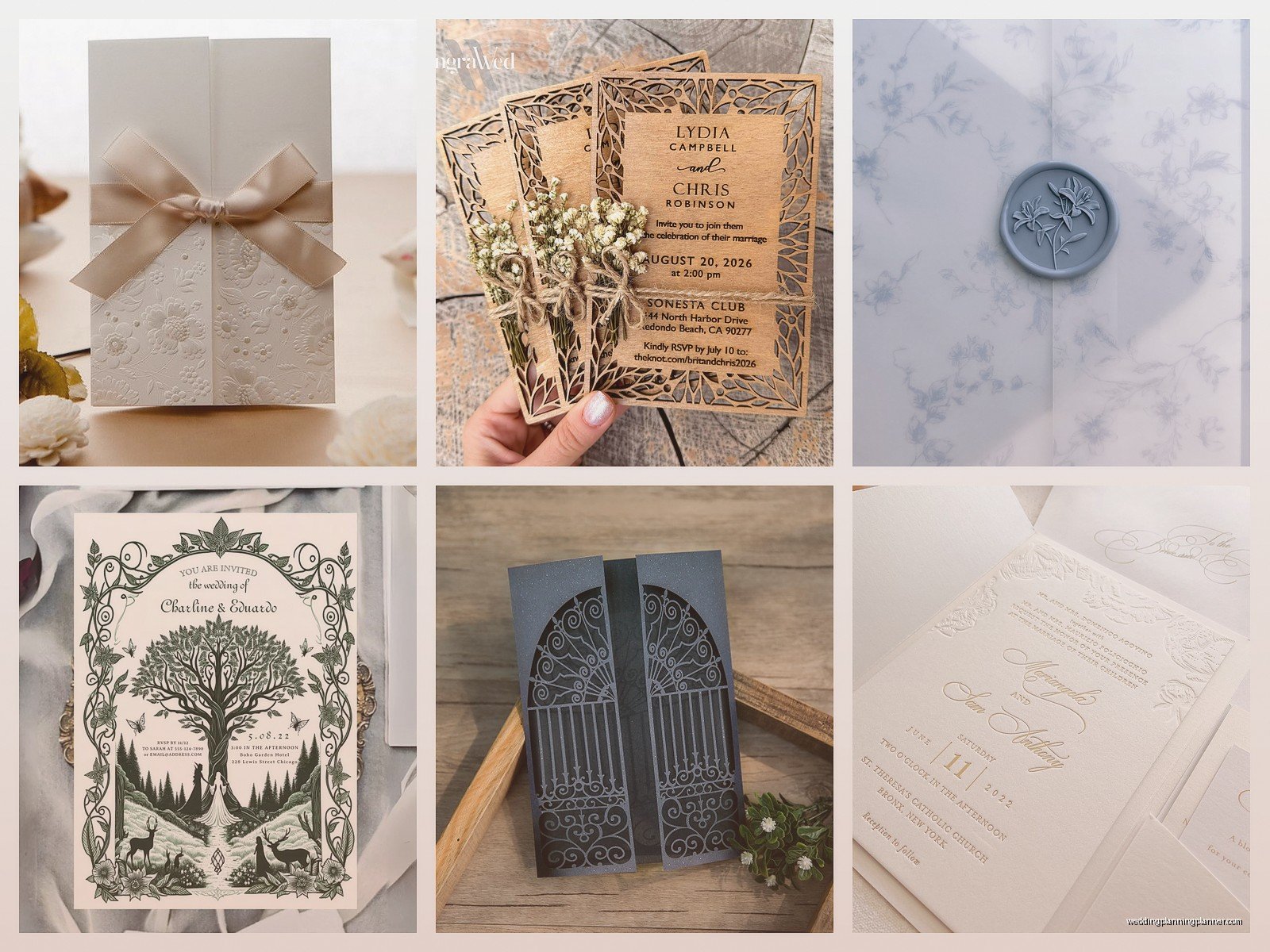
Engraving has limitations you gotta work with. You can’t do full-color designs or photographs or gradients. It’s basically line work and solid areas. But that’s not really a bad thing because the constraints actually make for elegant designs.
Best design choices for engraving:
- Classic serif fonts like Copperplate, Garamond, or Baskerville
- Traditional script fonts but not the super swirly ones that are hard to read
- Simple borders or frames
- Monograms—these look absolutely stunning engraved
- Clean layouts with good spacing
You want thick paper for engraving. Like minimum 110lb cover weight but honestly 130lb or higher is better. The paper needs to withstand all that pressure without tearing and it needs to show off that impression on the back. Cotton paper works beautifully—Crane’s Lettra is like the gold standard but there are other good options that don’t cost quite as much.
The color situation
Traditional engraving uses one color of ink per printing pass. Most couples go with black or navy because it’s classic and readable. But you can do other colors—I’ve done burgundy, forest green, chocolate brown, even a really pretty charcoal gray.
If you want multiple colors it gets complicated and expensive fast because each color needs its own plate and its own press run. I usually steer people toward either one color engraving or we combine engraving for the main text with a different printing method for accent colors. Like letterpress for a colored border or digital printing for envelope liners.
Oh and metallic inks don’t really work with engraving or they work but they look muddy and weird so just… don’t.
Cost breakdown because everyone asks
Engraving is gonna be your most expensive printing option. Period. There’s no way around it because you’re paying for:
- The engraved plates which are custom made for your design
- Skilled labor because this isn’t automated
- Premium paper that can handle the process
- Time because it’s slow
- Higher waste rate than other methods
Ballpark pricing for a full invitation suite with 100 sets:
Basic engraved invitation only: $800-1200. That’s just the main invite card, nothing else.
Full suite with invitation, response card, details card, and envelopes: $1500-3000 depending on how fancy you get.
If you add things like envelope addressing, custom envelope liners, belly bands, or additional enclosure cards you’re looking at $3000-5000+ easily.
My cat just knocked over my coffee while I’m writing this which is perfect timing because I need people to understand that these prices are real and if a printer quotes you way less they’re probably not doing actual engraving.
The thermography trap
So many couples get confused about this. Thermography is NOT engraving even though some vendors call it “raised printing” to make it sound fancy. Thermography uses powder and heat to create raised text but there’s no impression on the back and the quality is just different.
Thermography costs way less—like maybe $400-800 for what would be $1500 engraved. It looks fine honestly and most guests won’t know the difference but if you specifically want engraving for the tradition and quality, don’t let someone talk you into thermography as a substitute.
I had a vendor try to pass off thermography as engraving to one of my clients once and when I called them out on it they got all defensive like “well it’s basically the same thing” and nah… it’s not. That’s dishonest and it drives me crazy.
Working with engravers
Find a printer who specializes in engraving specifically. Not a print shop that does everything—you want someone whose whole business is traditional printing methods. Look at their portfolio and ask questions like:
- Can I see samples of your engraving work in person
- What’s your actual production timeline right now
- What happens if I need to make changes after plates are made
- What paper options do you recommend and why
- How do you handle reprints if there are errors
Good engravers will walk you through the whole process and explain limitations upfront. They’ll also do proofs—usually a digital proof first and then sometimes a plate proof which is an actual printed sample before they do your full run.
The wording and etiquette part
If you’re going traditional enough to use engraving you probably care about proper invitation wording. The classic format has the hosts listed first (traditionally the bride’s parents), then the request line, the couple’s names, and all the details spelled out completely.
Traditional rules say:
- Spell out everything—no abbreviations except Mr., Mrs., Ms., Dr.
- Write out the date and time in full
- Use “honour” and “favour” with the British spelling if you want to be really proper
- List the ceremony location with full address spelled out
- Reception details go on a separate card if it’s at a different location
But honestly I have plenty of couples who do engraving with more casual modern wording because they like the printing method but not all the stuffy tradition. That’s totally fine. Your invitations should sound like you.
Addressing envelopes
Okay so you’ve got these gorgeous engraved invitations and now you need envelopes that match the vibe. You’ve got options:
Hand calligraphy is beautiful but expensive—usually $3-8 per envelope depending on the calligrapher. Digital calligraphy or addressed printing is cheaper at $1-3 per envelope. Some people do envelope engraving for return addresses which looks amazing but adds cost and time.
I usually recommend saving money on guest addressing and splurging on engraved return addresses on the back flap. That gives you the engraved look without breaking the budget on every single envelope.
Inner envelopes are traditional with formal invitations—you have an outer envelope with the full address and an inner envelope with just the guests’ names. Honestly most couples skip inner envelopes now because it’s extra cost and kind of unnecessary but if you’re going full traditional you might want them.
The assembly situation
Engraved invitation suites usually come unassembled and you’ll need to put everything together. Order of assembly from bottom to top:
- Invitation card face up
- Reception card if you have one
- Response card tucked under the flap of its envelope
- Any other enclosure cards like directions, hotel info, weekend events
- Belly band or ribbon if you’re using one
Then everything goes into the envelope with the text facing the back flap so when someone opens it they see your beautiful invitation right away.
Some couples hire assembly services or rope in their wedding party for an assembly party with wine which can actually be fun or completely tedious depending on… I don’t know, the wine probably.
Common mistakes I see constantly
Not ordering enough extras. Always order at least 20-25 more than your guest count because you’ll have last-minute additions, damaged pieces, and you’ll want keepsakes.
Choosing paper that’s too thin. It’ll tear or not show the impression properly and then you’re stuck with mediocre results after paying premium prices.
Trying to cram too much text onto the invitation. Engraving looks best with breathing room and elegant spacing. If you have tons of information split it across multiple cards.
Not proofreading carefully enough. Once those plates are made, corrections are expensive or impossible. I literally make clients read their proof out loud to me word by word because people miss their own typos constantly.
Waiting too long to order. I cannot stress this enough—if you want engraving you need to start early because there’s no rushing this process without paying rush fees that’ll make you cry.
Alternatives if engraving doesn’t fit your situation
Look, sometimes engraving just doesn’t work. Maybe the budget isn’t there or the timeline is too tight or the design you want isn’t compatible. That’s totally fine. Other printing methods can look gorgeous too.
Letterpress gives you a similar impression and tactile quality but usually costs a bit less. Foil stamping adds metallic shine and texture. Flat printing on really nice paper with good design can be stunning and way more affordable.
The printing method matters less than the overall design and paper quality honestly. I’ve seen gorgeous flat printed invitations on luxe paper that felt more special than poorly designed engraved ones.
Samples and testing
Before you commit to anything order samples from multiple engravers. You need to see and feel the quality in person because photos don’t capture the texture and weight properly. Look at:
- How crisp the lines are
- Whether the impression is even across the whole design
- If there’s any ink bleeding or smudging
- How the paper quality feels
- Whether the bruise on the back is clean or ragged
Good engraving should have sharp clean lines and a beautiful even impression. The bruise on the back should be smooth not torn or fuzzy. The ink should be solid and rich not patchy.
Some printers charge for samples and some don’t. Either way it’s worth spending $50-100 on samples from your top choices because you’re about to spend thousands on the real thing and you want to know exactly what you’re getting.