Planning Guides, Style Guide
Muslim Marriage Card: Design & Ordering Guide
Jun
Getting the Design Right First
So the first thing you gotta know about Muslim marriage cards is that they’re not just invitations—they’re announcements of something really sacred and the design needs to reflect that without being over the top or looking like you grabbed the first template off Etsy. I learned this the hard way in spring 2023 when a client’s mother-in-law literally rejected the first proof because we’d used a floral pattern that she said looked “too Hindu wedding” and I was like… okay, back to the drawing board at 9pm on a Tuesday.
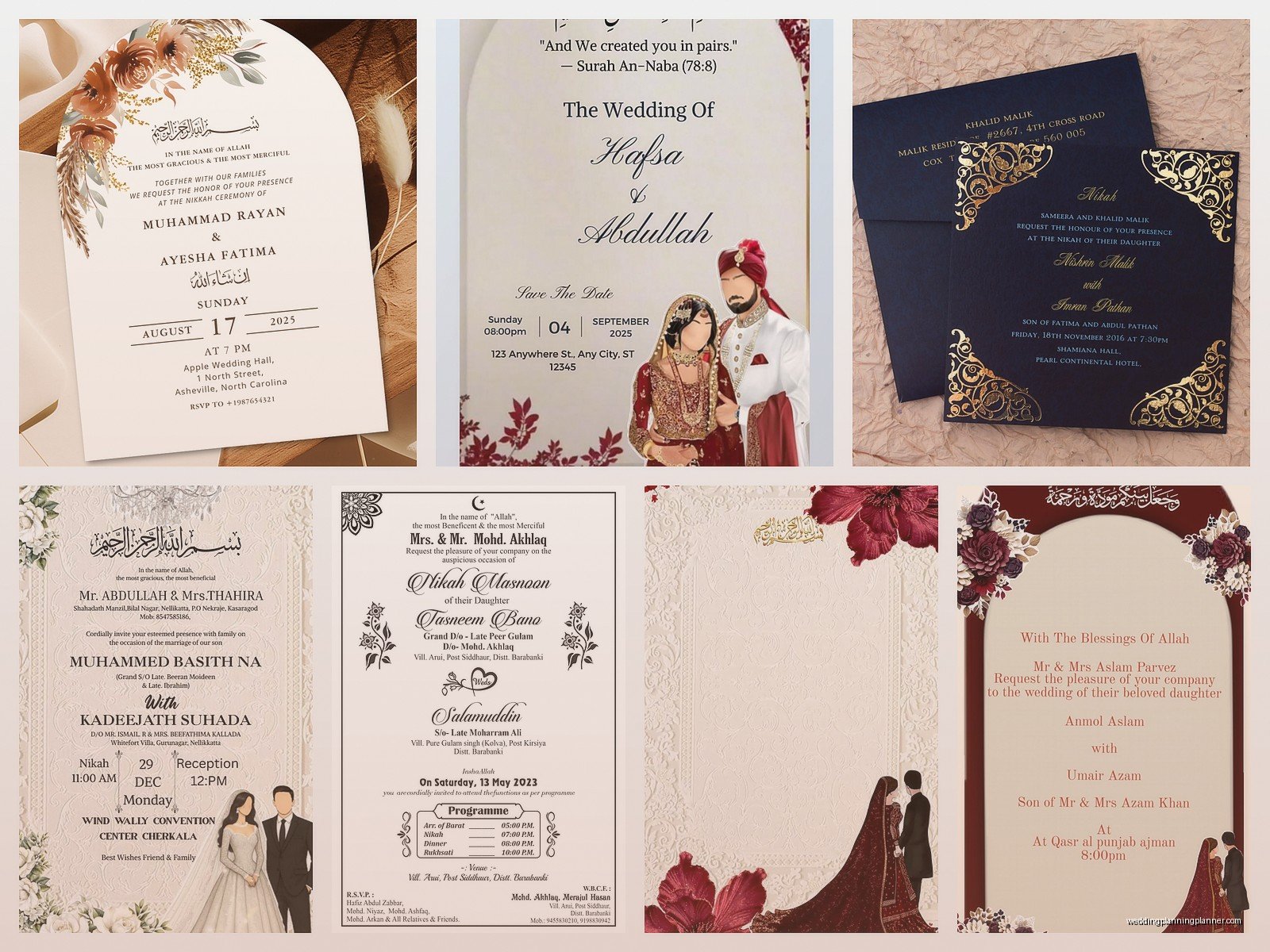
The bismillah is usually your starting point. Most Muslim wedding cards open with “Bismillah ir-Rahman ir-Rahim” or at minimum have it somewhere prominent. You’ll see it at the top, sometimes in beautiful Arabic calligraphy, sometimes in English transliteration. I always ask couples what their preference is because some families are very particular about having the Arabic script and others are fine with English. Don’t assume.
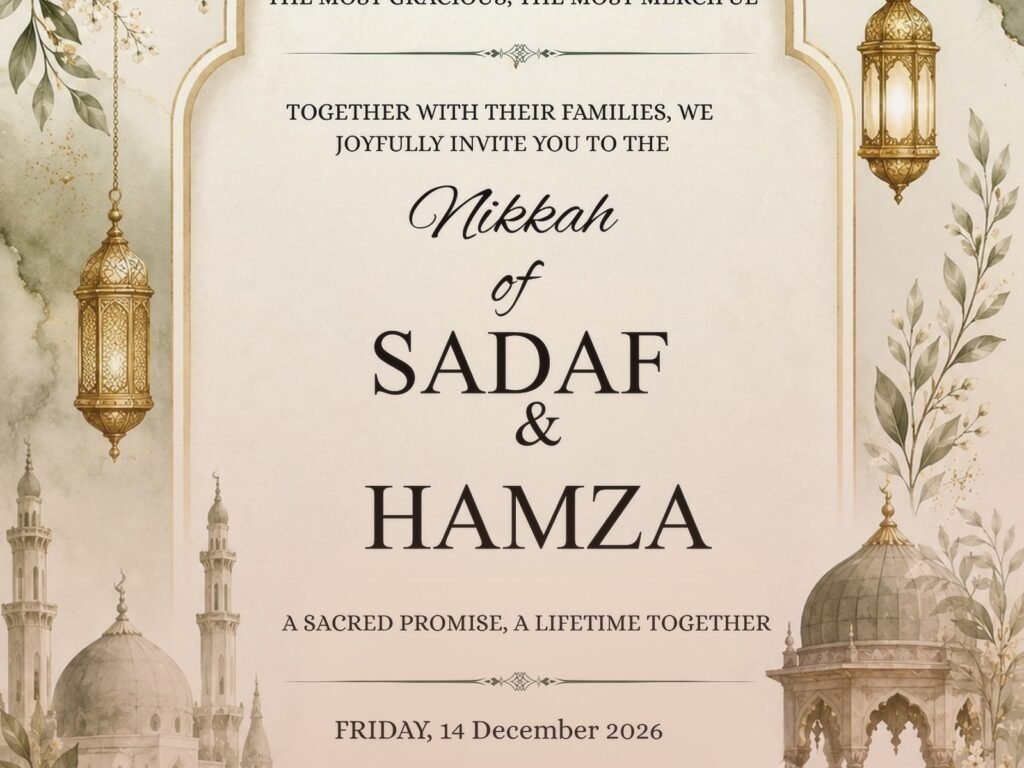
Color choices matter more than you’d think. Gold and emerald green are classic combinations. Deep burgundy with gold. Navy with silver. Ivory with rose gold has been trending lately and honestly looks gorgeous if you’re going for something a bit more modern. What really annoyed me last year was when a printer told me they couldn’t match Pantone 7727C (that specific emerald) and tried to substitute with like… a teal? Nah. That’s not how this works. Get color swatches before you commit to a printer.
Islamic geometric patterns work beautifully as borders or background elements. Arabesque designs, those intricate interlocking patterns, they add elegance without being too busy. But—and this is important—make sure the text remains readable. I’ve seen cards where the background pattern was so elaborate that you literally couldn’t read the venue address and that defeats the entire purpose.
The Wording Part That Everyone Overthinks
Okay so the wording is where families sometimes disagree and you might find yourself mediating between what the couple wants and what their parents expect. Traditional Muslim wedding cards often start with a Quranic verse. Surah Ar-Rum 30:21 is super popular: “And among His signs is this, that He created for you mates from among yourselves, that ye may dwell in tranquility with them, and He has put love and mercy between your hearts.” You can use the full verse or just reference it.
Then you’ve got the actual invitation part. Some families prefer very formal language: “Mr. and Mrs. [Father’s name] request the honor of your presence at the Nikah ceremony of their daughter…” Others go more casual: “Join us as we celebrate the marriage of…” There’s no wrong answer but you need to figure out early what tone the family wants because reprinting 200 cards is expensive and time-consuming.
Include both the Nikah ceremony details and the Walima reception if they’re separate events. Sometimes they’re on different days, sometimes different venues. Be really clear about this. I once had a guest show up to the Walima thinking it was the Nikah and they missed the actual ceremony entirely because the card layout made it confusing which event was which.
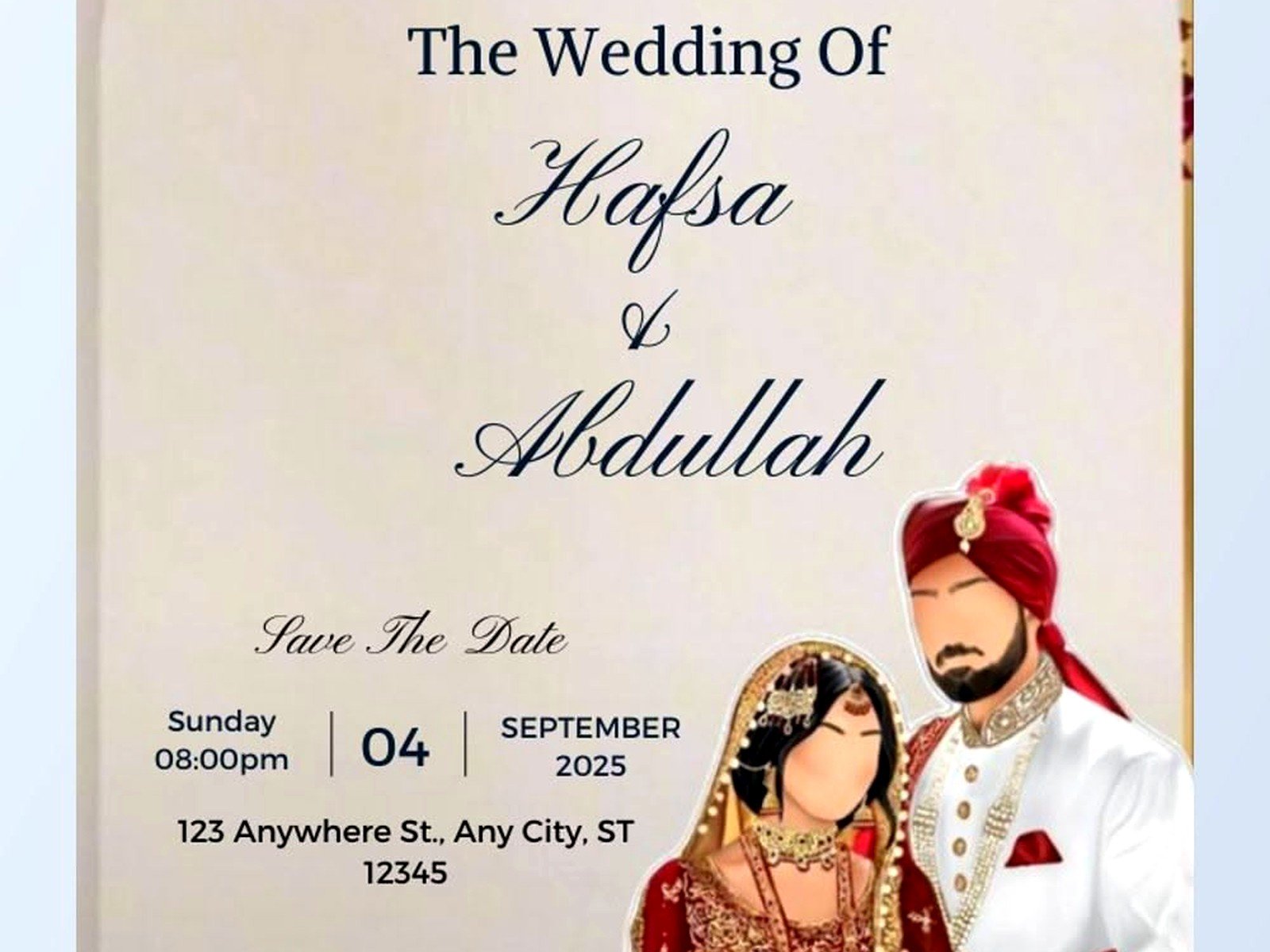
Date formatting—you might want to include both the Gregorian date and the Islamic (Hijri) date. Not everyone does this but it’s a nice touch that shows cultural respect. There are online converters that’ll tell you the Hijri date for any Gregorian date, just double-check it because I’ve seen converters that were off by a day.
Design Elements That Actually Work
Mosque silhouettes or dome illustrations can look really elegant when done right, but they can also look clipart-ish if you’re not careful. If you’re gonna use architectural elements, make sure they’re high-quality vector graphics or custom illustrations. That pixelated dome situation? Not a good look on a formal invitation.
Calligraphy is huge in Muslim wedding card design. Whether it’s the couple’s names in Arabic calligraphy or decorative elements, it adds authenticity. You can hire a calligrapher on Fiverr or through Instagram—there are tons of talented artists who specialize in Islamic calligraphy. Budget maybe $50-150 for custom calligraphy work depending on complexity.
Foil stamping in gold or silver makes everything look more luxurious. Real foil, not digital gold ink. There’s a difference and people can tell. The foil catches light and has this dimensional quality that printed gold just… doesn’t. It does add to the cost though, usually $1-3 per card depending on how much foil coverage you want.
Laser cutting is another option that’s become more accessible. You can get these intricate cut-out patterns on the card cover that reveal a colored insert underneath. They’re stunning but also kinda delicate—I always tell clients to order extras because someone’s always gonna accidentally tear one.
What About the Actual Card Structure
Single card invitations are the most straightforward. One card, all the info on it, done. They’re cost-effective and easy to mail. But they can feel a bit… simple? if you’re going for something more elaborate.
Folded cards (bifold or trifold) give you more space to work with. The front can be decorative, inside left has the invitation text, inside right might have RSVP details or a quote. Trifolds let you separate the Nikah info, Walima info, and other details across different panels.
Boxed invitations are for when budget isn’t really a concern. We’re talking $15-30 per invitation here. The card comes in a decorative box, sometimes with additional inserts, maybe some dried flowers or a small gift. They’re gorgeous and memorable but you gotta factor in shipping costs because these things get heavy.
Pocket-style invitations have a pocket (shocking, I know) that holds multiple insert cards. Main invitation, RSVP card, accommodation details, wedding website info, whatever you need. They look organized and high-end. My cat knocked over an entire stack of these once and insert cards went everywhere—took me 45 minutes to match everything back up.
The Ordering Process Nobody Warns You About
Order samples first. I cannot stress this enough. Colors look different on screen versus in print. Paper weight matters. What looks elegant online might feel flimsy in person. Most online printers will send you sample packs for $10-20. Get them.
Timeline-wise, you want to order invitations about 4-6 months before the wedding. That gives you time for design, proofing, printing, and mailing with enough buffer that you’re not panicking. Rush orders are possible but they’ll cost you—sometimes double the regular price.
Quantities: order 20-30% more than you think you need. Seriously. You’ll mess up addresses, lose some in the mail, people will ask for extras, you’ll want to keep some as keepsakes. If you need 100 invitations, order 125-130. The cost difference is minimal compared to having to do a second print run.
Printers… okay so you’ve got online options like Minted, Shutterfly, Vistaprint for the budget-conscious. They’re fine for basic designs but their templates aren’t usually culturally specific. For Muslim wedding cards specifically, look into specialized printers like 123WeddingCards, Indian Wedding Card, or Shaadi Bazaar (even if you’re not South Asian, they understand the cultural elements). There are also local print shops in areas with large Muslim populations that really know what they’re doing.
Proofing Is Where Mistakes Happen
Read the proof seven times. Then read it backwards to catch typos. Then have someone else read it. Then maybe read it again? I’m only half-joking. The number of times I’ve caught errors on the third or fourth read-through is embarrassing.
Check these specific things: dates (day of the week matching the date), times (AM vs PM), venue addresses (Google Maps it to make sure), spelling of all names, phone numbers, RSVP deadlines. One client almost sent out 200 invitations with the ceremony time listed as 7pm instead of 7am for a Fajr Nikah and we caught it literally the day before printing.
If you’re including Arabic text, have someone who reads Arabic fluently check it. Translation apps are not reliable for formal religious text. A friend who’s a native Arabic speaker or an imam from your local mosque can help with this.
Special Inserts and Add-Ons
RSVP cards are pretty standard. Include a pre-addressed, stamped envelope if you actually want people to send them back. Or honestly, just set up a wedding website with online RSVP and include that info instead—way easier to track and you’re not chasing people down for responses.
Accommodation cards with hotel blocks and local info are helpful for out-of-town guests. Keep it simple: hotel name, address, booking code, cutoff date.
Reception cards if your Nikah and Walima are separate or if the reception is adults-only while the ceremony isn’t. Be clear about this or you’ll have people bringing kids to an event that’s not set up for children.
Direction cards or maps if your venue is hard to find, though honestly most people just use Google Maps now so this feels a bit… outdated? But some older guests appreciate it.
Envelopes and Addressing
Envelope color should complement your card. If your card is ivory with gold, maybe a champagne or cream envelope. Match metals—gold card details with gold envelope liner or gold addressing.
Inner and outer envelopes are traditional but not necessary unless you’re being very formal. Outer envelope has the mailing address, inner envelope has just the names and sits inside the outer one. It’s extra and adds cost but looks fancy.
Addressing options: hand calligraphy (expensive but stunning, $3-5 per envelope), printed calligraphy (cheaper, $1-2 per envelope), your own handwriting (free but time-consuming), or printed labels (budget-friendly but less elegant). I usually recommend printed calligraphy as the sweet spot between cost and appearance.
Return address goes on the back flap or upper left corner of the outer envelope. Some people get a custom return address stamp which is reusable and costs like $20-30.
Budget Real Talk
Basic single-card invitations from an online printer: $1-3 per invitation. Mid-range with some custom elements, nicer paper, maybe foil: $4-8 per invitation. High-end with laser cutting, custom calligraphy, boxed presentation: $10-30+ per invitation.
For 150 invitations (a pretty typical number), you’re looking at anywhere from $150 on the low end to $4,500 on the high end. Most couples I work with land somewhere in the $600-1,200 range for invitations including postage.
Postage isn’t standard rate if your invitations are heavy or oversized. Square envelopes cost extra. Anything over 1 oz costs extra. Go to the post office with a finished, stuffed invitation and have them weigh it before you buy stamps in bulk. I learned that the hard way when a bunch of invitations got returned for insufficient postage and it was mortifying for the couple.
Digital Alternatives Worth Mentioning
E-vites are becoming more accepted, especially for smaller events or when you’re working with a tight timeline or budget. Paperless Post has some nice designs. You can also hire a designer on Etsy to create a custom digital invitation for $30-100 that you can text or email.
Video invitations are kinda trending? Like a 30-second video with all the details, some nice visuals, maybe a voiceover. They’re shareable on WhatsApp which is how a lot of Muslim families communicate anyway. Not traditional but practical.
The thing is, for major events like a Nikah, most families still want physical invitations. There’s something about a tangible card that feels more official, more respectful, more… I don’t know, permanent? Digital is great for supplementary communication or save-the-dates though.
Common Mistakes to Avoid
Don’t forget to include whether the event is segregated or mixed. Some Muslim weddings have separate areas for men and women, some don’t. Guests need to know this for dress code and planning purposes.
Dress code—if you want guests in traditional attire or formal wear, say so. “Traditional attire encouraged” or “Formal attire requested” gives people guidance.
Prayer times if it’s an all-day event. Including info about prayer facilities at the venue is thoughtful and practical, or at least noting that there will be designated prayer times…
I’m running out of specific things but basically just think about what information someone would actually need to attend your event and make sure it’s all there, clearly presented, without making the card so cluttered it’s overwhelming to look at which is a balance that takes some trial and error honestly.