Planning Guides, Style Guide
Muslim Marriage Invitation: Design & Ordering Guide
Jun
Getting Your Muslim Wedding Invitations Right Without Losing Your Mind
Okay so the first thing you gotta know about Muslim wedding invitations is that they’re not just one thing. Like, I had this client back in summer 2021 who came to me with a Pinterest board and half the designs were for Pakistani Walima invitations and the other half were Moroccan henna party cards and she wanted to somehow merge them for her Nikah and I was like… we need to back up and figure out what event we’re even designing for first.
Muslim weddings can have multiple events—the Nikah (the actual marriage ceremony), the Walima (the reception hosted by the groom’s family), Mehndi or Henna parties, engagement ceremonies—and you might need different invitations for different events or one main invite that covers everything. Figure this out before you even think about colors or fonts.
What Information Actually Needs to Go On There
The basics are obviously the couple’s names, date, time, venue. But here’s where it gets specifically Islamic: you’re gonna want to include “Bismillah” or “Bismillah ar-Rahman ar-Rahim” at the top usually. That’s the “In the name of Allah, the Most Gracious, the Most Merciful” part. Some families are super particular about this and some are more relaxed, so check with your couple or their parents.
A lot of Muslim invitations also include a Quranic verse or hadith about marriage. The most popular one I see is from Surah Ar-Rum (30:21): “And among His signs is this, that He created for you mates from among yourselves, that you may dwell in tranquility with them, and He has put love and mercy between your hearts.” You don’t have to include the full Arabic text if space is tight, but many families prefer it.
Then there’s the whole thing about how you list the parents’ names. In many Muslim cultures, both sets of parents are hosting and their names go on the invitation. The format usually goes something like “Mr. and Mrs. [Bride’s Parents] and Mr. and Mrs. [Groom’s Parents] request the honor of your presence…” This is different from a lot of Western invitations where it’s just the bride’s parents, so don’t assume.
Timing and When to Send These Out
Send your invitations 6-8 weeks before the wedding. If you’ve got a lot of international guests or the wedding falls during Ramadan or Hajj season, bump that up to 10-12 weeks. People need to plan travel, and if it’s during Ramadan, they’re gonna need extra time to figure out their schedule around fasting and Taraweeh prayers.
Save-the-dates are becoming more common now too, especially for destination weddings or if you’re having a wedding during a popular time. You can send those 4-6 months out.
Design Elements That Actually Matter
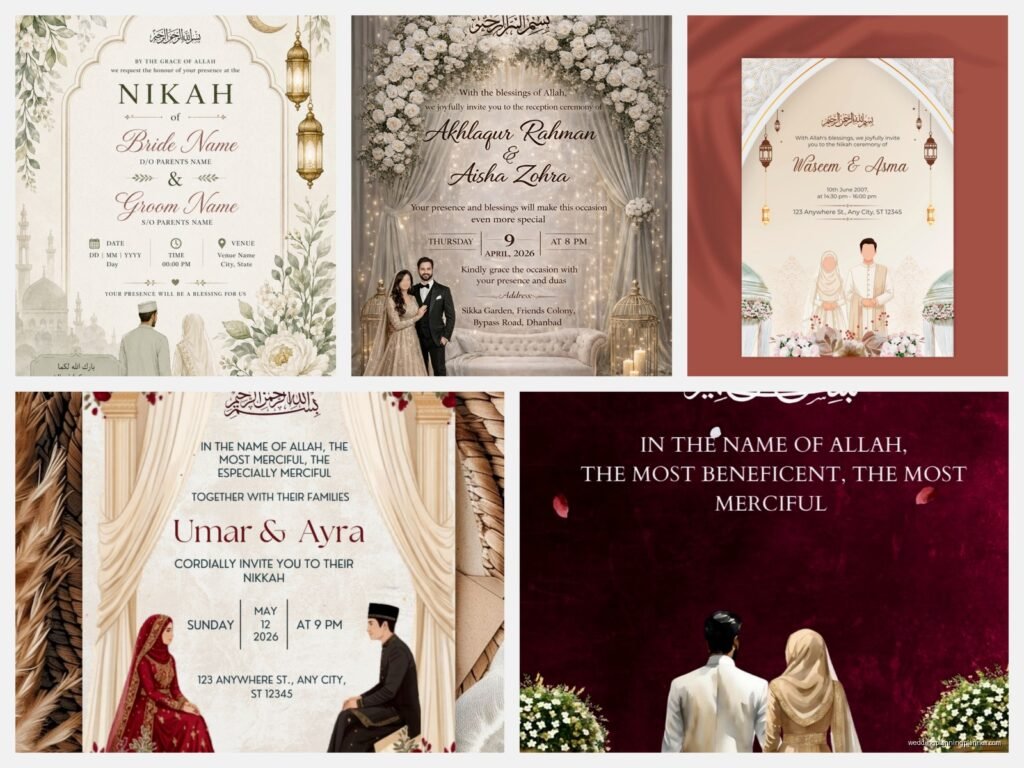
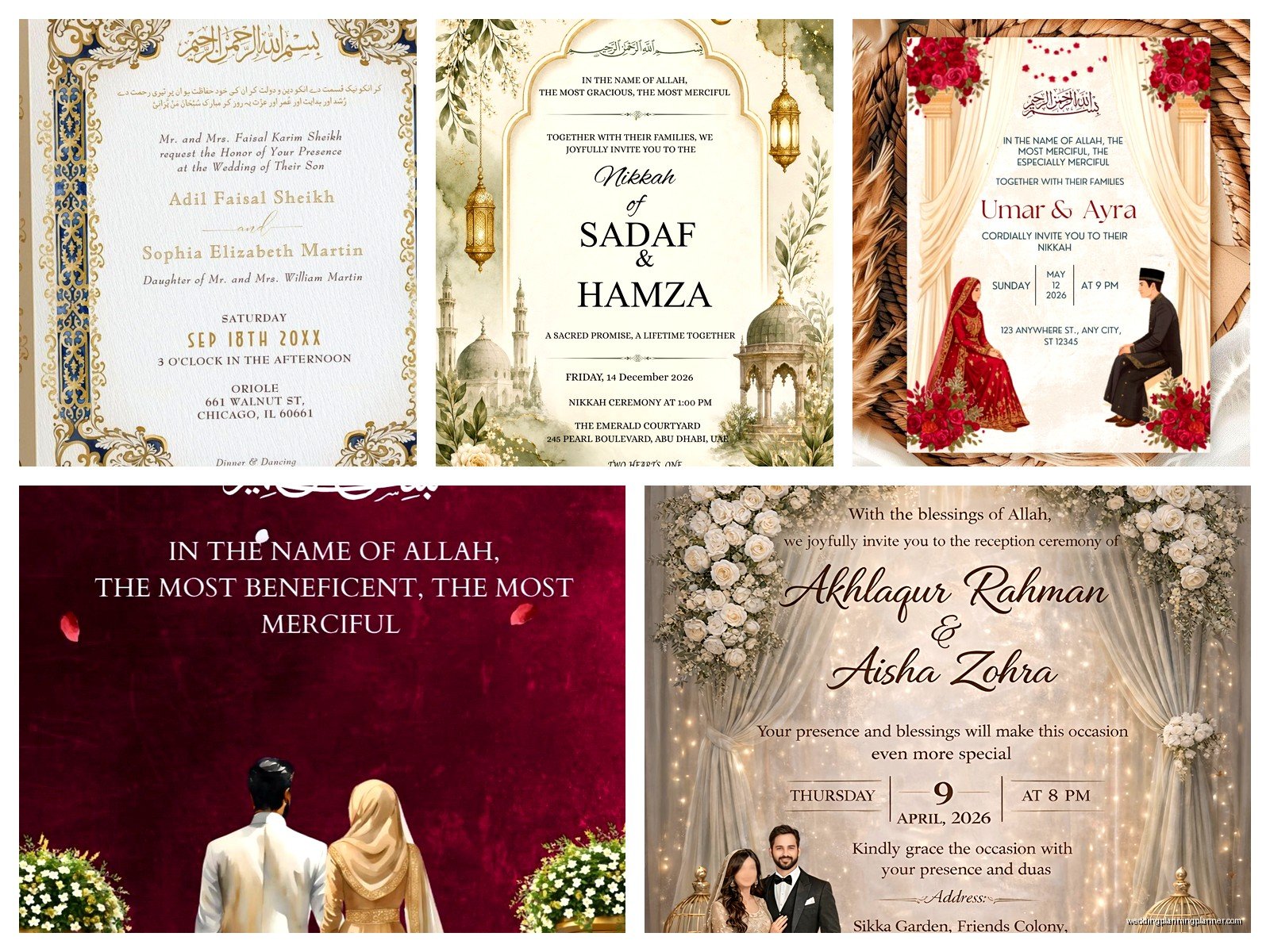
The aesthetic range is HUGE. You’ve got everything from ultra-traditional with lots of gold foiling and intricate borders to minimalist modern designs with just clean typography. I’ve seen invitations that look like illuminated manuscripts and I’ve seen ones that are basically elegant white cards with simple black calligraphy.
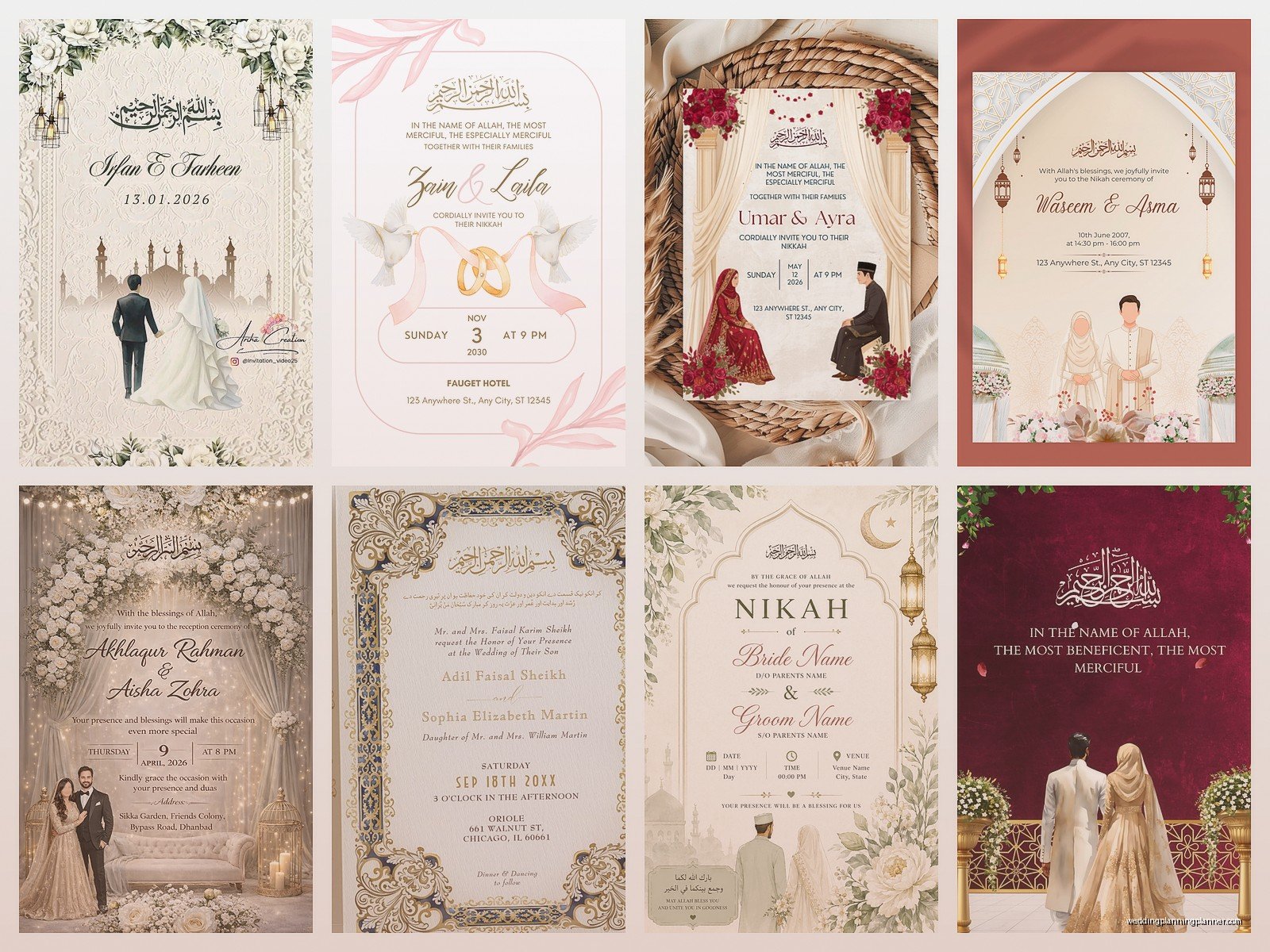
Popular design elements include:
- Islamic geometric patterns (you know, those interlocking star patterns)
- Arabesque or floral motifs
- Calligraphy—either Arabic calligraphy for religious phrases or just fancy English script
- Mosque silhouettes or domes (though this can read kinda cheesy if not done well)
- Crescent moon and star imagery
- Mandala-style patterns
Color-wise, deep jewel tones are super popular—emerald green, sapphire blue, ruby red, royal purple. Gold is basically mandatory in many South Asian Muslim weddings. But I’ve also done gorgeous invitations in soft pastels for Arab weddings and modern black and white designs for Turkish couples.
One thing that really annoyed me last year was when a printer tried to tell my client that “all Muslim weddings use red and gold” and refused to print her navy and silver design because it “wasn’t authentic.” Like… there are Muslims in literally every country and culture, there’s no one authentic color scheme. Ugh.
The Whole Separate Seating Thing
Some Muslim weddings have gender-segregated seating or even completely separate events for men and women. If this applies to your wedding, you need to make this CLEAR on the invitation. I usually recommend a small insert card that explains the arrangement politely. Something like “Please note: This will be a gender-segregated event with separate halls for men and women” or whatever applies to your situation.
You don’t want guests showing up confused or… I had this happen in spring 2023 where the couple didn’t mention it and half the non-Muslim guests brought their spouses and then felt awkward when they had to separate. Just communicate it upfront.
Finding a Designer or Template
You’ve got a few routes here. Custom design from a stationer like me is obviously gonna be the most expensive but you get exactly what you want. I work with couples to create something that reflects their specific cultural background and personal style. Budget like $500-2000+ for custom design and printing depending on quantity and printing techniques.
Etsy has a TON of Muslim wedding invitation templates. You can find downloadable templates for like $15-40 and then either print them yourself or send them to a print shop. Just make sure the seller allows commercial printing and check the file format—you want high-resolution PDFs or editable files in Canva or Adobe.
Sites like Minted, Zola, and Paperless Post have some Islamic wedding designs now too, though the selection is kinda limited compared to general wedding invites. Vistaprint and similar services are fine for budget-friendly options but the designs tend to be pretty generic.
If you’re going custom, find a designer who has experience with Muslim weddings or at least understands your cultural background. I’ve seen designers mess up Arabic text direction (it goes right to left, people!) or use inappropriate imagery. Always ask to see their portfolio.
Printing Methods and What They Cost
Digital printing is your most affordable option—works great for most designs and you can get 100 invitations for maybe $150-300 depending on paper quality. The colors are vibrant and it’s quick.
Letterpress gives you that beautiful impression in the paper but it’s pricey and doesn’t work well with super intricate Islamic geometric patterns because the detail gets lost. Better for minimalist designs.
Foil stamping is GORGEOUS for Muslim invitations, especially gold or rose gold foil on deep colored cardstock. It’s more expensive—add like $200-500+ to your printing costs—but it looks so elegant and luxe. My cat knocked over my coffee on a foil sample once and it still looked perfect after I wiped it off, so there’s that durability factor too.
Thermography gives you that raised ink effect and costs less than letterpress. It’s a good middle-ground option.
Laser cutting is huge right now for Muslim invitations—think intricate geometric patterns cut into the card or a laser-cut overlay. Beautiful but definitely on the expensive end, and you need to order early because the production time is longer.
The Actual Ordering Process
Order samples first. Always. I cannot stress this enough. Colors look different on screen versus in person, and you need to feel the paper quality. Most online printers will send you sample packs for free or cheap.
For quantities, order 10-15% more than your guest count to account for mistakes, last-minute additions, and keepsakes. If you’re inviting 150 people, order like 175 invitations. You’ll use them, trust me.
Timeline for ordering: if you’re doing custom design, start 4-5 months before you need to mail them. Design takes 2-4 weeks with revisions, printing takes 2-4 weeks depending on the method, and then you need time to assemble and address them. If you’re using a template, you can compress this to like 2-3 months total.
Wording Variations You’ll See
The invitation wording can be in English, Arabic, Urdu, or whatever language makes sense for your guests. Bilingual invitations are super common—English on one side, Arabic or another language on the other, or English with Arabic phrases interspersed.
Some families prefer more religious language throughout and some keep it minimal. Like you might see “request the honor of your presence at the Nikah ceremony uniting” versus just “invite you to celebrate the marriage of.” Both are fine, it’s about what feels right for your family.
For the dress code, be specific if you want guests to dress modestly or if you’re hoping for traditional attire. “Traditional attire encouraged” or “Modest dress requested” gives people clear guidance without being preachy.
Extra Insert Cards You Might Need
RSVP cards are standard. Include a pre-addressed stamped envelope if you want people to actually mail them back, or set up online RSVPs through your wedding website (honestly easier for tracking).
If your wedding has multiple events, include a schedule card. List out what’s happening when—like Mehndi on Friday evening, Nikah on Saturday afternoon, Walima on Saturday evening. Include addresses if they’re at different venues.
Accommodation cards with hotel blocks and local info are helpful, especially if you have lots of out-of-town guests.
Registry information—though some Muslim families don’t do registries or prefer not to include this in the invitation suite. You can put registry info on your wedding website instead.
Direction cards or maps if your venue is hard to find.
Addressing and Assembly
Addressing etiquette for Muslim families can be… well, it depends on the family. Some are very formal about titles and some are casual. Generally, use “Mr. and Mrs.” for married couples, but check if the family prefers different titles. Some Muslim women keep their maiden names, so don’t assume.
For unmarried couples or guests with plus-ones, you’ll need to decide your approach. Some Muslim families don’t extend plus-ones to unmarried partners, some do. This is a family values thing, not a religious requirement necessarily, but be prepared for those conversations.
Inner and outer envelopes are traditional but honestly kinda wasteful? I usually recommend just outer envelopes unless you’re doing a very formal wedding. Use the inner envelope for clarity if you’re inviting kids or specific family members only.
Assembly order from bottom to top: invitation card, then reception card, then any other insert cards, then RSVP card and envelope on top. Put it all in the envelope with the text facing the back flap so when someone opens it, they see everything right-side-up. Or don’t stress about this too much because people will figure it out either way.
Budget Reality Check
You can do DIY printable invitations for under $100 total if you’re printing at home or using a copy shop. They won’t be fancy but they’ll work.
Standard digital printing with online companies runs $200-500 for 100-150 invitations including envelopes.
Custom design with upgraded printing (foil, letterpress, laser cutting) can easily hit $1000-3000+.
The super luxury invitations with multiple cards, silk boxes, hand-tied ribbons, and elaborate embellishments? I’ve seen those go up to $5000+ for 150 invitations. Are they stunning? Yes. Necessary? Nah.
Remember you also need postage—wedding invitations usually need extra stamps because they’re heavier than regular mail. Check weights at the post office before you buy 200 regular stamps and then find out you need two stamps per invite.
Digital Invitations—Are They Okay?
This is gonna depend on your family and community. Some Muslim families are totally fine with digital invitations, especially for younger, more casual weddings or for additional events like Mehndi parties. Others consider it disrespectful or too informal for a Nikah.
I’ve noticed digital invites becoming more accepted, especially post-pandemic when everyone got used to virtual everything. Sites like Greenvelope and Paperless Post have nice Islamic designs. The environmental argument resonates with a lot of people too.
But if you’ve got older relatives or very traditional family members, printed invitations show more respect and effort. Maybe compromise—printed for the Nikah and Walima, digital for other events?
Just don’t send a WhatsApp message as your official invitation unless you want your aunties talking about it for the next decade. Trust me on this one, I’ve heard the stories from clients who tried it and…
Anyway, the main thing is to start early, communicate clearly with your family about expectations, and don’t let perfect be the enemy of good enough. Your invitation gets people to your wedding—it doesn’t have to be a museum piece. Though it’s nice when it’s beautiful and represents your faith and culture in a way that feels authentic to you both.