
Planning Guides, Style Guide
Marriage Reception Invitation: Design & Ordering Guide
Jun
Okay so reception invitations are honestly where people get the most confused
First thing you gotta understand is that reception invitations are NOT the same as wedding invitations even though I’ve had like a million couples think they can just use the same design. They serve different purposes and honestly back in summer 2021 I had this couple who ordered 200 wedding invitations and then were shocked—literally shocked—when I told them they needed separate reception cards for their evening guests and they’d already blown their stationery budget. That was a fun conversation.
When you actually need reception-only invitations
So there are basically a few scenarios where you’re gonna need these. One is when you’re having a small ceremony with just family and close friends but then a bigger party later. Super common actually. Or sometimes people do a destination wedding with like 20 people and then come home and throw a reception for everyone else. I’ve also seen it where couples get legally married at a courthouse or town hall and then have the big celebration later—sometimes months later.
The other scenario is cultural or religious ceremonies that are private or restricted to certain family members or community members and then you have the reception where everyone’s invited. This comes up a lot with certain Hindu ceremonies or Orthodox Jewish weddings where the religious part is separate from the party.
Design stuff that actually matters
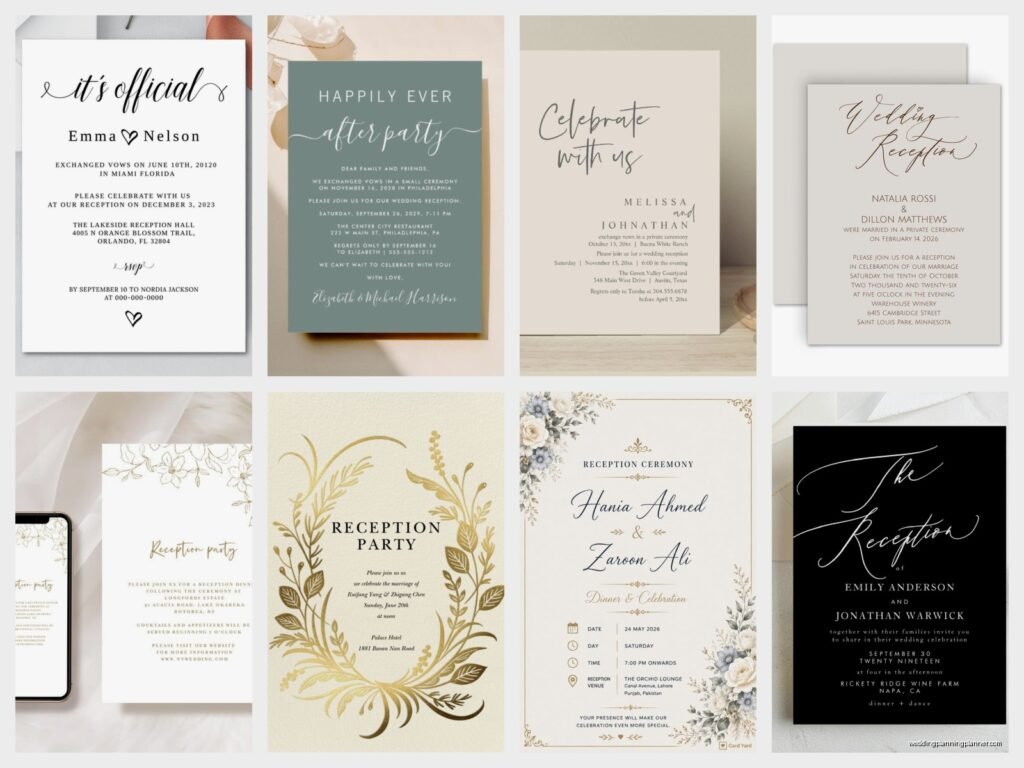
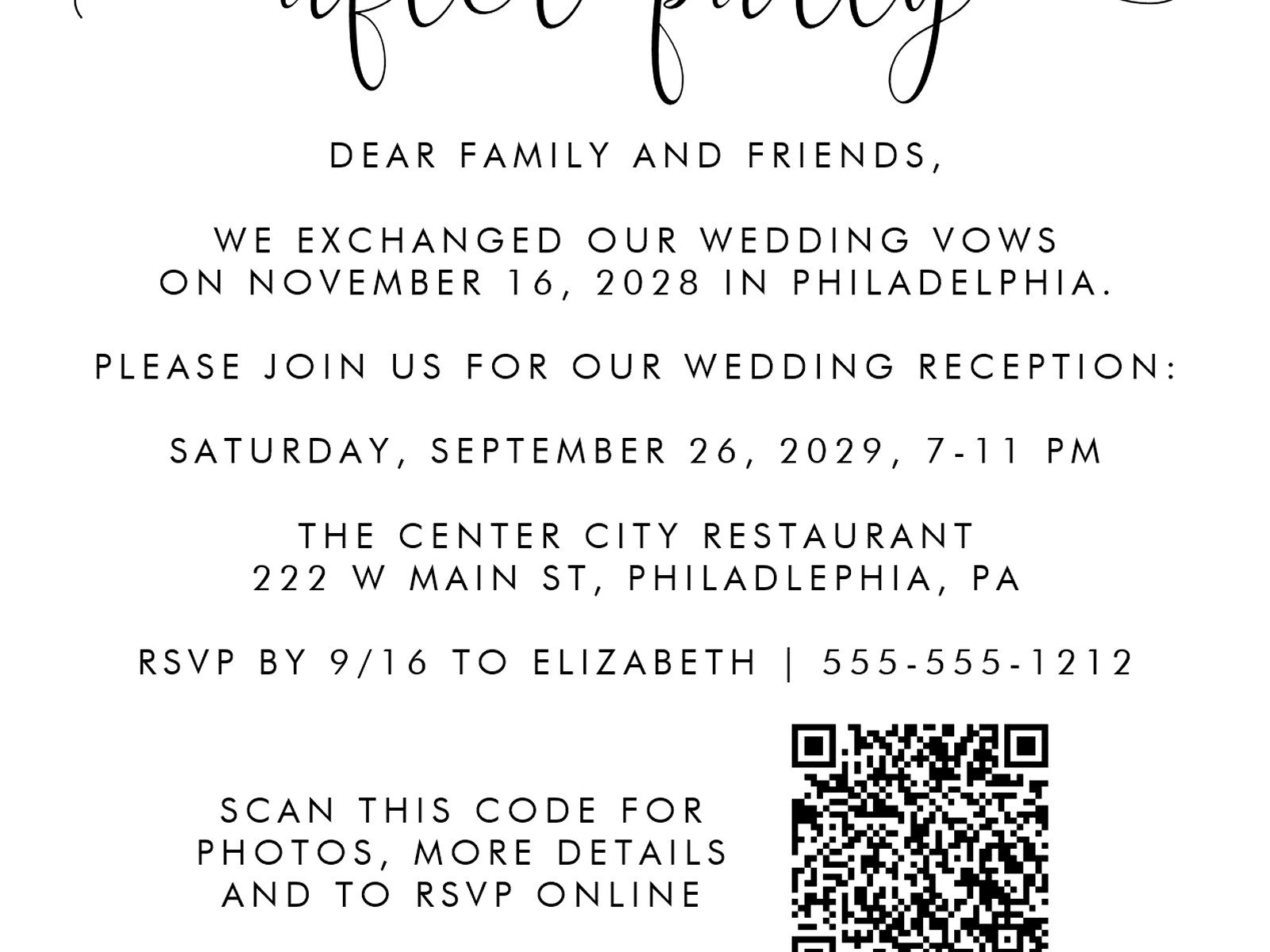
Alright so the wording is where people mess up constantly. You can’t just say “reception” and call it a day. You need to be clear about what kind of event this is. Are you calling it a wedding reception? A celebration of marriage? A marriage celebration? The wording tells guests what to expect.
Here’s what I usually recommend for the main text:
- Names of the couple (obviously)
- Clear statement that you’re already married or will be married
- The word “reception” or “celebration” prominently featured
- Date and time
- Venue name and address
- Dress code if it’s not obvious
- RSVP details
Something that annoys me SO much is when couples try to be too cutesy with the wording and guests literally don’t understand what they’re being invited to. I once saw an invitation that said “Join us for an evening of merriment” and didn’t mention wedding or marriage anywhere and half the guests thought it was a birthday party. Don’t be that person.
The actual design process
You’ve got a few routes here. You can go with a professional stationer, use an online template service like Minted or Paperless Post, or DIY it completely. Each has pros and cons and honestly it depends on your budget and how much you care about this stuff.
Professional stationers are great if you want something custom and you have the budget—expect to spend anywhere from $500 to $2000+ depending on how fancy you wanna get. They’ll do custom illustrations, letterpress, foil stamping, all that stuff. The timeline is usually 8-12 weeks from first consultation to delivery so plan accordingly.
Online services are the middle ground. You pick a template, customize the colors and text, and they print and ship. Usually runs $200-600 for like 100 invitations depending on the service and options. Timeline is faster—maybe 2-4 weeks total. I use Minted a lot for clients who want nice design but don’t have a huge budget.
DIY is obviously cheapest but umm it’s also the most time-consuming and you gotta be realistic about your design skills. Canva has templates you can customize and then you print at home or through an online printer. Could cost under $100 if you’re smart about it but I’ve seen people spend 40 hours on DIY invitations and then hate how they turned out so… yeah.
What to include design-wise
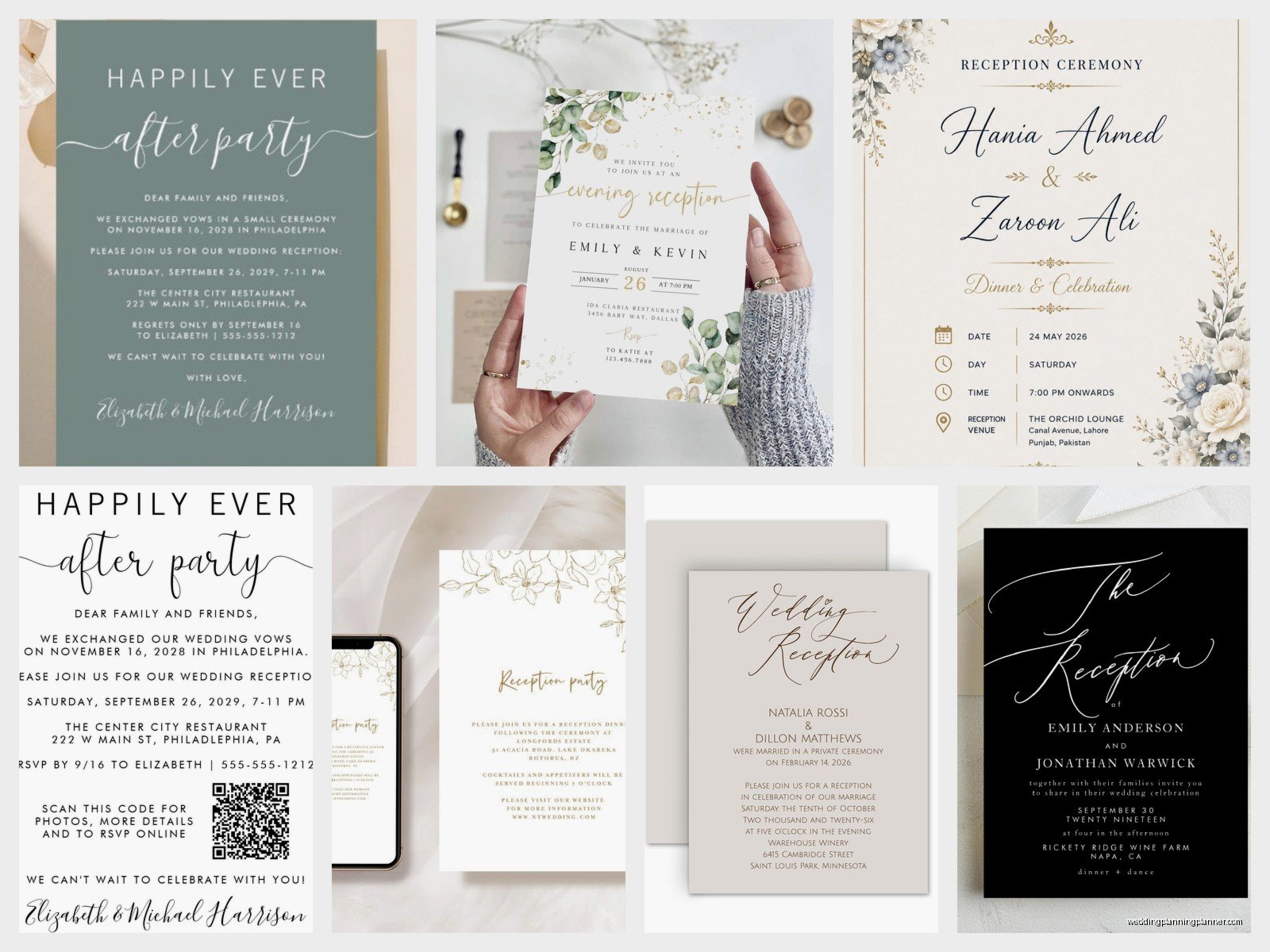
The invitation itself should match your reception vibe. If you’re doing a casual backyard BBQ reception you probably don’t want formal script on heavy cardstock. If you’re doing a black-tie hotel ballroom thing, the invitation should reflect that.
Colors should ideally tie into your wedding colors but honestly for a reception-only situation you have more flexibility. I’ve seen couples use completely different aesthetics for their reception invitations especially if the ceremony happened months earlier or was in a different style.
Photos are a personal choice. Some couples include an engagement photo or a photo from their ceremony if it already happened. This works really well for reception-only invites because it helps guests feel connected to the wedding even if they weren’t at the ceremony. But it’s not required and some people think it looks too casual or… my cat just knocked over my coffee mug, hang on.
Paper and printing options breakdown
Okay so paper weight matters more than you think. Standard cardstock is 80-100 lb and that’s fine for most situations. If you want something that feels more luxe go for 110-130 lb. Anything heavier starts getting expensive and also you’ll pay more for postage which brings me to—
Postage is something people forget about constantly. A standard invitation in a standard envelope with one insert is usually fine with a regular stamp. But if you’re doing square envelopes, oversized cards, or adding a bunch of enclosures you might need extra postage. Take a fully assembled invitation to the post office and have them weigh it BEFORE you buy 150 stamps. Trust me on this. Spring 2023 I had a bride who had to hand-apply additional postage to 180 invitations because she didn’t check and half of them got returned. She was not happy.
Printing methods:
- Digital printing: Most affordable, good quality, works for most designs. This is what online services use mostly.
- Letterpress: Beautiful texture, creates an impression in the paper, expensive, takes longer. Looks amazing though.
- Foil stamping: Metallic or colored foil pressed into the paper, also pricey but really eye-catching.
- Thermography: Raised printing that mimics engraving, middle price point, classic look.
- Flat printing: Just ink on paper, totally fine for casual events.
Envelope situations
You need to decide on envelope style and this actually affects the whole look. Standard A7 envelopes (5.25 x 7.25 inches) work for most invitation sizes. You can get them in different colors—white, cream, kraft paper, colored options, whatever.
Addressing is its own thing. You can handwrite them if you have nice handwriting or hire a calligrapher which adds $2-5 per envelope usually. Or you can print labels or print directly on the envelopes. For reception invitations I think printed addresses are totally acceptable since the whole event is usually more relaxed anyway.
Inner envelopes are kinda old-fashioned and honestly I don’t think you need them for a reception invitation unless you’re doing a very formal event. They add cost and bulk.
What to include inside besides the invitation
RSVP cards are pretty much essential. You can do traditional mail-in cards with stamped return envelopes or you can direct people to a wedding website or email. I’m gonna be honest, online RSVPs are way easier to track and you don’t have to deal with people who don’t fill out the cards properly or forget to mail them back. But some older guests prefer physical cards so know your audience.
Details card or info card—this is where you put stuff like your wedding website, hotel room blocks if you have them, directions or parking info, what kind of food will be served if that’s relevant, whether kids are invited or not. Basically anything that doesn’t fit on the main invitation.
Registry information should NOT go in the invitation itself. That’s still considered tacky even for a reception. Put it on your wedding website and include the website on your details card. Or rely on word of mouth.
Dress code—if you’re not including this on the main invitation, put it on the details card. People need to know if they should wear jeans or a gown.
Timeline for ordering and you probably need more time than you think
Okay so working backwards from your reception date, here’s roughly what you need:
Send invitations 6-8 weeks before the reception. You can go a bit shorter—like 4 weeks—if it’s super casual and local, but I wouldn’t recommend less than that. People need time to plan.
Before you can send them, you need to have them printed and assembled. If you’re ordering from a professional or online service, add 2-4 weeks for production and shipping. Custom work takes longer—sometimes 8-12 weeks like I mentioned earlier.
Before you can order, you need to finalize the design and wording. This can take a few days or a few weeks depending on how decisive you are and whether you’re working with a designer who needs time to create mockups.
And before THAT you need your guest list finalized with addresses. Start collecting addresses as soon as you know you’re doing a reception. People are slow to respond to address requests and you’ll always have a few stragglers.
So realistically you should start the invitation process at least 3-4 months before your reception date. More if you’re doing custom work.
Budgeting this whole thing out
Here’s roughly what you’re looking at cost-wise for 100 invitations (prices vary a lot by region and vendor):
- Budget option (online templates, digital printing): $150-300
- Mid-range (semi-custom design, nice paper): $400-800
- High-end (custom design, letterpress or foil): $1000-2500+
Don’t forget to add in postage—figure $70-100 for stamps for 100 invitations at current rates. More if you need extra postage.
If you’re doing calligraphy for addressing add another $200-500 depending on the calligrapher.
Common mistakes I see literally all the time
Not ordering enough invitations. Always order 10-15% more than you think you need. You’ll mess some up while assembling, addresses will change, you’ll forget people, whatever. Just get extras.
Forgetting about the RSVP deadline. Set it for at least 2-3 weeks before your reception so you have time to follow up with people who don’t respond and give final counts to your caterer.
Making the font too small or too fancy. Your grandmother needs to be able to read this without a magnifying glass. I’ve seen invitations with 8-point script font and it’s just… no. Stick with at least 10-12 point font for the important info.
Not proofreading enough. Have at least three people read the final design before you submit it for printing. Check dates, times, addresses, spelling of names, everything. I once caught an invitation that had the wrong year listed and the couple had already approved it and would’ve wasted $600 if I hadn’t noticed.
Waiting too long to start. Seriously the timeline sneaks up on you and then you’re scrambling to get invitations out 3 weeks before your reception and people can’t make it because they already have plans or—
Digital invitations are also totally a thing now
Look, not everyone needs paper invitations anymore. Digital invitations through services like Paperless Post or Greenvelope are completely acceptable for reception-only events especially if you’re doing something casual. They’re cheaper, faster, easier to track RSVPs, and better for the environment if you care about that.
The etiquette people will tell you digital is too informal but honestly for a reception that’s separate from the ceremony I think it’s fine. I’ve planned receptions where couples did digital invites and nobody cared. Just make sure the design still looks polished and intentional.
You can also do a hybrid approach—send digital invites to most people and paper invites to older relatives or VIPs who might prefer the traditional option.
Working with vendors or services
If you’re using an online service the process is pretty straightforward. Pick template, customize, proof, order, done. Most services will send you a digital proof and some will send a physical sample for an extra fee which I recommend if you’re spending more than like $400.
If you’re working with a professional stationer, you’ll usually have a consultation first where you discuss your vision, budget, timeline. They’ll create some mockups based on that conversation. You’ll go back and forth on revisions—usually 2-3 rounds is normal. Then they’ll send a final proof for approval before printing.
Ask about their revision policy upfront. Some designers include unlimited revisions, others charge after the second or third round. Also ask about their timeline and whether they can accommodate rush orders if needed (usually for an extra fee).
Make sure you understand what’s included in the quoted price. Does it include envelopes? Envelope liners? RSVP cards and envelopes? Assembly? Addressing? All of this varies by vendor so get it in writing.
Assembly and mailing tips
Alright so once you have your printed invitations you gotta assemble and mail them. Set aside an afternoon, put on a good show (I binged The Great British Bake Off during my last big assembly project), and get organized.
Assembly order for a standard invitation suite: details card goes on top of the invitation, then RSVP card and envelope go on top of that, all facing up. Slide the whole stack into the envelope so guests see the invitation first when they open it.
For RSVP envelopes pre-stamp them and pre-address them to whoever is collecting RSVPs. Do not make your guests provide their own postage. That’s just rude and you’ll get way fewer responses.
Seal your envelopes and then take one fully assembled invitation to the post office to get it weighed before you stamp everything. I know I already said this but it’s important.
Mail everything on the same day if possible so they all arrive around the same time. Don’t mail them on a Friday afternoon—they’ll sit in the post office all weekend. Monday or Tuesday morning is ideal.
Keep a spreadsheet of who you sent invitations to and track RSVPs as they come in. You’ll need to follow up with people who don’t respond and this makes it way easier.