Planning Guides, Style Guide
Muslim Nikah Invitation Card: Design & Ordering Guide
Jun
Getting Your Muslim Nikah Invitation Cards Right
So you’re planning a Nikah and need invitations that actually work—not just pretty cards that miss half the important info. I’ve been doing this for almost two decades and the number of times I’ve seen couples scramble because they forgot to include the wali’s name or the actual ceremony time is… well, let me just help you avoid that mess.
First thing about Nikah invitations: they’re different from regular wedding invites because you’re dealing with specific Islamic elements that need to be there. Not optional, actually need to be there. Your guests need to know this is a religious ceremony, and honestly, the design should reflect that this isn’t just any party—it’s a sacred contract.
What Actually Needs To Be On The Card
Okay so the basics that I tell every couple (and I had this one bride in summer 2021 who literally wanted to leave off her father’s name because they weren’t speaking and that was a whole thing): you need the bismillah or at least some Quranic verse, the couple’s names obviously, the wali’s name if the bride has one involved in the ceremony, date and time, venue address, and whether there’s a walima reception following or if that’s separate.
The bismillah—”Bismillah ir-Rahman ir-Rahim”—usually goes at the top. Some couples do the full Arabic calligraphy, some do a translation, some do both. I personally think both looks more elegant but you do you. Then you’ve got options for Quranic verses. Surah Ar-Rum verse 21 is super popular (the one about spouses being a source of tranquility), or Surah An-Nisa verse 1. Don’t just slap any verse on there though—make sure it’s relevant to marriage.
Here’s what drives me absolutely nuts: when couples don’t specify the actual ceremony time versus the reception time. Your Nikah might be at 2pm but if the walima starts at 6pm, you need to make that crystal clear. I’ve seen guests show up four hours early or miss the actual Nikah entirely because the invitation just said “join us for our wedding celebration at 6pm” and everyone assumed that’s when everything started.
Design Styles That Work
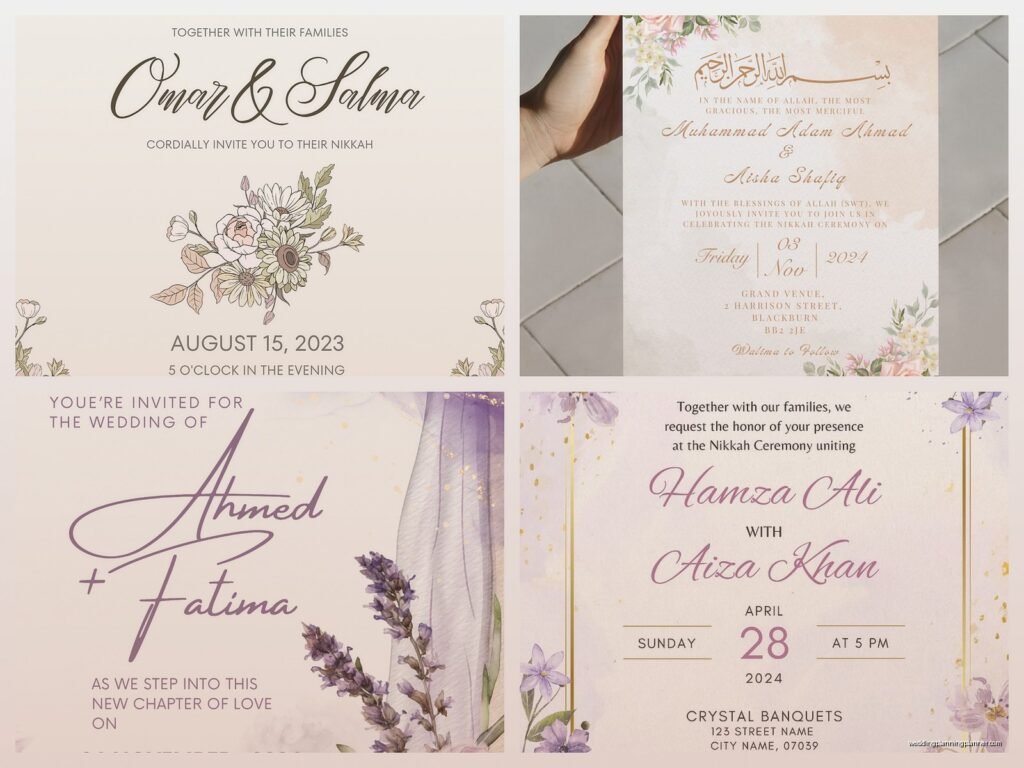
You’ve got a few directions you can go design-wise. Traditional Islamic geometric patterns are always gorgeous—those intricate mandala-style designs in gold or emerald or deep burgundy. They photograph really well too if you’re gonna post them on Instagram (which, let’s be real, everyone does now).
Arabic calligraphy is another route. You can have the couple’s names written in beautiful calligraphy, or the bismillah, or both. Just make sure whoever’s doing the calligraphy actually knows Arabic because I’ve seen some… questionable attempts. If you’re working with a designer who doesn’t specialize in Islamic designs, you might wanna find a calligrapher separately and have them create that element to insert into the design.
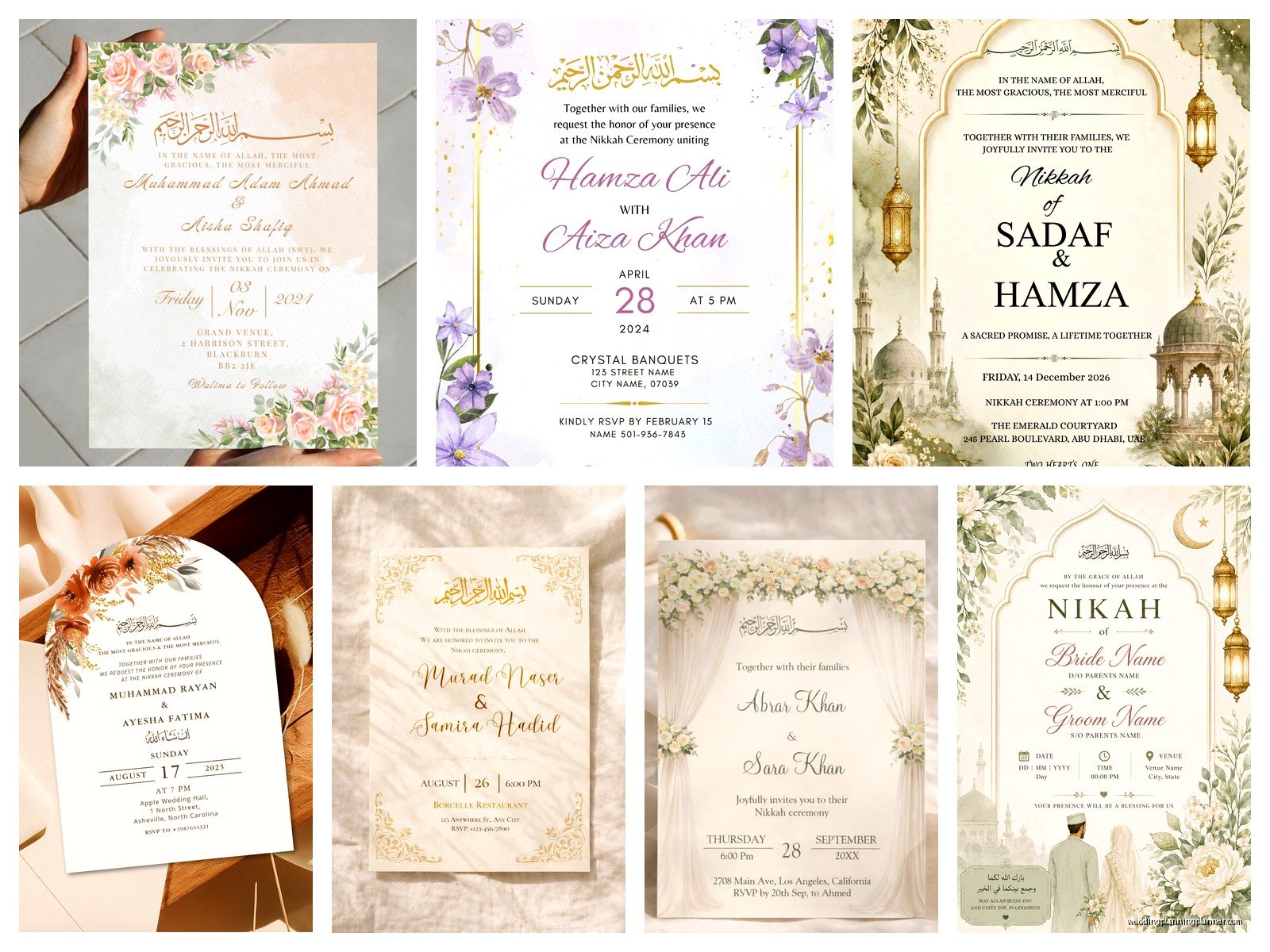
Modern minimal is trending hard right now—clean lines, lots of white space, maybe one elegant geometric border and simple typography. It’s less traditional but it looks really sophisticated. I had a couple last year who did black letterpress on cream paper with just a single line of gold geometric pattern at the top and it was stunning.
Color-wise, emerald green, burgundy, navy, and gold are classic choices. They feel formal and appropriate for a religious ceremony. But honestly I’ve also seen beautiful blush pink and sage green combinations for couples who wanted something softer. Just maybe avoid anything too bright or casual-looking—this isn’t a birthday party invitation.
Wording Choices
The wording is where things get kinda tricky because you’re balancing formality with clarity. Some families are very traditional and want the invitation to come from the parents: “Mr. and Mrs. [Father’s name] request the honor of your presence at the Nikah of their daughter…” Other couples, especially if they’re older or paying for everything themselves, go with: “Together with their families, [Bride] and [Groom] invite you…”
You’ll also need to decide if you’re using the Arabic terms or English translations. Nikah versus marriage ceremony, walima versus wedding reception. I usually suggest using both if you’ve got a mixed crowd of guests—some who are familiar with Islamic terminology and some who aren’t. Like “Nikah (Islamic Marriage Ceremony)” so everyone’s on the same page.
Oh and include dress code info! Whether you want guests in formal attire, traditional Islamic dress, or whatever. Don’t assume people know. I’ve had guests show up to formal Nikahs in jeans because nobody specified.
Printing Options And What They’ll Cost You
Alright so printing—you’ve got digital printing, letterpress, foil stamping, and thermography as your main options. Digital is cheapest, usually like $2-4 per invitation for decent quality. It’s totally fine if you’re on a budget. The colors are accurate and you can do complex designs without extra cost.
Letterpress is that pressed-into-the-paper look that’s super tactile and beautiful. Expect $8-15 per invitation though. It’s pricey but it feels luxurious. Works best with simple designs—too much detail gets lost.
Foil stamping (usually gold or silver foil) runs about $5-10 per invitation depending on how much foil coverage you want. It’s really popular for Islamic invitations because that gold calligraphy just pops. You can combine foil with digital printing to keep costs down—like foil for the bismillah and couple’s names, digital for everything else.
Thermography gives you raised printing that looks almost like letterpress but cheaper, maybe $3-6 per invitation. It’s a good middle ground.
Where To Actually Order These Things
Online options: Minted has some nice Islamic-inspired designs you can customize. Not specifically Muslim wedding invitations but you can adapt them. Zazzle has more options including some designed by Muslim artists. Etsy is honestly your best bet for unique Islamic designs—there are tons of sellers who specialize in Muslim wedding invitations and they’ll work with you on customization.
I usually point couples toward Etsy sellers who have good reviews and clear communication. You can see their previous work, read reviews from other Muslim couples, and most of them are really responsive about changes. Prices vary wildly—anywhere from $3 to $20 per invitation depending on printing method and customization level.
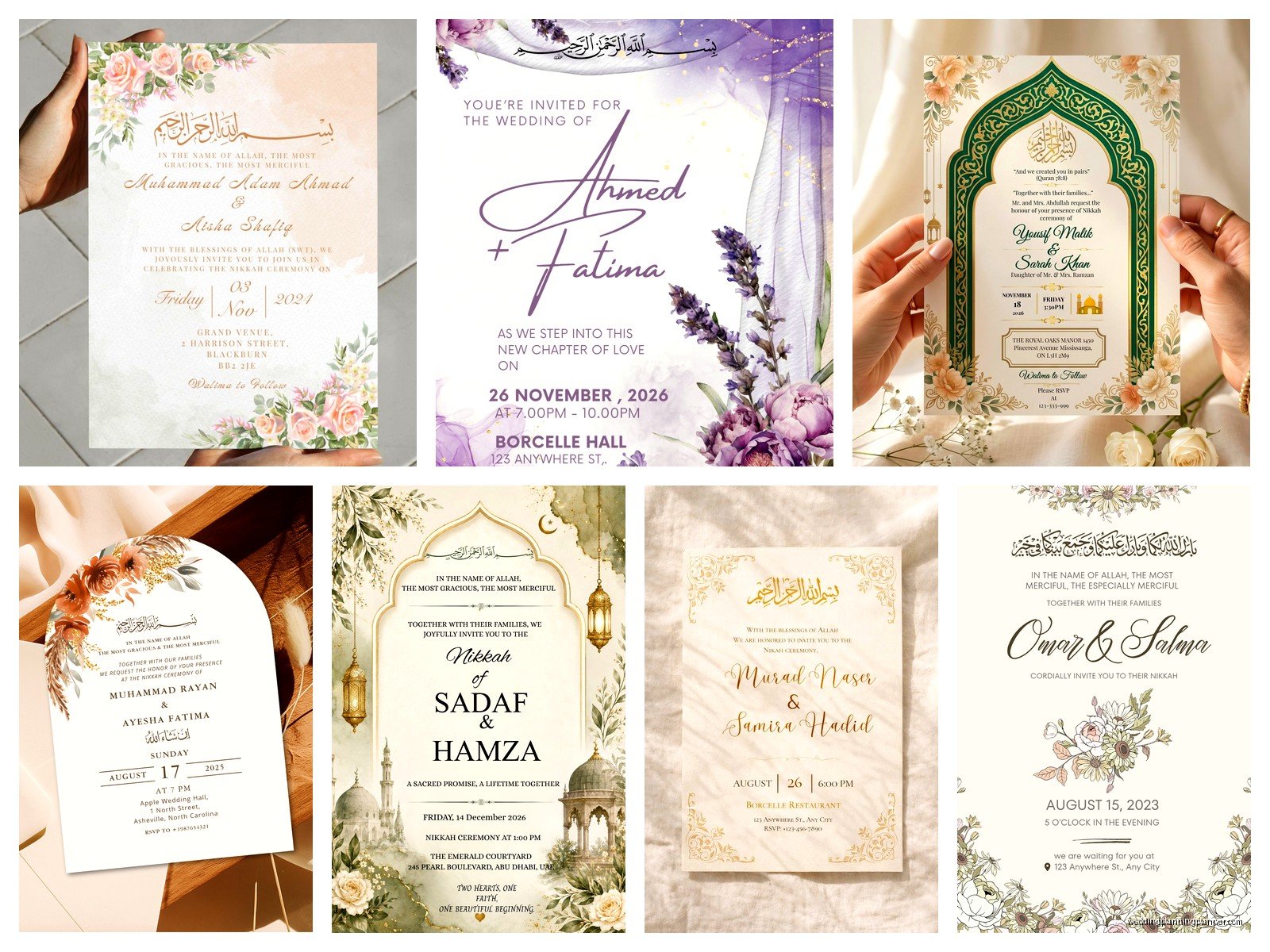
There are also specialized Islamic wedding invitation companies like Niqaabi Brides, Muslim Wedding Cards, or Shaadi Bazaar if you want something super traditional. They understand the cultural elements and won’t give you weird looks when you’re explaining what needs to be included.
Local print shops can work too, especially if you’ve got a designer creating a custom invitation for you. Just bring them the final print-ready file. This gives you more control over paper quality and you can see samples in person before committing to 150 invitations.
Timeline For Ordering
You’re gonna want to start looking at designs like 4-5 months before your Nikah. That gives you time to choose a design, customize it, order samples (always order samples!), make changes, place the final order, wait for printing and shipping, and then assemble and mail everything.
Most online printers need 2-3 weeks for production plus shipping time. Custom letterpress or foil stamping can take 4-6 weeks. Then you need to factor in assembly time if you’re doing envelope liners or belly bands or any of that fancy stuff, plus addressing envelopes.
Mail invitations 6-8 weeks before the Nikah. Earlier if you’ve got a lot of out-of-town guests who need to book travel. I know some people say 4 weeks is fine but trust me, people are slow to RSVP and you’ll want that buffer.
The Whole Suite Thing
So beyond the main invitation, you might want save-the-dates (send those 3-4 months out), RSVP cards, details cards for hotel blocks or dress code or directions, and thank you cards for after. You don’t need all of this but it’s helpful.
RSVP cards should have a deadline that’s at least 2 weeks before your Nikah so you can get final counts to your caterer or venue. Include a pre-stamped envelope because otherwise people definitely won’t mail them back—they’ll just text you at random times and you’ll lose track of who said yes. Ask me how I know.
Details cards are clutch for Islamic weddings because there’s often more info to communicate—is the Nikah and walima same day or different days, are men and women separated, what time is each event, etc. Don’t try to cram all that onto the main invitation, it gets too crowded.
Digital Invitations Are A Thing Now
Look, I’m old school about paper invitations but digital is totally acceptable now, especially post-2020. You can create a beautiful digital invitation with all the same Islamic design elements and email it or text it. Apps like Greenvelope, Paperless Post, or even Canva let you design nice digital invites.
The benefit is you can include way more information without it feeling cluttered—links to your wedding website, hotel booking links, registry info, directions, photos, whatever. Plus it’s environmentally friendly and way cheaper. And you can track who’s opened it.
Some couples do a hybrid—digital save-the-dates and then paper invitations for the actual Nikah. Or paper for close family and elders who appreciate traditional invitations, digital for everyone else. No judgment, do what works for your budget and your crowd.
Common Mistakes To Avoid
Don’t forget to proofread everything multiple times. I mean everything—names, dates, times, addresses, Quranic verses. Have like three different people check it because once you’ve looked at it fifty times you stop seeing typos. In spring 2023 I had a couple who printed 200 invitations with the wrong ceremony time and had to reorder rush shipping and it was a disaster.
Don’t order the exact number you need—order 10-15% extra for last-minute additions, mistakes during assembly, or keepsakes. You’ll want extras, trust me.
Don’t pick a font that’s too decorative or hard to read. Yes, that swirly script looks pretty but if your grandmother can’t read the address, what’s the point? Readability over style, always.
And don’t forget to actually include response tracking info—whether that’s RSVP cards, a wedding website link, your phone number, or email. You need to know who’s coming.
Assembly And Mailing
Once your invitations arrive, you gotta assemble them. If it’s just a single card in an envelope, easy. But if you’ve got multiple inserts, RSVP cards, envelope liners, belly bands, or wax seals, set aside a whole afternoon. Maybe bribe some friends with pizza to help because addressing 150 envelopes by yourself is mind-numbing.
My cat knocked over an entire box of assembled invitations once and I had to redo like forty of them, so maybe do this in a room you can close off from pets or small children or whatever chaos exists in your life.
For addressing, you can handwrite them (looks personal and elegant), print labels (faster and neater), or hire a calligrapher (beautiful but expensive, like $3-5 per envelope). If you’re handwriting, use a nice pen and take your time. Messy handwriting on a gorgeous invitation is… well, it’s not great.
Before you mail everything, take one complete invitation with all the inserts and put it in the envelope and actually weigh it at the post office. Oversized or heavy invitations need extra postage and there’s nothing worse than having invitations returned because of insufficient postage. Also invitations with wax seals or weird shapes need to be hand-cancelled at the post office or they’ll get destroyed in sorting machines.
Budget Real Talk
Invitation costs add up fast. Figure $5-10 per guest for decent quality invitations when you factor in printing, envelopes, postage, any extra inserts, and assembly supplies. So for 100 guests that’s $500-1000 just for invitations. You can definitely do it cheaper with digital printing and DIY assembly, or spend way more with letterpress and custom calligraphy.
Set your budget first, then see what’s possible within it. Don’t blow your whole wedding budget on invitations—I promise nobody remembers the invitations as much as they remember whether the food was good and if they had fun. But you do want something that looks appropriate and includes all the necessary info, so find that balance.
Honestly the most important thing is that your invitations clearly communicate what’s happening, when, where, and what’s expected of guests. Everything else—the fancy printing, the gold foil, the custom calligraphy—is lovely but optional. Make sure the basics are covered first, then add the pretty stuff if your budget allows. And order those samples before you commit to printing 200 of something you’ve only seen on a screen because colors and paper quality can look totally different in person and yeah, learned that one the hard way with a client back in like 2019 where the “ivory” was basically yellow and we had to scramble to reorder.