Planning Guides, Style Guide
Passport Wedding Card: Design & Ordering Guide
Jun
Okay so passport wedding invitations are having a MOMENT
Honestly they’ve been popular for like five years now but I’m still getting clients who want them and I totally get why. They’re fun, they’re different, and if you’re doing a destination wedding they just make sense. But here’s the thing—most couples don’t realize how much goes into actually designing and ordering these things until they’re knee-deep in it and panicking three months before their wedding.
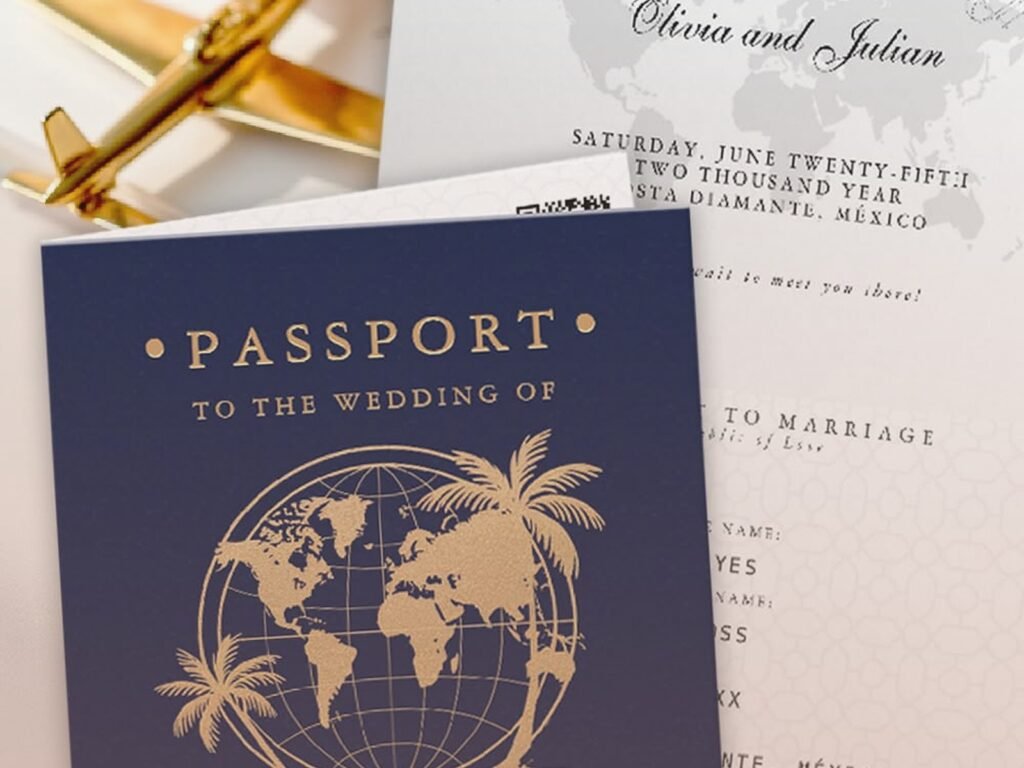
So passport invites are basically wedding invitations that look like actual passports. They can be mini versions that fit in your hand or full-size replicas. The cover usually has that classic navy or burgundy look with gold foil stamping, and inside you’ve got pages with all your wedding details designed to look like visa stamps and immigration pages. It’s kinda genius for destination weddings because the whole travel theme is built right in.
What you need to figure out BEFORE you start designing
First thing—and I cannot stress this enough—you gotta decide if you want a booklet style or a folded style. Booklet style means it’s actually bound like a real passport with multiple pages. Folded style is just designed to look like a passport but it’s really just a fancy folded card. The booklet ones are way more impressive but they’re also more expensive and heavier which means more postage.
Back in spring 2023 I had this couple who fell in love with a full booklet design they found on Etsy and didn’t realize until AFTER they ordered 150 of them that each invitation was gonna cost like $4.50 to mail because of the weight. They had budgeted for regular stamps. That was an awkward conversation when the invoice came in.
You also need to think about what information goes where. Typical passport invites include:
- Cover with your names or initials
- A photo page with your engagement photo styled like a passport photo
- Ceremony details designed as a visa or entry stamp
- Reception details as another stamp
- Accommodations info
- RSVP card that looks like a boarding pass (this is usually separate)
- Weekend itinerary if you’re doing multiple events
The design process is where it gets real
If you’re going the DIY route you’re gonna need design software. Canva has some passport templates but honestly they’re pretty basic. I’ve seen better results from people who use Adobe Illustrator or InDesign but that requires actual skills. There are also Etsy templates you can customize yourself which is like the middle ground—you buy the template for $15-30 and then edit it with your details.
The thing that annoyed me SO MUCH when I first started helping clients with these is that everyone wants to cram every single detail into the passport. Like yes it’s cute to have a page that looks like departure times but do you really need that AND a full itinerary AND accommodations AND registry info? It gets cluttered fast. Real passports have lots of blank pages and that’s okay. White space is your friend.
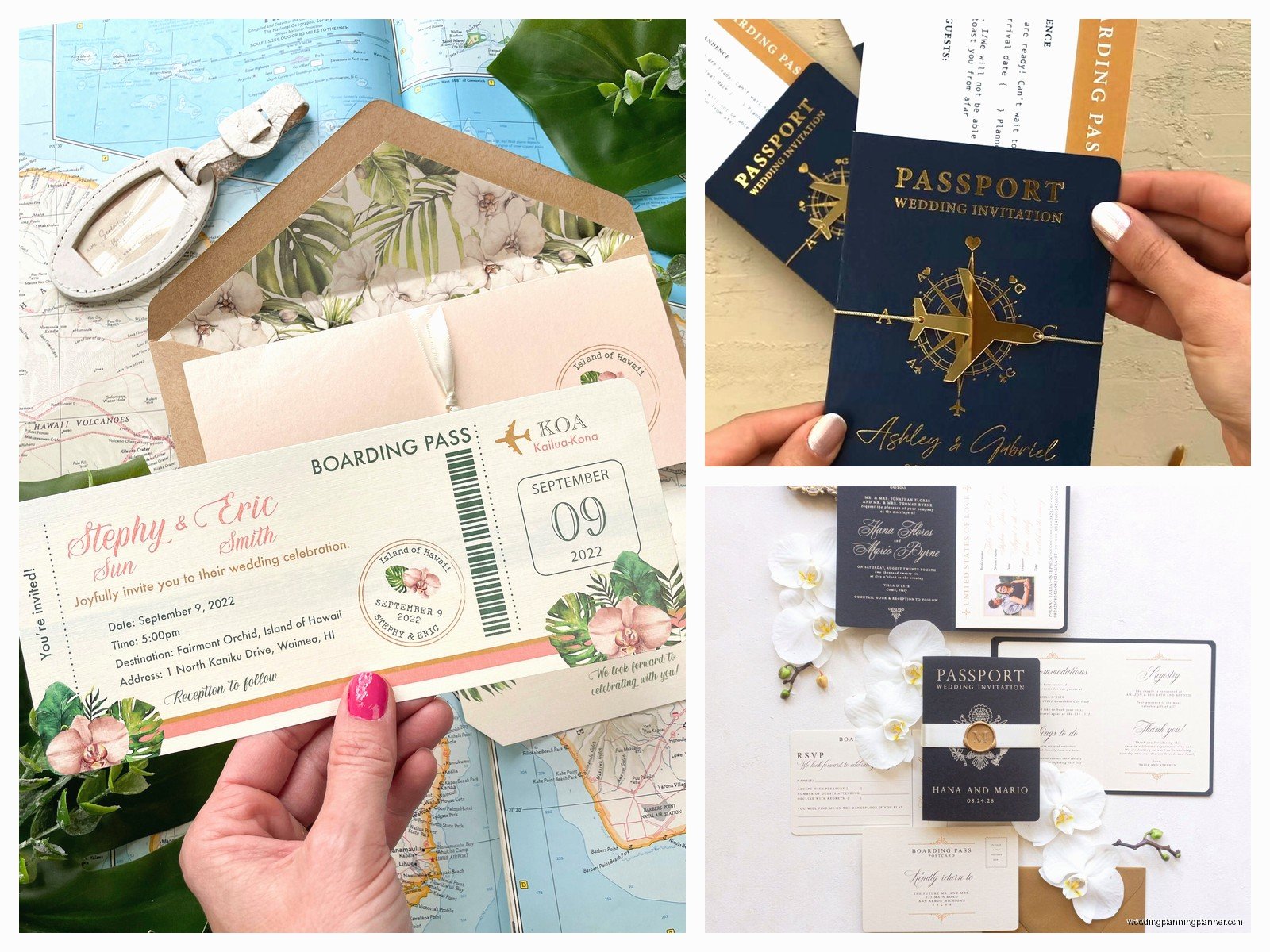
Colors matter more than you think. Most people go with navy blue or burgundy/maroon for the cover because that’s what real passports look like. But I’ve seen gorgeous ones in sage green, dusty blue, even black. Just make sure whatever color you pick works with your wedding colors overall because these set the tone for everything else.
Gold foil stamping on the cover is pretty much essential if you want it to look authentic. This is where costs jump up though. Foiling adds like $2-5 per invitation depending on your printer. Some couples skip it and just do gold ink instead which… look it’s fine but it doesn’t have that same luxe feel.
Actual specifications you need to know
Standard passport size is 5 x 3.5 inches but wedding passport invites usually come in a few sizes:
- Mini: 4.25 x 5.5 inches (fits in A2 envelopes)
- Standard: 4.875 x 3.375 inches (closest to real passport size)
- Oversized: 5 x 7 inches (easier to read but less authentic looking)
Page count typically ranges from 4 pages to 16 pages. Remember that in booklet printing pages come in sets of 4 so you’re looking at 4, 8, 12, or 16 pages total including covers. Don’t try to do 6 pages because your printer will look at you like you have three heads.
Paper weight is another thing people forget about. You want at least 80lb cover stock for the actual cover and 70lb text weight for interior pages. Anything lighter feels flimsy and cheap. My cat knocked over a whole stack of sample invites once and the only ones that survived without bending were the ones printed on proper cardstock so there’s your real-world test I guess.
Where to actually ORDER these things
You’ve got a few options and they all have pros and cons:
Online print shops: Places like Vistaprint, Minted, Zazzle—they have passport templates you can customize. Super easy, relatively affordable ($3-8 per invite), fast turnaround. The downside is you’re limited to their templates and paper options. Quality is usually fine but not amazing.
Etsy sellers: This is probably the most popular route. You find a designer who specializes in passport invites, they create a custom design for you, and then either they print them or they send you the files to print yourself. Cost varies wildly from like $200 for a template to $1000+ for fully custom design and printing. I’ve worked with probably 20 different Etsy designers and quality is all over the place so definitely read reviews and ask for samples.
Local print shops: If you have a good relationship with a local printer they can definitely do passport invites. You’ll need to provide print-ready files though. The advantage is you can see paper samples in person and work directly with someone. Usually more expensive than online options but better quality control.
Specialty wedding stationers: These are the high-end option. Companies that specialize in wedding invitations and do everything custom. You’re looking at $8-20+ per invitation but they’re gorgeous and they handle everything. Worth it if you have the budget and want something really special.
The printing details that matter
Okay so binding is a big deal for booklet-style passports. Your options are:
Saddle stitch (stapled in the middle)—cheapest option, works fine for 8-12 pages, looks kinda basic. Perfect binding (glued spine like a real book)—more expensive, looks professional, best for 16+ pages. Spiral or wire binding—nah don’t do this it looks weird for passports. Some luxury versions are actually sewn which is beautiful but unless you’re spending $15+ per invite it’s probably not in your budget.
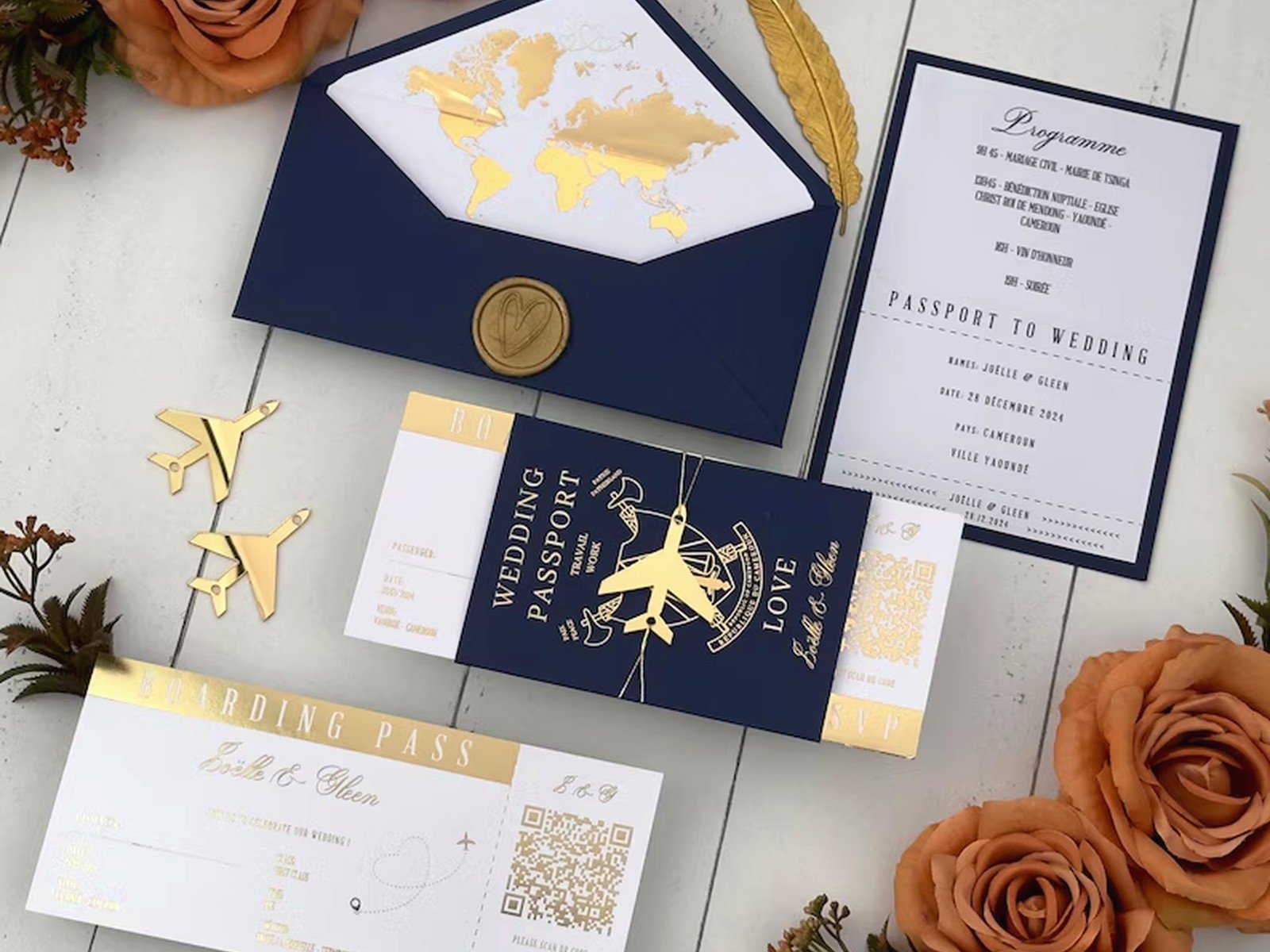
If you’re doing foil stamping you need to ask your printer specifically about it because not all printers have foil capabilities and it’s usually an add-on service. They’ll need a separate file just for the foil areas. Also foil comes in different colors—gold, rose gold, silver, copper—and you can even do holographic foil which looks cool but might be too much depending on your vibe.
Rounded corners are that little detail that makes passport invites look really authentic because real passports have rounded corners. Some printers include this automatically, others charge extra for corner rounding. It’s usually like 25-50 cents per invite but makes a difference.
Timeline for ordering because you’re probably behind already
Design phase: 2-4 weeks if you’re working with a designer, maybe 1-2 weeks if you’re using a template
Proofing and revisions: 1-2 weeks (always order a physical proof before printing 150 invites trust me on this)
Printing and production: 2-4 weeks depending on complexity and whether you’re doing foiling
Shipping to you: 1 week
Addressing and mailing: 1-2 weeks
So you’re looking at like 8-12 weeks total from start to finish. Wedding invitations should go out 8 weeks before your wedding date or 12 weeks for destination weddings which means you need to start this process like 5 months before your wedding. Yeah I know that sounds early but I’ve seen too many couples scrambling.
The RSVP situation
Most passport invitations come with a separate RSVP card designed to look like a boarding pass or luggage tag. These are cute but here’s what nobody tells you—people lose them constantly. Like way more than regular RSVP cards. I think it’s because they don’t look like traditional wedding stuff so guests set them aside and forget about them.
Consider doing online RSVPs instead or at least having it as a backup option. Include a QR code somewhere in the passport that links to your wedding website. Way easier for everyone and you don’t have to deal with… oh wait I was gonna say you don’t have to deal with postage both ways but honestly the environmental thing matters too, all that paper we use in the wedding industry is kinda ridiculous when you think about it.
Envelope and packaging decisions
You can’t just shove a passport invite in a regular envelope and call it a day. Well you can but it looks sad. Options include:
Belly bands—paper or ribbon wraps that hold everything together, adds like $1-2 per invite. Pockets or folders—the passport sits in a pocket with other inserts, clean look but bulky for mailing. Clear sleeves—protective and modern looking, cheap option. Box packaging—for really fancy invites, expensive and heavy, probably overkill unless you’re also including welcome gifts.
Whatever you choose make sure you assemble one complete invitation with all inserts and take it to the post office to weigh it BEFORE you buy stamps for all of them. Awkward square envelopes also cost more to mail even if they’re under an ounce because they can’t go through automated sorting. The postal worker will tell you if you need hand-canceling which is another fee.
Common mistakes I see all the time
Using photos that are too low resolution—your engagement photo needs to be high-res or it’ll look pixelated when printed small. At least 300 DPI.
Forgetting to include important stuff like dress code or your wedding website because you got too focused on making it look cute. Function over form matters.
Not proofreading carefully—I had a client in summer 2021 who ordered 200 invites with the ceremony time listed as 4:00 AM instead of 4:00 PM and didn’t catch it until they arrived. The designer had made the mistake and they had approved the proof without really looking. Always have like three different people proofread everything.
Ordering exact quantities—always order 10-15% extra for mistakes, last-minute additions, and keepsakes. You can’t just reorder 5 more later because printing setups have minimum quantities.
Choosing fonts that are too small or too decorative—remember some of your guests are older and need to actually read this thing. If the font size is under 10pt for important details you’re gonna get texts asking what time the wedding is.
DIY vs hiring it out
Look I’m all for DIY when it makes sense but passport invites are complicated. If you’re crafty and have design skills and lots of time then yeah go for it. You can save probably 40-60% doing it yourself. But if you’re already stressed about wedding planning and you’ve never used design software before this is not the project to learn on.
The middle ground is buying a template and having it printed professionally. You customize the template yourself which is pretty straightforward—just changing text and uploading photos—then you send the files to a printer. This saves money on design fees but you still get professional printing quality.
Or honestly just hire someone who knows what they’re doing. A good stationer is worth the money because they handle all the technical stuff and make sure everything is correct. Plus if something goes wrong it’s their responsibility to fix it not yours. When you’re already juggling a million wedding decisions sometimes it’s worth paying someone to just take this off your plate entirely.