
Planning Guides, Style Guide
Wedding Invitation Printing Services: Professional Printers
Sep
So You Need a Professional Printer for Your Wedding Invites
Okay so professional printing services are honestly where most couples get totally overwhelmed and I get it because there’s like… so many options and price points and terms you’ve never heard before. Let me just walk you through what I’ve learned after dealing with literally hundreds of orders.
First thing – you gotta understand the difference between digital printing and letterpress and offset and thermography because printers will throw these terms at you and assume you know what they mean. Digital printing is basically like a really fancy office printer, it’s perfect for full-color designs and photographs and it’s usually the most affordable option. I had this couple in spring 2023 who wanted these gorgeous watercolor invitations with like twelve different colors and digital was absolutely the way to go for them.
Letterpress is that pressed-into-the-paper look that everyone’s obsessed with on Pinterest. It’s beautiful, don’t get me wrong, but it’s expensive and there are limitations on colors and… honestly some printers do it way better than others. You can feel the impression on the back of the paper and it has this vintage elegant thing going on.
Finding the Right Printer
So where do you even start looking? I usually tell clients to begin with online print shops because you can compare prices easily and most of them have really good sample kits. Minted, Artifact Uprising, Bella Figura, these are all solid options that I’ve used multiple times. But also check out local print shops in your area because sometimes – and this really depends on where you live – they can be more flexible with rush orders or custom requests.
Here’s what annoys me though: when printers don’t show you actual printed samples before you commit to like 150 invitations. Some places only show you digital proofs on screen and colors NEVER look the same on screen versus paper. Never. I learned this the hard way back in summer 2021 when a client approved a “dusty blue” invitation online and when it arrived it was basically gray. We had to reorder everything and it pushed their timeline back three weeks.
Ask for printed samples. Physical samples you can hold. Most professional printers will send you a sample kit for free or like ten bucks, and if they won’t do that… that’s kinda a red flag honestly.
Questions You Need to Ask Before Ordering
When you’re talking to a printer, whether it’s online chat or on the phone or whatever, here’s your list:
- What’s the turnaround time for printing? And then ask what’s the ACTUAL turnaround time because sometimes they say two weeks but that doesn’t include proofing and revisions
- Do they offer design services or do you need to provide print-ready files?
- What paper stocks do they have? Weight matters – you want at least 110lb cardstock for invitations
- What’s their policy on reprints if there’s an error?
- Do they do envelope printing and addressing? This is separate from invitation printing usually
- Minimum order quantities – some places won’t print less than 50 or 100
- Can they handle different envelope sizes? Because if you’re doing a 5×7 invitation versus a square one, envelope availability changes
Paper Types and Finishes
Alright so paper is where things get really specific and honestly it’s my favorite part to talk about because it makes SUCH a difference in the final product. You’ve got matte, glossy, pearl, linen, cotton, recycled… I could go on forever.
Matte cardstock is super versatile and works with any printing method. It’s not shiny, it’s smooth, it feels substantial. Glossy is gonna make colors really pop but you’ll see fingerprints on it and some people think it looks cheap? I don’t necessarily agree but it’s something to consider.
Cotton paper is gorgeous and expensive and has this soft textured feel. It’s what you use for letterpress usually. Linen has a crosshatch texture that’s really subtle and elegant. Pearl or shimmer cardstock has a slight iridescent quality – I love this for evening weddings or formal events.
Paper weight is measured in pounds (lb) or grams per square meter (gsm). For invitations you want:
- 110lb to 130lb cover stock – this is standard and feels substantial
- 80lb to 100lb cover stock – this is thinner, works fine for inserts or details cards
- Anything less than 80lb feels flimsy for a wedding invitation honestly
Understanding Printing Methods Better
Digital Printing
This is what most people end up using because it’s affordable and the quality has gotten really good over the past few years. It can handle full color, gradients, photographs, basically any design you can create digitally. The colors are printed directly onto the paper using toner or ink.
Pros: affordable, fast turnaround, perfect for complex colorful designs, can do small quantities
Cons: colors might vary slightly from screen to print, can’t do white ink on dark paper (well, some specialty printers can but it’s more expensive)
Letterpress
Okay so letterpress is old-school printing where metal or polymer plates press into the paper creating an impression. It’s tactile and beautiful and has been having this huge renaissance in the wedding industry.
The thing about letterpress is that it works best with simple designs – line art, text, solid colors. You typically can’t do gradients or photographs. And each color requires a separate plate which means each additional color adds to the cost.
Pros: stunning tactile quality, looks incredibly elegant, works beautifully on thick cotton paper
Cons: expensive (like really expensive), limited color options per budget, can’t do fine details or photos
I had a bride once who wanted letterpress but her design had this intricate floral watercolor background and we had to basically… we had to have a whole conversation about simplifying the design or switching to digital and she was not happy initially but once she saw the letterpress samples with a simplified version she got it.
Thermography
This is that raised printing you see sometimes where the text is actually lifted off the paper. It’s created by applying powder to wet ink and heating it. It’s less expensive than letterpress but still gives you that dimensional quality.
Pros: more affordable than letterpress, nice tactile element, works on various paper types
Cons: can only print on one side usually, doesn’t work well with large solid areas, has a slight shine to it
Offset Printing
This is traditional commercial printing, best for really large quantities like 300+ invitations. The quality is excellent and colors are super consistent but most offset printers have high minimums.
Working With Design Files
So if you’re providing your own design – whether you made it yourself or hired a designer – you need print-ready files. This usually means PDF format with specific settings that I’m gonna try to explain without getting too technical.
Your printer will give you specs but generally you need:
– CMYK color mode, not RGB (this is for print versus screen)
– At least 300 dpi resolution
– Bleed area (usually 0.125 inches) which means your design extends past where it’ll be cut
– Crop marks showing where to trim
– All fonts embedded or outlined
If this sounds like gibberish to you, that’s totally fine – most online printing services have templates you can use in Canva or they offer design services. But if you’re working with a designer, make sure they understand print specifications because not all graphic designers have print experience and that’s caused me so many headaches over the years.
Envelope Printing and Addressing
Okay so you’ve got your invitations printed, now what about envelopes? You’ve got options here too and honestly this is where people tend to… wait I should mention that my cat just knocked over my coffee while I’m writing this and I’m choosing to ignore the mess for now.
Anyway, envelope printing options:
Digital printing directly on envelopes: Many professional printers can print return addresses and even guest addresses directly on envelopes. It’s clean and modern looking. Works great for solid colored envelopes.
Envelope liners: These are decorative paper liners that go inside your envelopes. Some printers offer these as add-ons. They’re gorgeous but they add cost and assembly time.
Guest addressing: You can have the printer do this, or hire a calligrapher, or do it yourself. Professional printing services often offer digital calligraphy printing which looks hand-done but isn’t. Real calligraphy is beautiful but expensive – usually $3-5 per envelope.
Proofing Process
Never ever skip the proofing stage. Most printers will send you a digital proof first – this is a PDF showing exactly how your invitation will look. You need to check:
- Spelling of every single name and word
- Dates and times are correct
- Addresses are accurate
- Design elements are positioned correctly
- Colors look approximately right (remember they’ll vary on paper)
Some printers offer printed proofs too – this is an actual printed sample of your invitation. It costs extra but for letterpress or thermography or if you’re really particular about colors, it’s worth it. I always recommend printed proofs for orders over 150 invitations because the cost of reprinting everything if there’s an issue is way more than the proof cost.
Timing and When to Order
You should order your invitations about 4-5 months before your wedding. This gives you time for:
- Design finalization: 2-3 weeks
- Printing: 2-3 weeks (longer for letterpress)
- Assembly: 1 week if you’re doing it yourself
- Addressing: 1-2 weeks
- Mailing: 8 weeks before wedding (this is standard etiquette)
Rush orders are possible with most digital printers but you’ll pay extra and honestly the stress isn’t worth it. I’ve had clients try to do everything in 3 weeks and it’s just… it’s chaos.
Quantity Considerations
Order more than you think you need. Seriously. I tell everyone to add 15-20 extra invitations to their count because:
- You’ll forget people and need to send additional invites
- Some will get lost in mail
- You’ll want keepsakes for parents, yourself, your planner
- Mistakes happen during assembly
Reordering later usually means paying setup fees again and the colors might not match exactly if there’s any time gap between print runs.
Cost Breakdown Reality Check
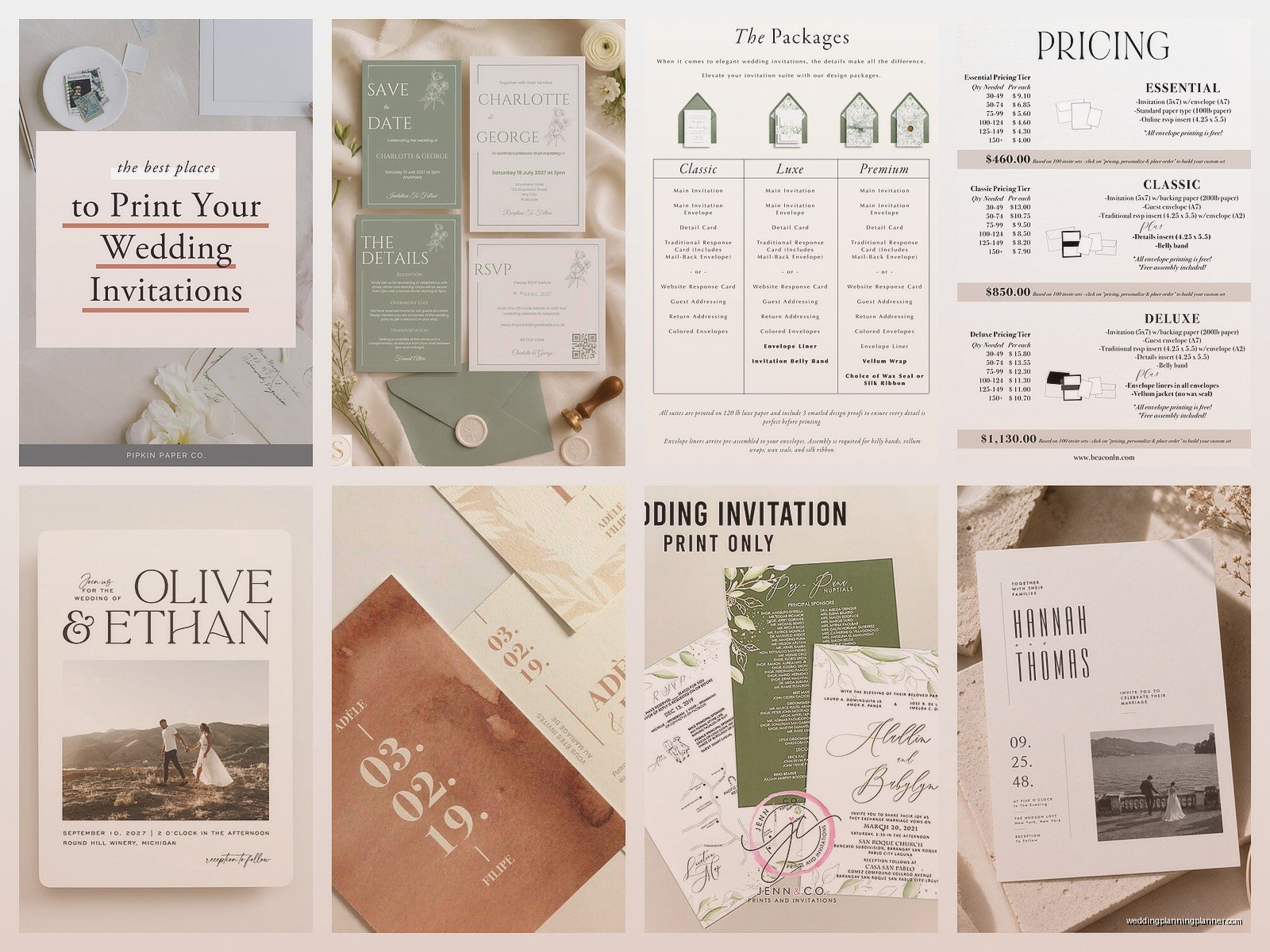
Let’s talk actual numbers because this is where people get sticker shock. For professional printing services:
Digital printing: $1.50-4.00 per invitation suite (invitation plus details card and RSVP)
Thermography: $3.00-6.00 per suite
Letterpress: $8.00-20.00+ per suite
Envelopes: usually included but addressing adds $0.50-1.50 per envelope for digital printing
Envelope liners: $1.00-2.00 each
Belly bands or ribbons: $0.75-2.00 per invitation
So for 100 guests you’re looking at anywhere from $150 to $2000+ depending on what you choose. Most of my clients end up in the $400-800 range for nice quality digital or thermography printing.
Red Flags to Watch For
Some warning signs that a printer might not be professional or reliable:
- Won’t provide samples before you order
- No clear return or reprint policy
- Can’t explain their printing process when you ask
- Prices that seem way too good to be true (they usually are)
- Poor communication or slow response times during the quote phase
- No reviews or portfolio to look at
Assembly Tips
Most professional printers don’t assemble your invitation suites – they print everything and ship it to you flat. Assembly means putting together all the pieces in the right order, adding belly bands or ribbons if you’re using them, stuffing envelopes.
Set aside a whole afternoon or evening for this. Put on a show you don’t need to pay attention to (I always recommend something you’ve seen before), get some wine or coffee, and create an assembly line. Stack everything in order and work through them one at a time. Don’t try to do different steps for different invitations – finish one completely before starting the next or you’ll definitely make mistakes.
If you’ve got RSVPs, make sure you stamp those before putting them in the envelope. Pre-stamping response cards increases your response rate significantly because people are lazy and won’t go find a stamp.
Online vs Local Printers
There’s pros and cons to both and I’ve used both successfully. Online printers like Minted or Zazzle or Vistaprint (for budget-conscious couples) offer convenience and competitive pricing. You can do everything from your couch at midnight. They have templates and design services and customer reviews.
Local printers offer personal service and the ability to see samples in person and build a relationship. If something goes wrong, you can literally go to their shop and talk to someone face-to-face. For letterpress especially, I prefer local printers because the quality variation between different letterpress printers is huge and you really need to see their work in person.
I usually suggest getting quotes from both online and local options and comparing not just price but also what’s included, turnaround time, and your gut feeling about their professionalism and communication.
Sustainable and Eco-Friendly Options
If environmental impact matters to you, there are professional printers who specialize in eco-friendly options. Look for recycled paper, soy-based inks, carbon-neutral printing processes. Companies like Paper Culture and Greenvelope (which is fully digital) focus on sustainability. The quality is just as good as traditional printing, you’re just making a different choice about materials.
