
Planning Guides, Style Guide
Wedding Planner Charges: Professional Services Guide

Oct
What Wedding Planners Actually Charge (And Why It’s So Confusing)
So here’s the thing about wedding planner fees – they’re all over the map and honestly it drove me crazy when I first started out because there’s no standard rulebook or anything. You’ll see planners charging $500 and others charging $15,000 for what seems like the same service, and couples get understandably confused.
Most wedding planners use one of these pricing structures, and I’ve used pretty much all of them at different points:
Flat Fee Packages
This is where you charge a set amount for a specific service. Like, full planning might be $4,500, partial planning is $2,200, day-of coordination is $1,200. Clean and simple. I switched to this model in spring 2023 after a really stressful situation where a client kept asking “but is THIS included?” every single week and I just… I couldn’t deal with the ambiguity anymore.
The flat fee works great if you have pretty standardized services. You know roughly how many hours each type of wedding takes, you’ve done enough of them to predict the workload, and you don’t want to nickel-and-dime people. The downside is that some weddings will take way more time than others and you’re stuck with the same fee.
Percentage of Wedding Budget
This is the traditional approach – charging 10-20% of the total wedding budget. So if someone’s spending $50,000 on their wedding, you’d charge $5,000-$10,000. Sounds fair in theory because bigger budgets usually mean more work, more vendors to coordinate, fancier expectations.
But ugh, this model annoyed me so much when I was starting out because couples would literally lie about their budget to get lower fees. They’d say their budget was $30,000 when it was actually $60,000, and then you’d find out halfway through planning when they’re booking a $8,000 photographer and a $12,000 venue. Like, the math doesn’t math, you know?
Also some couples genuinely don’t HAVE a set budget yet, which makes this impossible to calculate upfront.
Hourly Rates
Charging by the hour – usually anywhere from $75 to $300+ per hour depending on your experience and market. This works well for consultation services or when someone just needs help with specific things. “I need 5 hours of help choosing my vendors and negotiating contracts” – boom, that’s $750 at $150/hour.
The problem with hourly is that you gotta track everything meticulously. Every email, every phone call, every vendor meeting. I used Toggl for a while to track my time and it was… it was kinda exhausting actually. Plus clients get nervous about the final bill because they don’t know what it’ll be.
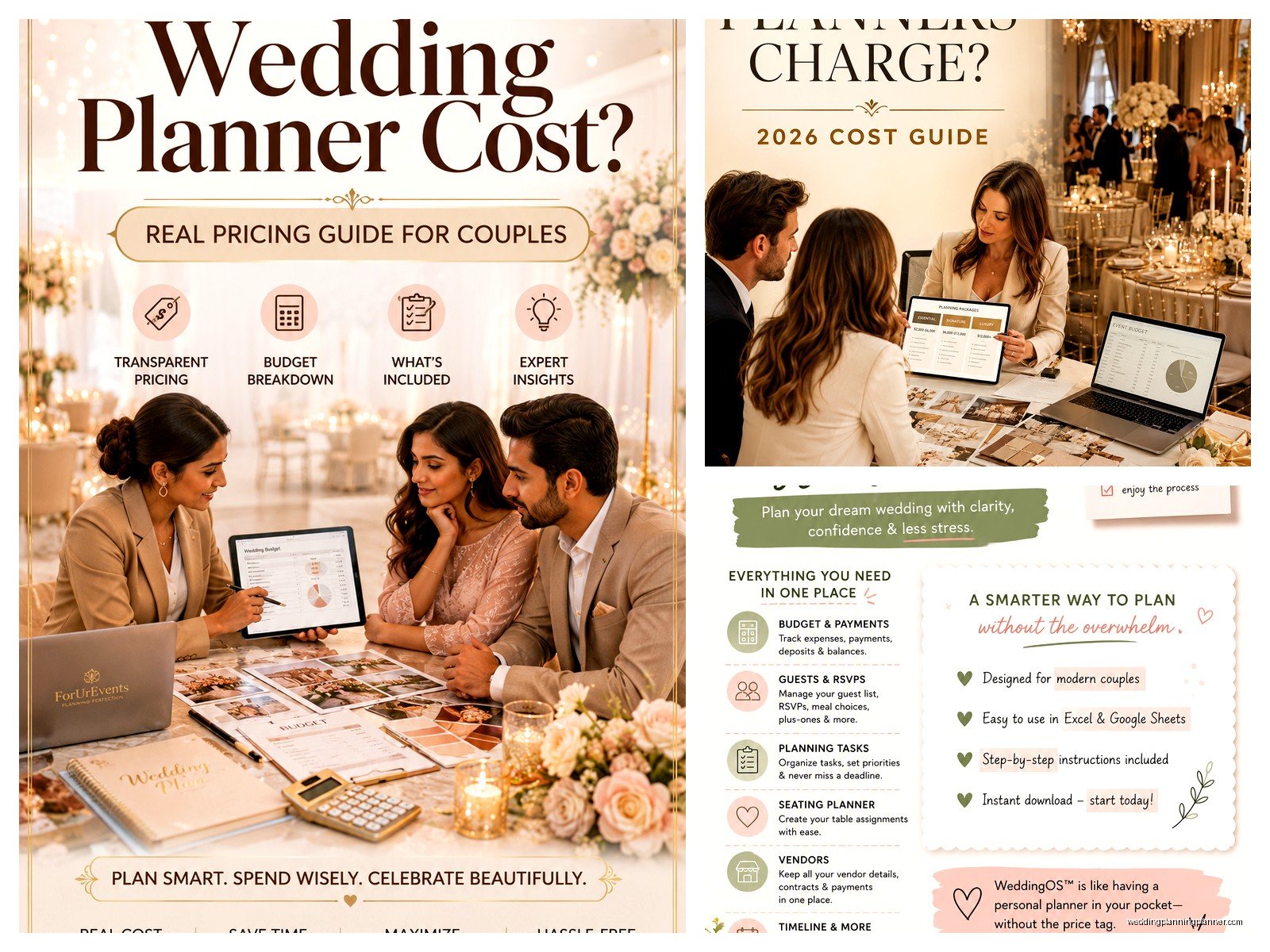
Breaking Down Actual Service Tiers
Most planners offer different levels of service, and the pricing reflects how involved you are:
Full Service Planning
This is the whole enchilada. You’re involved from day one – budget creation, venue search, all vendor recommendations and bookings, design concept, timeline creation, managing RSVPs, handling family drama (okay that’s not officially included but it happens), final walk-throughs, day-of coordination, the works.
Pricing usually ranges from $3,000 to $15,000+ depending on location and experience. In major cities like NYC or LA, top planners charge $20,000-$50,000. In smaller markets, you might see $2,000-$5,000. I typically charge around $5,500 for full planning, which includes unlimited communication, all meetings, vendor management, and up to 14 months of planning time.
The time investment is huge – I’d estimate 80-120 hours total for a full planning client, spread across the entire engagement.
Partial Planning
Sometimes called “month-of” or “planning assistance,” though I hate the term month-of because it’s never actually just a month. This is where couples have already booked their major vendors but need help pulling everything together in the final 2-4 months.
You’re creating timelines, confirming vendor details, doing the rehearsal coordination, and managing the wedding day. You’re NOT helping them find vendors or doing design work from scratch.
I charge $2,800 for this service. Other planners range from $1,500 to $5,000. The time commitment is maybe 40-60 hours total.
Day-Of Coordination
Okay so this is where things get tricky because couples think this means you show up on the wedding day and that’s it. Nah. You typically start 2-4 weeks before the wedding, collect all the vendor contracts and contacts, create a detailed timeline, do a final walk-through, manage the rehearsal, and then coordinate the actual day with your team.
Pricing ranges from $800 to $3,000. I’m at $1,400 for day-of, which includes one planning meeting, unlimited email support for 3 weeks before, rehearsal coordination, and 10 hours of wedding day coverage with an assistant.
What really annoyed me recently was a bride who booked day-of coordination and then kept asking me to call vendors and renegotiate her contracts and redesign her centerpieces and I’m like… that’s not what you paid for, babe.
What Actually Goes Into The Pricing
Here’s what you need to factor in when you’re setting your rates or understanding why planners charge what they do:
Time (The Big One)
Every client email, every venue tour, every vendor meeting, every timeline revision. Then there’s the invisible time – research, creating presentations, following up with non-responsive vendors, tracking down RSVPs from guests who apparently don’t understand deadlines.
Summer 2021 I had a wedding where the bride changed her mind about the color scheme FOUR TIMES and each time meant hours of finding new linens, new florals, new stationery options, creating new mock-ups. I was charging a flat fee and definitely lost money on that one.
Experience and Expertise
A planner with 15 years of experience and 200 weddings under their belt can command way higher rates than someone in their first year. You’re paying for their vendor relationships, their problem-solving skills, their ability to handle disasters calmly. I once saw a planner fix a situation where the caterer didn’t show up – she literally had food delivered from three different restaurants, plated it beautifully, and no one knew the difference. That’s worth premium pricing.
Business Expenses
Insurance (you need liability insurance, trust me), software subscriptions (planning tools, contract software, accounting), marketing, website hosting, business cards, professional development, taxes… it adds up. My cat knocked over my coffee onto my laptop last month and that was a $900 replacement that came straight out of business income.

Team and Assistance
Most wedding day coordination requires at least one assistant, sometimes two or three depending on guest count and complexity. You gotta pay them, which comes out of your fee.
Regional Variations That’ll Make Your Head Spin
Where you live drastically affects pricing. In Manhattan, day-of coordination starts around $2,500. In rural Kentucky, you might find it for $600. It’s not that planners in expensive cities are greedier or that small-town planners are worse – it’s cost of living, market expectations, and what couples are accustomed to spending.
I’m in a mid-sized market and my pricing reflects that. If I moved to San Francisco tomorrow, I’d probably raise my rates 40-60%. If I moved to a small town in Arkansas, I’d need to lower them or offer way more value-adds to justify current pricing.
À La Carte Services
Some planners (including me) offer individual services for couples who don’t want full packages:
- Venue search assistance: $500-$1,500
- Vendor recommendations and contract review: $300-$800
- Design consultation (2-hour session): $250-$600
- Timeline creation: $200-$500
- Rehearsal coordination only: $300-$600
This works for couples who are pretty organized but need expert help on specific things. Like, I had a client who just wanted help negotiating with her venue because they were being difficult about bringing in outside catering, and she paid me $400 for basically 3 hours of my time handling that situation.
Hidden Costs and Extras
Travel fees are common if the wedding is outside your normal service area. I charge $0.50/mile beyond 30 miles from my office, plus hotel accommodations if needed for rehearsal and wedding day.
Overtime charges might apply if the wedding day runs long – like if you booked 8 hours of coverage but the reception goes 10 hours, that’s extra. I charge $100/hour for additional time.
Rush fees for weddings booked less than 3 months out. Everything’s compressed and stressful and you’re probably turning down other clients to accommodate the tight timeline.
Destination wedding fees are usually higher because you’re traveling, spending multiple days away from home and other clients, and dealing with unfamiliar vendors and venues.
Payment Structures
Most planners don’t require full payment upfront. Common structures:
- 50% deposit to book, 50% due 2 weeks before the wedding
- 33% deposit, 33% at 6 months out, 34% final payment 2 weeks before
- 25% deposit, then monthly payments spread across the planning period
I do 40% deposit, 30% at 3 months before, and 30% final payment 2 weeks before the wedding day. The deposit is non-refundable because I’m turning away other potential clients for that date.
What You Should Actually Expect to Pay
If you’re hiring a wedding planner, here’s realistic pricing for someone with decent experience (3-5+ years) in an average US market:
- Full planning: $4,000-$8,000
- Partial planning: $2,000-$4,000
- Day-of coordination: $1,200-$2,500
Brand new planners might charge 30-50% less to build their portfolio. Ultra-experienced luxury planners might charge double or triple these amounts.
For destination weddings or luxury events with budgets over $100,000, add another 50-100% to these estimates.
Red Flags in Planner Pricing
If someone’s charging $300 for full wedding planning, they’re either brand new and undervaluing themselves, or they’re gonna ghost you halfway through. No experienced planner can afford to work for pennies.
If there’s no contract or the pricing is super vague (“we’ll figure it out as we go”), run away. You need clear deliverables and clear costs.
If they won’t explain what’s included in each package, that’s sketchy. You should know exactly what you’re paying for.
The Stationery Angle
Since I also do stationery consulting, I sometimes bundle that into planning packages or offer it separately. Custom invitation design and printing coordination usually adds $800-$2,000 to a planning package, depending on how elaborate the suite is and guest count.
Some planners mark up stationery products, some charge flat design fees, some do hourly. I do a flat fee for design ($600-$1,200 depending on complexity) plus pass through printing costs at my actual cost – I don’t mark those up because it feels kinda icky to me, though plenty of planners do and that’s their business decision.
Anyway, I was watching The Bear last week and thinking about how the chaos in that kitchen is basically what wedding planning feels like sometimes, except instead of food you’re coordinating flowers and linens and… okay that metaphor doesn’t totally work but you get it.
The bottom line is that professional wedding planning costs real money because it’s real work that requires real expertise. But the pricing structure should make sense for both the planner’s business model and the couple’s needs. Whether you’re paying $1,500 or $15,000, you should know exactly what you’re getting and feel confident that the investment matches the value you’re receiving. And planners should be pricing themselves in a way that’s sustainable, fair, and reflects their actual costs and expertise without either undervaluing themselves or gouging clients who are already stressed about wedding budgets
