
Planning Guides, Style Guide
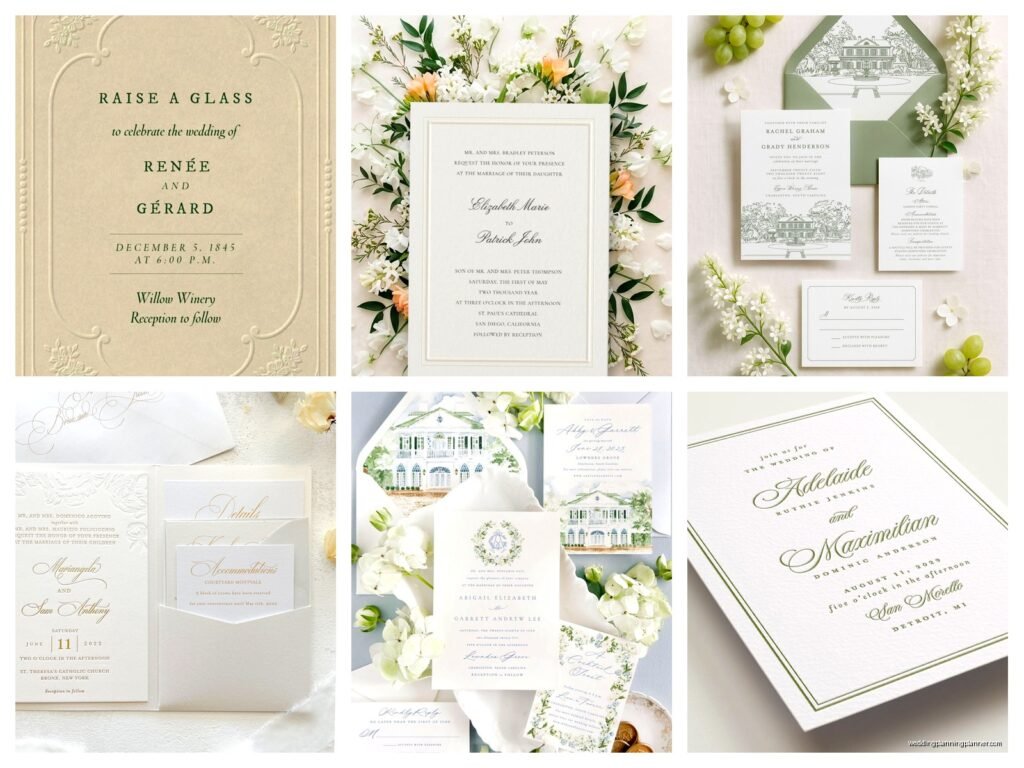
Traditional Wedding Invitations: Classic Formal Designs
Nov
Okay so traditional wedding invitations are basically the foundation of formal wedding stationery
Traditional invitations follow these really specific rules that have been around forever and honestly when I first started doing wedding planning back in like 2008, I thought some of these rules were totally outdated but then you realize they exist for actual reasons. The formality creates this whole tone for your wedding and guests DO notice when something feels off.
The classic formal invitation has specific components and they go in a particular order. You’ve got the host line at the top (usually the parents), then the request line (like “request the honour of your presence”), then the couple’s names, the ceremony details, and reception information if it’s at the same location. If reception is elsewhere, you use a separate reception card.
The actual paper and printing methods matter way more than you’d think
I had this bride in summer 2021 who wanted “traditional invitations” but then picked this super thin cardstock from an online vendor and when they arrived she was devastated because they felt cheap. Traditional formal invitations should be on heavy cardstock – I’m talking 100lb cover weight minimum, but really you want 110-130lb for that proper substantial feel. When someone picks up a formal invitation, it should feel like something important.
Printing methods are where it gets interesting. Engraving is the most traditional and most expensive option. It creates this raised text on the front and you can feel the indentation on the back. It’s gorgeous but gonna cost you. Letterpress is another classic option where the text is actually pressed INTO the paper, creating an impression. Thermography is the budget-friendly version that looks like engraving but it’s raised printing created with heat and powder. Honestly for most weddings, thermography looks perfectly fine and your guests won’t know the difference unless they’re stationery nerds like me.
Flat printing (digital or offset) is the most affordable but it’s not really “traditional” in the formal sense. You can make it work if you use really high-quality paper though.
Wording is where people get really stressed and it’s kinda justified
The wording conventions for formal invitations are super specific and this is what annoys me sometimes – couples get SO hung up on following rules that don’t even apply to their situation anymore. But okay here are the actual traditional rules:
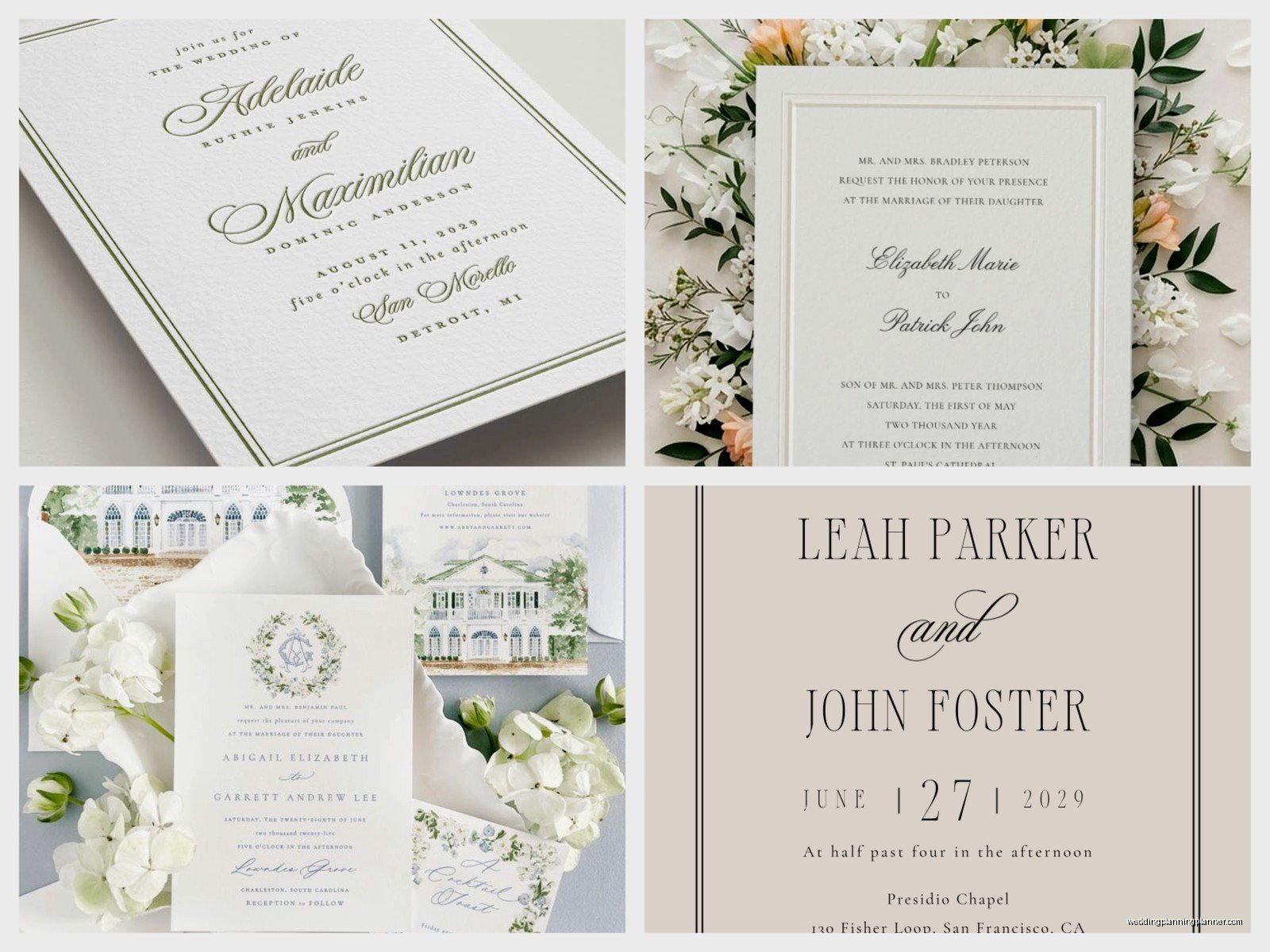
If the bride’s parents are hosting, it goes:
Mr. and Mrs. John Michael Smith
request the honour of your presence
at the marriage of their daughter
Sarah Elizabeth
to
Mr. James Robert Anderson
Notice “honour” is spelled with a U – that’s the traditional British spelling and it’s used specifically for religious ceremonies. If you’re having a non-religious ceremony, you’d say “request the pleasure of your company” instead.
If both sets of parents are hosting:
Mr. and Mrs. John Michael Smith
and
Mr. and Mrs. Robert Charles Anderson
request the honour of your presence
at the marriage of their children
Sarah Elizabeth Smith
and
James Robert Anderson
When the couple is hosting themselves (which is super common now), you can go with:
The honour of your presence is requested
at the marriage of
Miss Sarah Elizabeth Smith
to
Mr. James Robert Anderson
Or just use your names without titles if that feels too formal even for a formal invitation.
Titles and names get complicated fast
Traditional etiquette says you use full formal names – no nicknames. Sarah Elizabeth, not Sarah or Sally. Middle names are included. For women, you’d traditionally use “Miss” if unmarried, “Mrs.” if married, “Ms.” if divorced or you prefer it. Men are “Mr.” unless they have professional titles like “Doctor” or military ranks.
I had this whole situation in spring 2023 where the groom’s father was a doctor and the bride’s father was also a doctor and they got into this whole thing about whose title should be more prominent and I’m sitting there thinking about how my cat had just knocked over an entire glass of water onto my keyboard that morning and wondering if this was really the hill anyone wanted to die on but you know what, traditional invitations bring out these concerns in people.
Divorced parents hosting gets tricky. You’d list them on separate lines and traditionally the mother is listed first:
Mrs. Patricia Anne Smith
Mr. John Michael Smith
request the honour of your presence
If a parent has remarried, you include the step-parent:
Mr. and Mrs. David James Wilson
request the honour of your presence
at the marriage of her daughter
Sarah Elizabeth Smith
Notice it says “her daughter” not “their daughter” because step-parent.
The date and time formatting is weirdly specific
You spell everything out in formal invitations. No numerals except for addresses and times after twelve o’clock (like half after four o’clock, but 4:30 would be wrong).
Dates are written like:
Saturday, the fifteenth of June
two thousand twenty-five
Or if you wanna be extra formal:
Saturday, the fifteenth day of June
in the year of our Lord two thousand twenty-five
But honestly that second version feels pretentious unless you’re having like a cathedral wedding.
Times are:
half after four o’clock
five o’clock in the afternoon
half past six o’clock in the evening
Morning is before noon, afternoon is noon to five-ish, evening is after five or six depending on who you ask. You don’t include “in the morning/afternoon/evening” if the time makes it obvious, but it’s nice to include for clarity.
Colors and design elements for traditional invites
Classic formal invitations stick to really conservative color palettes. Black ink on white or ecru (cream) paper is the most traditional. Navy ink is also acceptable and actually super pretty. I love a good navy on ecru combo – it feels formal but slightly warmer than stark black and white.
For design, less is more. You might have a simple border, maybe a monogram, but traditional formal invitations don’t have florals all over them or watercolor backgrounds. That’s not to say those things are bad – they’re just not traditionally formal. A classic formal invite is about elegant typography and quality paper, not decorative elements.
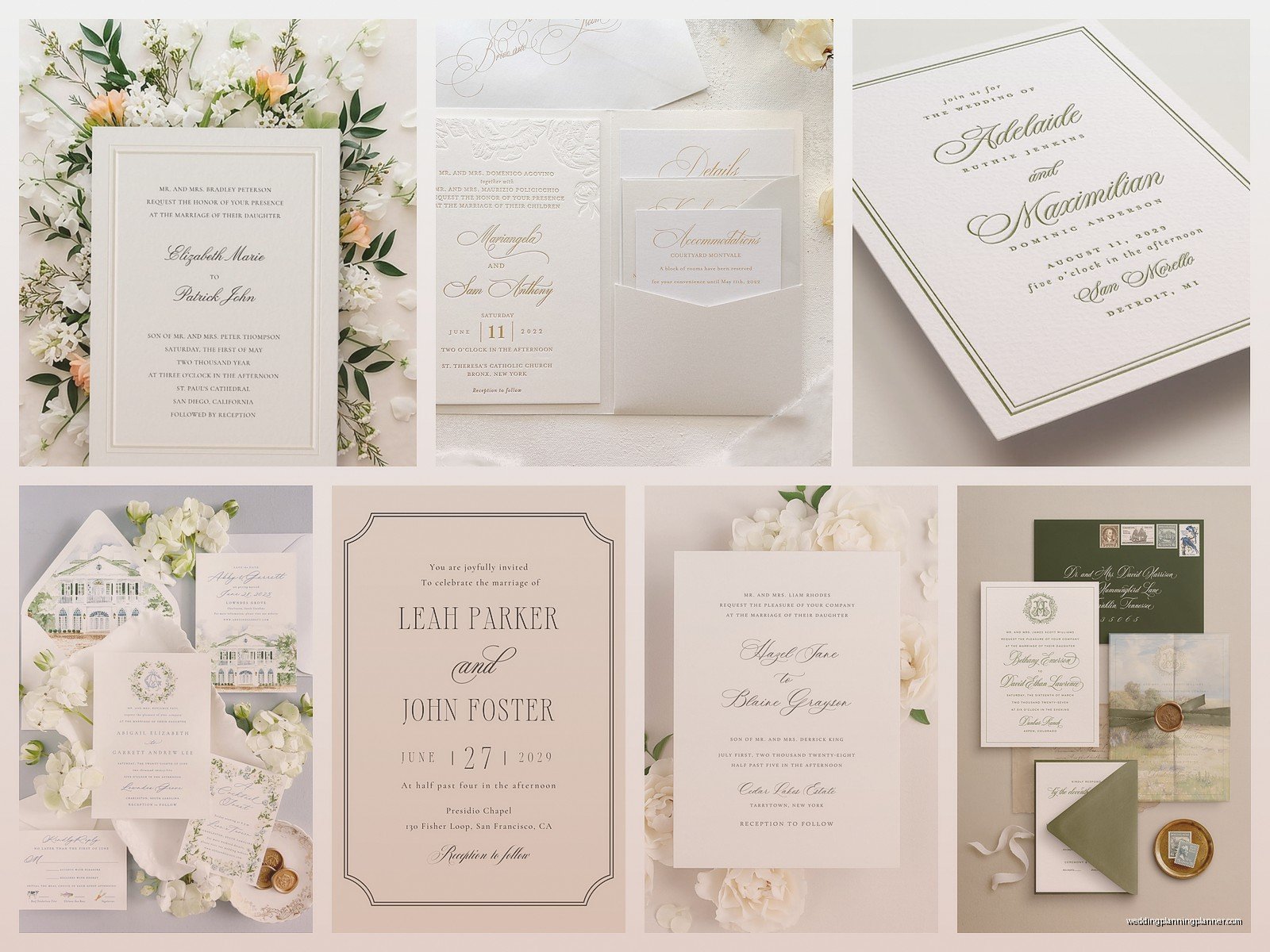
Font choices matter too. You want something like copperplate, script fonts that are actually readable (nothing too swirly), or classic serif fonts. Those trendy modern sans-serif fonts? Nah, not for traditional formal invitations.
The full invitation suite components
A complete traditional formal invitation suite includes several pieces and they all serve specific purposes:
The main invitation: This is the ceremony invitation with all the details I mentioned above.
Reception card: If your reception is at a different location or significantly later, you include a separate reception card. It might say:
Reception
immediately following the ceremony
The Country Club of Virginia
123 Club Lane
Richmond, Virginia
Response card with envelope: Guests use this to RSVP. Traditional wording is:
The favour of a reply is requested
by the twentieth of May
M_____________________
_____ accepts
_____ declines
The “M” line is where guests write their names with title (Mr. and Mrs., Miss, etc.). You include a pre-addressed, pre-stamped envelope for the response card because you’re not making your guests pay to respond to YOUR invitation.
Inner and outer envelopes: This is old-school but properly traditional. The outer envelope has the mailing address and gets sealed. The inner envelope goes inside unsealed and has just the names of the invited guests (no address). This served a practical purpose back when mail was hand-delivered and envelopes got dirty – the inner envelope stayed clean. Now it’s mostly about formality and making it crystal clear who is invited.
Direction/map card: Less common now with GPS but still nice for venues that are hard to find.
Accommodations card: Lists hotel blocks for out-of-town guests.
Weekend events card: If you have welcome drinks, brunch, etc.
Envelope addressing is its own whole thing
Formal invitations should have hand-calligraphied envelopes or at least printed in a calligraphy-style font. No labels. I know, I know – it’s time-consuming and expensive but it’s part of the traditional formal aesthetic.
Outer envelope formal addressing:
Mr. and Mrs. John Michael Smith
123 Maple Street
Richmond, Virginia 23226
Inner envelope (more casual):
Mr. and Mrs. Smith
Sarah and Michael
If you’re inviting children, their names appear only on the inner envelope under the parents’ names. This is actually how you indicate who IS and ISN’T invited. No inner envelope with kids’ names = kids aren’t invited. This drives modern couples crazy because it feels indirect but that’s the traditional method.
For unmarried couples living together, names go on separate lines on the outer envelope (alphabetically), together on the inner.
Assembly order matters for traditional presentation
There’s a proper way to assemble these invitations and when I first learned this I thought it was excessive but then you see a properly assembled invitation suite and it just feels… right?
Order from bottom to top:
- Main invitation (face up)
- Tissue paper (this was originally to prevent ink smudging but now it’s decorative)
- Reception card (if separate)
- All other enclosure cards stacked by size, largest to smallest
- Response card tucked under the flap of its envelope (face up so you can read it)
This whole stack goes into the inner envelope (if you’re using one) with the printed side facing the back flap so when someone opens it, they immediately see the invitation text. Then the inner envelope goes into the outer envelope with the guests’ names facing the back flap.
Seal the outer envelope and that’s it. Well, except for the addressing and stamping but you get the idea.
Timing for traditional formal invitations
Order your invitations at least four to five months before the wedding. Formal printing methods take longer – engraving especially can take 6-8 weeks. Then you need time for addressing (if you’re hiring a calligrapher, book them early because good ones fill up fast).
Mail formal invitations 8-10 weeks before the wedding. This gives guests time to make arrangements, especially if travel is involved. For destination weddings, you’d go even earlier – like 12 weeks.
Save-the-dates should go out 6-8 months before (or 8-12 months for destination weddings) but those don’t need to be formal even if your invitations are.
Budget real talk
Traditional formal invitations are expensive. There’s no way around it. You’re looking at anywhere from $8-15 per invitation for thermography, $15-30+ for letterpress or engraving, and that’s before you add calligraphy addressing which can be $3-8 per envelope.
For 150 invitations (which covers about 300 guests since couples get one invite), you might spend:
- Budget formal: $1,500-2,000 (thermography, printed addressing)
- Mid-range formal: $3,000-4,500 (letterpress, calligraphy)
- High-end formal: $6,000-10,000+ (engraving, hand calligraphy, premium paper)
These numbers include the full suite with all the pieces. If you’re cutting costs, skip the inner envelope (most people do now anyway), print your own direction cards on nice paper, or do digital RSVPs instead of printed response cards. But honestly if you’re going for traditional formal, you kinda gotta commit to at least some of these elements or it won’t have that formal feel you’re after.
Common mistakes I see all the time
People mix formal and casual elements and it creates this weird disconnect. Like they’ll have perfectly formal wording but then use a super casual font or bright pink paper. Pick a lane – either go traditional formal or do something more modern, but don’t try to split the difference because it usually doesn’t work.
Another thing is ordering too late. I cannot stress this enough – formal invitations take TIME. I’ve had couples in full panic mode trying to rush-order engraved invitations six weeks before their wedding and it’s just… it’s not gonna happen or you’ll pay through the nose for rush fees.
Also forgetting to account for weight when buying postage. These formal suites with multiple cards and heavy paper often need extra postage. Take a fully assembled invitation to the post office and have them weigh it before you buy stamps. Nothing worse than having invitations returned for insufficient postage.
Oh and this drives me crazy – people forget to include important information because they’re so focused on following format rules. Like they’ll have beautiful formal wording but forget to put the actual venue name or they’ll say “reception to follow” but the reception is two hours later and guests need to know that. Function over form, even with traditional invitations.
