
Planning Guides, Style Guide
Jewish Wedding Invitations: Hebrew Cultural Traditional Designs
Nov
The Hebrew Text Thing Everyone Gets Wrong
Okay so the biggest mistake I see with Jewish wedding invitations is couples just slapping Hebrew text onto their design without actually thinking about how it reads or what it means. Like, I had this couple in spring 2023 who came to me after ordering invitations online and the Hebrew was literally backwards because the designer didn’t understand right-to-left formatting. They’d already printed 150 invitations and had to scrap them all.
Hebrew reads right to left. This seems obvious but you’d be shocked how many designers mess this up. If you’re incorporating Hebrew text—whether it’s just the names, the date, or traditional blessings—you need someone who actually reads Hebrew to check it. Not Google Translate. Not your cousin who went to Hebrew school for like two years in elementary school.
Traditional Design Elements You Should Know About
Jewish wedding invitations traditionally include specific symbols and motifs that carry meaning. The most common ones are the chuppah (wedding canopy), which represents the new home you’re building together, pomegranates for fertility and abundance, the Tree of Life, Stars of David, and Jerusalem cityscapes if you want something really traditional.
Honestly what annoys me is when people use these symbols without knowing what they mean and then get all confused when their bubbie asks why they chose that particular image. Do a little research, you know? Or at least ask your planner or stationer what the symbolism is.
The hamsa hand is super popular right now but it’s actually more of a general Middle Eastern protective symbol than specifically Jewish, though it’s definitely used in Jewish culture. Same with the chai symbol—those are pretty universally recognized but make sure the style fits your overall aesthetic.
Color Palettes That Work
Traditional Jewish wedding invitations often use deep blues (representing heaven and divinity), golds (Jerusalem stone, holiness), white (purity), and sometimes burgundy or wine colors (think the kiddush wine). But honestly, you can use whatever colors you want. I’ve done blush pink and gold Jewish invitations, sage green with copper foiling, even black and white modern designs.
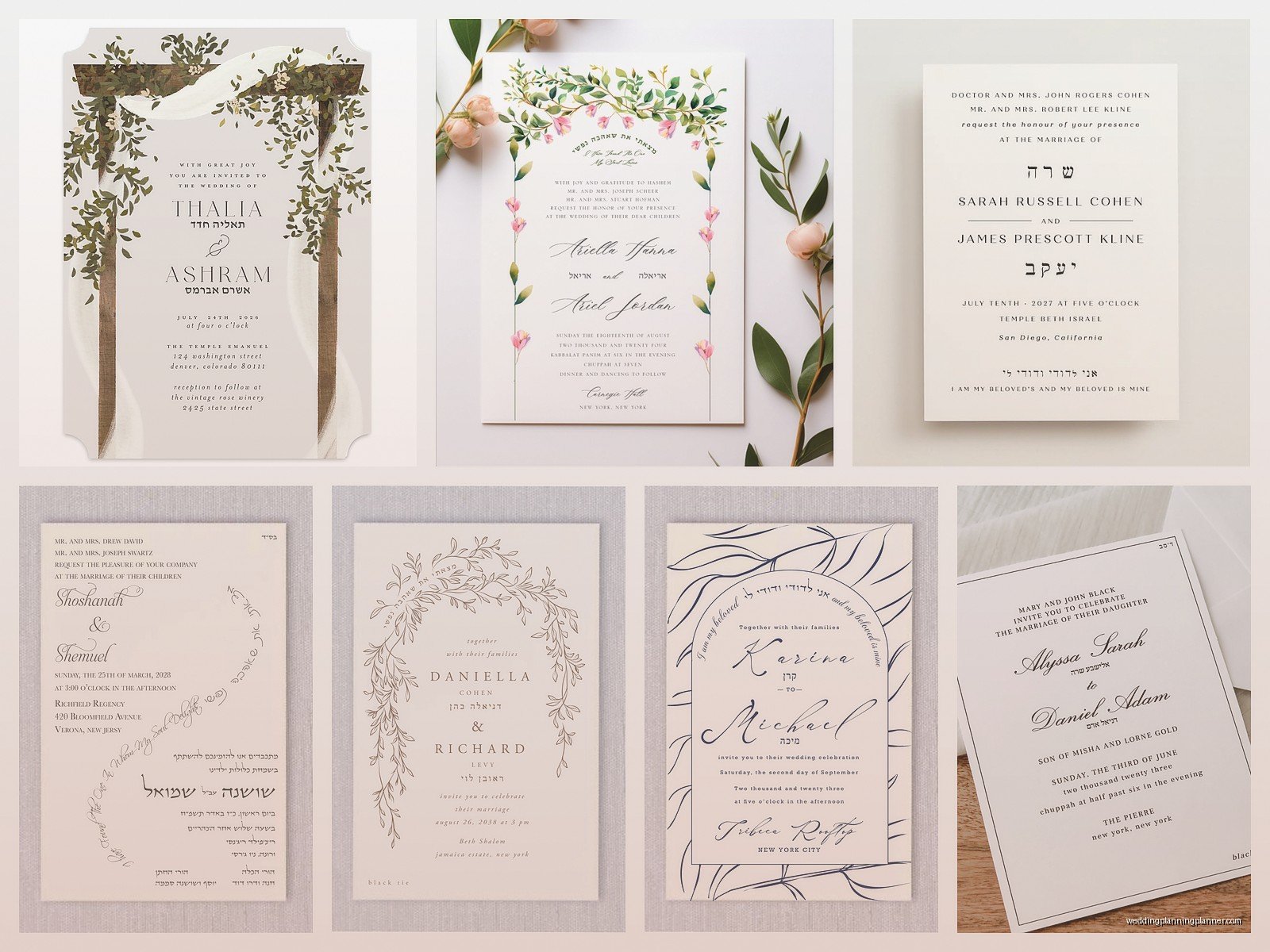
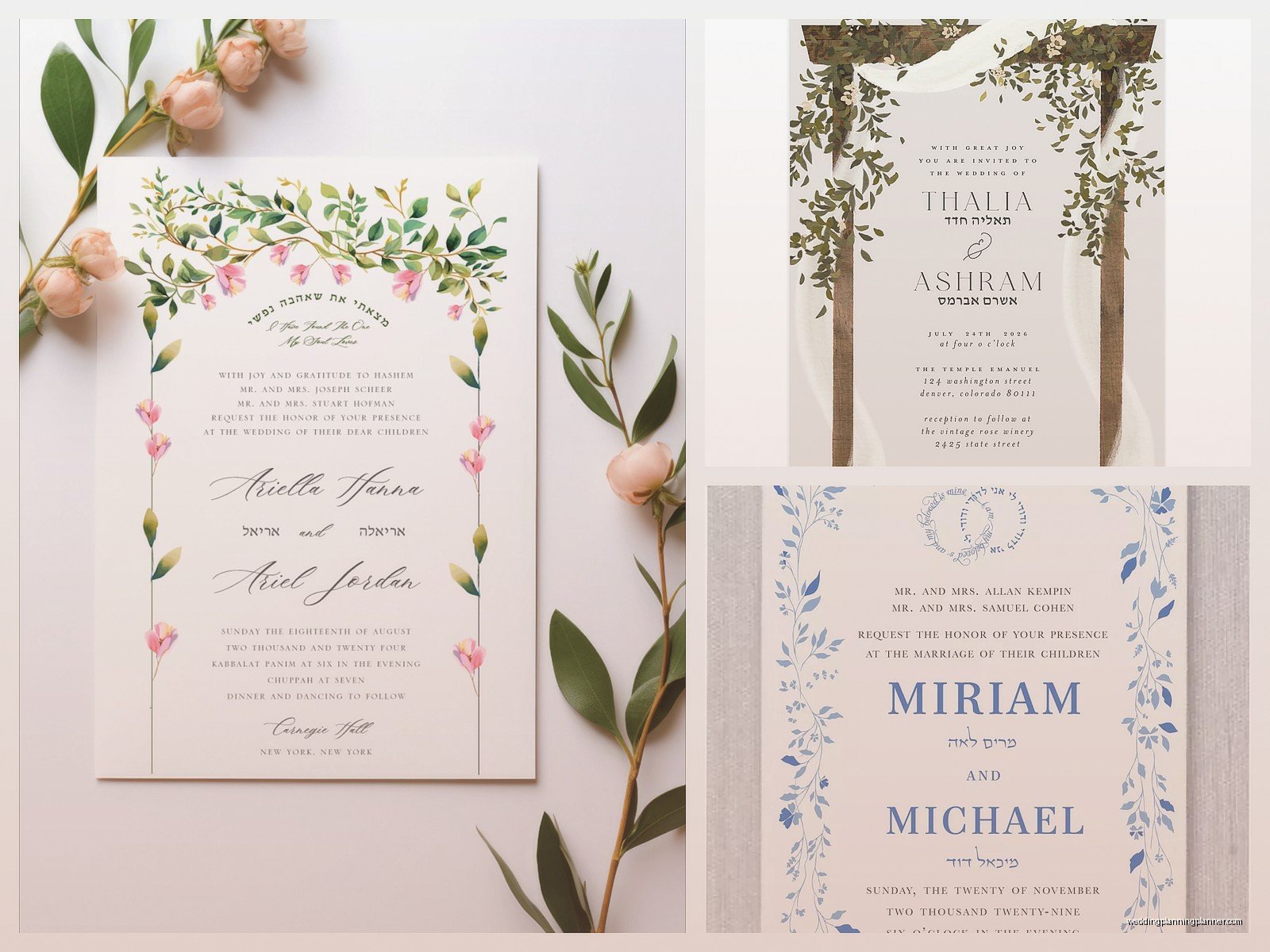
The key is balancing the traditional elements with your personal style. You don’t gotta go full traditional unless that’s your vibe. Mix modern typography with a traditional chuppah illustration. Use contemporary colors but include Hebrew text. That’s kinda where the magic happens.
The Hebrew Text Sections You’ll Need
Most Jewish wedding invitations include Hebrew in a few specific places. First, the couple’s Hebrew names—usually their name plus their father’s name, like “Yitzhak ben Avraham” (Isaac son of Abraham). Some families also include the mother’s name, especially in more egalitarian or Reform communities.
Then there’s the date. The Hebrew calendar date is different from the Gregorian calendar, so you’ll need to convert it. There are online converters but double-check with your rabbi or a Hebrew calendar because sometimes there are discrepancies around sunset times and date changes.
Traditional blessings or phrases might include “B’Simcha” (with joy), “Simcha” (celebration), or the common “B’Siman Tov U’Mazal Tov” (with good signs and good luck). Some couples include the phrase “Im Yirtzeh Hashem” which means “God willing” when listing future events.
Oh and if you’re doing a bilingual invitation—English and Hebrew—you need to decide if you want two separate cards or one card with both languages. I usually recommend separate cards because the directional reading thing gets messy otherwise, but some people want everything on one piece for simplicity or… actually I had a client once who insisted on one card because she didn’t want people throwing away “just the English one” and I was like okay, your wedding, but the layout is gonna be tricky.
Font Choices for Hebrew Typography
Hebrew fonts are their own whole thing. You’ve got traditional fonts that look like they came straight from a Torah scroll—very formal, very traditional. Then there are modern Hebrew fonts that are clean and contemporary. The font you choose for Hebrew text should complement your English font but doesn’t have to match exactly.
Popular traditional Hebrew fonts include Frank Ruehl and Hadassah. For modern looks, try Heebo, Rubik, or Varela Round which all have Hebrew character sets. Make sure whatever font you choose has proper nikud (vowel markings) if you’re including those, though most wedding invitations skip the nikud for a cleaner look.
Pro tip: not all “Hebrew” fonts you find online actually have complete character sets. Test them with all the text you need before committing to a design.
The Wording Structure
Jewish wedding invitations have traditional wording that’s different from Christian or secular invitations. Instead of “Mr. and Mrs. So-and-So request the honor of your presence,” Jewish invitations traditionally have the couple themselves issuing the invitation, or sometimes both sets of parents together.
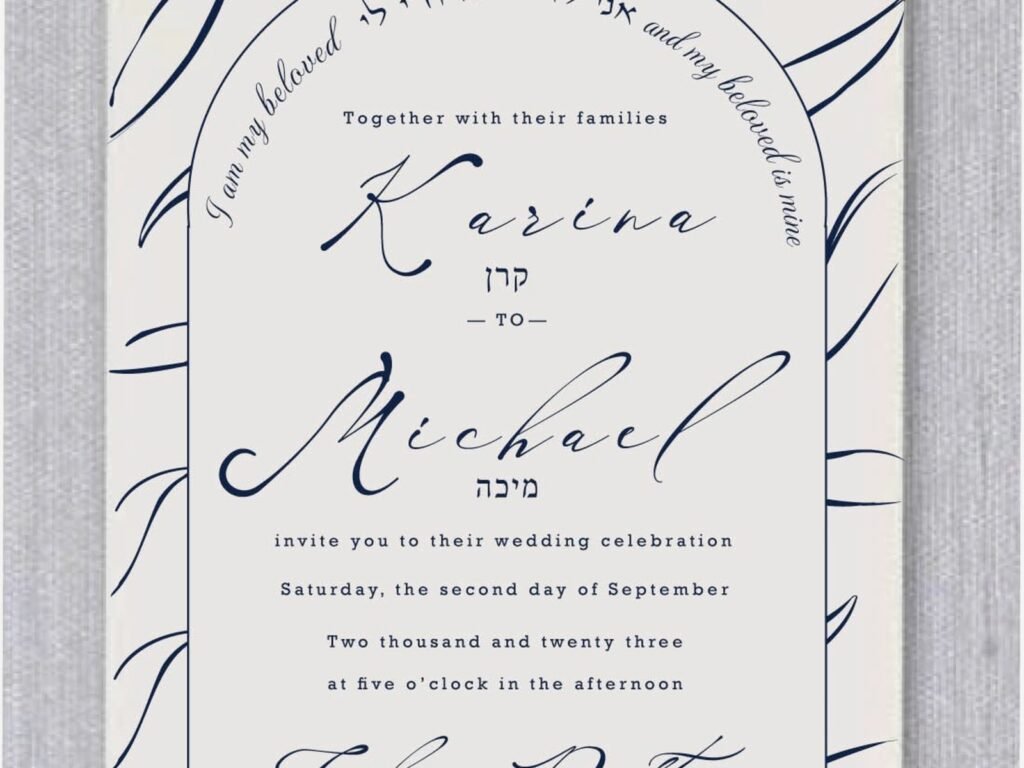
A traditional format goes something like: “Together with their families, [Bride’s name] and [Groom’s name] invite you to share in their joy at their wedding.” You can also do the parents’ names: “[Bride’s parents’ names] and [Groom’s parents’ names] invite you to celebrate the marriage of their children.”
The ceremony is called a wedding ceremony, not a “marriage ceremony” typically, though both work. You’ll want to specify if it’s under the chuppah. The time matters because Jewish weddings can’t happen on Shabbat (Friday evening through Saturday evening) or on major holidays, so you’re usually looking at Sunday through Thursday evenings or Saturday night after Shabbat ends.
During that stressful situation in summer 2021—we had a couple who needed to move their wedding date because they’d accidentally scheduled it during the Nine Days (a mourning period in the Jewish calendar when weddings aren’t held) and we had to reprint everything—I learned to always double-check the Jewish calendar against the proposed date before anything goes to print.
Separate Ceremony and Reception Cards
Some Jewish couples do separate ceremony and reception invitations, especially if the ceremony is more intimate or if there’s a significant time gap between the ceremony and reception. Orthodox weddings sometimes have separate seating for men and women, which you might need to mention on the invitation.
If you’re having a bedeken (veiling ceremony) or a tisch (groom’s table) before the main ceremony, you can include that timing on a details card. Most guests won’t attend these unless they’re family or very close friends, but it’s nice to include the information.
Paper and Printing Considerations
Hebrew calligraphy is gorgeous but it’s harder to find calligraphers who can do Hebrew well. If you want hand-lettered Hebrew on your invitations, start looking early. Like, really early. There aren’t as many Hebrew calligraphers as English ones, at least not in most US cities.
For printing, letterpress and foil stamping both look beautiful with Hebrew text. The right-to-left thing actually creates interesting design opportunities—you can have Hebrew flowing from the right side of the invitation and English from the left, meeting in the middle with a design element or symbol.
I’m gonna be honest, digital printing is perfectly fine for most invitations and it’s way more budget-friendly. You can get beautiful results without going the letterpress route, especially if you choose good quality paper stock. Cotton paper in cream or white feels substantial and traditional.
The Ketubah Connection
Your ketubah (marriage contract) is a separate thing from your invitation but some couples like their invitation design to coordinate with their ketubah design. If you’re commissioning a custom ketubah, think about whether you want visual elements to tie together—maybe the same color palette or similar motifs.
The ketubah is actually signed before the ceremony and displayed during the reception usually, so it becomes part of your wedding decor. Some couples feature it on their invitation suite by including a small illustration of their ketubah design or using the same artist for both pieces.
Modern Variations and Contemporary Twists
You don’t have to go super traditional if that’s not your style. I’ve designed minimalist Jewish wedding invitations that just had the couple’s Hebrew names in a modern font with tons of white space. I’ve done watercolor illustrations of Jerusalem with contemporary typography. I’ve even done invitations that incorporated modern Israeli design aesthetics—very geometric, very colorful, very different from traditional styles.
Some couples do a modern ketubah text in both Hebrew and English on their invitation as the main design element. Others use Hebrew letters as decorative elements, spelling out words like “ahava” (love) or “simcha” (joy) in artistic ways.
My cat knocked over my coffee all over a set of invitation samples once and honestly the watercolor ones survived better than you’d think, but anyway—
What to Include in Your Invitation Suite
A full Jewish wedding invitation suite typically includes the main invitation, an RSVP card, a details card with hotel information and wedding website, and maybe a reception card if ceremony and reception are at different locations or if the reception is significantly later.
You might also want to include information about dress code—some Jewish weddings request modest dress, especially if it’s in an Orthodox synagogue where shoulders and knees should be covered. A Shabbat card if you’re doing a Shabbat dinner the night before or after the wedding. Directional cards or maps if your venue is hard to find.
Some couples include explanations of Jewish wedding traditions for non-Jewish guests or for Jewish guests who might not be familiar with traditional ceremonies. This can be on a separate card or on your wedding website.
Envelope Addressing with Hebrew
Addressing envelopes gets interesting when you’re including Hebrew names. You can do guest names in English on the outer envelope and include Hebrew names on the inner envelope. Or do both languages on the outer envelope, though that gets crowded.
Calligraphy in Hebrew is beautiful but again, you need someone who knows what they’re doing. The letters connect differently than English cursive and there are specific rules about letter forms that change depending on where they appear in a word.
Digital calligraphy or good quality printing is also totally acceptable. Not everything needs to be hand-calligraphed, I promise.
Timeline for Ordering
Order Jewish wedding invitations even earlier than you would regular invitations if you’re including custom Hebrew elements. You need time for translation verification, design rounds, and proofs. I usually tell couples to start the invitation process at least 4-5 months before the wedding date.
That gives you time to design, proof, print, address, and mail with enough lead time for guests to RSVP. Jewish weddings often have guests traveling from different cities or even different countries, so you want people to have plenty of notice for travel planning.
Rush orders are possible but they’re stressful and expensive and sometimes the Hebrew verification gets rushed which is how mistakes happen. Just… don’t do that to yourself unless you absolutely have to.
Working with Your Stationer
Find a stationer who has experience with Jewish weddings or who’s at least willing to learn and work with you. You shouldn’t have to explain basic concepts like right-to-left text or what a chuppah is. Though honestly, if they’re willing to research and collaborate, that can work too.
Bring reference images of designs you like. Explain which traditions are important to you and which ones you’re flexible about. If you have specific Hebrew text or blessings you want included, bring them already translated and verified by someone who knows Hebrew—your rabbi, a Hebrew-speaking family member, someone reliable.
Ask to see samples of previous Jewish wedding invitations they’ve designed. Look at how they handled the Hebrew text, the layout, the cultural elements. Make sure their aesthetic matches what you’re envisioning for your wedding.

Canva
Wedding Memories Hardcover Template Canva Editable For Notebook, Journal, Novel, Hard Covers, Canva template For KDP Cover 6×9″ 120 pages
Canva
The Ultimate Wedding Planning Bundle, Canva Editable.
Canva
Customizable Wedding Video Invitations templates, Canva Editable Digital Wedding invitation Minimalist, Animated Custom Invitation
Digital Planning Templates
Wine Wedding Planner Bundle – 200-Page Printable PDF + 10 Editable Wedding Invitations | Instant Digital Download
Canva
Orange Wedding Planner Bundle – 200-Page Editable Canva Templates + 10 Editable Wedding Invitations | Instant Digital Download
Digital Planning Templates
Champagne Wedding Planner Bundle – 200-Page Printable PDF + 10 Editable Wedding Invitations | Instant Digital Download
Canva
Wedding Memories Hardcover Template Canva Editable For Notebook, Journal, Novel, Hard Covers, Canva template For KDP Cover 6×9″ 120 pages
Digital Planning Templates
Yellow Wedding Planner Bundle – 200-Page Printable PDF + 10 Editable Wedding Invitations | Instant Digital Download
Canva
Dusty Blue Wedding Planner Bundle – 200-Page Editable Canva Templates + 10 Editable Wedding Invitations | Instant Digital Download