
Planning Guides, Style Guide
Cool Wedding Invitations: Trendy Hip Modern Designs
Nov
Okay So Modern Wedding Invitations Are Having a Moment
The whole wedding invitation game has completely changed in the last few years and honestly it’s about time. I’ve been doing this for almost two decades now and the shift I saw around 2021 was wild—couples just stopped caring about the traditional cream cardstock with calligraphy thing. Like they just… didn’t want it anymore. Which kinda annoyed me at first because I had spent YEARS perfecting my vendor relationships for classic invites, but whatever, we adapt.
Cool invitations now are all about showing your actual personality instead of following some rulebook your grandmother wrote. You want acrylic invites? Do it. Neon colors? Sure. A QR code that links to your Spotify playlist? I’ve seen it work.
Acrylic and Perspex Invitations Are Everywhere
These clear acrylic invites are seriously trendy right now. They’re basically printed on clear plastic sheets and they look super sleek and modern. I worked with a couple in spring 2023 who did frosted acrylic invites with white ink and they were STUNNING. The thing is, they’re not cheap—you’re gonna pay anywhere from $8 to $20 per invite depending on thickness and printing method.
You can do:
- Clear acrylic with any color ink (black and gold is classic, neon is fun)
- Frosted finish for a softer look
- Colored acrylic like blush or navy
- Layered pieces with different textures
The main issue with acrylic is postage. They’re heavier than paper so you’ll pay more to mail them, and you absolutely need proper padding because they can crack. Also they make noise in the mailbox which is either cool or annoying depending on your perspective.
Minimalist Typography Designs
If you’re into that clean aesthetic, typography-focused invites are where it’s at. I’m talking barely any graphics, just really intentional font choices and lots of white space. You might use one stunning modern font or mix two contrasting ones.
What works:
- Sans serif fonts in bold weights
- Lots of negative space
- One or two colors max
- Asymmetrical layouts instead of centered text
- Oversized letters for names or dates
I had this bride once who insisted on using like seven different fonts and I had to gently explain that minimalism means… minimal. We got it down to two fonts and it looked a million times better. Sometimes less really is more, even though that sounds like something from a Pinterest quote.
Bold Colors and Color Blocking
Nah, you don’t have to stick with blush and sage anymore. Bold jewel tones are huge—emerald green, sapphire blue, deep burgundy. Or go the opposite direction with bright, saturated colors like coral, electric blue, or sunny yellow.
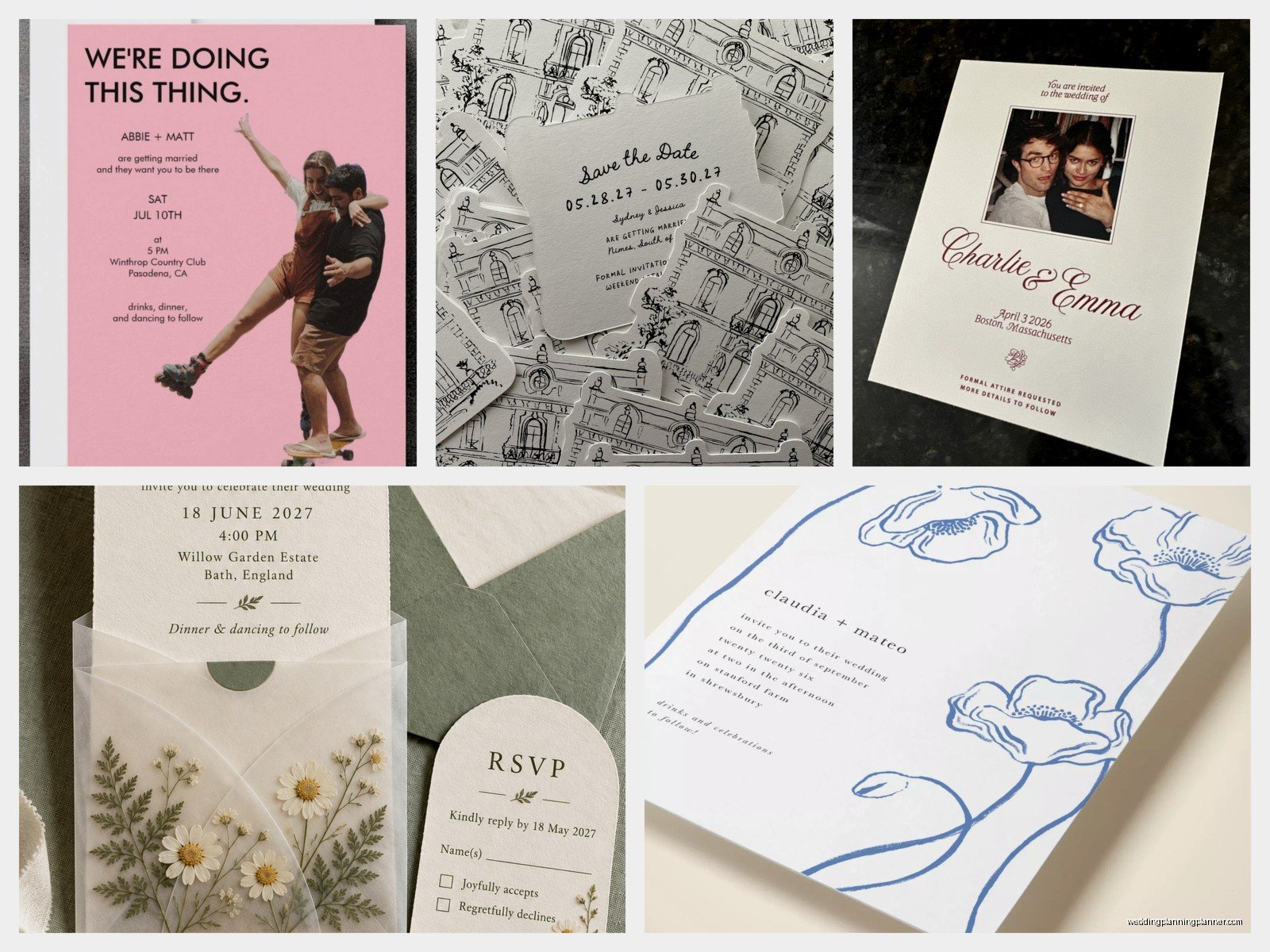
Color blocking is when you use geometric shapes in different colors to create sections on your invite. Think a bright pink rectangle with white text, next to a navy section with gold text. It’s graphic and modern and definitely makes a statement.
My cat knocked over my coffee on a set of color-blocked samples once and honestly the stain kinda looked intentional because the design was already so chaotic, but anyway—
You can also do ombre effects where one color gradually transitions to another. Printing techniques matter here though. Digital printing works fine for most color work, but if you want really vibrant colors, you might need to go with a specialty printer.
Laser Cut and Die Cut Designs
Laser cutting is when they use an actual laser to cut intricate patterns into paper or cardstock. Die cutting is similar but uses a metal die. Both create really cool dimensional effects that feel modern and detailed at the same time.
Popular laser cut styles:
- Geometric patterns around the borders
- Your monogram cut out
- Cityscape silhouettes if you’re having an urban wedding
- Abstract organic shapes
- Art deco inspired patterns
The thing that annoyed me about laser cutting for a while was that so many couples wanted it but had no idea how expensive it gets. You’re paying for the setup, the machine time, and the detail level. A simple geometric border? Maybe reasonable. An intricate mandala design? That’s gonna cost you.
I usually tell people to do laser cutting on just the belly band or the envelope liner if budget is tight, not the whole invitation suite.
Vellum Overlays and Layers
Vellum is that semi-transparent paper that adds a soft, dreamy layer over your main invitation. It’s not new exactly, but the way people are using it now is more modern. Instead of using it to be romantic or vintage, you’re using it as a design element.
Try:
- Printing your ceremony details on vellum over a colorful background
- Using black vellum (yes it exists) for drama
- Vellum jackets that wrap around the whole invite
- Printing abstract shapes or patterns on vellum as a top layer
Vellum is tricky to print on—your home printer probably can’t handle it, and even some professional printers struggle with ink adhesion. Make sure whoever you’re working with has experience with it or you’ll end up with smudged ink everywhere.
Illustrated and Custom Artwork Invites
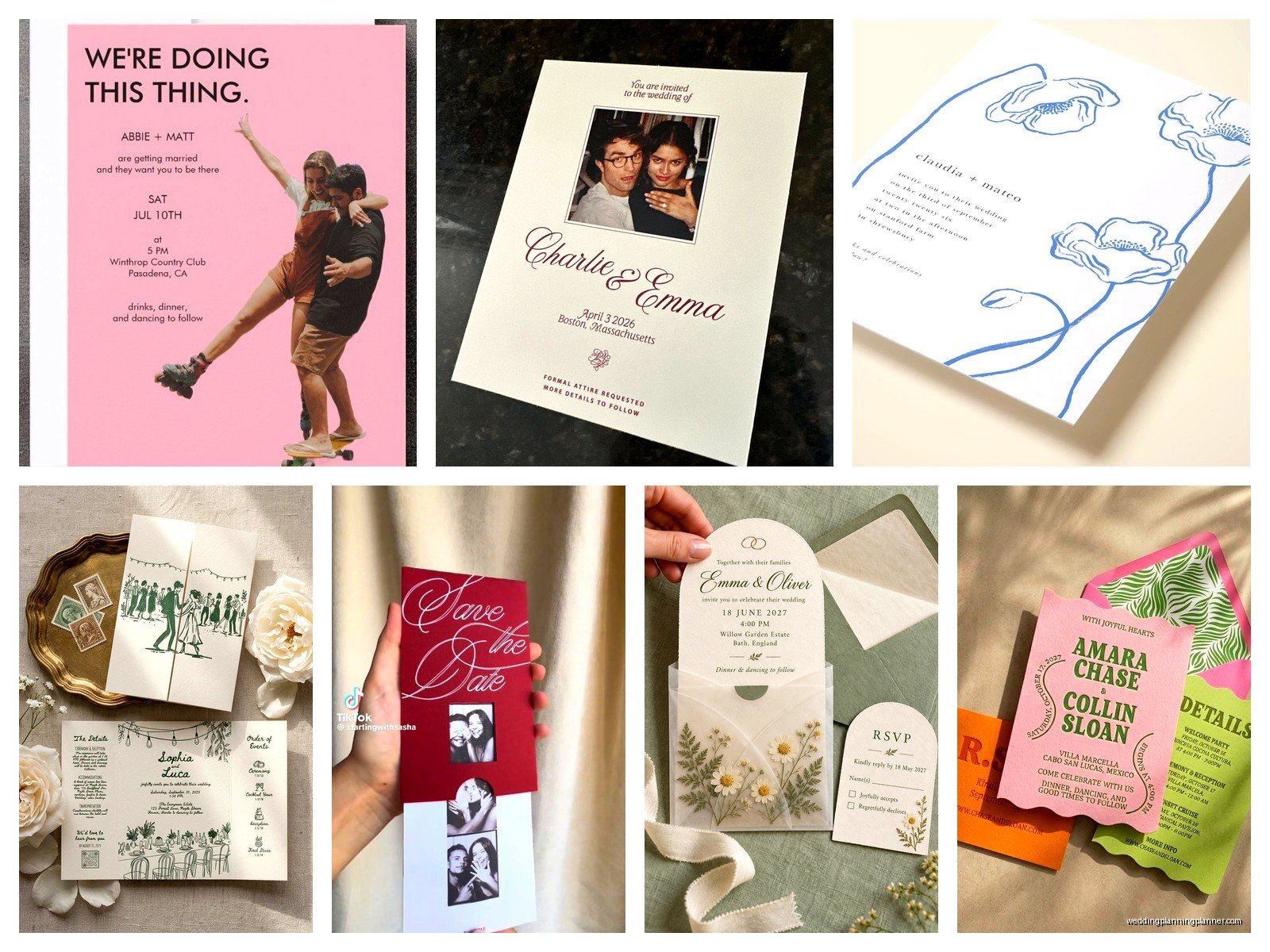
If you’ve got budget and want something truly unique, commissioned illustrations are incredible. I worked with a couple who hired an artist to draw a map of their neighborhood with little illustrations of meaningful spots—where they met, their favorite restaurant, their apartment building. It was printed on thick cotton paper and people are probably still displaying it.
You can commission:
- Portraits of you and your partner
- Your venue illustrated
- Abstract art that matches your wedding colors
- A custom pattern or motif used throughout your suite
- Line drawings in a modern minimalist style
Etsy has tons of artists who do this kind of work, or you can find illustrators on Instagram. Budget anywhere from $200 to $1000+ depending on complexity and the artist’s rate. Then you still gotta pay to have them printed, so factor that in.
Digital First Designs (With Cool Printed Options)
Okay so this is interesting—a lot of couples are designing primarily for digital now and then adapting to print, instead of the other way around. You might send a digital save-the-date that’s animated or includes a video, then do simpler printed invitations.
Or you do a gorgeous printed invite that includes a QR code linking to your wedding website where people RSVP, see accommodation info, browse your registry, whatever. The QR code becomes part of the design instead of an afterthought.
I’ve seen QR codes designed as:
- Part of a geometric pattern
- In your wedding colors
- Shaped like a heart or other icon
- Integrated into an illustration
Some couples are even doing fully digital invitations with no printed version at all, which saves money and is better for the environment, but you lose that tangible special feeling that… okay I’m gonna be honest, older relatives will complain. They will. Your grandmother will call your mom and say she doesn’t understand “the computer thing.” Just be prepared for that conversation.
Unconventional Materials
Wood invitations are a thing. Fabric invitations are a thing. Metal invitations exist. I even saw someone do invites printed on recycled coffee bags once, which sounds weird but actually looked really cool for their rustic-industrial wedding.
Material options:
- Thin wood veneer (usually birch or walnut)
- Handmade paper with embedded flowers or leaves
- Fabric like linen or silk
- Cork
- Recycled cardboard with a kraft paper vibe
- Slate or stone (yes really, for the truly extra)
The challenge with alternative materials is always printing. UV printing works on most surfaces but not every printer offers it. And again, postage gets expensive when you’re mailing wooden rectangles to 150 people.
Metallic Accents and Foil Stamping
Foil stamping is where metallic foil is pressed into paper using heat and pressure. It’s been around forever but modern designs are using it differently—not just for borders or names, but for bold graphic elements, solid shapes, or even full-coverage backgrounds.
Popular foil colors right now:
- Rose gold (still going strong)
- Copper
- Silver in a brushed finish
- Holographic or iridescent foils
- Colored foils like emerald or sapphire
You can also do foil on colored paper for high contrast. Black paper with gold foil is super dramatic and elegant. Navy with silver is crisp and modern.
Fair warning: foil stamping is one of the pricier printing techniques. You’re paying for setup fees and the foil itself. If you want multiple foil colors, each one requires a separate pass through the press, so costs multiply. I usually suggest choosing one foil accent and using it strategically rather than foiling everything.
Brutalist and Edgy Typography
There’s this whole trend toward intentionally rough, unpolished design that’s called brutalism. In wedding invites, this might mean:
- Distressed or rough-edged fonts
- Text that overlaps or crowds the page
- Black and white with high contrast
- Asymmetrical layouts that feel almost chaotic
- Mixing different text sizes dramatically
This is definitely not for everyone. Your mom might hate it. But if you’re having a moody, unconventional wedding, it can be perfect. I had a couple in summer 2021 doing a warehouse wedding who went full brutalist with their invites—black paper, white ink, harsh angular fonts, no decoration whatsoever. Their parents were confused but their friends thought it was the coolest thing ever.
Mix and Match Suites
Instead of everything matching perfectly, modern couples are mixing different paper stocks, colors, and even design styles within one invitation suite. Your main invite might be minimalist black and white, your details card could have a pop of color, and your RSVP card might have a fun pattern.
This works if there’s some unifying element:
- Same font family used throughout
- Consistent color palette even if designs vary
- Similar design motif or theme
- Coordinating (not matching) papers
The eclectic look feels more personal and less like you ordered everything from a template, which is kinda the point of modern design anyway—it should feel like YOU, not like Wedding Template #47.
Oversized Formats
Who says invitations have to be 5×7? Oversized invitations make a statement just by their size. Think 7×10, or even 8×11. Some couples are doing long narrow formats, or square invitations, or custom sizes that fit their design.
Just remember that non-standard sizes cost more to mail. The post office has specific size categories and anything outside the standard letter size gets hit with extra charges. You’ll also need custom envelopes, which adds cost. But the visual impact can be worth it if you have the budget.
Retro and Vintage-Modern Mashups
There’s this trend of taking retro design elements—like 70s fonts, art deco patterns, or 90s color palettes—and mixing them with modern, clean layouts. It’s nostalgic but not costume-y.
Examples:
- Groovy 70s fonts in terracotta and mustard colors but with lots of white space
- Art deco geometric patterns in unexpected color combos like pink and orange
- 90s-style gradients and geometric shapes
- Retro color blocking with modern sans serif fonts
This style works really well if your wedding has a specific era vibe or if you just love vintage aesthetics but don’t want something that looks literally old.
Practical Stuff You Gotta Think About
Okay so beyond just picking a cool design, here’s the practical wedding planner side of things coming out—you need to think about timing and budget and logistics because cool invitations don’t matter if they arrive late or you go broke paying for them.
Timeline: Order samples like 8-10 months before your wedding. Give yourself time to actually see and touch different options. Place your final order at least 3-4 months out, especially if you’re doing custom work. Mail them 6-8 weeks before the wedding date.
Budget: You can find trendy designs at every price point. Digital invitations or simple modern designs might be $1-3 per invite. Mid-range with some special printing runs $5-8. High-end with multiple printing techniques, fancy paper, and custom elements can easily hit $15-25 per invitation. And yes, that’s per invitation, not per guest, so if you’re inviting couples you still need one per household but budget accordingly.
Postage: Test your actual assembled invitation at the post office before you mail all of them. Square envelopes cost extra. Anything over 1 ounce costs extra. Wax seals sometimes require hand-canceling which costs extra. Just… go weigh one complete invitation and get the real number.
Proofreading: I cannot stress this enough—have like five people proofread your invitation before you print 150 of them. I’ve seen couples spell their own venue name wrong. Check dates, times, addresses, website URLs, everything. Then check again.
Where to Actually Get These Made
Minted and Paperless Post are popular for semi-custom modern designs. Etsy has thousands of designers doing cool stuff at various price points. Local print shops can often do specialty printing if you bring them a design. For truly custom work, hire a graphic designer and then work with a specialty printing house.
If you’re crafty, you can DIY some of this—print-at-home designs work fine for simpler modern styles, though you’re limited in what printing techniques you can do. Just be realistic about your time and skill level because DIY invitations always take longer than you think they will.
