
Planning Guides, Style Guide
Gay Wedding Invitations: LGBTQ+ Inclusive Designs
Nov
So You Need Gay Wedding Invitations That Don’t Suck
Okay so first thing – the whole “gay wedding invitation” category is kinda weird because honestly a good invitation is a good invitation regardless of who’s getting married. But I get it, you want designs that actually reflect your relationship without all the hetero assumptions baked in, and yeah, that’s totally valid and honestly overdue.
The biggest thing that annoyed me for YEARS in this industry was vendors acting like they were doing couples this huge favor by offering “inclusive” designs when really they just meant they’d swap out “bride and groom” for “partner and partner” on their most boring template. Like wow, thanks for the bare minimum effort there. This was especially bad around 2019-2020 when everyone suddenly wanted to capitalize on the wedding equality momentum but put in zero actual thought.
Pronoun and Name Formatting That Actually Works
Alright so the most basic thing you gotta figure out is how to list both names without it looking weird or forced. Traditional invitations have that whole “Mr. and Mrs.” structure that just… doesn’t apply here obviously.
Here’s what I typically recommend to clients:
- First names only if you want it casual and modern
- Full names with no titles – cleanest option honestly
- Mx. as a title if one or both people prefer it
- Just skip titles entirely, they’re outdated anyway unless you’re going super formal
The order of names used to stress people out SO much. I had this couple in spring 2023 who spent like an hour debating whether alphabetical order seemed too impersonal. My advice? Pick whatever feels right – alphabetical, who proposed, who’s more organized (kidding but also not really), whatever. There’s no rule here and anyone who tells you there is can mind their own business.
Design Elements Beyond Rainbows
Look, I love a good rainbow as much as the next person, but if I see one more invitation suite that thinks slapping a rainbow flag on generic cardstock equals LGBTQ+ design, I’m gonna lose it.
Here’s what actually makes an invitation feel inclusive without being like, aggressively rainbow everything:
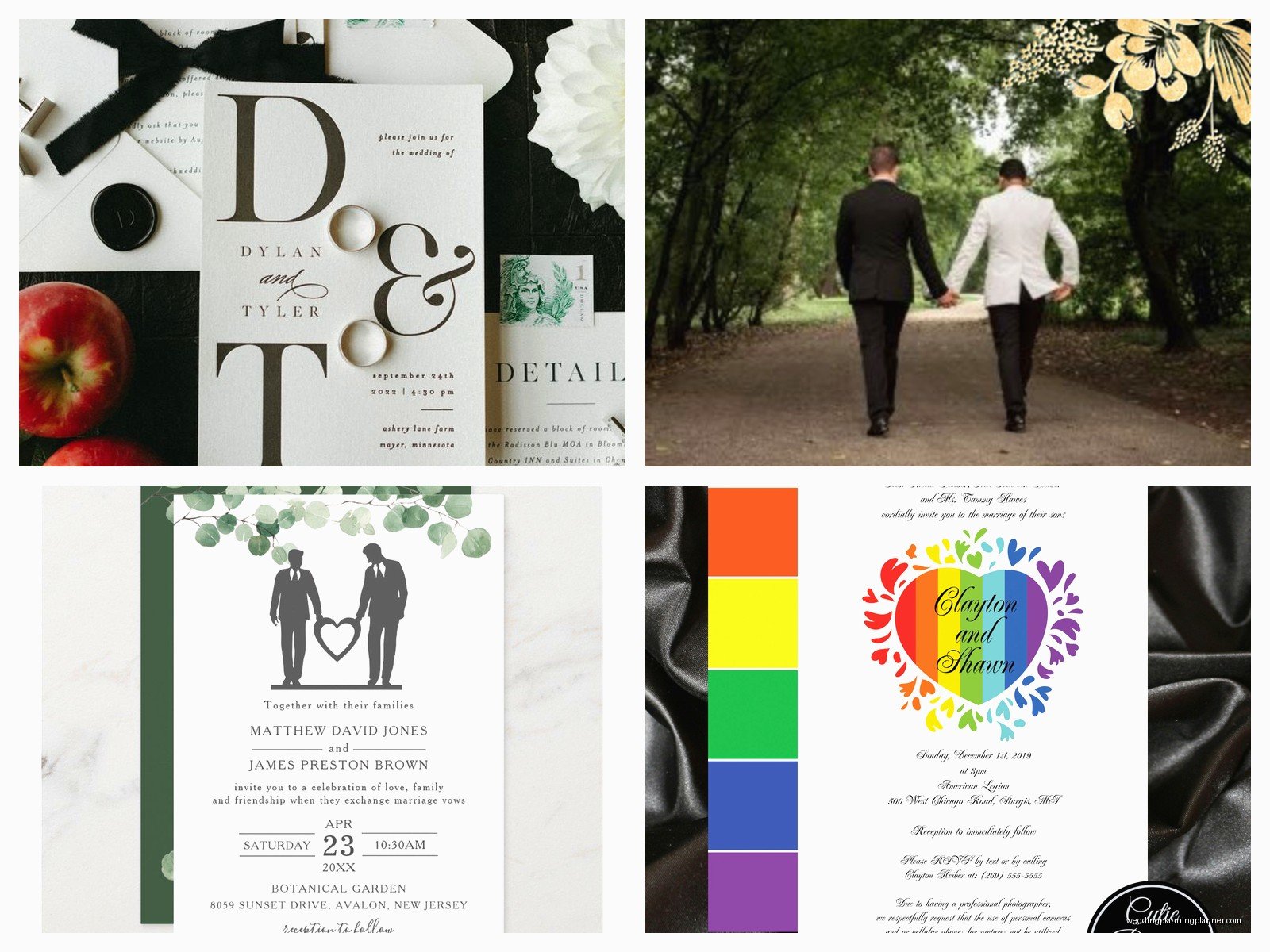
Gender-neutral imagery: Botanical designs, geometric patterns, celestial themes, art deco vibes – these all work beautifully without assuming anything about the couple. I’ve used succulent illustrations, mountain landscapes, vintage travel themes, all of that.
Abstract representations of couples: Instead of those creepy silhouette cake toppers turned into invitation art (please no), think about intertwined initials, two rings designed uniquely, complementary color palettes that represent each person.
Symbolic elements that mean something to YOU: Did you meet at a coffee shop? Incorporate subtle coffee bean illustrations. First date at a baseball game? Work in some vintage sports vibes. Your relationship isn’t a stereotype and your invitations shouldn’t be either.
Wording That Doesn’t Assume Anything
The traditional invitation wording is so heteronormative it hurts. “Mr. and Mrs. Johnson request the honor of your presence at the marriage of their daughter…” – okay but what if both sets of parents are hosting? What if you’re hosting it yourselves? What if family dynamics are complicated because, oh I don’t know, not everyone’s family was immediately supportive?
I usually start with who’s actually hosting and paying. If that’s the couple themselves:
Together with their families, [Name] and [Name] request the pleasure of your company…
Or if you wanna be more casual:
[Name] and [Name] invite you to celebrate their marriage…
If parents are hosting and everyone’s on good terms, you can list them out: “Sarah and Michelle Chen, together with Robert and David Martinez…” – see, not hard, just say who’s who.
One thing that’s become more common and I actually really like is acknowledging chosen family. I had a couple last year who opened with “Together with their beloved families, both given and chosen” and honestly it made me tear up a little bit, not gonna lie.
The Dress Code Situation
Dress codes for LGBTQ+ weddings can be trickier because the traditional “black tie” or “cocktail attire” comes with gendered assumptions about what people should wear. Some couples I work with just… don’t include a dress code and let people figure it out. Others get more specific.
If you want to give guidance without being gendered about it, try:
- “Formal attire” or “Semi-formal attire” without specifying what that means gender-wise
- “Dress to impress in whatever makes you feel fabulous”
- “Garden party chic” or other vibe-based descriptions
- Including example photos on your wedding website (super helpful actually)
I had this moment during a really stressful client situation in summer 2021 where the couple wanted “black tie” but also wanted to make clear that didn’t mean “men in tuxes, women in gowns” and we ended up with “Black tie – interpret that however speaks to you” which worked perfectly for their crowd.
Finding Designers and Vendors Who Get It
This is where it gets real – you need to find stationery designers who aren’t gonna make you explain basic things or act weird about your relationship.
Green flags when looking at designers:
- Their portfolio already shows same-sex couples without making a big deal of it
- Their contact forms don’t assume gender (like dropdown menus that only have “bride” and “groom” options – ugh)
- They use inclusive language on their website naturally, not performatively
- They have Pride-related content that goes beyond June and seems genuine
Red flags:
- All their examples are heterosexual couples (not inherently bad but like… show me you’ve done this before?)
- They call it “alternative” weddings or “non-traditional” in a weird way
- Their pricing suddenly changes when they realize it’s a same-sex couple (yes this still happens, it’s infuriating)
- They ask invasive questions about your relationship that they wouldn’t ask straight couples
Online Printing Services vs Custom Designers
So you’ve got options here depending on budget and how custom you wanna go.
Online services like Minted, Zola, Paperless Post – they’ve gotten way better about inclusive templates. Most now let you customize everything including pronouns, names, wording, all of it. They’re affordable and convenient. The downside is you’re working with templates, so if you want something totally unique or have specific vision, might feel limiting.
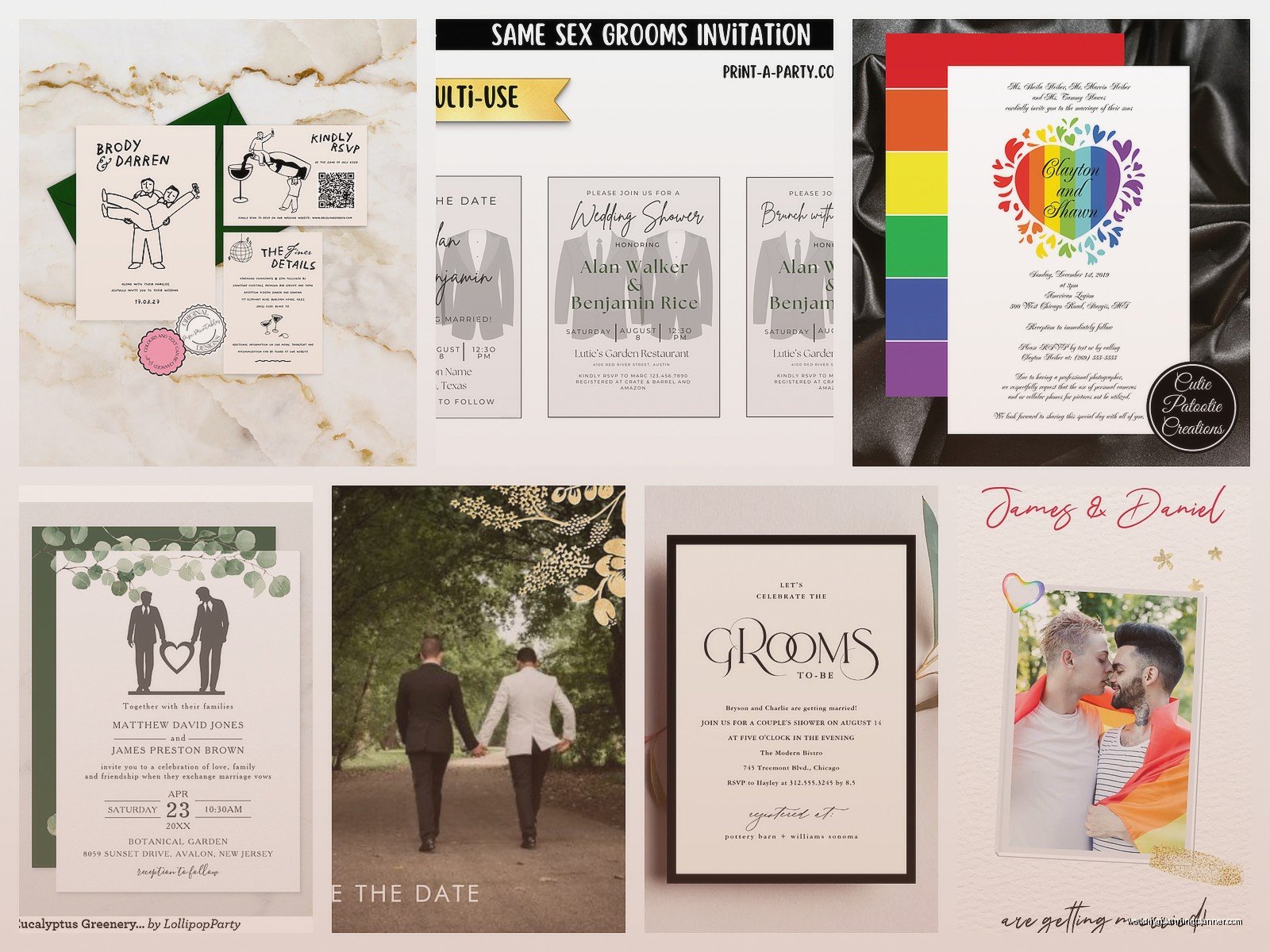
Custom designers (hi, that’s part of what I do) give you complete control but cost more. You’re paying for someone to create something from scratch based on your style, story, colors, the whole thing. Worth it if stationery is important to you or if you have a specific aesthetic that templates can’t capture.
Semi-custom is the middle ground – designer templates that you can customize pretty heavily. Good balance of affordability and personalization.
The Whole Suite Beyond Just the Invitation
Okay so you can’t just think about the invitation itself, there’s like a whole ecosystem of paper goods for weddings and they all need to work together…
Save the dates, invitations, RSVP cards, details cards, programs, menus, place cards, thank you notes – it’s a lot. My cat knocked over my coffee on a full suite last month and I almost cried, but anyway.
For LGBTQ+ couples, pay attention to:
RSVP card wording: Instead of “M___________” for the guest name line (which assumes a title), just use “Name(s)” or a blank line. Let people write what they want.
Program wording: If you’re having a wedding party, you might have people who don’t identify with “bridesmaid” or “groomsman” – use “wedding party” or get creative with it. I’ve seen “best people,” “person of honor,” “attendants,” whatever works.
Seating charts and place cards: Same deal with names and titles. Keep it simple and don’t assume.
Color Palettes and Aesthetics
Can we talk about how liberating it is to not have to stick to “masculine” or “feminine” color schemes? Like you can do whatever you want and it doesn’t have to make sense to anyone but you two.
Some combinations I’ve loved working with:
- Deep burgundy and sage green with gold accents
- Navy and blush (yes, two “masculine” and “feminine” colors together, wild concept)
- All jewel tones – emerald, sapphire, amethyst
- Black and white with one bright pop color
- Literally any color combo that makes you happy, there are no rules here
I think sometimes couples feel like they need to prove something with their wedding aesthetic, make it super bold or really obviously queer, but honestly? If you want classic and elegant, do that. If you want rainbow everything, do that. If you want something totally weird that reflects your specific interests – I once did invitations themed around a couple’s obsession with true crime podcasts, and it was perfect for them.
Digital vs Print Invitations
This is more of a practical consideration but worth mentioning. Digital invitations have come a long way and they’re not just the cheap option anymore, they can be really beautifully designed.
Benefits of digital for LGBTQ+ couples specifically: easier to update if family situations change, can include more info and resources on your wedding website, environmentally friendly if that matters to you, way easier to customize last-minute.
Print still has that tangible, special feeling though. I’m biased because I love paper, but there’s something about a physical invitation that feels more… I dunno, ceremonial? Plus older relatives tend to appreciate them more.
You can also do both – print for close family and friends, digital for everyone else. Saves money and trees.
Addressing Envelopes Without Losing Your Mind
Okay this part is tedious no matter who you are, but it gets extra complicated when you’re thinking about inclusive addressing.
For couples on your guest list, don’t assume their configuration or how they want to be addressed. If you’re not sure, just ask them. Most people appreciate it rather than being offended.
Some options:
- “Alex and Jamie Smith” (first names, shared last name)
- “Alex Johnson and Jamie Smith” (different last names)
- “The Smith-Johnson Family” (if they have kids)
- “Alex Johnson and Guest” (if you’re offering a plus-one)
Skip the “Mr. and Mrs.” or “Mr. and Mr.” unless you know for sure that’s what they prefer. Titles are sorta outdated anyway for most modern weddings.
Including Your Wedding Website Info
Most couples now have a wedding website with all the details, and this is honestly where you can get even more specific about things that matter to your community.
Your website is a great place to:
- Explain your venue choice (especially if you picked somewhere explicitly LGBTQ+ friendly)
- Include information about local LGBTQ+ resources if you have out-of-town guests
- Share your pronouns and encourage guests to share theirs
- Explain any non-traditional ceremony elements
- Give more detailed dress code guidance with photos
- Share your love story without the constraints of invitation wording
On the actual invitation, keep the website URL simple and easy to type. I’ve seen some couples create a custom short URL which is smart.
Budget Real Talk
Wedding invitations can range from like $1 per invite to $50+ per invite, it’s wild. For LGBTQ+ couples, sometimes there’s this pressure to have everything be perfect and amazing because you waited so long for the right to marry (if you’re in a place where that was even a fight), but also… you don’t have to spend a fortune on paper.
Here’s a rough breakdown:
Digital invitations: $0-$150 for the whole thing usually
Online printed templates: $1.50-$5 per invitation
Semi-custom: $5-$15 per invitation
Fully custom: $15-$50+ per invitation
Remember you need to factor in the whole suite – save the dates, invites, RSVP cards, envelopes, postage (it’s expensive!), thank you cards later.
My advice? Spend money on what matters to you. If stationery isn’t your thing, go cheaper and splurge on the food or the photographer or whatever you actually care about. If you’re both design nerds who will cherish these forever, invest more.
Timing This All Out
Send save the dates 6-8 months before the wedding (earlier if it’s a destination wedding or holiday weekend). Send actual invitations 8-12 weeks before. Request RSVPs back 3-4 weeks before the wedding.
Give yourself extra time if you’re doing custom work because there’s usually back and forth with the designer, then printing time, then addressing all those envelopes which takes forever, then actually mailing them.
I always tell couples to order a few extra invitations because someone will spill coffee on theirs (like me with that client suite…), addresses will change, you’ll want to keep some as keepsakes.
When Family Makes It Complicated
This is the hard part nobody really wants to talk about but it comes up a lot. Not everyone’s family is supportive, and figuring out how to handle that on invitations is genuinely difficult.
If your parents aren’t supportive but you still want to acknowledge them somehow, you can keep it vague: “Together with their families…” If they’re not in the picture at all, you can host it yourselves or acknowledge chosen family or just… not mention parents, that’s totally fine.
I worked with a couple once where one person’s family was great and the other’s wasn’t speaking to them, and we ended up with “[Name]’s family, together with [Name] and [Name]…” which acknowledged the supportive side without making the absence obvious or painful.
There’s no perfect answer here and it sucks that this is even a consideration, but do what protects your peace and joy. This is your wedding, your invitation, your rules.
Little Details That Make a Difference
Envelope liners in your colors, wax seals with your initials, custom stamps, hand lettering, vintage postage – these little touches can make your invitations feel really special without necessarily costing a ton more.
Also consider the paper texture and weight. Thicker cardstock feels more luxe. Textured paper adds visual interest. Vellum overlays are very popular right now and look elegant.
For eco-conscious couples, there are recycled paper options, seed paper that guests can plant, or like I mentioned before, going digital reduces waste entirely.
