Planning Guides, Style Guide
Marriage Invitation: Traditional Wedding Card Complete Guide
Mar
Traditional Wedding Cards Are Still A Thing And Here’s What You Actually Need To Know
Okay so traditional wedding invitations – they’re literally the first impression your guests get of your wedding and I cannot stress enough how many couples mess this up. Like the number of times I’ve had to fix invitation disasters in the final hour is honestly ridiculous. Let me just walk you through what actually matters because there’s so much noise online about this stuff.
First thing you gotta understand is that traditional doesn’t mean boring or old-fashioned necessarily. It means there’s a structure, an etiquette, a way things are done that actually makes sense when you think about it. The format exists because it communicates all the essential info clearly while also setting the tone for your event.
The Actual Components You Need
A proper traditional wedding invitation suite has like several pieces and yeah it can feel overwhelming. The main invitation card is obviously the star – this is where your ceremony details go. Then you’ve got your reception card if the reception is at a different location or time, response card with its own envelope (this one drives me nuts when people forget the return address), any additional info cards for hotels or directions, and the outer envelope plus inner envelope if you’re going really traditional.
I had this client in spring 2023 who insisted she didn’t need an inner envelope because “nobody does that anymore” and then got SO mad when half her guests brought uninvited plus-ones because the outer envelope said “The Smith Family” and everyone just… assumed everyone was invited. Inner envelopes exist for a reason – they specify exactly who’s invited. Mr. and Mrs. John Smith vs Mr. and Mrs. John Smith, Sophie and Jacob. See the difference?
Wording That Won’t Make Your Parents Freak Out
Traditional wording follows a formula and honestly once you know it, it’s pretty straightforward. The host line comes first – usually whoever’s paying or hosting. Could be both sets of parents, just the bride’s parents, the couple themselves, or some combination.
If bride’s parents are hosting it goes like:
Mr. and Mrs. Robert James Mitchell
request the honour of your presence
at the marriage of their daughter
Catherine Anne
to
Mr. David William Foster
Notice “honour” is spelled the fancy British way with a u – that’s traditional for ceremony invitations. For reception cards you use “pleasure of your company” instead. Don’t ask me why, that’s just how it works.
When both sets of parents host:
Mr. and Mrs. Robert Mitchell
and
Mr. and Mrs. Thomas Foster
request the honour of your presence
at the marriage of their children
Catherine Anne
and
David William
If the couple is hosting (which is like super common now):
Ms. Catherine Anne Mitchell
and
Mr. David William Foster
request the honour of your presence
at their marriage
Or you can go with “Together with their families” at the top which I actually love because it acknowledges everyone without the whole formal parent listing thing.
Date And Time Formatting Because Apparently Numbers Are Complicated
Okay this is gonna sound fussy but traditional invitations spell everything out. No numerals except for addresses and years sometimes. So:
Saturday, the twenty-first of June
two thousand twenty-five
at half after four o’clock in the afternoon
Not Saturday, June 21st, 2025 at 4:30pm. I know, I know, it’s extra. But that’s the traditional format. Times before noon are “in the morning,” noon to five are “in the afternoon,” five to seven are “in the evening,” and after that is “in the evening” still… or some people say “at night” after eight but honestly I’ve seen both.
Half past four, half after four, four-thirty in the afternoon – all acceptable. Quarter past is fine too. But if it’s like 4:45 you kinda have to write “three quarters after four o’clock” which sounds insane so maybe just pick a time on the hour or half hour.
Paper Stock And Printing Methods Matter More Than You Think
Listen, I’ve worked with budgets from $200 to $20,000 for invitations and you can absolutely do traditional invitations affordably. But you need to understand what you’re looking at. Cardstock weight matters – you want at least 100lb cover stock for the main invitation, preferably 110-130lb. Anything lighter feels cheap in your hand.
Printing methods from most affordable to most expensive: digital printing, thermography, letterpress, engraving. Digital has come SO far and honestly most guests cannot tell the difference between good digital and thermography. Thermography gives you that raised print effect and costs more but looks expensive. Letterpress creates an impression in the paper and is gorgeous but pricey. Engraving is the most traditional and most expensive – it’s what royalty uses, literally.
I had a bride once who spent $8k on engraved invitations and her cat knocked over a glass of wine on half of them the week before mailing and… yeah that was a rough day for everyone involved. We overnighted digital replacements that looked 90% as good for a fraction of the cost. Sometimes perfect is the enemy of done.
Colors And Design Elements For Traditional Vibes
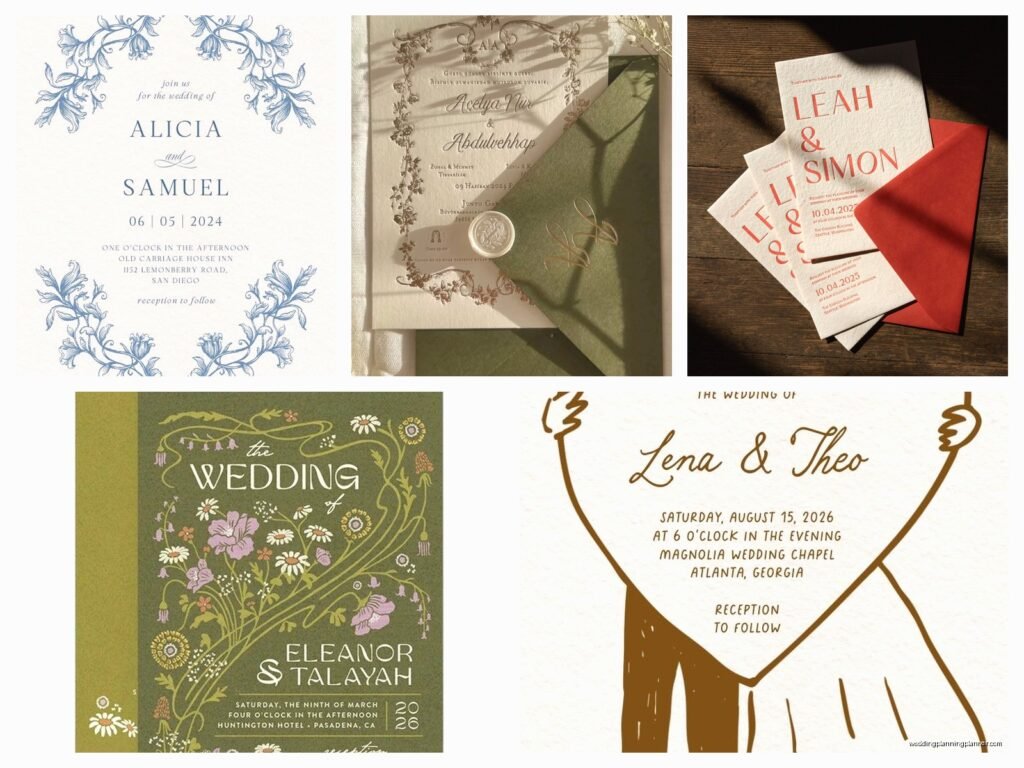
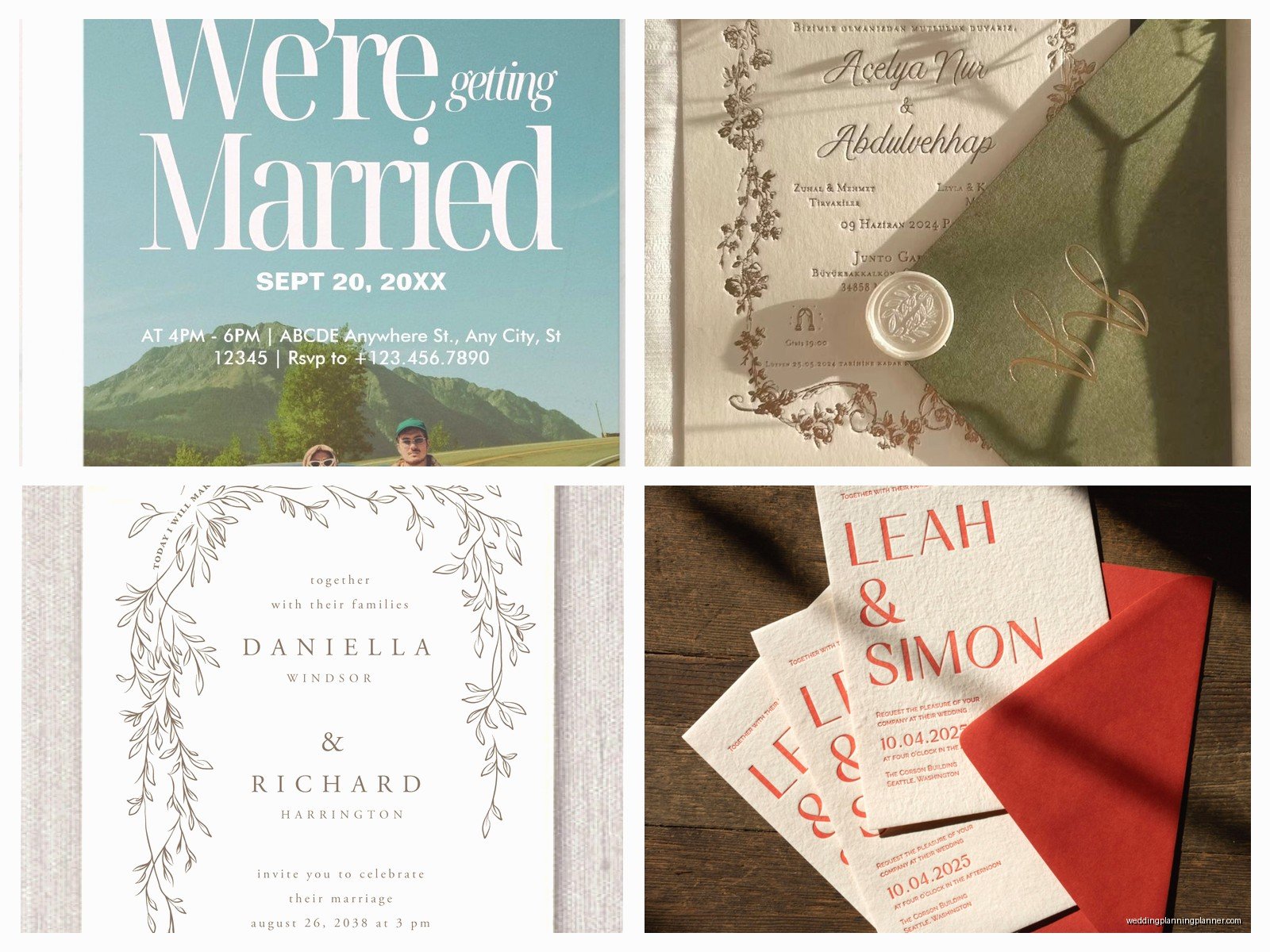
Traditional wedding invitations typically stick to classic color palettes. We’re talking black ink on white or ecru paper, navy, deep burgundy, forest green, or maybe a soft gold accent. Metallics are fine – gold, silver, rose gold – but use them as accents not the main event.
Borders are very traditional. A simple frame around the text, maybe a subtle decorative element at the top. Monograms are classic too but make sure you get the format right – for unmarried couples it’s usually bride’s first initial, couple’s shared last initial in the center larger, groom’s first initial. After marriage it’s first initial, last initial, first initial with the shared last name large in the middle.
What really annoys me is when couples pick a super traditional wording format but then do like… neon pink paper with emoji graphics. Either commit to traditional or don’t, but mixing formal language with casual design is jarring. Your invitation should feel cohesive.
Envelope Addressing Is Where Everyone Gets Lazy
Okay so you’ve got your beautiful invitations printed and now you need to address 150 envelopes and this is where I see people give up on traditional formatting. But honestly this part matters because it’s the literal first thing guests see.
Outer envelopes get the full formal names and no abbreviations except Mr., Mrs., Ms., and Dr. So:
Mr. and Mrs. John Michael Thompson (if wife took husband’s name and uses Mrs.)
Mr. John Thompson and Ms. Sarah Mitchell (if she kept her name)
Ms. Sarah Mitchell and Ms. Rebecca Cole (same-sex couple, alphabetical or by who you’re closer to)
Dr. and Mr. James Patterson (if she’s the doctor)
The Honorable Ruth Ginsburg and Mr. Martin Ginsburg (if someone has a title, it goes first)
Inner envelopes are less formal – you can just use first names for close family, or Mr. Thompson and Guest if you’re allowing a plus-one.
Street addresses spell out everything – “Street” not “St.”, “Apartment” not “Apt.” State names spelled in full. Yeah it’s tedious. Hire a calligrapher if you can afford it ($2-5 per envelope usually) or print them nicely. Those clear labels everyone uses for their Christmas cards? Nah, not for wedding invitations. If you’re gonna do traditional, the addressing needs to match.
Response Cards And Managing RSVPs
Your response card should include a blank line for guests to write their names (with an M. at the start so they write Mr./Mrs./Ms. and their name), a line that says “_____ accepts _____ declines” or “will _____ attend” where they fill in the blank, and your RSVP deadline date.
The response card envelope should be pre-addressed to whoever’s collecting responses (often the couple or the bride’s parents) and pre-stamped. Yes you have to pay for those stamps. Don’t make your guests pay to respond to your invitation, that’s tacky.
Something I started doing around summer 2021 is including a small note card that says “Please visit our wedding website at [URL] for additional details and accommodations” because honestly trying to fit hotel blocks and registry info and dress code on insert cards gets messy. Traditional invitations don’t mention registries at all – that info goes on your website or is shared by word of mouth.
Timeline For Ordering And Mailing
Order your invitations like 4-6 months before your wedding. This gives you time for design, proofing (ALWAYS order a printed proof, don’t just approve a PDF), printing, and addressing. Traditional etiquette says to mail invitations 6-8 weeks before the wedding, with an RSVP deadline about 3-4 weeks before.
For destination weddings or holidays, mail 3 months out. Save the dates should go out 6-8 months in advance, or up to a year for destination weddings.
What You Can Skip And Still Be “Traditional”
Look, full traditional invitation suites can have like tissue paper overlays (originally to prevent ink smudging), ribbon belly bands, wax seals, inner envelopes, reception cards, direction cards, hotel cards, weekend event cards… it gets excessive. You can absolutely skip the tissue paper – modern printing doesn’t smudge. You can combine your reception details onto the main invitation if it’s the same location. You can put hotel and direction info on your website instead of printing separate cards.
What you shouldn’t skip: proper wording, quality paper stock, a response card with pre-stamped envelope, and decent addressing. Those are the core elements that make an invitation feel traditional and respectful.
Common Mistakes That Make Me Want To Scream
Using “and guest” on the outer envelope – that goes on the inner envelope only. Sending invitations to people you know can’t come just to get a gift – people can tell and it’s rude. Forgetting to account for envelope weight when buying stamps – a thick invitation suite often needs extra postage, take one to the post office to weigh it. Not ordering enough – always order 10-15% extra for mistakes and keepsakes.
Also? Putting “no kids” or “adults only” directly on the invitation is considered rude in traditional etiquette. You communicate that through your addressing – if the kids aren’t named on the envelope, they’re not invited. Yeah I know modern couples sometimes add a note but it’s not technically proper.
Special Situations And How To Handle Them
Divorced parents hosting together: list them separately on different lines, don’t connect with “and”
Deceased parent: “daughter of Mrs. Margaret Foster and the late Mr. Robert Foster”
Casual reception after formal ceremony: you can shift to more relaxed wording on the reception card
Military titles: use them and they go before Mr./Ms./Mrs.
I was watching this show the other night about wedding planners and they totally glossed over invitation etiquette which honestly drives me crazy because that’s where so much drama starts…
Anyway, the thing about traditional wedding invitations is they’re basically a way to show respect for your guests and your event. They say “we’re taking this seriously, we’ve put thought into this, and we want you to join us for something meaningful.” When done right they’re elegant and clear and set the perfect tone. When done wrong they’re confusing or offensive or just forgettable. You want people to stick your invitation on their fridge and feel excited about your wedding, not confused about what time to show up or whether their kids are invited.