Planning Guides, Style Guide
Church Wedding Program Template: Religious Service Order
Jul
The Basic Church Wedding Program Template You Actually Need
Okay so the absolute first thing you need to know about church wedding programs is that they’re not just pretty paper you hand out – they’re literally a roadmap for your guests who might not be familiar with religious services. I learned this the hard way in spring 2023 when I had a bride whose entire groom’s side was completely lost during a full Catholic mass because she thought programs were “too formal” and skipped them. The confusion was… visible.
The standard order of service for most Christian church weddings follows a pretty predictable flow, and honestly once you’ve seen the template you can adapt it for basically any denomination. Let me break down what you’re actually gonna need.
The Processional Section
This is where everyone walks down the aisle and you need to list it out because otherwise guests don’t know who they’re looking at. Start with:
- Officiant enters (sometimes from the side, sometimes down the aisle)
- Groom and groomsmen (or they’re already standing there)
- Grandparents – usually ushered to their seats first
- Parents of the groom
- Mother of the bride (last parent seated)
- Wedding party in order – bridesmaids, junior attendants, flower girl, ring bearer
- Maid/Matron of Honor
- Bride with escort (usually father, but not always)
On your program template you don’t need to write every single step, but I usually include something like “Processional: Bridal Party and Family Enter” with maybe the names of parents if the couple wants. Some couples list every bridesmaid’s name which is kinda sweet but also makes the program super long.
Welcome and Opening Prayer
The officiant does their thing here. On the program I write something like:
Welcome and Invocation
Reverend Michael Patterson
Or whatever their title is. This is where it gets annoying though – you have to confirm the exact wording the officiant wants. Some say “Opening Remarks,” some say “Call to Worship,” some Presbyterian churches use totally different language than Methodist ones and I’ve had officiants get genuinely upset about the wrong terminology on programs. Just ask them directly what they want it called.
Scripture Readings
Most religious ceremonies include at least one or two readings. Your template should have space for:
First Reading
1 Corinthians 13:4-8
Read by Sarah Mitchell, Sister of the Bride
Second Reading
Ecclesiastes 4:9-12
Read by James Cooper, Friend of the Groom
I always tell couples to include the actual verse numbers because guests might want to follow along if there are pew Bibles, plus it just looks more official. You can include the full text of short readings right on the program but honestly that takes up so much space and… most guests aren’t reading along anyway, they’re watching the reader.
Musical Selections
This is where you note any special music. Could be:
- Solo performances
- Choir pieces
- Instrumental music
- Congregational hymns (if guests are supposed to sing along)
For congregational hymns you gotta include the lyrics or at least the hymn number if the church has hymnals in the pews. I format it like:
Hymn
“Great Is Thy Faithfulness”
Hymnal #140
My cat literally jumped on my desk and walked across my keyboard while I was formatting one of these last month and somehow managed to delete an entire musical section, which I didn’t notice until programs were printed. Always save your work, people.
The Homily or Sermon
Some officiants give a short message about marriage. On the program:
Message
Reverend Patterson
Or “Homily” or “Sermon” depending on the denomination. Catholic ceremonies call it a homily, Protestant services usually say sermon or message. Again – just ask.
The Marriage Ceremony Itself
This is the actual legal and religious part where vows happen. I break it down like:
Declaration of Intent (the “do you take this person” part)
Exchange of Vows
Blessing and Exchange of Rings
Unity Ceremony (if applicable – candle lighting, sand ceremony, etc.)
Some couples write their own vows and want them printed in the program which is beautiful but also makes your program like six pages long. I usually suggest just writing “Personal Vows” unless the vows are really short. You can include traditional vows if you want but most churches… I don’t know, it feels redundant when everyone’s hearing them out loud?
The Prayers
Different denominations do this differently but usually there’s:
Pastoral Prayer or Prayer of Dedication
Reverend Patterson
Catholic ceremonies have specific prayers at specific times, Orthodox ceremonies have a whole different structure with the crowning ceremony, and I once did a Quaker wedding that had almost no structured order at all which made the program basically pointless but the couple wanted one anyway.
The Pronouncement
This is the “I now pronounce you married” moment. On the program:
Pronouncement of Marriage
The First Kiss (some couples include this, some think it’s cheesy)
Closing Blessing and Recessional
The officiant gives a final blessing and everyone exits. I write:
Benediction
Reverend Patterson
Recessional
Bridal Party Exits
You can list the recessional music here too if there’s a specific song playing.
Denomination-Specific Stuff You Need To Know
Catholic Mass Weddings
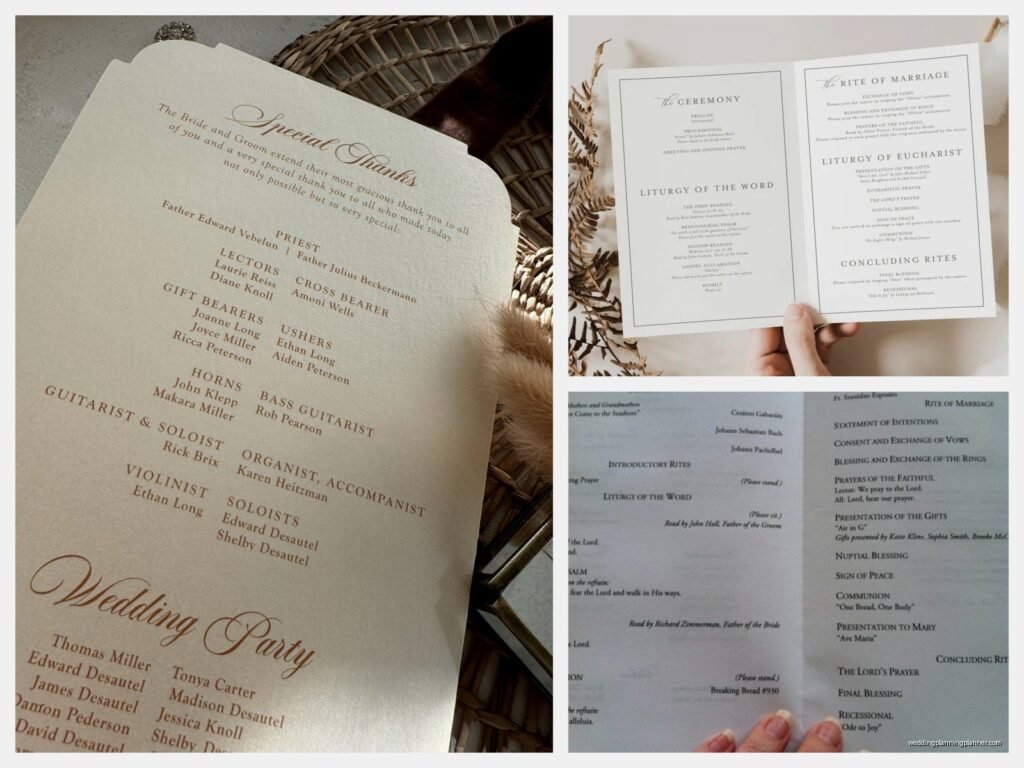
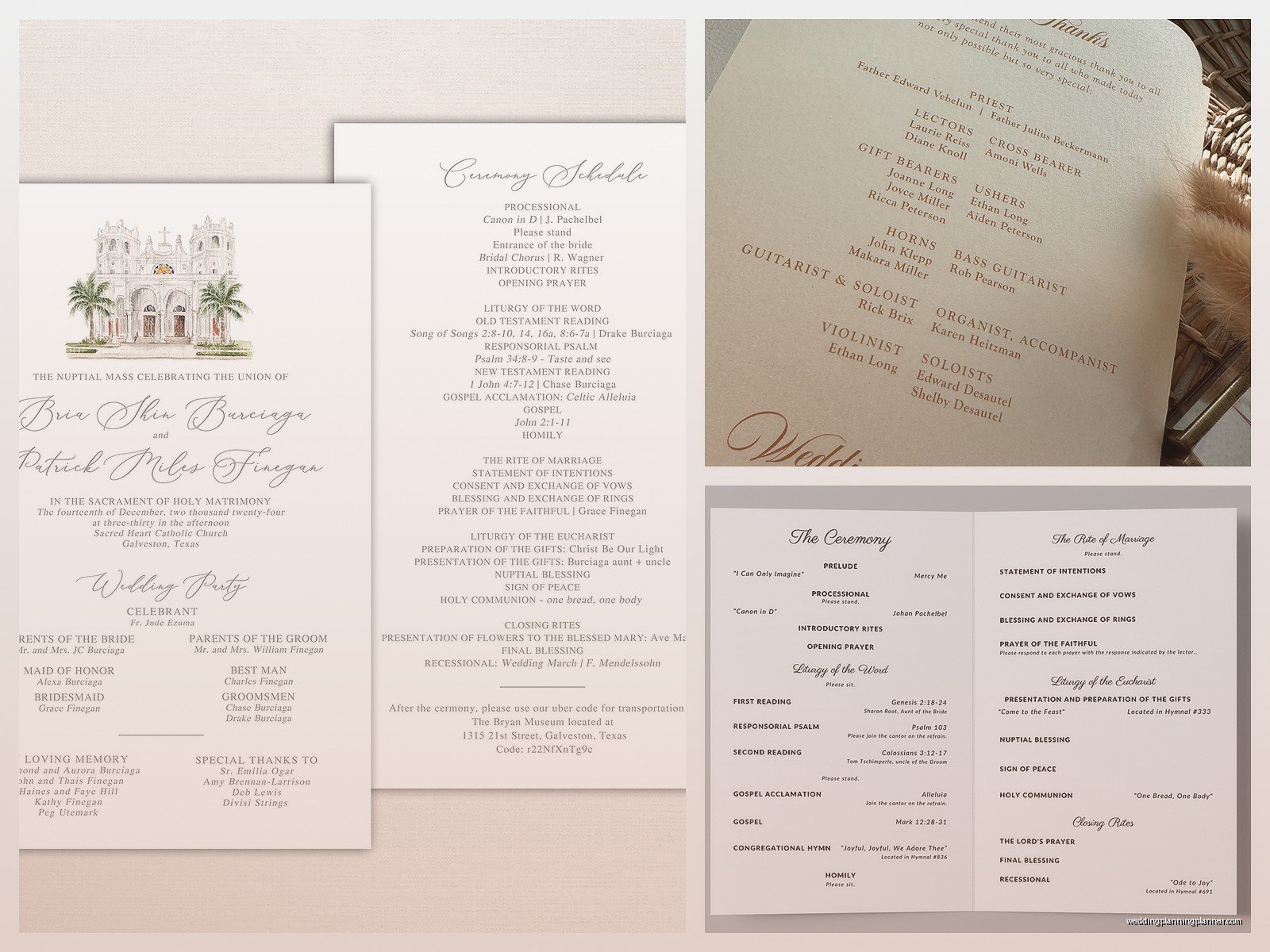
Oh boy. Catholic wedding masses are LONG and have a very specific order. If your couple is having a full mass (not just a ceremony), your program needs:
- Introductory Rites
- Liturgy of the Word (with specific readings – Old Testament, Psalm, New Testament, Gospel)
- Rite of Marriage (the actual wedding part)
- Liturgy of the Eucharist
- Communion (with instructions for non-Catholic guests about whether they can participate – usually they can’t receive communion but can come forward for a blessing)
- Concluding Rites
This annoyed me so much when I first started because I didn’t realize how detailed it needed to be and a church coordinator literally sent back my draft with like fifteen corrections. Catholic programs are basically their own beast.
Jewish Weddings
Completely different structure obviously. You’d include:
- Signing of the Ketubah (sometimes before the ceremony)
- Processional
- Welcoming Blessings
- Seven Blessings (Sheva Brachot)
- Ring Exchange
- Reading of the Ketubah
- Breaking of the Glass
- Recessional
Plus explanations for non-Jewish guests about what everything means because the symbolism isn’t gonna be obvious to everyone.
Non-Denominational or Interfaith
These are actually easier because you’re basically building your own order of service. Just make sure the program reflects whatever the couple and officiant have planned, and maybe include a note about why certain elements from different traditions are included.
The Practical Format Stuff
Most church wedding programs are either:
- Single sheet, folded in half (4 pages total) – this is the most common
- Flat card, single-sided or double-sided
- Booklet style for longer ceremonies (Catholic masses usually need this)
- Tri-fold panels
The folded half-sheet is your best bet for most ceremonies. It’s cheap to print, easy to hold, fits in a standard envelope if you’re mailing them as keepsakes later.
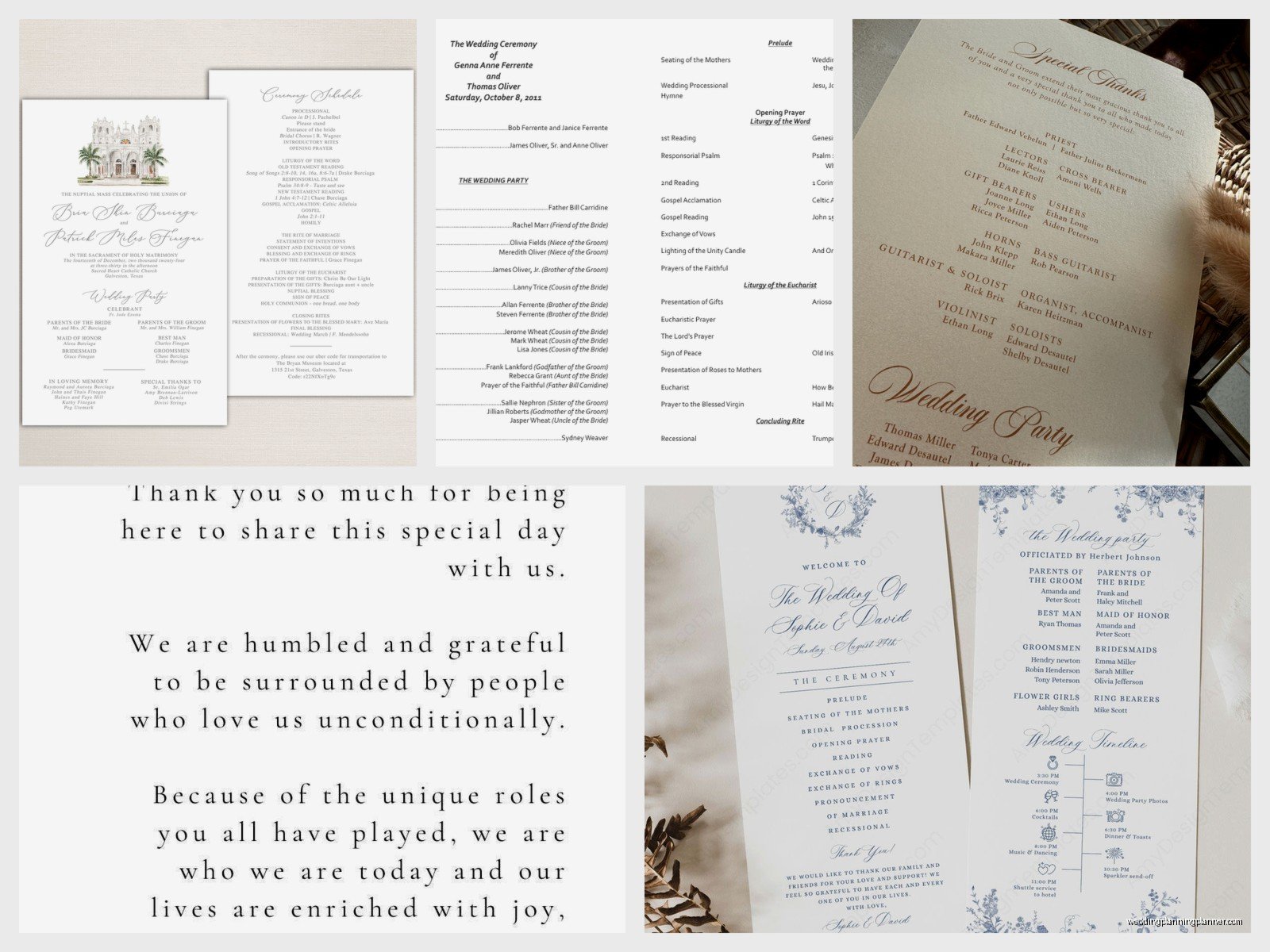
On the front cover you need the basics:
The Wedding Celebration of
Jennifer Marie Thompson
and
Christopher David Martinez
Saturday, June 15th, 2024
Two O’Clock in the Afternoon
St. Mark’s Lutheran Church
Portland, Oregon
Inside left panel is usually the order of service (everything I listed above). Inside right panel can be:
- Wedding party names and roles
- Thank you message to parents and guests
- In memory of deceased loved ones
- Explanation of unity ceremony or cultural traditions
- Lyrics to congregational hymns
Back cover is often:
- Reception details
- A quote or poem
- Additional thank yous
- Directions to reception venue
Or you can leave it blank with just a decorative design.
What Actually Needs To Be In There vs What’s Optional
Must-haves:
- Couple’s names
- Date and location
- Basic order of service
- Officiant’s name
Nice-to-haves:
- Wedding party names
- Readers’ names
- Musicians’ names
- Parents’ names
- Explanations of religious elements
- Lyrics or readings printed in full
Don’t-really-needs:
- Your entire love story
- Detailed vendor credits (save that for your website)
- Super long thank you speeches
Design Tips From Someone Who’s Seen Too Many Programs
Keep the font readable. I know you love that gorgeous calligraphy script but if your 80-year-old grandmother can’t read it in dim church lighting, it’s not functional. Use script for names and headers, use a clean serif or sans-serif for the actual order of service.
White space is your friend. Don’t cram everything together just to fit it on fewer pages. A clean, spacious layout looks more elegant anyway.
Match your wedding invitation style but programs can be simpler. You don’t need all the fancy envelope liners and wax seals here – people are literally gonna leave most of them in the pews or throw them away, which is fine, that’s what they’re for.
Print extras. I always tell couples to print at least 25% more than their guest count because people take multiple copies, some get messed up, you’ll want extras for your wedding album and for parents.
Timeline For Getting This Done
You need the final order of service from your officiant before you can finalize the program. Some officiants are super organized and give you this months in advance. Others… in summer 2021 I had an officiant who didn’t confirm the exact ceremony order until literally five days before the wedding and we had to rush-order programs. It was a whole thing.
Ideal timeline:
- 3 months before: Get draft order of service from officiant
- 2 months before: Finalize design and wording
- 6 weeks before: Send to printer
- 3-4 weeks before: Programs arrive, you proof them for errors
If you’re doing them yourself with a home printer or at a print shop, you can wait longer, but I don’t recommend printing the week of the wedding because that’s when everything else is crazy.
The Stuff People Always Forget
Spelling. Check every single name three times. I’ve seen programs with the groom’s name spelled wrong, the church name wrong, the date wrong. It happens when you’re rushing.
The officiant’s correct title. Is it Reverend, Pastor, Father, Rabbi, Imam, Minister? Get it right.
Whether guests can take photos. A lot of churches don’t allow photography during the ceremony and couples forget to mention this in the program. A simple note like “We kindly ask that you silence cell phones and refrain from photography during the ceremony” saves you from having Uncle Bob standing in the aisle with his iPad.
What to do during communion if you’re having a Catholic mass. Non-Catholic guests need to know they can stay seated or come forward for a blessing with arms crossed over their chest.
Reception location if it’s not immediately following at the same venue. You’d be surprised how many guests don’t check all their invitation inserts and show up to the church with no idea where to go next.
Your program doesn’t have to be perfect or super elaborate. It just needs to guide people through the service and help them feel included in your ceremony. That’s literally it. The Pinterest-perfect programs are gorgeous but a simple, clean, readable program does the exact same job and honestly? Most guests are watching you, not reading the program anyway. But it’s still worth doing because it shows you put thought into helping everyone participate in your wedding ceremony, and that’s kinda the whole point of having one in the first place.