Planning Guides, Style Guide
Muslim Marriage Card Design: Design & Ordering Guide
Apr
Understanding Muslim Wedding Card Basics First
So Muslim wedding invitations have their own specific requirements and you really can’t just copy-paste from a standard Western invitation template, trust me on this. The biggest thing is making sure you include the right religious elements without making it look cluttered or — and this drove me crazy back in spring 2023 when I had three Muslim weddings in one month — without accidentally putting sacred text next to decorative elements that don’t match the formality.
The main components you’re gonna need are the Bismillah (the “In the name of Allah” phrase), sometimes a Quranic verse about marriage, the couple’s names obviously, and here’s where it gets specific: you need to mention the Walima reception separately if there is one, because the nikah ceremony and the reception are distinct events. Some families do them on different days entirely.
I had this one client whose mother-in-law insisted we needed to include a specific Surah on the invitation, but the bride wanted something more modern and minimal. We ended up doing a beautiful compromise with a small, elegant Arabic calligraphy piece at the top that didn’t overwhelm the design. That taught me that you gotta ask about family expectations super early in the process.
Color Choices Matter More Than You Think
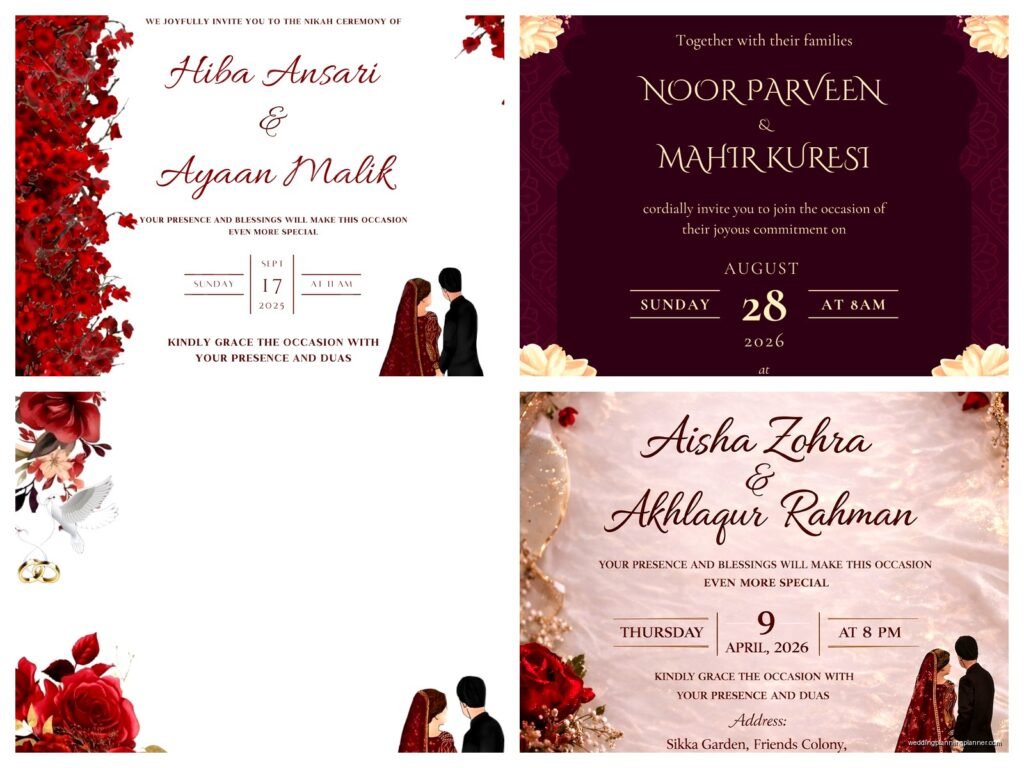
Okay so traditionally, gold and green are huge in Muslim wedding invitations. Gold represents prosperity and green has religious significance in Islam. But honestly? I’ve seen gorgeous invitations in burgundy, navy, emerald, deep purple, and even blush pink work beautifully. The key is richness — you want colors that feel luxurious and respectful.
Red is tricky because it’s more associated with Hindu weddings, so some Muslim families avoid it, but others don’t mind at all. You really need to ask your specific couple or family what their preferences are. White is generally fine as an accent but using it as the primary color can feel too Western or plain for some families.
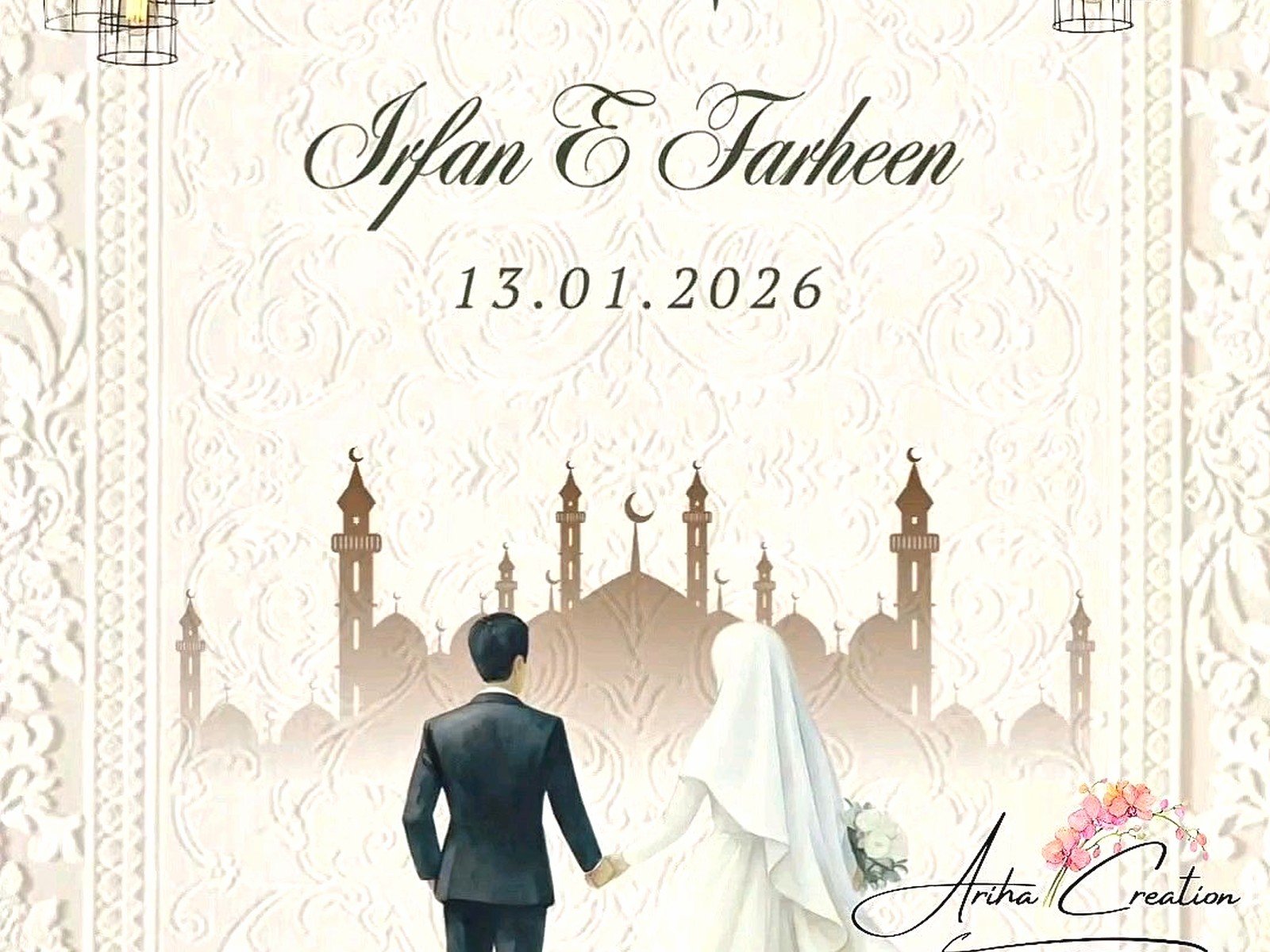
One thing that annoys me SO much is when designers just slap a mosque silhouette on everything like that’s the only way to make it “look Muslim” — there are so many more sophisticated ways to incorporate Islamic design elements. Geometric patterns, arabesque designs, intricate borders inspired by Islamic architecture, beautiful calligraphy… you don’t need a literal building on there.
Typography and Calligraphy Decisions
The Arabic calligraphy needs to be done right or not at all. I’ve seen so many invitations where someone clearly just used Google Translate and then stuck it in a random Arabic font, and native speakers can tell immediately that something’s off. If you’re including Arabic text, hire someone who actually knows Arabic calligraphy or at least have a native speaker review it.
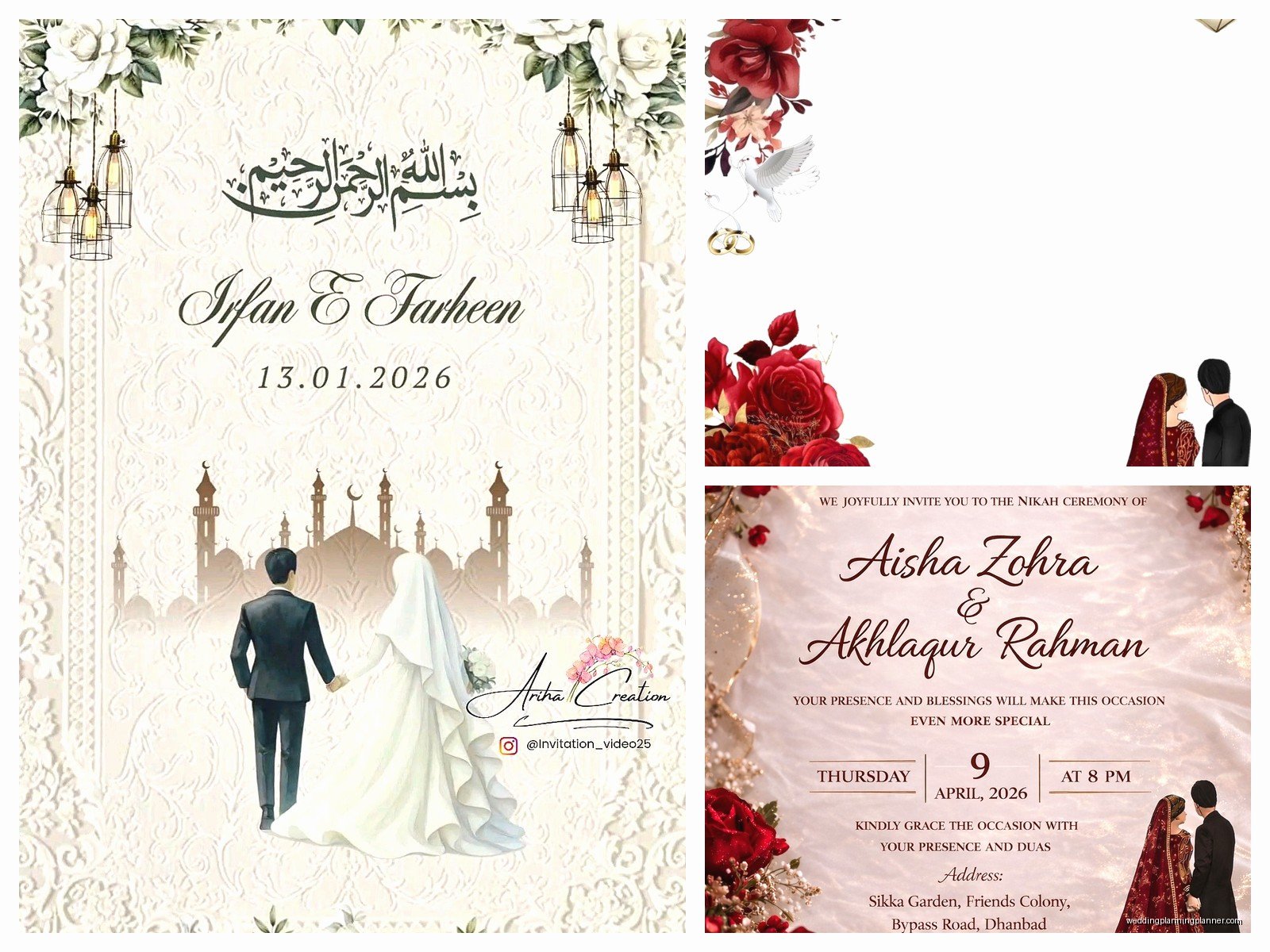
For the English text, elegant serif fonts work great for formal weddings. Script fonts can be beautiful but make sure they’re still readable — your elderly guests shouldn’t need a magnifying glass. I usually pair a decorative font for names with a clean, simple font for the details and information.
Some families want the entire invitation in Arabic, some want English with Arabic accents, some want both languages side by side. This affects your layout significantly, so figure this out before you start designing anything.
Layout and Design Elements
Muslim wedding invitations often open like a book or have a gatefold design, which I love because it creates this sense of unveiling something special. You can do a single card too, but the multi-panel designs feel more traditional and give you more space to include all the necessary information without cramming.
The Bismillah usually goes at the very top, centered. Then you might have a Quranic verse or dua about marriage. After that comes the actual invitation wording with the couple’s names and their parents’ names — and yes, both sets of parents are typically mentioned because marriage in Islam is seen as joining two families, not just two people.
I remember during summer 2021, I was working on an invitation while my cat kept walking across my keyboard, and I accidentally sent a draft to the printer with “hjkhjkhjk” in the middle of the venue address. Thankfully I caught it before the final print run, but that was… a moment.
What Information You Actually Need
Here’s your checklist and you’re gonna want to gather all this before you even start designing:
- Opening Islamic phrase (Bismillah or similar)
- Parents’ names for both bride and groom
- Couple’s full names
- Nikah ceremony details: date, time, exact location
- Walima reception details if separate: date, time, location
- Dress code if there is one
- RSVP information and deadline
- Registry information if they’re including it
- Phone number or email for questions
- Any specific cultural customs guests should know about
Some families also include a small note about gender-segregated seating if that applies to their wedding, or mention if it’s an alcohol-free event, though that’s kinda assumed for Muslim weddings anyway.
Choosing Your Printing Method
Digital printing is the most affordable and works great for simpler designs. You get good quality and quick turnaround, and it’s perfect if you need to print different quantities because not everyone gets the same inserts or whatever.
Letterpress is stunning but expensive — we’re talking $15-30 per invitation easily. It gives you that gorgeous tactile quality with the pressed impression. If budget allows and you want something really special, this is beautiful for Muslim weddings because it makes the calligraphy and geometric patterns really stand out.
Foil stamping in gold or rose gold is super popular for Muslim wedding invitations because it adds that luxurious feel without the letterpress cost. You can foil stamp just the Bismillah and the couple’s names to make them pop, or go all out with foiled borders and patterns. Expect to pay $8-15 per invitation depending on how much foil you’re using.
Thermography is like the middle ground — it creates raised text that looks similar to letterpress but costs way less, usually $4-8 per invitation. It photographs really well too.
Paper Quality Actually Makes a Difference
Don’t cheap out on paper, seriously. A beautiful design on flimsy paper looks… cheap. I recommend at least 100lb cardstock for the main invitation card. If you’re doing multiple inserts, those can be lighter weight, like 80lb.
Textured papers like linen or laid finish add elegance. Pearl or shimmer papers are popular for Muslim weddings because they catch the light beautifully, especially if you’re incorporating gold elements. Matte papers feel more modern and sophisticated if that’s the vibe you’re going for.
Working With Muslim-Specific Design Companies vs General Printers
There are companies that specialize specifically in Muslim wedding invitations, and honestly? They understand the requirements without you having to explain everything. They have templates with proper Islamic calligraphy, they know the standard wording, they get the cultural nuances.
But general high-quality printers can work too if you have a clear design vision and maybe work with a designer who has experience with Muslim weddings. The advantage is often more customization and sometimes better printing quality, but you’ll need to educate them on what’s important.
I’ve used both approaches depending on the client’s needs and budget. For couples who want something very traditional, the specialized companies are usually easier. For couples who want something more modern or fusion-style, working with a general printer and a good designer gives you more flexibility.
Timing Your Order
Okay so Muslim weddings sometimes happen quickly — like, sometimes the engagement period is shorter than what you see in Western weddings, or the date gets set based on Islamic calendar considerations or family availability. But you still need time for invitations.
Ideally, start your design process at least 4-5 months before the wedding. That gives you time to finalize the design, order samples, make any changes, do the final print run, and mail them out 6-8 weeks before the wedding date. Rush printing is possible but it costs more and limits your options.
If you’re ordering from overseas (some couples order from Pakistan, India, or Middle Eastern countries where they can get incredible hand-crafted invitations), add at least 2-3 extra months for production and shipping. International shipping is unpredictable and customs can delay things.
Sample Orders Are Non-Negotiable
Always, always order a sample before you commit to printing 200 invitations. The colors might look different in person, the paper might feel different, the size might be off, the Arabic text might have an error you didn’t catch on screen. I learned this the hard way early in my career and I’m not making that mistake again.
Most companies charge $5-15 for a sample, which is absolutely worth it. Some companies offer free samples of their standard designs, which at least lets you feel the paper quality and printing method even if it’s not your exact design.
Envelope and Assembly Considerations
Your envelopes need to fit your invitation comfortably — sounds obvious but I’ve seen people order envelopes that are just barely big enough and then the invitations get bent trying to stuff them in. Leave at least a quarter inch of space on all sides.
Envelope liners add a really nice touch and they’re not that expensive, usually $1-2 per envelope. You can do them in a coordinating color or with a pattern that matches your invitation design. Gold or geometric patterns work beautifully for Muslim wedding invitations.
Wax seals are having a moment and they look gorgeous on Muslim wedding invitations. You can get custom wax seals with Arabic calligraphy or the couple’s initials. They do add time to assembly though, because you’re literally melting wax and stamping each envelope individually, or… you can get the modern peel-and-stick wax seals that look real but are way faster.
Belly bands, ribbons, or decorative wraps can hold all your pieces together and add to the overall presentation. Just make sure whatever you use doesn’t make the invitation too bulky or you’ll pay extra postage.
Postage and Mailing
Take a fully assembled invitation to the post office and have them weigh it before you buy stamps. Square envelopes, thick invitations, and anything with wax seals or ribbons usually costs more than standard postage. Nothing worse than having to add extra stamps to already-sealed envelopes because you underestimated.
Consider hand-canceling at the post office, which means they manually process your invitations instead of running them through machines. It costs a bit extra but prevents your beautiful invitations from getting torn or smudged by the sorting machines. For the record, this is totally worth it if you spent good money on foil stamping or letterpress.
Budget Breakdown Reality Check
Let’s talk actual numbers because I feel like people get sticker shock with wedding invitations and don’t budget realistically. For 100 invitations (which probably covers 200-250 guests depending on how many couples vs individuals you’re inviting):
Budget option with digital printing on decent cardstock: $200-400. This gets you a nice invitation but nothing fancy.
Mid-range with some special touches like foil stamping or letterpress on one element: $600-1000. This is where most of my clients end up.
High-end with multiple printing techniques, premium paper, custom calligraphy, fancy envelopes and liners: $1500-3000+. This is for couples who really prioritize the invitation as a keepsake.
These prices usually include envelopes and basic assembly. Add more for envelope liners, wax seals, ribbon, professional calligraphy for addressing, and any extra inserts like direction cards or accommodation information.
Common Mistakes I See All The Time
Not proofreading the Arabic text carefully enough — get multiple native speakers to check it, not just one person.
Forgetting to include parking information for the venue, which matters more than you think, especially if your mosque or venue has limited parking.
Making the text too small because you’re trying to fit too much information on one card — just add an insert card, honestly.
Not considering that older relatives might have vision problems, so you need good contrast between text and background, and readable font sizes.
Ordering exactly the number you need with no extras — always order at least 15-20 extra invitations for last-minute additions, mistakes, or keepsakes.
Choosing a design that doesn’t photograph well, which matters because everyone posts their invitations on social media now, like it or not.
Digital Invitations as Supplements
Some couples are doing paper invitations for close family and older relatives, then digital invitations for everyone else, which honestly makes sense from a budget and environmental perspective. There are beautiful digital invitation platforms now that let you include all the same design elements, Arabic calligraphy, everything.
But know that some families, especially older generations, might feel like digital invitations are impersonal or not respectful enough for a wedding. It’s a balance between practicality and tradition, and you gotta know your audience.
You can also do paper invitations for everyone but include a wedding website link for additional details, RSVP tracking, registry information, and updates. This is probably the best of both worlds approach and what I recommend most often to clients who are trying to be practical but still honor traditions