Planning Guides, Style Guide
Wedding Planner Contract Sample: Agreement Template Example
Jun
What Actually Needs to Be in Your Wedding Planner Contract
So look, I learned this the hard way back in spring 2019 when a bride literally tried to claim I never told her my cancellation policy even though we’d discussed it three times and it was in the contract she signed. Except… it wasn’t clearly labeled and the font was tiny and basically I made it way too easy for her to say she “didn’t see it.” That’s when I completely overhauled my contract template and honestly it saved my business.
The thing is, your wedding planner contract isn’t just some formality you throw together because everyone says you need one. It’s literally the document that’s gonna protect you when things get weird, and trust me, things get weird. I’ve seen couples break up three weeks before the wedding, I’ve had vendors ghost everyone, I’ve dealt with family members who think they can fire me even though they’re not the ones who hired me… you need this stuff in writing.
The Header Section and Party Identification
Start with the basics at the top. You need the date of the agreement, your business name (use your legal business name, not just your cute Instagram handle), your business address, and then the client’s full legal names and their address. I usually write it like:
WEDDING PLANNING SERVICES AGREEMENT
This agreement is entered into on [DATE] between Olivia Hart Wedding Planning (“Planner”) located at [your address] and [Client Name] and [Client Name] (“Clients”) located at [their address].
Some planners put the wedding date right here too, which is smart because then there’s no confusion about which event you’re talking about if you end up working with the same client on multiple events.
Scope of Services
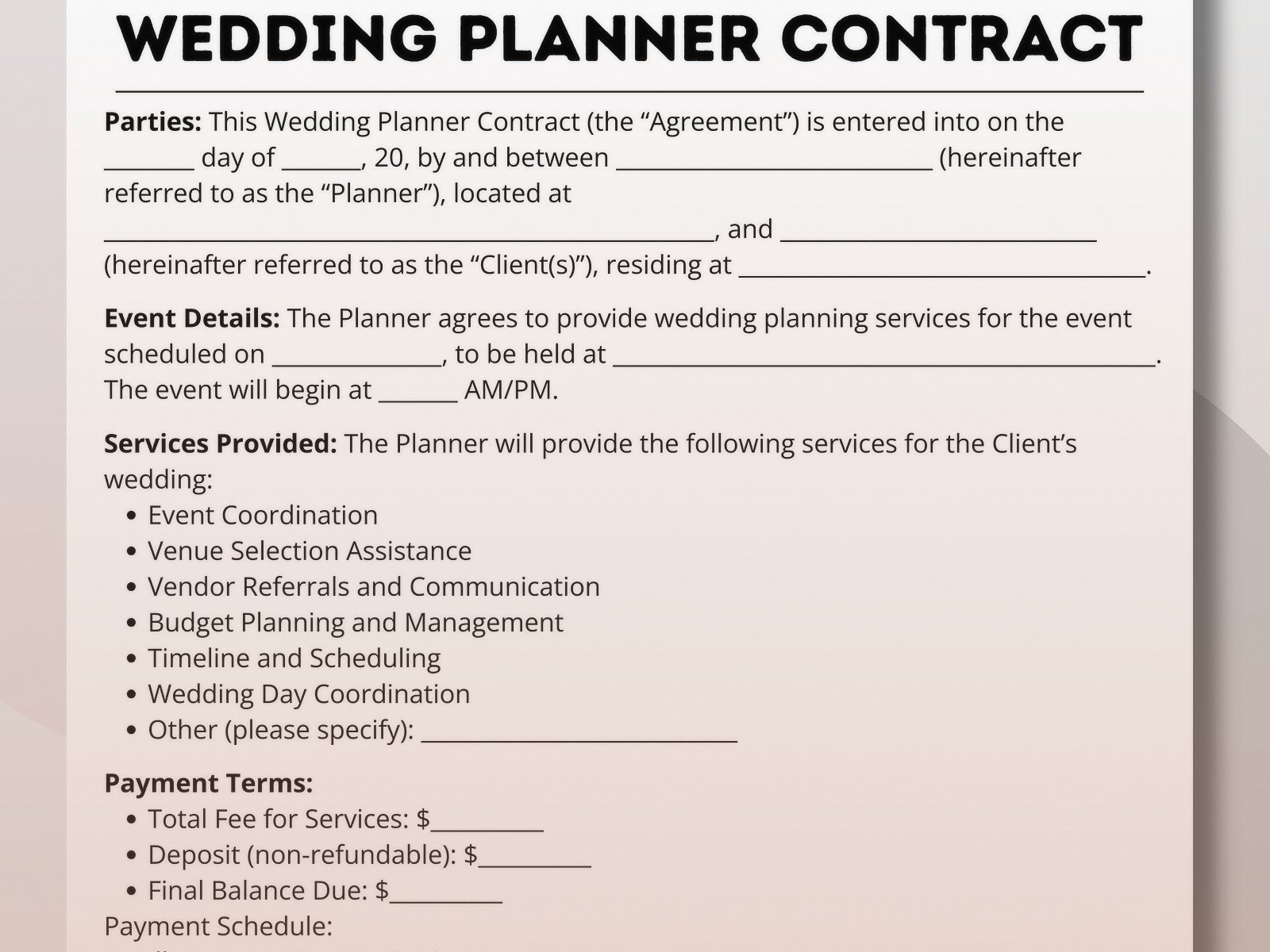
This is where you gotta be super specific about what you’re actually doing. I used to just write “full service wedding planning” and call it a day, but nah, that’s not enough. You need to list out every single thing you’re providing because if it’s not listed, the client will assume it’s included and then you’re stuck either doing free work or having an awkward conversation.
Break it down by planning phase if you’re doing full service:
Planning Services Include:
- Unlimited phone and email consultations during business hours (define your business hours)
- Venue research and site visits (specify how many)
- Vendor recommendations and contract review
- Budget development and tracking
- Design consultation and mood board creation
- Timeline creation for the wedding day
- RSVP tracking assistance
- Seating chart development
Day-of Coordination Includes:
- Final venue walkthrough two weeks prior
- Coordination of all vendors on wedding day
- Setup supervision and breakdown coordination
- Timeline management
- On-site for [number] hours on wedding day
- [Number] of assistant coordinators
Then you need a section for what’s NOT included because this is just as important. Like, I don’t do floral design, I don’t stuff envelopes (okay I have done this but I shouldn’t have to), I don’t provide transportation, I don’t clean up after guests, I don’t babysit drunk relatives even though that one uncle always seems to think that’s part of my job.
Payment Terms and Pricing Structure
Alright so this is where people get really uncomfortable but you cannot be vague about money. I’ve seen planners write “payment due upon completion” which is insane because you’ll never see that money and also when is “completion” exactly?
Here’s what you need:
Total Investment: $[amount] for [package name/services described above]
Payment Schedule:
- $[amount] non-refundable retainer due upon signing to secure services
- $[amount] due [date or milestone]
- $[amount] due [date or milestone]
- Final payment of $[amount] due no later than [typically 2 weeks before wedding]
I learned to add this part after summer 2021 when a client kept paying late and I was basically chasing her for money while also trying to plan her wedding: “Late payments will incur a fee of $[amount] per day after the due date. Services may be suspended if payment is more than [number] days overdue.”
Also specify your payment methods. I take credit cards, checks, and bank transfers but not Venmo or PayPal Friends & Family because that’s not professional and you lose your protection.
Cancellation and Refund Policy
This is the section that saved me with that spring 2019 bride I mentioned. You need to spell out exactly what happens if they cancel, if you cancel, or if the wedding is postponed.
My current policy looks like this:
Client Cancellation: If Clients cancel services, the retainer is non-refundable. Any additional payments made are refundable as follows: [I do a sliding scale – more than 6 months out, 75% refund; 3-6 months, 50% refund; less than 3 months, no refund except the retainer]
Postponement: If the wedding is postponed, retainer and payments can be applied to the new date if Planner is available. If new date is more than 18 months away, this is considered a cancellation. Replanning fees may apply depending on how much work needs to be redone.
That postponement clause became really important during 2020 and 2021 for obvious reasons. I had couples postponing multiple times and I needed to protect my time because replanning the same wedding three times is essentially like planning three different weddings.
Planner Cancellation and Backup Plans
You also need to cover what happens if YOU can’t fulfill the contract. I know it’s uncomfortable to think about but what if you get seriously ill or have a family emergency or, I don’t know, your cat knocks over a candle and your house burns down and you lose all your planning materials (this didn’t happen to me but it happened to a planner I know).
I include: “In the unlikely event that Planner is unable to perform services due to illness, injury, or other circumstances beyond Planner’s control, Planner will provide a qualified substitute planner or issue a full refund of payments received.”
And honestly, you should have a network of other planners you trust who could step in. I have an informal agreement with two other planners in my area where we’d cover for each other if needed.
Liability Limitations
This is the part that protects you from being sued for every little thing that goes wrong. Because here’s the thing… weddings are complex events with a million moving pieces and some of those pieces are completely outside your control.
I include language like: “Planner is not liable for any damages, delays, or disappointments caused by vendors, venues, weather, acts of God, or any circumstances beyond Planner’s reasonable control. Planner’s liability is limited to the total amount paid for planning services.”
You also wanna add something about how you’re not responsible for vendor performance. You can recommend vendors and coordinate them, but if the florist doesn’t show up or the cake tastes terrible, that’s between the client and that vendor. I learned this when… okay so there was this bakery that I’d recommended like fifteen times with no issues, and then they just completely forgot to make a cake for one of my weddings and the bride wanted to sue ME about it even though I had confirmed with the bakery multiple times and had all the emails to prove it.
Client Responsibilities
People forget this section but it’s super important because planning a wedding is a collaboration and clients have responsibilities too. If they don’t hold up their end, you can’t do your job properly.
Include things like:
- Clients will respond to emails and requests for information within [timeframe]
- Clients will make timely decisions when presented with options
- Clients will review and approve all plans, timelines, and vendor contracts
- Clients will inform Planner immediately of any changes to plans or vendor contracts
- Clients are responsible for all vendor payments and contracts unless otherwise specified
- Clients will attend scheduled planning meetings
I also add something about how many people can be decision-makers. Like, I don’t need the bride, the groom, both moms, the maid of honor, and the bride’s best friend from college all weighing in on every decision because that’s how nothing ever gets decided and also how I lose my mind.
Communication Expectations
Set boundaries around communication because otherwise you’ll be answering texts at 11pm about napkin colors and I say this from experience because I used to do that and it was terrible for my mental health.
Specify your business hours, typical response time (I say within 24-48 hours for emails, same day for urgent matters during business hours), and preferred communication methods. I prefer email for most stuff because then there’s a record of everything, but I’ll do phone calls when we need to hash out complicated stuff.
Also – and this kinda goes with the decision-maker thing – specify who you’ll communicate with. I usually work primarily with the couple and will CC parents or other family members if requested, but I’m not managing a group chat with seventeen people.
Vendor Management and Coordination
This section should clarify your role with vendors. Are you just recommending them, or are you managing their contracts? Are you responsible for making sure they show up on time, or just for creating a timeline that tells them when to show up?
I specify that I’ll create a comprehensive vendor timeline, share it with all vendors, and coordinate everyone on the wedding day, but I’m not responsible if a vendor doesn’t follow the timeline or doesn’t show up. That’s a contract issue between the client and the vendor.
Also note whether you review vendor contracts (I do this as a courtesy but I’m not a lawyer so I make that clear) and whether you attend vendor meetings.
Wedding Day Coverage Details
Get really specific about your wedding day coverage. What time will you arrive? What time will you leave? What happens if the event runs long? How many assistants will you have?
I typically include: “Planner will be on-site for [number] hours on wedding day, from [time] to [time]. If event runs longer than scheduled, overtime fees of $[amount] per hour will apply. Planner will have [number] assistant coordinators.”
I learned to add the overtime clause after a wedding that was supposed to end at 10pm but the couple kept the party going until 1am and I was just… stuck there because I hadn’t planned for that scenario in my contract.
Force Majeure (The Disaster Clause)
After 2020, everyone knows what force majeure means now. This is the clause that covers what happens when something completely outside everyone’s control makes the wedding impossible – natural disasters, pandemics, government shutdowns, venue burning down, whatever.
You need to specify that neither party is liable if the wedding can’t happen due to these circumstances, and outline what happens to payments. I typically offer to apply payments to a postponed date if I’m available, but if the wedding is cancelled entirely due to force majeure, my policy is different than if the client just changes their mind.
Intellectual Property and Social Media
This is something I didn’t think about early in my career but now I always include. Can you share photos from their wedding on your website and social media? Can you use their wedding as a case study? Can you list them as a client?
Most clients are fine with this but some aren’t, especially if they’re private people or have security concerns or whatever. Better to address it upfront.
I usually write: “Planner may use photographs and details from the wedding for marketing purposes including website, social media, and promotional materials unless Client opts out in writing.”
Some planners include a clause about credited mentions – like, if the wedding gets published in a magazine or blog, the planner should be credited. That’s fair.
Termination Clause
What happens if either party wants to end the contract before the wedding? You’ve already covered cancellation by the client, but what if the working relationship just becomes impossible?
I’ve never had to terminate a contract but I came close once with a bride who was just… she would call me crying multiple times a day, she’d change her mind about everything constantly, she’d yell at vendors and then I’d have to smooth things over, and it got to the point where I was like, I cannot do this anymore for my own wellbeing.
My termination clause says either party can terminate with written notice, and outlines what happens to payments in that scenario. Usually if I terminate, I refund unused portions (minus retainer and work completed). If they terminate, it follows the cancellation policy.
Dispute Resolution
Nobody wants to think about this but what happens if there’s a major disagreement? I include a clause requiring mediation before either party can file a lawsuit, and I specify which state’s laws govern the contract.
Something like: “Any disputes will be resolved through mediation in [your county/state]. If mediation fails, disputes will be handled in the courts of [your county/state]. This agreement is governed by the laws of [your state].”
This matters more than you think because if you’re in California and your client is in Texas and you don’t specify, things can get really complicated really fast if there’s a legal issue.
The Annoying Thing About Contracts
Okay so here’s what really annoys me about wedding planner contracts – clients don’t read them. Like, I send this detailed multi-page document that I spent hours perfecting and covers every possible scenario, and they just scroll to the bottom and sign it without reading anything. Then later they’re surprised by something that was clearly stated in the contract.
So now what I do is I go through the major points verbally during our first meeting, and I send a separate one-page summary of key terms along with the full contract. The summary covers payment schedule, cancellation policy, what’s included/not included, and wedding day coverage. It’s not legally binding on its own but it helps people actually understand what they’re signing.
Signature Section
This seems obvious but you need a proper signature section with:
- Signature lines for both clients (if it’s a couple, both should sign)
- Your signature line
- Date fields for each signature
- Printed names under each signature line
I use electronic signature software now (DocuSign or HoneyBook) which makes this way easier and creates automatic records of when everyone signed. Plus you don’t have to deal with printing and scanning and all that.
Additional Clauses You Might Need
Depending on your business model, you might need some other specific clauses. Like if you get commission from vendors (I don’t, but some planners do), you need to disclose that. If you’re bringing in subcontractors or additional staff, you need to specify that.
If you’re doing destination weddings, you need travel expense clauses – who pays for your flights, hotel, meals, etc. I typically include travel costs in my package price for destination weddings, but some planners bill separately.
Some planners include a clause about gratuities – like, clarifying that tips are appreciated but not included in the contract price. I personally think that’s kinda tacky to put in writing but I get why people do it because it manages expectations.
Get It Reviewed By a Lawyer
Look, I’m gonna be real with you – everything I’ve told you here is based on my experience and what works for me, but I’m not a lawyer and you shouldn’t just copy-paste someone else’s contract and call it a day. Every state has different laws about contracts, liability, business practices, all that stuff.
I paid a lawyer who specializes in small business and event planning to review my contract template and it was worth every penny. She caught things I hadn’t thought about and made sure the language was actually enforceable. It cost me like $500 but it’s protected me from way more than that in potential issues.
You can find templates online – there are wedding planner associations that offer sample contracts, legal template websites, other planners who sell their contract templates – but at minimum, have a lawyer review whatever you end up using and customize it for your specific business and state.
Keep It Updated
Your contract isn’t a set-it-and-forget-it thing. I update mine at least once a year, usually after tax season when I’m reviewing my whole business anyway. Every time I encounter a new situation or problem, I think about whether my contract addresses it and update if needed.
Like after 2020, I added way more detailed force majeure language. After that situation with the bride who kept paying late, I added the late fee clause. After working with a couple who broke up before the wedding (awkward), I added a specific clause about what happens in that scenario.
Your contract should evolve as your business evolves and as you learn from experience what issues come up. Just make sure that when you update it, you’re using the new version for new clients – don’t try to retroactively apply new terms to existing contracts because that doesn’t work legally.
Using Your Contract in Real Life
Having a great contract doesn’t help if you don’t actually use it properly. I send the contract