
Planning Guides, Style Guide
Wedding Proposal Planner: Engagement Coordination Services
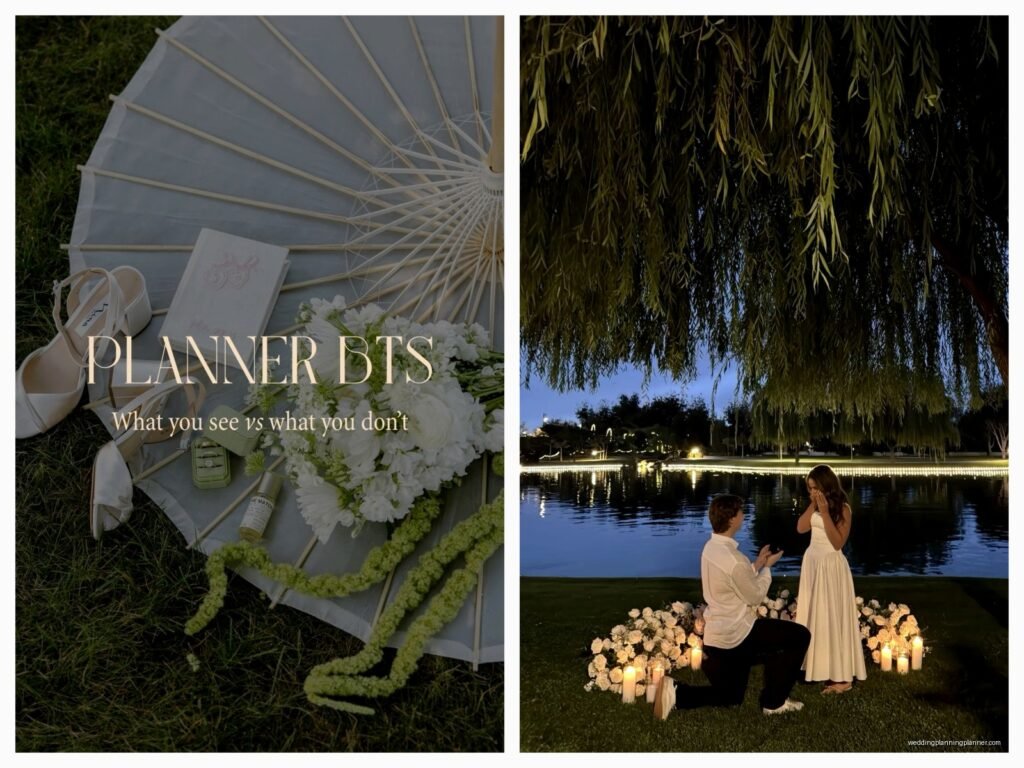
Oct
What Even Is Proposal Planning and Why People Hire Someone For It
Okay so proposal planning is basically when someone (usually the person who’s gonna pop the question) hires you to coordinate their entire engagement proposal. Like the whole thing. Location scouting, hiring photographers, setting up decorations, making sure the ring doesn’t fall in a lake, coordinating with restaurants or hotels, getting family members in position… it’s wedding planning‘s chaotic younger sibling.
I started offering this service back in spring 2023 after a groom told me at his wedding that he wished he’d had help with his proposal because he almost dropped the ring off a cliff in Big Sur and his hands were shaking so bad he couldn’t get it out of his pocket. That got me thinking about how stressful proposals actually are and how there’s this whole market of people who want it perfect but have no idea how to execute it.
The thing is, people hire proposal planners because they’re terrified of messing up this one massive moment. They’ve got the ring, they know they wanna do it, but the logistics? The backup plans? What if it rains? What if the restaurant screws up? What if their partner’s best friend can’t make it to hide in the bushes with a camera? That’s where you come in.
Getting Started With Proposal Coordination Services
You need a service structure first. I offer three tiers because people’s budgets are all over the place. Basic package is consultation only—I help them brainstorm, give vendor recommendations, create a timeline, but they execute everything themselves. Mid-tier includes consultation plus I’m there on the day coordinating behind the scenes. Premium package is full planning and coordination where I literally do everything except get down on one knee.
Pricing varies wildly depending on your market but I charge $500 for basic, $1200 for mid-tier, and $2500+ for full planning. Some planners in big cities charge way more. The full planning package usually takes 15-20 hours of work when you factor in all the vendor coordination and site visits and backup planning.
You’re gonna need vendor relationships. Photographers who specialize in proposals and understand they need to be sneaky. Florists who can set up quickly and discreetly. Restaurants with private areas or cooperative management. Musicians if that’s the vibe. I’ve worked with the same proposal photographer for almost two years now and she’s worth her weight in gold because she knows how to hide behind trees without looking like a creep.
Initial Client Consultation
When someone reaches out about proposal planning, I schedule a video call first. You need to figure out if they actually know their partner well enough to plan something they’ll love, which sounds obvious but… you’d be surprised. I ask about their relationship, how they met, what their partner loves and hates, whether they’re private or extroverted, if they’ve talked about marriage.

One thing that really annoys me is when clients want to plan something that’s clearly more about showing off on social media than about what their partner would actually enjoy. Like this guy in summer 2022 wanted a flash mob proposal at a busy shopping center and when I asked if his girlfriend liked being the center of attention he said “not really but it’ll look amazing on Instagram.” I turned that one down because nah, I’m not helping you traumatize your girlfriend for likes.
During consultation you need to gather: budget, timeline (when they want to propose), location preferences, whether they want it public or private, if they want family/friends involved, their partner’s schedule and how you’ll work around it, ring details (do they have it yet, does it need to be picked up somewhere), and any dealbreakers.
Location Scouting and Logistics
Location is everything and it’s way more complicated than people think. You can’t just show up at a public park and set up an elaborate picnic without checking if you need permits. I learned this the hard way when—okay this was actually kinda funny in retrospect but stressful at the time—I had set up this gorgeous beachside proposal with lanterns and flowers and a local ranger showed up and started asking about our permit. I had to fast-talk our way through it while texting the client to hurry up and propose already.
When scouting locations you need to check: permits required, accessibility, backup indoor options if weather’s a factor, parking situation, whether there’s cell service (important for coordinating), bathrooms nearby (people get nervous and need to pee, trust me), lighting conditions at the time of day they want to propose, and how busy it’ll be.
I always do a site visit at the exact time of day the proposal will happen. Lighting changes everything. A spot that’s gorgeous at 2pm might be completely backlit and terrible for photos at 6pm. You also need to see how crowded it gets—proposing at a “quiet” overlook that’s actually packed with tourists at sunset is not the vibe.
Coordinating Vendors and Services
You’re basically running point on everything. The photographer needs to know where to hide and when to start shooting. If there’s a musician they need to know when to start playing. Restaurant staff needs to know when to bring out the champagne. Florist needs to know when they can set up without the partner seeing.
Create a detailed timeline with buffer time built in. Something will run late. The client will get stuck in traffic or their partner will want to stop for coffee or whatever. I usually build in 20-30 minutes of flex time and give the photographer and any other vendors a window rather than an exact time.
Communication is constant leading up to the day. I’m texting the client updates, confirming with vendors, checking weather forecasts obsessively, making sure everyone has everyone else’s contact info. I create a group chat usually 48 hours before with just the vendors so we can coordinate without the client getting overwhelmed.
The Actual Day Coordination
On proposal day you need to be there early. I usually arrive 60-90 minutes before the scheduled proposal time to make sure everything’s set up right. If there are decorations, I’m setting them up or supervising setup. Making sure the photographer has good sight lines. Checking that the musician is in position. Confirming the restaurant has the champagne chilled.

You’re also managing the client’s nerves which is honestly half the job. They’re freaking out. They’re texting you panicked messages. They’re convinced something will go wrong. I usually have a phone call with them the morning of to walk through everything one more time and calm them down.
The tricky part is staying hidden while also being able to see what’s happening. I’ve hidden behind buildings, in cars, behind large groups of tourists… my cat judges me when I come home with leaves in my hair from crouching behind bushes but whatever, it’s part of the job. You need to be close enough to troubleshoot if something goes wrong but far enough that you don’t ruin the surprise.
During the actual proposal I’m watching to make sure the photographer is getting good angles, that any coordinated elements happen at the right time, and that nothing goes sideways. I had one proposal where the musician started playing the wrong song and I had to very carefully get his attention and mouth “OTHER SONG” while staying out of the couple’s line of sight.
Handling the Unexpected
Something will go wrong. Not like disaster wrong usually, but wrong enough that you need to adapt. Weather is the biggest wild card. I always have a backup plan and usually a backup to the backup plan. Indoor locations that can be reserved last-minute, umbrellas and blankets in my car, relationships with venues that can accommodate us on short notice.
I keep an emergency kit in my car: safety pins, double-sided tape, stain remover wipes, tissues, phone chargers, mini sewing kit, bobby pins, and weirdly specific but important—ring size adjusters. You’d be amazed how often someone gets sized wrong or their partner’s fingers are swollen from the heat or whatever and the ring doesn’t fit right. Having those little clear adjusters has saved the day more than once.
Sometimes the partner gets suspicious. This happened to me where the girlfriend was like “why are we getting so dressed up to go to the park” and I had to text the client suggestions for how to explain it without giving it away. We went with “there’s a fancy restaurant nearby we’re going to after” which worked.
Working With Families and Friends
When families are involved it gets exponentially more complicated. You’re coordinating schedules for multiple people, making sure everyone knows where to be and when, managing group chats with people who have very different communication styles, and often dealing with family dynamics you don’t fully understand.
I require a designated family coordinator—one person who’s responsible for getting everyone there on time and in the right spot. Usually it’s the client’s sister or best friend or someone organized. Because I cannot be texting fifteen different people asking where they are when I’m also trying to coordinate everything else.
You need to give family members very clear instructions: where to park, where to wait, when they’ll get a signal to come out (if it’s a surprise appearance), what the photographer needs from them. I send a detailed email 48 hours before and then a reminder text the morning of with just the essentials.
The thing about family involvement is some people love it and some people would be mortified. You gotta make sure the client really knows what their partner wants. I’ve seen proposals where the newly-engaged person was so overwhelmed by surprise family members showing up that they kinda shut down emotionally and couldn’t fully enjoy it, which defeats the whole purpose.
Post-Proposal Coordination
Your job doesn’t end when they say yes. If you’ve planned a post-proposal celebration—dinner reservation, champagne toast with family, whatever—you’re making sure that happens smoothly. Coordinating with the restaurant to have the table ready, making sure the photographer gets family photos if that’s part of the package, helping transition from proposal mode to celebration mode.
I also handle getting the photos to the couple quickly. I work with my photographer to get at least a few edited sneak peeks within 24 hours because people are dying to post on social media and share with family. Full gallery usually takes a week or two but those initial photos keep everyone happy.
Follow-up is important for your business too. I send a congratulations gift (usually a nice bottle of champagne or a custom ornament with their engagement date) and check in to make sure they’re happy with everything. This is also when I mention my wedding planning services because hello, they’re gonna need a planner and you just proved you can handle their vision.
Building Your Proposal Planning Business
Marketing proposal services is different from marketing wedding planning. You’re targeting people who are about to get engaged, which means they’re not searching for “proposal planner” six months in advance. They’re usually searching 2-8 weeks before they want to propose, sometimes even less.
I get most of my proposal clients through Instagram and Google. Instagram because I post photos (with permission obviously) of proposals I’ve coordinated and engaged couples tag their location and the whole thing becomes discoverable. Google because people literally search “proposal planner near me” or “how to propose in [city]” when they’re ready to do this.
Your website needs a proposal planning page that’s separate from wedding planning with different packages clearly listed, a portfolio of past proposals, and testimonials. Video testimonials are especially good for this because you can feel the emotion and excitement.
Partnerships matter. I have relationships with jewelers who refer clients to me after someone buys a ring, hotels that recommend me to guests planning proposals, and photographers who send people my way when someone reaches out about proposal photography but seems overwhelmed by the planning.
Pricing Strategy and Profitability
Don’t underprice this. Proposal planning is specialized and time-sensitive and people will pay for expertise. Your pricing should reflect the hours you’ll spend plus the stress factor of coordinating something that can’t be rescheduled easily and has to go perfectly.
I include everything in my pricing—consultations, site visits, day-of coordination, vendor coordination, emergency kit supplies, all of it. The only things that cost extra are actual vendor fees (photographer, musicians, flowers, etc.) which I either have clients pay directly or I collect and pay on their behalf with a small coordination fee added.
Profitability comes from efficiency. Once you have your systems down—your vendor relationships, your emergency kit stocked, your contract templates ready, your timeline templates—each proposal takes less time to plan. My first proposal planning client took me probably 25 hours all in. Now I can do full planning in 15-18 hours because I know what I’m doing and who to call.
Legal and Practical Considerations
You need a solid contract that covers what happens if they break up before the proposal (it’s happened, it’s awkward, you need to address it), what your refund policy is, what happens if weather forces a postponement, and liability stuff. I’m not a lawyer so definitely have yours review your contract but basically you need to protect yourself.
Insurance is important. Your general liability insurance for wedding planning should cover proposal planning too but check with your provider. You’re often working in outdoor locations, coordinating vendors, sometimes handling valuable items—you need coverage.
Privacy is huge. You cannot post photos or share details without explicit permission. Some couples want to keep their proposal totally private and you have to respect that even though it means you can’t use it for marketing. I have a separate permission form specifically for proposal clients that asks what they’re comfortable with me sharing and when.
Deposits are non-negotiable. I require 50% down when they book and the remaining 50% one week before the proposal date. This protects you if they get cold feet or break up or whatever. The deposit is non-refundable but I’ll apply it to a future proposal if they postpone more than two weeks in advance.
You also gotta be prepared for the reality that sometimes people say no. It hasn’t happened to me yet (knock on wood) but I know planners who’ve dealt with it and you need to have a plan for how you’ll handle that situation professionally and compassionately because it’s gonna be awful for everyone involved. Your contract should address whether you still get paid (you should, you did the work) and how you’ll handle it discretely… or I guess I should say discretely because that’s actually something you need to think through before you’re in that situation.
