Planning Guides, Style Guide
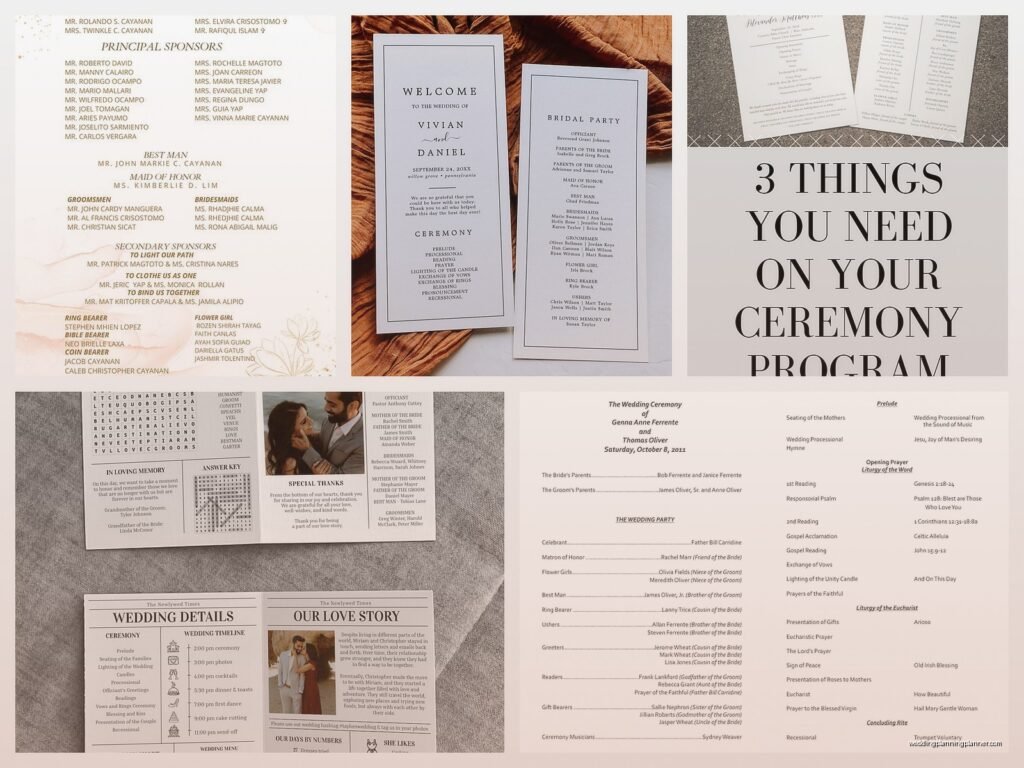
Ceremony Program Examples: Order of Service Samples
Mar
Okay So Ceremony Programs Actually Matter More Than You’d Think
The order of service is literally just the roadmap of your ceremony but people get SO confused about what to include and honestly I get it because every ceremony is different depending on whether you’re doing religious, secular, traditional, or like that mix of everything that most couples end up with.
So the basic structure you’re gonna see most often goes something like this: processional, welcome/opening remarks, readings, vows, ring exchange, pronouncement, kiss, recessional. That’s your skeleton. Everything else gets built around that depending on what traditions you’re incorporating or what you’re skipping entirely.
Traditional Religious Ceremony Programs
For a traditional Catholic ceremony (and I planned one in spring 2023 where the priest was VERY particular about the wording), your program needs to be way more detailed because there’s a lot happening. You’re looking at:
- Prelude music (list the actual songs if you want)
- Processional
- Opening prayer or greeting
- Scripture readings (usually two or three)
- Responsorial psalm
- Gospel reading
- Homily
- Exchange of vows
- Blessing and exchange of rings
- Unity candle or other symbolic gesture
- Nuptial blessing
- The Lord’s Prayer
- Sign of peace
- Final blessing
- Recessional
Jewish ceremonies are completely different and you gotta include things like the signing of the ketubah (which sometimes happens before the ceremony even starts), the bedeken if you’re doing that, circling, the seven blessings, breaking the glass. I always tell couples to work directly with their officiant on the exact order because different rabbis have different preferences and Reform vs. Orthodox vs. Conservative ceremonies can look really different from each other.
Non-Religious or Secular Ceremony Examples
This is where you have SO much flexibility and honestly where most of my couples end up these days. A basic secular ceremony program might look like:
- Seating of honored guests (parents, grandparents)
- Processional
- Welcome and opening words from officiant
- Reading or poem (maybe two)
- Personal story or reflection about the couple
- Declaration of intent (“do you take this person”)
- Vows (personal or traditional)
- Ring exchange with words
- Unity ceremony if you’re doing one (sand, candle, whatever)
- Pronouncement
- The kiss
- Presentation of the couple
- Recessional
The thing that annoys me SO MUCH is when couples put every single tiny detail in the program like “officiant walks to position” or “couple holds hands” like… your guests can see that happening, they don’t need a play-by-play of every movement. Keep it to the actual segments that matter.
What to Actually Write for Each Section
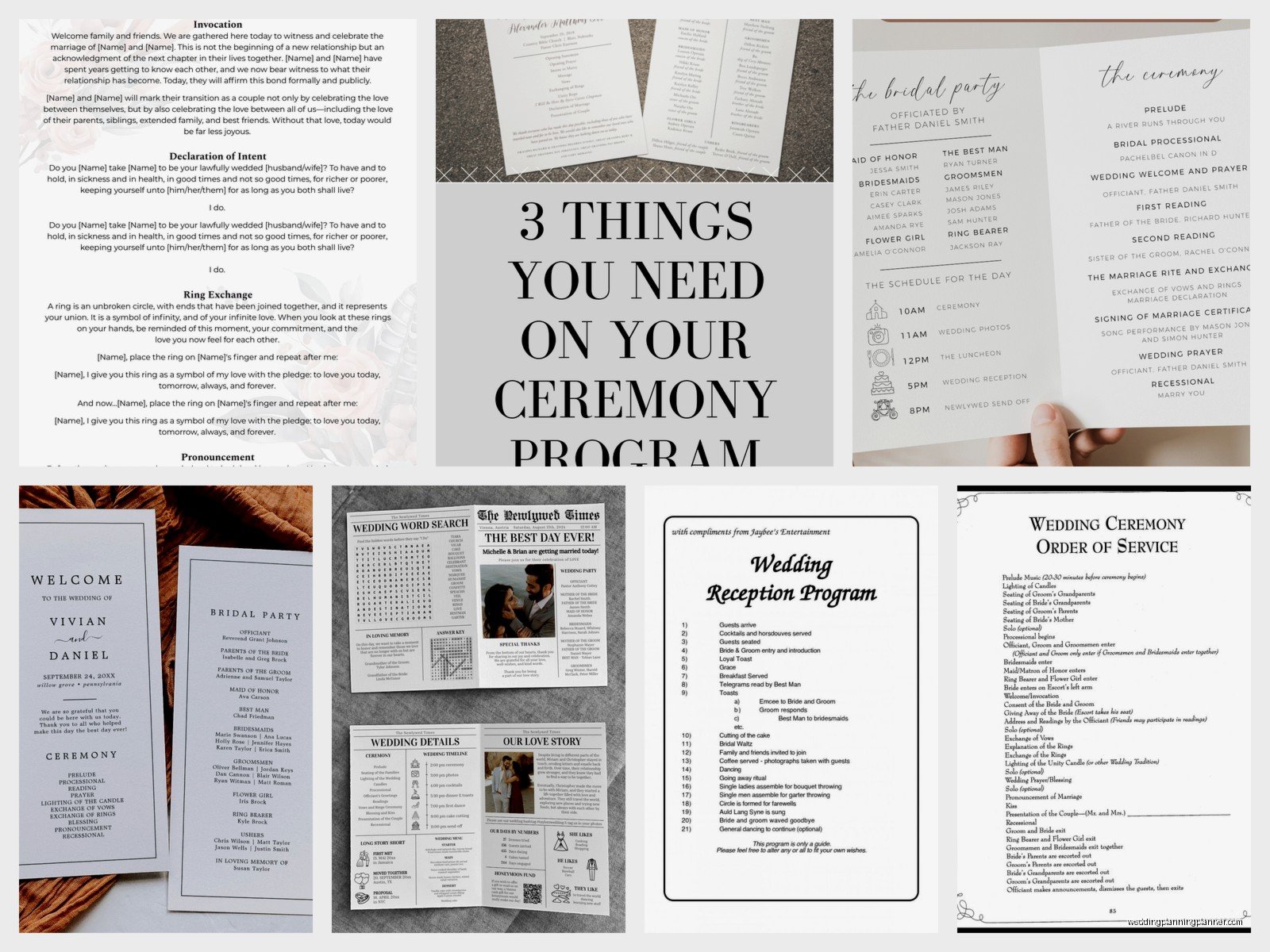
So you don’t just list “Vows” and call it a day. You wanna give a little context. Like instead of just “Reading,” you’d write something like:
Reading
“Union” by Robert Fulghum
Read by Sarah Mitchell, sister of the bride
Or for the vows section, if you’re writing your own, you might just put:
Exchange of Vows
Emma and Jordan share their personal promises
If you’re using traditional vows, you could include the actual text so guests can follow along, but that makes the program longer and honestly most people aren’t reading along word-for-word anyway, they’re watching you.
Special Cultural Elements and How to List Them
This is where programs get really helpful because if you’re incorporating traditions that not everyone will recognize, a little explanation goes a long way. Like for a Hindu ceremony, you might write:
Saptapadi (Seven Steps)
The couple takes seven steps together, each step representing a marital vow and blessing for their life together
Or for a handfasting in a Celtic ceremony:
Handfasting Ritual
The couple’s hands are bound together with ribbon, symbolizing their union. This is where the phrase “tying the knot” originates.
I had this couple in summer 2021 who did a Filipino wedding cord ceremony and literally nobody on the groom’s side knew what was happening, and they hadn’t put it in the program, so there was this confused murmuring during one of the most meaningful parts of their ceremony. Such an easy fix if they’d just included a one-sentence explanation.
Sample Interfaith Ceremony Order
Interfaith ceremonies are tricky because you’re blending traditions and sometimes they don’t naturally flow together, so the program becomes even more important. Here’s an example I used for a Jewish-Catholic couple:
- Processional
- Welcome by both officiant
- Opening prayer (non-denominational)
- Reading from the New Testament
- Reading from the Torah
- Reflection on marriage from both faith perspectives
- Exchange of vows
- Blessing and exchange of rings
- The Seven Blessings (Sheva Brachot)
- Unity candle
- Final blessing
- Breaking of the glass
- Pronouncement
- The kiss
- Recessional
You can see how we alternated between traditions rather than doing all the Catholic stuff then all the Jewish stuff, which would’ve felt really divided.
Short and Sweet Ceremony Programs
If you’re having a super short ceremony (like 15-20 minutes), your program can be really simple. Something like:
- Entrance of the wedding party
- Welcome and opening words
- Reading: “A Blessing for a Marriage” by James Dillet Freeman
- Personal vows
- Ring exchange
- Pronouncement and first kiss
- Recessional
Done. You don’t need to overcomplicate it just because you think a program should be longer or… wait, actually I’m gonna contradict myself here because sometimes a longer program is good even for a short ceremony if you’re including song titles and reader names and stuff.
Music Listings
You can include your music selections in the program or not, it’s totally up to you. Some couples love listing every song with the composer and performers, others just note “Prelude Music” without specifics. If you spent a ton of time choosing meaningful songs, might as well tell people what they’re listening to:
Processional
“Canon in D” by Johann Pachelbel
Performed by the String Quartet
Signing of the Register
“Marry You” by Bruno Mars
Performed by The Riverside Band
My cat literally just knocked over my water bottle onto my desk while I’m writing this, so if this suddenly gets weird, that’s why everything’s damp now.
Honoring Deceased Family Members
This comes up ALL the time and it’s kinda sensitive to figure out where to put it. Some couples include a small section in the program like:
In Loving Memory
We remember and honor those who are with us in spirit:
Robert Chen, grandfather of the groom
Margaret Sullivan, grandmother of the bride
Thomas Hart, uncle of the bride
You can put this on a separate page or at the bottom of the order of service. Some couples prefer to have a memorial table with photos instead and skip mentioning it in the program entirely.
Explaining Who’s Who
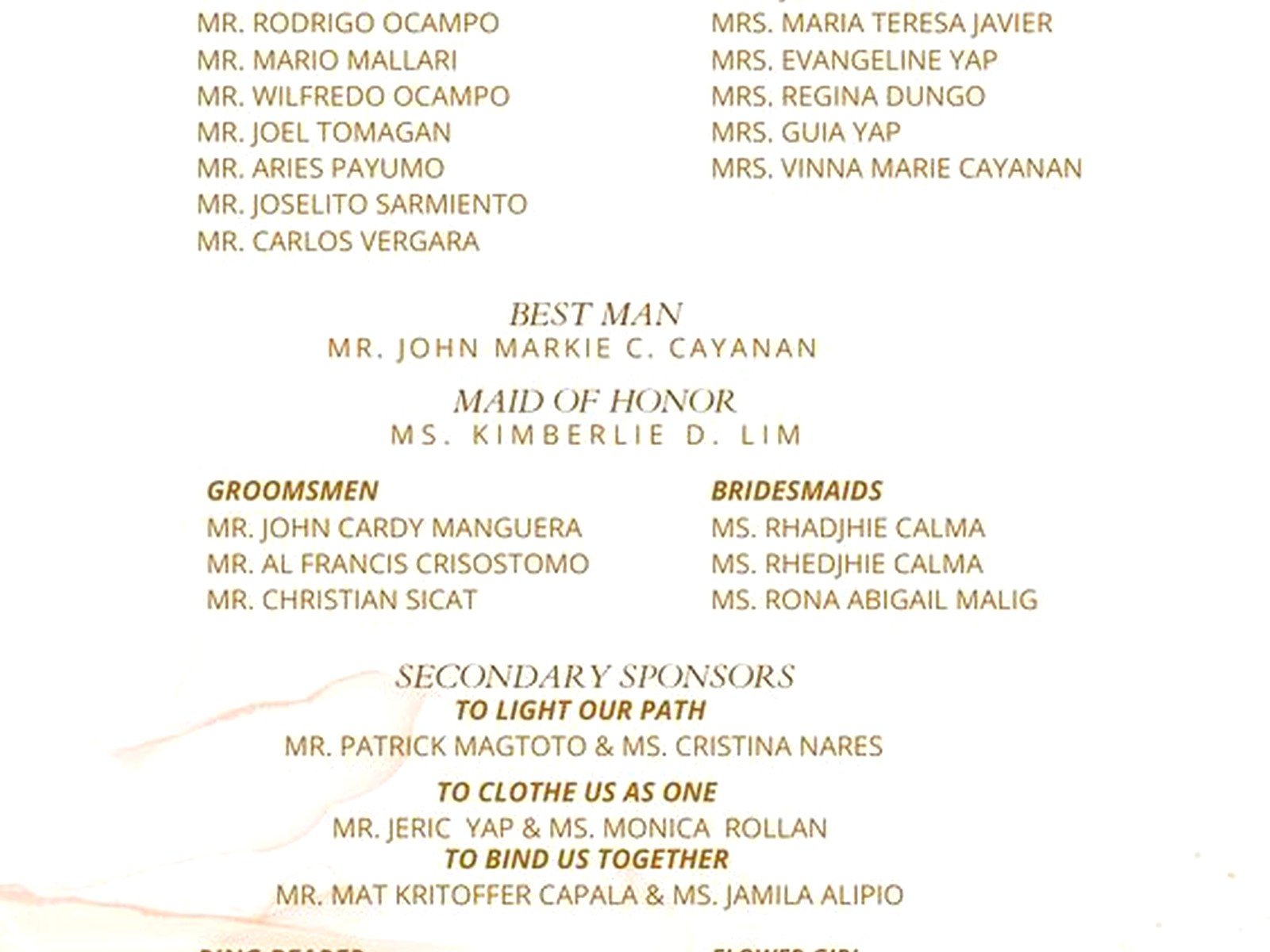
Your program is a great place to list your wedding party, especially if you have a big one and guests might not know everyone. You could do:
Wedding Party
Maid of Honor: Jessica Rodriguez, best friend since college
Best Man: Michael Torres, brother of the groom
Bridesmaids: Amanda Lee (cousin), Rachel Kim (college roommate), Sophie Zhang (coworker and dear friend)
Groomsmen: David Park (childhood friend), James Wilson (brother of the bride), Chris Martinez (grad school buddy)
This gives context and helps guests feel more connected to what’s happening. Plus it’s nice recognition for your wedding party.
Participation Elements
If you want guests to participate in any way during the ceremony, you gotta make that super clear in the program. Like if there’s a group blessing or a congregational response or everyone’s supposed to stand for certain parts:
Community Blessing
The officiant will ask all guests to stand and offer their support for this marriage. Please respond “We do” when asked.
Or if you’re having a rose ceremony where you’re giving flowers to your moms, explain that:
Rose Ceremony
The couple presents roses to their mothers as a symbol of gratitude and love for their families.
Formatting and Layout Tips
Okay so practically speaking, most programs are either a single flat card (like 5×7) or a folded booklet. For a simple ceremony, the flat card works fine. You put the order of service on one side, maybe wedding party names on the back.
For longer ceremonies (especially religious ones), you’ll need a folded program. The front has your names and wedding date, inside left has the order of service, inside right might have readings or song lyrics, back cover has thank yous or wedding party names.
Don’t use a font smaller than 11 point because hello, lots of guests need reading glasses and will be outside in sunlight. I’ve seen so many programs with like 8-point script font and it’s just mean to your guests.
What You Can Skip
Honestly, you don’t NEED a program at all. If your ceremony is short and straightforward, guests will figure it out. Programs are most helpful when:
- The ceremony is longer than 30 minutes
- You’re including cultural or religious traditions guests might not recognize
- There are multiple readings or musical selections you want to highlight
- You have a large wedding party and want to introduce everyone
- You’re having a religious service with responses or parts where guests participate
If none of that applies, you could totally skip it and save yourself the printing cost and the hassle of someone having to hand them all out.
Sample Destination Wedding Ceremony
For beach or destination weddings, programs often double as fans (genius idea honestly) and they’re usually more casual in tone:
- Gather at the beach (shoes optional!)
- Processional to “Somewhere Over the Rainbow” by IZ
- Welcome and opening thoughts
- Reading: “The Art of Marriage” by Wilferd Arlan Peterson, read by Maria Santos
- Personal vows
- Ring exchange and blessing
- Sand ceremony blending three colors representing our families and new life together
- Pronouncement
- First kiss as married partners
- Recessional to “Marry Me” by Train
- Head to the reception for tacos and dancing!
See how the tone there is more relaxed? That matches the vibe of a beach wedding.
Bilingual Programs
If you have guests who speak different languages, you can do a bilingual program with everything in both languages side by side. I’ve done English-Spanish, English-Mandarin, English-Korean… it takes up more space but it’s really inclusive and makes sure everyone can follow along. Usually you’d do English on the left page, the other language on the right page of a folded program.
Thank You Messages
Lots of couples include a thank you note in their program, usually on the back:
Thank you for celebrating with us today. Your presence means the world to us. We’re so grateful to our parents for their endless love and support, and to each of you for traveling to be here. We can’t wait to party with you!
Keep it short and genuine. You don’t need to thank every vendor and your third-grade teacher.
Random Practical Stuff Nobody Tells You
Order like 10-20 extra programs beyond your guest count because people will want keepsakes, some will get dropped in puddles or blown away if you’re outside, and you’ll want a few for your own memory box.
If your ceremony is outdoors, consider the weather. Programs can become projectiles in wind, and ink can smear in humidity. Maybe go with heavier cardstock.
You don’t have to match your program design exactly to your invitations but it should feel cohesive. Same color palette, similar vibe.
Assign someone specific to hand out programs—ushers, a wedding party member, a coordinator. Don’t just leave them in a pile and hope people take them because half your guests won’t notice them.
If you’re printing them yourself, do a test run at least a week before to make sure your printer doesn’t jam or run out of ink at the last minute. Trust me on this.