Planning Guides, Style Guide
Reception Cards for Wedding: Party Details Insert Cards
May
So You Need Reception Cards
Okay so reception cards are basically those little insert cards that tell your guests where the party’s actually happening if it’s not at the same place as your ceremony. Sometimes they’re called reception details cards or party cards or whatever your stationer decides to call them that day. The point is—they go in your invitation suite and give people the info they need to show up at the right venue at the right time.
I had this bride back in spring 2023 who got SO mad at me because she didn’t think she needed these cards. Her ceremony was at a church and reception at a country club like fifteen minutes away, and she was convinced everyone would just “figure it out” because she was gonna post it on her wedding website. And then like three weeks before the wedding she panicked because her older relatives kept calling asking where to go after the ceremony and she realized not everyone checks websites. We had to rush order the reception cards and honestly it was a whole thing that could’ve been avoided.
When You Actually Need Them
You definitely need reception cards if your ceremony and reception are at different locations. That’s the main one. But also consider them if:
- There’s a significant time gap between ceremony and reception (like more than an hour)
- The reception venue is tricky to find
- You’re having adults-only reception but all-ages ceremony
- The reception is the next day (like a brunch thing)
- You want to include extra details that don’t fit on the main invite
If your ceremony and reception are in the same place, you can usually just put “reception to follow” on the main invitation and call it a day. But if there’s ANY potential for confusion, just make the card. It’s not that expensive compared to fielding forty phone calls from confused aunts.
What Info Goes On These Things
Alright so the basic info you gotta include is pretty straightforward but I see people mess this up all the time. Here’s what needs to be on there:
The venue name and full address. Not just “The Riverside Pavilion” but the actual street address. I cannot stress this enough because GPS needs actual addresses and your venue might have the same name as like four other places in your state.
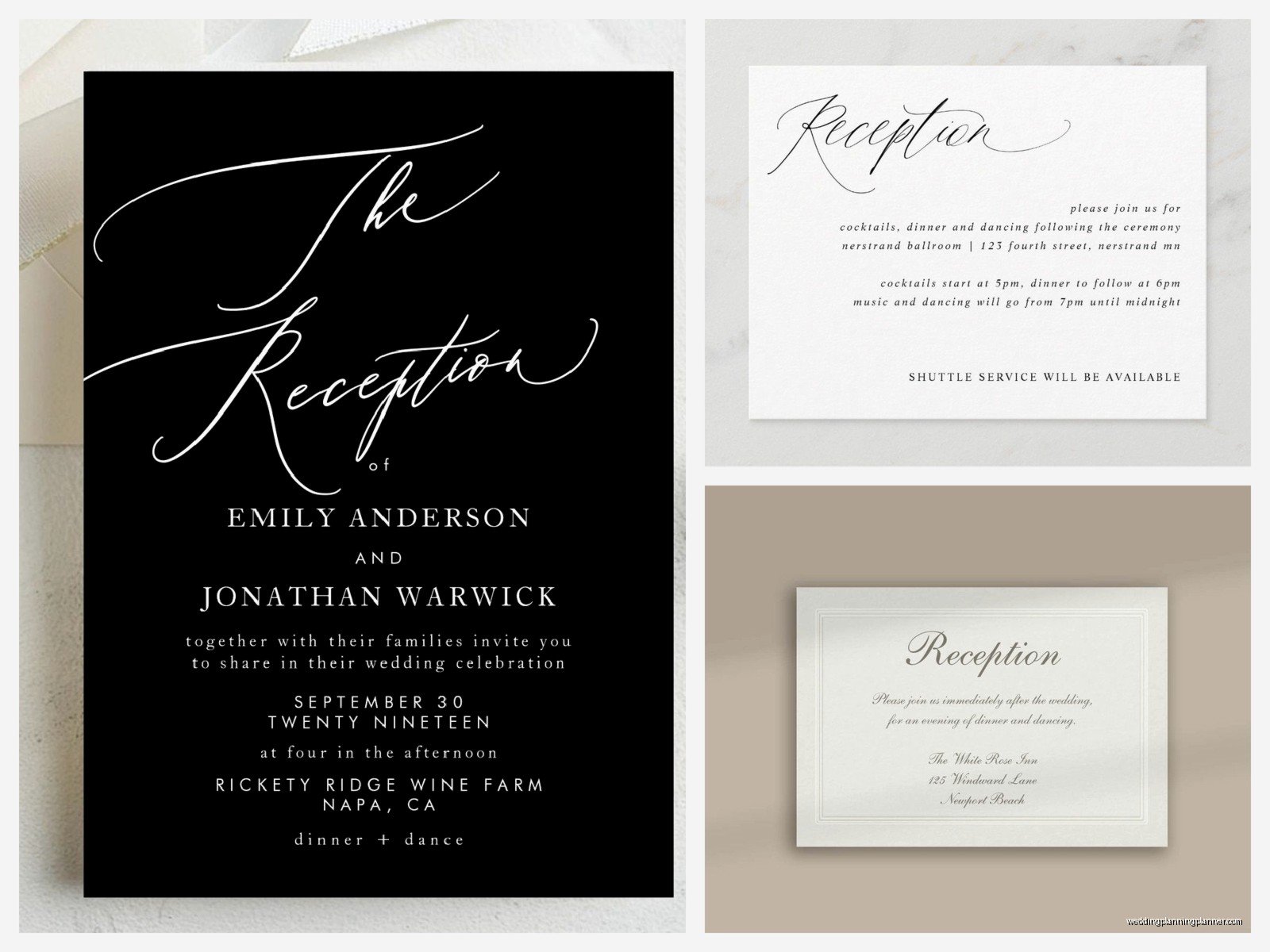
The time. If cocktail hour starts at 5:30 but dinner‘s not till 6:30, I usually put the earlier time so people don’t miss anything. Some planners disagree with me on this but whatever, I’d rather have guests arrive early than miss the cocktails they paid good money for.
Any dress code specifics. If you’re doing black tie optional or beach formal or whatever, this is where it goes. Although honestly you can put this on the main invite too, it’s kinda up to you.
Optional Details To Consider
You can also add things like parking instructions (super helpful for city venues), whether dinner will be served (so people know not to eat beforehand), if there’s a shuttle situation happening… basically anything that helps your guests know what to expect.
One thing that annoys me though is when couples try to cram their entire wedding day timeline onto this tiny card. Like I had a groom once who wanted to list: cocktail hour 5:30, grand entrance 6:15, first dance 6:25, dinner service 6:35, toasts 7:00, cake cutting 7:45, bouquet toss 8:30… it looked insane. Your guests don’t need a minute-by-minute itinerary, they just need to know where to be and roughly when.
Size and Format Stuff
Most reception cards are smaller than your main invitation. Common sizes are like 4×6 inches or 4.25×5.5 inches, but honestly it depends on your envelope size and what else you’re tucking in there. I usually recommend keeping them small enough that everything fits in one envelope without getting too bulky.
The card stock should match your invitation suite—same color, same weight, same finish. Some couples do a contrasting color but then it needs to coordinate with your overall palette. I worked with this couple who had blush invitations and decided to do navy reception cards and it looked… well it looked like they ordered from two different places, which they actually did, and it was obvious.
You can do single-sided or double-sided depending on how much info you need to convey. Single-sided is cleaner looking but if you’ve got parking instructions AND a dress code AND timing details, you might need both sides.
Wording Examples Because Everyone Asks
The wording can be formal or casual depending on your vibe. Here’s some options:
Traditional formal:
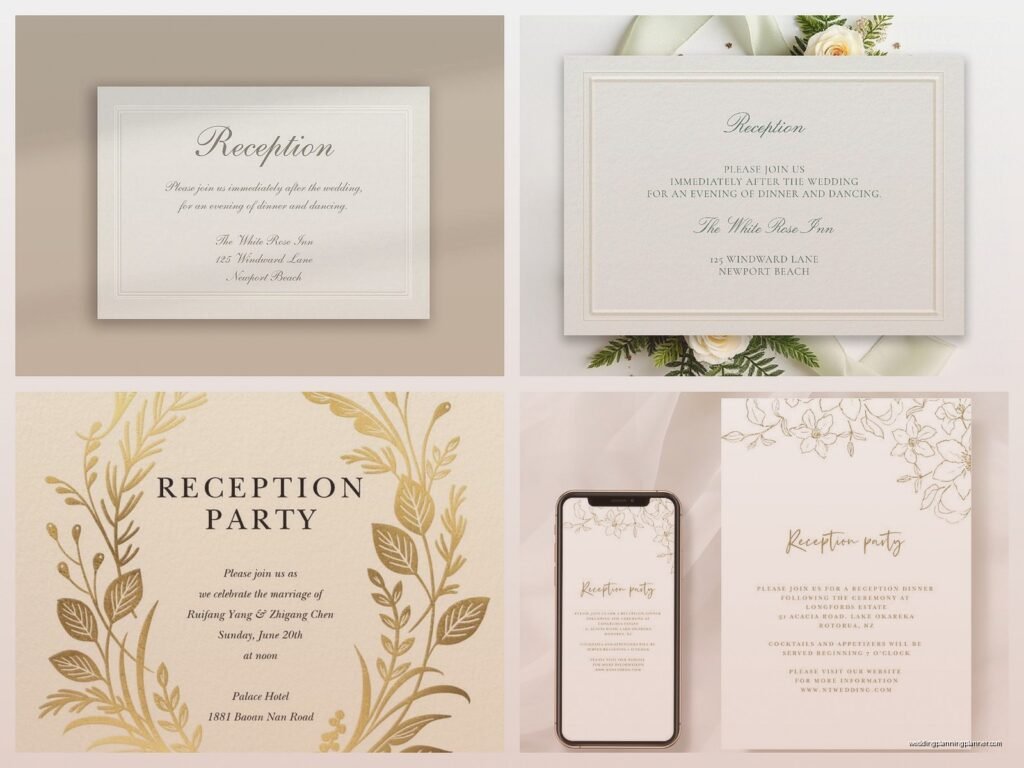
Reception immediately following
The Grand Estate
123 Celebration Lane
Anytown, State 12345
Dinner and dancing to follow
More casual:
Join us for cocktails, dinner, and dancing
The Lakeview Pavilion
456 Waterfront Drive
Anytown, State 12345
6:00 in the evening
If there’s a time gap:
Please join us for an evening reception at seven o’clock
[venue name and address]
You don’t have to reinvent the wheel here. Keep it simple and clear. I see people trying to be super creative with the wording and then their guests literally don’t understand what’s being communicated, which defeats the entire purpose of the card.
Design Considerations That Actually Matter
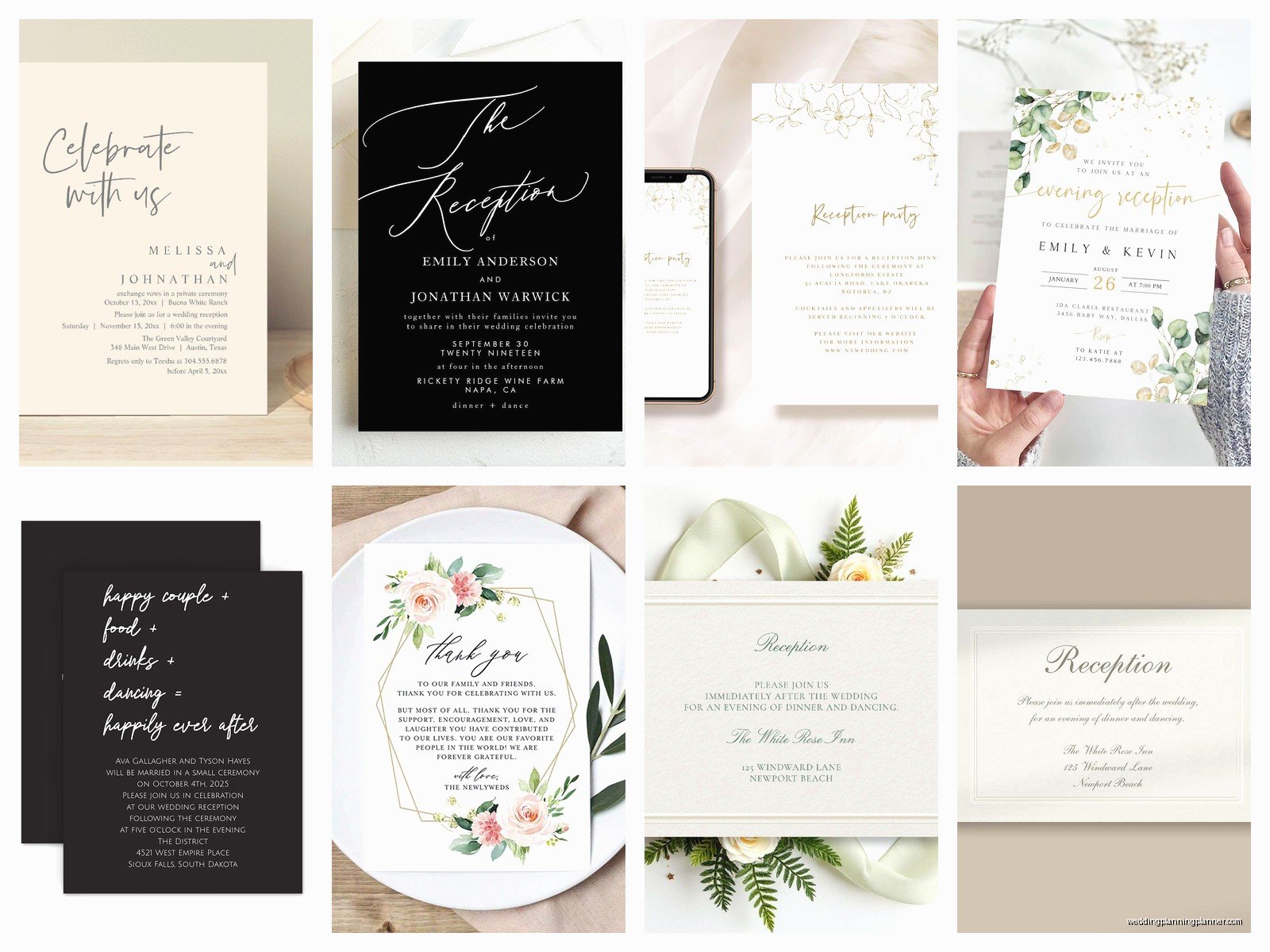
The reception card should obviously match your invitation suite but it doesn’t have to be identical. You can do a complementary design—like if your main invite has this elaborate floral border, your reception card might just have a small floral accent in the corner. Or if you’re doing letterpress invitations, maybe the reception card is flat printed to save money but uses the same fonts and colors.
Font size is important and people forget this. If you’re inviting older guests (which you probably are), don’t go smaller than 10-point font. I know it’s tempting to shrink everything down to fit more info but then nobody can read it and they’re calling you anyway so what was the point.
Leave some white space. Cramming every inch of the card with text makes it hard to read and looks kinda desperate? Not sure how else to describe it but you know what I mean.
Printing Methods
You’ve got options here depending on budget. Digital printing is the most affordable and totally fine for most weddings. Letterpress is gorgeous but expensive—probably only worth it if you’re doing letterpress for your whole suite. Foil stamping can add a nice touch without being as pricey as letterpress. Thermography gives you that raised print effect for less money than engraving.
My cat just knocked over my coffee while I’m writing this and honestly I’m more annoyed than I should be but anyway… where was I.
Practical Ordering Tips
Order the same quantity as your invitations, duh. But actually order like 25 extra because you WILL mess some up while assembling or you’ll have last-minute additions or whatever. They’re cheap compared to having to do a whole second order.
Timeline-wise, you want these at the same time as your invitations so everything goes out together. If you’re ordering from different vendors for some reason (not recommended but sometimes it happens), make sure the timing lines up. Give yourself at least 8-12 weeks before your mail date for printing, especially if you’re doing letterpress or engraving.
Check your proofs carefully. I had a couple once who approved their reception cards without noticing the venue address was wrong. We caught it before printing thank god, but it was close. Read everything three times, have someone else read it, then read it again.
Assembly and Mailing
The reception card usually goes on top of the invitation when you’re stacking everything, or sometimes behind it—honestly there’s like seventeen different “correct” ways to assemble invitation suites and they’re all fine. What matters is that everything fits in the envelope and nothing gets bent or damaged.
If you’re using an inner envelope (kinda old-fashioned but some people still do it), all your inserts including the reception card go inside that. If you’re just using one envelope, stack everything neatly with the invitation on the bottom, facing up, and layer your other cards on top.
Weight matters for postage. Once you add your invitation plus reception card plus RSVP card plus whatever else, you might need extra postage. Take a fully assembled invite to the post office and have them weigh it before you buy stamps. Nothing worse than having invites returned for insufficient postage.
Digital Alternatives
Some couples skip the physical reception card and just put everything on their wedding website. This works if your crowd is tech-savvy and you’re okay with a less formal approach. You’d still want to mention the website on something in your invitation suite—maybe the details card or on the back of the invitation itself.
Personally I think if you’re already doing printed invitations, you might as well include the reception card. It’s not that much more expensive and it’s just… easier for everyone. But I get that some couples are trying to minimize paper waste or whatever, and that’s valid too.
Common Mistakes I See All The Time
Not including the full address is probably number one. “The Smith Estate” tells me nothing if I don’t already know where that is.
Forgetting to mention if it’s adults-only. If kids aren’t invited to the reception but they are to the ceremony, you gotta make that clear somehow or you’ll have confused parents showing up with toddlers.
Making the card too busy. You have like 20 square inches of space, you don’t need to include your love story and a map and three different fonts and a poem.
Waiting too long to order them. If you’re mailing invites 8 weeks before the wedding, you need to have ordered your reception cards like 10-12 weeks before that mail date.
Special Situations
If you’re having a destination wedding, your reception card might need more info than usual—like resort name, area of the resort, what’s included, etc. Sometimes couples do a whole separate details card for destination weddings that covers lodging and reception and activities all together.
For multi-day weddings, you might have separate cards for each event or one card that lists everything. I usually recommend separate cards if the events are at different venues, combined if they’re all in one place.
If your reception is significantly later (like next-day brunch), you definitely need a separate card because people need to know they’re not just showing up right after the ceremony expecting food.
Budget Reality Check
Reception cards usually run like $1-3 per card for digital printing, more if you’re doing fancy printing methods. So for 100 invitations you’re looking at $100-300ish, which in the scheme of wedding costs is pretty minimal. I know every dollar counts but this is not the place to cut corners because confused guests will cost you way more in stress than the cards cost in money.
You can save money by keeping the design simple, using standard sizes, and going with digital printing. You don’t need foil stamping and letterpress and hand-torn edges to communicate where your reception is.
Some online printers offer package deals where if you order invitations plus reception cards plus RSVP cards together you get a discount. Worth looking into if you’re price shopping.