Planning Guides, Style Guide
Wedding Card Sample: Invitation Design Examples
Apr
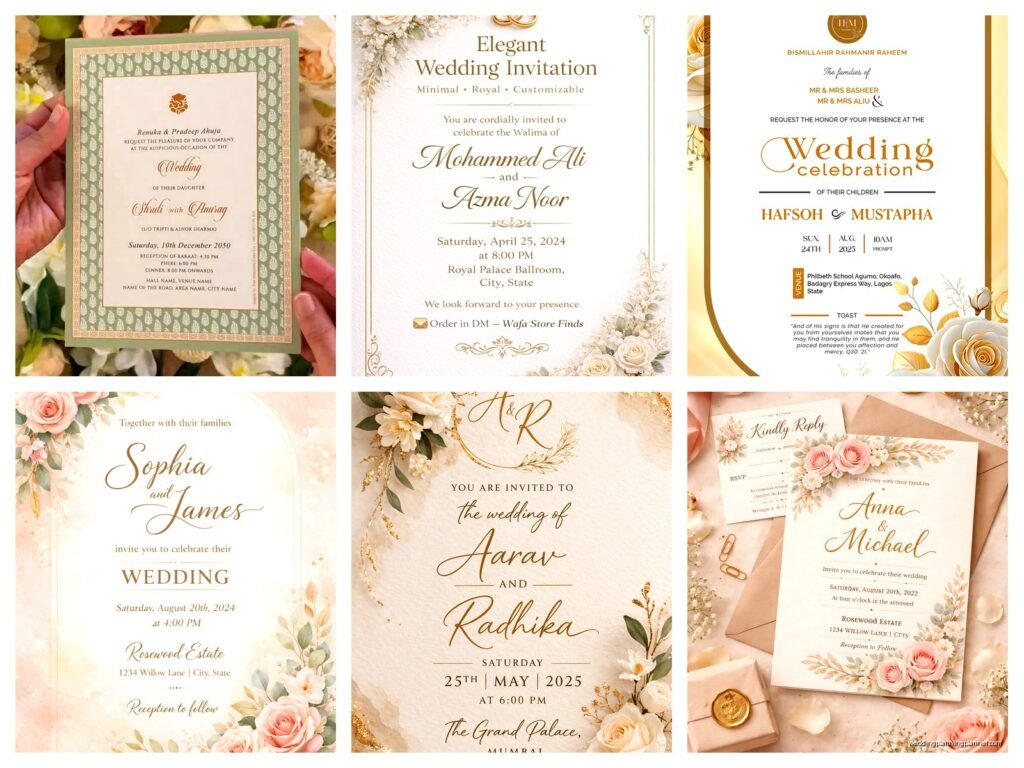
Wedding Invitation Design Examples That Actually Work
Okay so you’re probably staring at a blank screen or some template wondering how to make your wedding invitations not look like everyone else’s right? I get asked about this literally every week and honestly the invitation is the first impression your guests get of your wedding vibe so let’s talk about what actually works.
First thing – and this is gonna sound basic but I promise it matters – you need to figure out your wedding’s personality before you even think about fonts or colors. Are you doing a black tie ballroom thing? A backyard BBQ? Beach casual? Because your invitation needs to match that energy or your guests will show up confused. I had this couple back in spring 2023 who sent out these super formal engraved invitations with gold foil and then their wedding was literally at a brewery with food trucks and I watched guest after guest walk in wearing floor length gowns looking completely out of place.
The Basic Components You Gotta Include
Every wedding invitation needs certain information and you’d be surprised how many people forget stuff. Here’s what needs to be on there:
- The hosts’ names (traditionally whoever’s paying but nowadays it’s flexible)
- The request line (like “request the pleasure of your company” or “invite you to celebrate”)
- The couple’s names – and yes it matters whose name goes first depending on formality
- Date and time spelled out for formal invites
- Venue name and city/state
- Reception details if it’s at a different location
- Dress code if you have one
The RSVP card goes in a separate envelope with your invitation but we’ll get to that.
Design Style Examples That I Actually Recommend
So here’s where it gets fun. I’m gonna walk you through some real design approaches that work and some samples I’ve seen succeed.
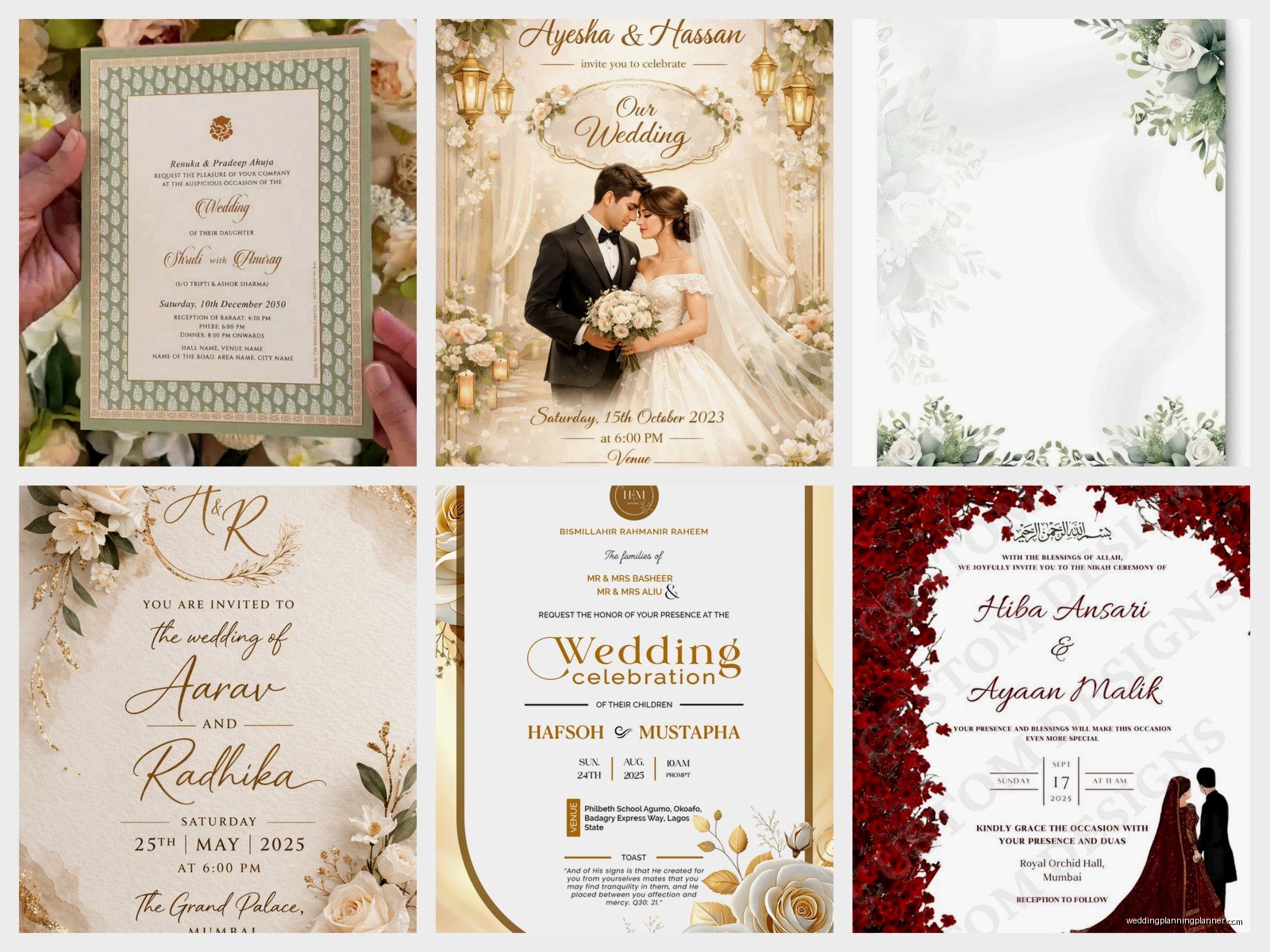
Classic Formal – This is your traditional engraved or letterpress invitation on heavy cardstock. Usually cream or white with black ink, maybe some gold or silver foil. The wording is super traditional like “Mr. and Mrs. Jonathan Hart request the honour of your presence at the marriage of their daughter.” Notice that’s “honour” with a U because formal invitations are fancy like that. The fonts are usually serif, elegant, nothing trendy. This style works for church weddings, hotel ballrooms, country clubs. It tells your guests to dress up and expect a traditional ceremony.
Modern Minimalist – Clean lines, lots of white space, simple sans-serif fonts. Maybe one pop of color or a geometric element. The wording is more casual like “Sarah and James invite you to their wedding.” I’m seeing this a lot with art gallery weddings or modern loft spaces. What I love about this style is it photographs really well for those flat lay shots everyone wants now.
Rustic/Botanical – Okay this one kinda exploded around 2019 and hasn’t really stopped. Lots of greenery illustrations, kraft paper, maybe some twine or vellum overlays. Fonts mixing script with sans-serif. The wording is casual to semi-formal. Works great for barn weddings, outdoor venues, winery celebrations. Just please don’t go overboard with the burlap… I’ve seen things.
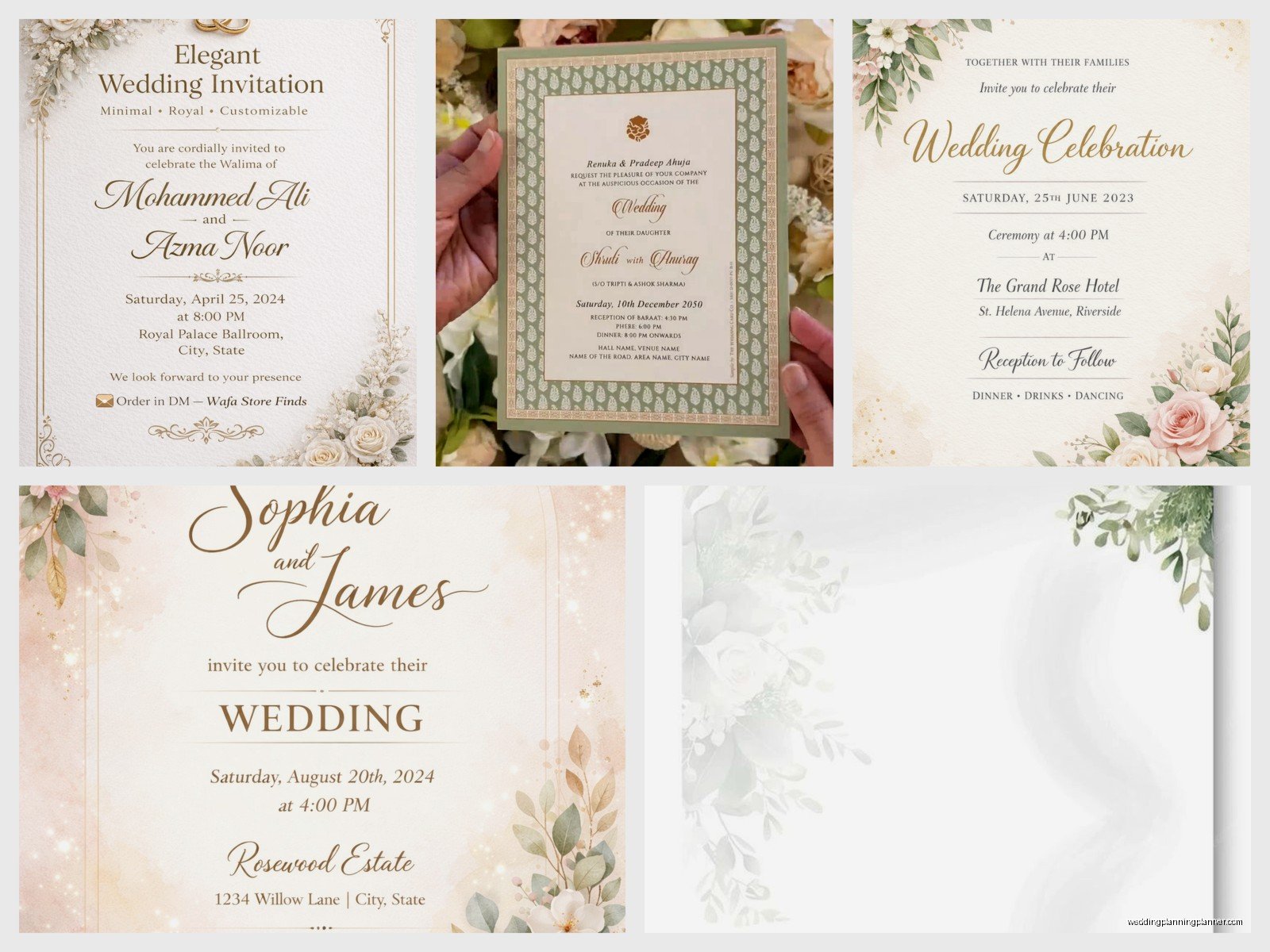
Destination/Travel Theme – If you’re getting married somewhere special, lean into it. I did invitations for a couple getting married in Italy and we designed them to look like vintage travel posters with illustrated landmarks. Another couple doing a beach wedding in Mexico used watercolor designs with tropical flowers and the invitation actually looked like a boarding pass which was really cute.
Color Choices and What They’re Saying
Colors matter more than you think. Navy and gold reads classic and sophisticated. Blush and sage green screams romantic garden wedding. Bold jewel tones like emerald or burgundy say dramatic formal event. All white or cream with black text is timeless and elegant but can also read kinda boring if you don’t add texture or interesting paper.
One thing that really annoys me is when couples pick colors that are impossible to read. Like light gray text on white paper? Nah. Your 70-year-old grandmother needs to be able to read this without a magnifying glass. I had a bride insist on pale yellow ink on ivory paper back in summer 2021 and we literally had three guests call asking what the invitation said because they couldn’t read it.
Actual Wording Examples
Let me give you some real samples because the wording trips people up constantly.
Traditional Formal (parents hosting):
Mr. and Mrs. Robert Mitchell
request the honour of your presence
at the marriage of their daughter
Elizabeth Anne
to
Mr. Christopher James Wong
Saturday, the twenty-first of June
two thousand twenty-five
at half after five o’clock
St. Mary’s Cathedral
Boston, Massachusetts
Modern Casual (couple hosting):
Emma Rodriguez & Tyler Chen
invite you to celebrate their wedding
Saturday, June 21, 2025
5:30 PM
The Glass House
Seattle, Washington
Dinner and dancing to follow
Both Families Hosting:
Together with their families
Maya Patel and Jordan Williams
request the pleasure of your company
at their wedding celebration
[date, time, location details]
See how the tone shifts? The formal one has everything spelled out and uses “honour” and “request the honour of your presence” while the casual one uses numbers and “invite you to celebrate.”
Size and Format Options
Standard invitation size is 5×7 inches but you can do whatever works for your design. I’ve seen 4×6 postcards for casual weddings, tall and skinny 4×9 invitations, square 6×6 which looks modern but costs more to mail FYI. Folded invitations are another option – like a greeting card style.
If you’re doing a really formal wedding you might have a whole suite: the main invitation, a reception card, accommodations card, directions card, RSVP card with envelope, maybe a weekend events card if you’re doing multiple events. All of this goes in an inner envelope which goes in an outer envelope and honestly it’s a whole thing.
For casual weddings you can simplify – just the invitation and an RSVP card or even just direct people to your wedding website for RSVPs.
Paper and Printing Methods
The paper quality makes such a difference and most people don’t realize this until they’re holding samples. Standard cardstock is fine but if you want to elevate it, look at:
- Cotton paper – feels substantial and luxurious
- Textured linen or felt paper
- Smooth matte cardstock
- Shimmer or metallic cardstock (but not too sparkly please)
Printing methods range from digital (most affordable) to letterpress (expensive but gorgeous with that pressed-in texture) to foil stamping (shiny metallic elements) to engraving (traditional and pricey). Digital printing has gotten really good though so don’t feel like you need to spend thousands unless you want to.
Envelope Addressing Tips
This is where people stress out but it’s really not that complicated. For formal invitations you write out everything – “Mr. and Mrs. Jonathan Hart” with no abbreviations, full state names, no apartment numbers abbreviated. For casual you can be more relaxed.
Inner envelopes (if you’re using them) just have the names without addresses. This is where you indicate who’s invited – if you write “Mr. and Mrs. Hart” that means just them, if you write “The Hart Family” that includes kids.
I always tell couples to hire a calligrapher if they’re doing formal invitations because your handwriting probably isn’t as good as you think it is… or use digital calligraphy printing which looks similar. My cat knocked over an entire stack of addressed envelopes once and I almost cried so maybe keep pets away from your invitation assembly station.
RSVP Card Design
Your RSVP card should match your invitation style obviously. Include a deadline that’s about 3-4 weeks before the wedding. You need:
- A line for guests to write their names
- Accept/decline checkboxes or fill-in-the-blank
- Meal choice options if you’re doing a plated dinner
- A pre-addressed and stamped return envelope
Some people do online RSVPs only now which saves money on printing and postage but older guests sometimes struggle with that so maybe have both options or…
Common Mistakes I See All The Time
Don’t use fonts that are hard to read just because they’re pretty. Script fonts are great for names but not for addresses or details.
Don’t forget to include the year – you’d be surprised how many invitations I’ve seen that just say “Saturday, June 21st” like okay but which year?
Don’t assume people know where your venue is. Include the city and state even if you think it’s obvious.
Don’t mail invitations without weighing them first. All those extra cards and ribbons and vellum layers? They add weight and might need extra postage. Take one fully assembled invitation to the post office and have them weigh it.
Don’t send invitations too early or too late. 8 weeks before for local weddings, 12 weeks for destination weddings is the sweet spot.
Budget-Friendly Design Ideas
Look you don’t need to spend $2000 on invitations unless you want to. Digital printing from online companies is totally fine and can look really nice. You can order from places like Minted or Zola and get good quality for reasonable prices.
Postcards instead of traditional invitations with envelopes saves on printing and postage. Just make sure you’re okay with your info being visible to mail carriers.
Skip the extras – you don’t need belly bands and wax seals and ribbon unless that’s your thing. A simple well-designed invitation on nice paper is better than a cluttered one with all the bells and whistles.
DIY is an option if you’re crafty but be realistic about your time and skills. I watched a bride have a complete meltdown trying to assemble 150 invitations with layered paper and ribbon the week before her wedding and it was not cute.
Suite Assembly Order
If you’re doing a full suite with multiple cards, here’s how they stack (from bottom to top): invitation on bottom, then reception card, then any other enclosure cards, RSVP card and envelope on top facing up. This all goes in the inner envelope if you’re using one, which goes in the outer envelope with the handwritten side of the inner envelope facing out.
For casual invitations just stack them neatly – invitation, then other cards, then RSVP with envelope.
The whole process of stuffing and addressing envelopes is actually kinda meditative once you get in a rhythm. Put on a good show – I rewatched the entire series of The Office while doing invitation assembly for a big wedding once – and just work through them systematically.
Digital vs. Paper Invitations
Okay so some people are going fully digital with email invitations or digital designs they text or message. This works for super casual weddings or if your crowd is young and tech-savvy. It’s obviously the most budget-friendly and eco-friendly option.
But honestly? Most guests still expect a physical invitation for a wedding. It feels more special and it’s something they can put on their fridge as a reminder. I’d say save the digital invites for your engagement party or bridal shower but send real invitations for the actual wedding unless you have a specific reason not to.