
Planning Guides, Style Guide
Marriage Invitation Design: Design & Ordering Guide
Apr
Okay so you need to design wedding invitations and honestly it’s not as scary as people make it seem
The biggest mistake I see is people ordering invitations like six weeks before their wedding and then having a complete meltdown when they realize printing takes time. I had this happen with a bride in spring 2023 who waited until April to order invites for a June wedding and she called me literally crying because the printer said 3-4 weeks turnaround. Like we barely made it work but my blood pressure was through the roof.
Timeline stuff you gotta know upfront
Order your invitations AT LEAST 4 months before your wedding date. Preferably 5-6 months out. Here’s why that math actually matters—you need about 2-3 weeks for printing (sometimes longer if you’re doing fancy techniques), then you need time to assemble them if there are multiple pieces, address all the envelopes, and mail them 6-8 weeks before the wedding. So yeah it adds up fast.
I always tell couples to start the design process even earlier, like 7-8 months out, because going back and forth on design revisions eats up time you don’t think about.
The actual design part where people get stuck
You need to figure out your vibe first. I know that sounds vague but are you doing formal black tie, casual backyard, rustic barn, modern minimalist, whatever. Your invitation is literally the first impression guests get of your wedding so if you’re having a relaxed beach wedding, don’t send out super formal engraved invitations with traditional wording because people will show up confused.
Colors should match your wedding colors obviously but don’t go overboard. I’d stick to max 3 colors on the invitation itself. One bride I worked with wanted to incorporate all seven of her wedding colors onto one 5×7 card and it looked like a kindergarten art project, I’m sorry but it did.
What information actually needs to be on there
This is where people either include too much or forget important stuff. Here’s what you need:
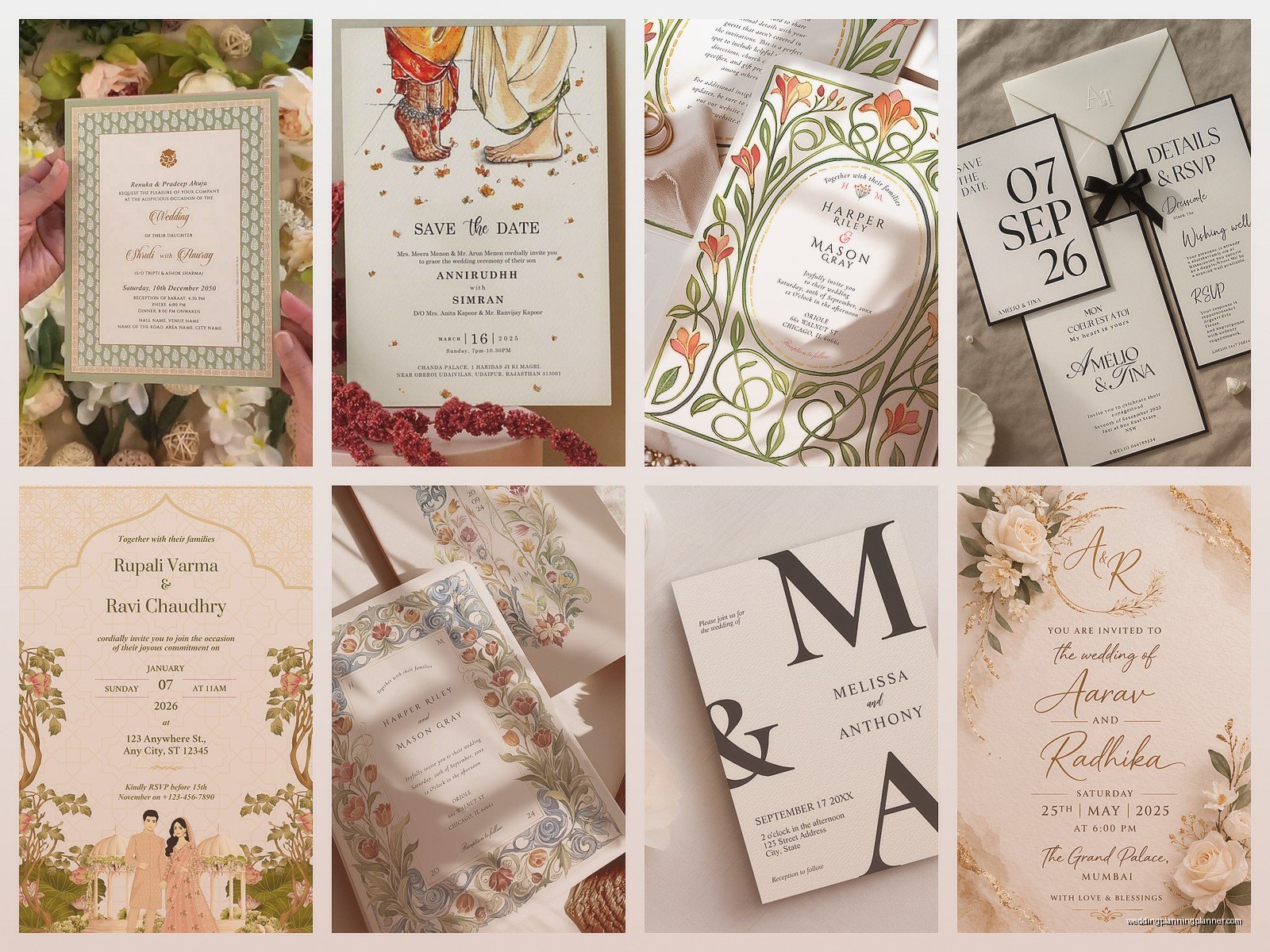
- Host line (who’s hosting—traditionally the bride’s parents but honestly nowadays it’s often the couple or both sets of parents or nobody specific)
- Request line (like “request the pleasure of your company” or “invite you to celebrate”)
- The couple’s names
- Date and time spelled out fully for formal invites
- Venue name and city/state
- Reception details if it’s at a different location or separate card
- Dress code if it’s not obvious
You don’t need to put registry information on the actual invitation, that’s what your wedding website is for. One thing that really annoys me is when couples try to cram their entire wedding website URL in huge letters on the invitation—just put it small at the bottom or on a separate details card, nobody’s gonna forget to google you.
Fonts oh my god the fonts
Please don’t use more than 3 different fonts. Ideally use 2. You want one script or decorative font for names or headers, and one clean readable font for all the details. I’ve seen invitations with like 5 different fonts and it looks like a ransom note.
Make sure your fonts are actually readable. That super swirly calligraphy font might look gorgeous but if your 70-year-old aunt can’t read the venue address, what’s the point. Print a test at actual size and show it to someone who will be honest with you.
Paper weights and printing methods because this stuff matters more than you think
Cardstock weight is measured in pounds or GSM. For invitations you want at least 80lb cover weight (around 220 GSM) or it’s gonna feel flimsy and cheap. I usually recommend 100-110lb cover weight. It feels substantial when people hold it.
Printing methods from cheapest to most expensive:
Digital printing is totally fine for most weddings, looks good, affordable, quick turnaround. It’s basically high-quality printing like from a nice color printer but professional. The colors are vibrant and you can do full color designs.
Thermography gives you raised lettering that feels fancy when you run your finger over it. It’s that classic wedding invitation feel without the cost of engraving. Takes a bit longer than digital.
Letterpress is having a huge moment right now and it’s gorgeous—the text is pressed into thick cotton paper so you get this beautiful debossed effect. But it’s expensive and takes longer. Usually starts around $800-1000 for 100 invitations depending on complexity.
Engraving is the most traditional and most expensive. The text is carved into a copper plate and then printed. You get thin raised lettering that’s super elegant. We’re talking $1500+ for 100 invitations usually.
Foil stamping is another option where metallic or colored foil is pressed onto the paper. Looks amazing but also pricey.
How many invitations do you actually need
This trips people up constantly. You don’t need one invitation per guest—you need one per household or couple. So if you’re inviting 150 people but that includes couples and families, you probably need like 75-90 invitations. Make a spreadsheet I’m serious.
Order about 15-20 extra invitations beyond what you think you need. You’ll mess up addressing some envelopes, you’ll want to keep some for your scrapbook or parents, plus last-minute additions always happen.
Suite components and what you actually need
A full invitation suite can include a bunch of pieces but you don’t need all of them. Here’s what exists:
- Main invitation card (required obviously)
- RSVP card with envelope (pretty much required unless you’re doing online RSVPs only)
- Reception card if ceremony and reception are different locations
- Details card with hotel info, website, transportation, etc
- Weekend events card if you have welcome party, brunch, whatever
- Accommodations card
- Directions card (kinda outdated now that everyone has GPS but some people still do it)
- Inner envelope (traditional but not necessary)
- Belly band, vellum wrap, wax seal, or ribbon to hold it together
Honestly for most weddings you need the main invite, an RSVP card, and maybe one details card. Everything else can go on your website. I had a couple once who insisted on having seven different cards in their suite and the postage alone was like $3 per invitation because it was so thick.
The RSVP situation
If you’re doing physical RSVP cards, include a pre-addressed and pre-stamped envelope. Don’t make your guests hunt down a stamp, they just won’t send it back. Put a deadline on the RSVP that’s about 3-4 weeks before your wedding date.
Number the back of each RSVP card in tiny pencil with a number that corresponds to your guest list spreadsheet, because I promise you someone will send back an RSVP with illegible handwriting and you won’t know who it’s from. This is a pro tip that’s saved my life multiple times.
Online RSVPs through your wedding website are totally acceptable now and honestly easier to track. You can do both options—let people RSVP by card or online.
Addressing envelopes without losing your mind
You have options here. Hand calligraphy looks beautiful but costs $3-5+ per envelope. Printed addresses are way cheaper and honestly look fine, you can get nice fonts. Or you can address them yourself if you have decent handwriting and a lot of patience and wine.
Use guest addressing etiquette: outer envelope is formal with full names and titles, inner envelope (if using one) is less formal. Like “Mr. and Mrs. John Smith” on outer, “John and Sarah” on inner. But honestly etiquette is more relaxed now so… my cat just knocked over my coffee cup and I’m realizing I should probably take a break but anyway where was I.
Oh right, get addresses from people WAY in advance because chasing down addresses a month before your wedding is genuinely terrible. Send out an email or online form asking for mailing addresses like 6 months before.
Where to actually order these things
You’ve got a bunch of options depending on budget and style. Minted and Paperless Post are popular online options with lots of designs, they’re mid-range pricing and pretty reliable. Shutterfly and Zazzle are more budget-friendly. Etsy has tons of independent designers who can do semi-custom or fully custom work.
Local print shops and stationery stores can do custom design work and you get to work with someone in person which some people prefer. This is usually more expensive but you get more hand-holding through the process.
High-end stationery designers will do fully custom work starting from scratch. You’re looking at $2000+ usually for this level but if you want something totally unique and have the budget, it’s worth it.
Order samples before committing to a full order. Most places let you order a sample for like $5-10 so you can see paper quality and colors in person. Colors on your screen don’t always match printed colors exactly.
Postage and mailing logistics
Take a fully assembled invitation to the post office and have them weigh it before you buy stamps. If it’s over 1 ounce or is square-shaped or has a wax seal or is lumpy from embellishments, you’ll need extra postage. Square envelopes cost more to mail for some reason that I’m sure made sense to someone at USPS.
You can get custom wedding stamps or vintage stamps which is a nice touch. Hand-canceling means the post office manually stamps them instead of running them through machines, which prevents damage. You have to specifically request this at the post office and not all locations will do it, which is annoying.
Mail invitations on the same day if possible so they all arrive around the same time. Don’t mail them on a Friday afternoon because they’ll sit there all weekend.
Common mistakes I see constantly
Ordering invitations before you’ve finalized your venue or date—seems obvious but it happens. Forgetting to include the year on the invitation which sounds dumb but I’ve seen it multiple times. Not proofreading carefully enough and then having 100 invitations with a typo, which is gonna happen to some poor couple reading this probably.
Choosing a dark envelope with white or light-colored ink for addressing—it’s hard to read and scanners at the post office sometimes can’t read it. Not including an RSVP deadline. Putting too much information on the invite and making it cluttered.
Also people wait until the last minute to assemble everything and then realize they need to stuff 150 envelopes while also doing everything else wedding-related and it becomes this whole stressful thing when it didn’t need to be.
Budget real talk
Invitations can range from like $200 to $5000+ depending on what you’re doing. A reasonable mid-range budget is around $500-800 for 100 invitations with basic suite components and digital printing. If you’re doing letterpress or foil or lots of layers and custom design, expect $1000-2000+.
You can save money by doing online RSVPs instead of printed cards, skipping inner envelopes, keeping the design simple with fewer colors, printing digitally instead of fancy methods, ordering from online retailers instead of custom designers, and assembling everything yourself.
Don’t cheap out so much that your invitations look bad though, because they really do set the tone. I’d rather see someone do a simple elegant design printed nicely than a complicated design printed cheaply.
DIY considerations if you’re thinking about it
You can DIY invitations but be realistic about your time and skills. Designing them yourself using Canva or similar is totally doable if you have some design sense. Then you can upload to a printing service. This saves money on design fees but you’re doing all the work.
Fully DIY printing at home usually doesn’t look as professional unless you have a really good printer and paper. The cutting is also annoying if you’re doing it yourself—getting clean straight cuts on 100+ cards is tedious.
Semi-DIY where you order printed invitations but assemble and address them yourself is pretty common and saves money. Just block out time to actually do it, don’t leave it until the week before.
If you’re crafty and have time, adding your own belly bands or wax seals or ribbon to simple printed invitations can make them look more custom without the full cost of having someone else do it. I’ve seen this work really well actually, just make sure you’re not gonna hate your life after sealing 100 envelopes with wax which takes forever and you will burn yourself at least once, trust me on this from personal experience that I don’t wanna talk about.