Planning Guides, Style Guide
Hindu Wedding Card Sample: Sample Ideas & Examples
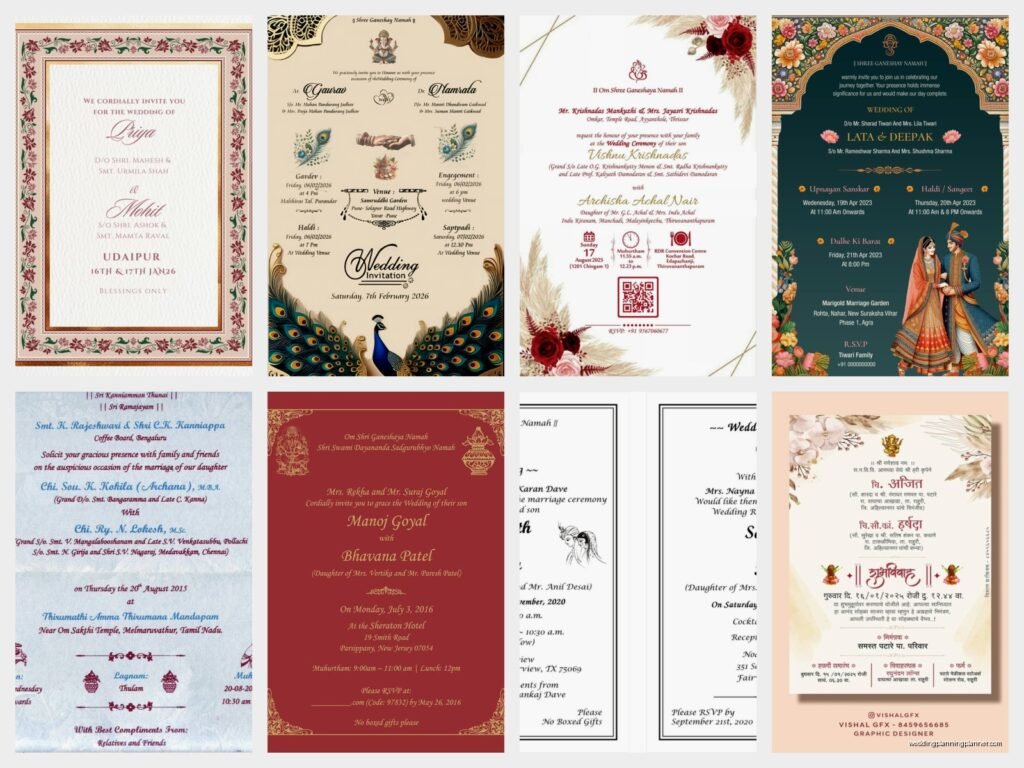
Apr
Hindu Wedding Card Samples That Actually Work
Okay so Hindu wedding invitations are honestly one of my favorite types to work on but they can get really overwhelming if you’ve never designed one before. There’s like this whole thing with symbols and colors and verses and honestly I made SO many mistakes when I first started doing these back in spring 2019.
The main thing you gotta know is that Hindu wedding cards aren’t just invitations they’re kinda like mini announcements of a sacred ceremony and they usually include WAY more information than your typical Western wedding invite. We’re talking multiple events over several days sometimes and you need to communicate all of that clearly without making the card look like a phone book.
The Ganesh Symbol Thing
Most Hindu wedding cards start with Lord Ganesh because he’s the remover of obstacles and you definitely want smooth sailing for a wedding right. I learned this the hard way when a client’s mother-in-law nearly had a meltdown because I’d placed the Ganesh symbol too small in the corner instead of prominently at the top. Summer 2021 was rough let me tell you.
You’ll see Ganesh depicted in different ways but the most common is just the simple line drawing or a more ornate illustration at the very top center of your invitation. Some families prefer just the “Om” symbol or “Shree Ganeshaya Namah” written in Sanskrit or Hindi. Here’s a sample opening:
Om Shri Ganeshaya Namah
With the blessings of Lord Ganesha and our beloved families
That’s your safe bet if you’re not sure what the family prefers.
Color Schemes That Don’t Look Like a Crayon Box Exploded
So Hindu weddings are vibrant and colorful but that doesn’t mean your invitation needs to use every color simultaneously. I see this mistake ALL the time and it honestly annoys me because people think “Indian wedding = rainbow” when really you want to pick maybe 2-3 main colors.
Popular combinations that actually look good:
- Red and gold (classic, traditional, can’t go wrong)
- Purple and gold (elegant, royal vibes)
- Orange and pink with gold accents (festive but not overwhelming)
- Maroon and cream (sophisticated, works for evening weddings)
- Green and gold (less common but gorgeous)
The gold is usually non-negotiable btw. Gold foiling, gold ink, gold borders, gold embossing—it represents prosperity and good fortune. My cat once knocked over an entire container of gold embossing powder all over my desk and I’m still finding sparkles in random places but anyway.
The Wording Structure
This is where it gets tricky because there’s no one “right” way but there’s definitely a flow that makes sense. You’re gonna start with the religious invocation, then introduce the families, then the couple, then the events, then the venue details.
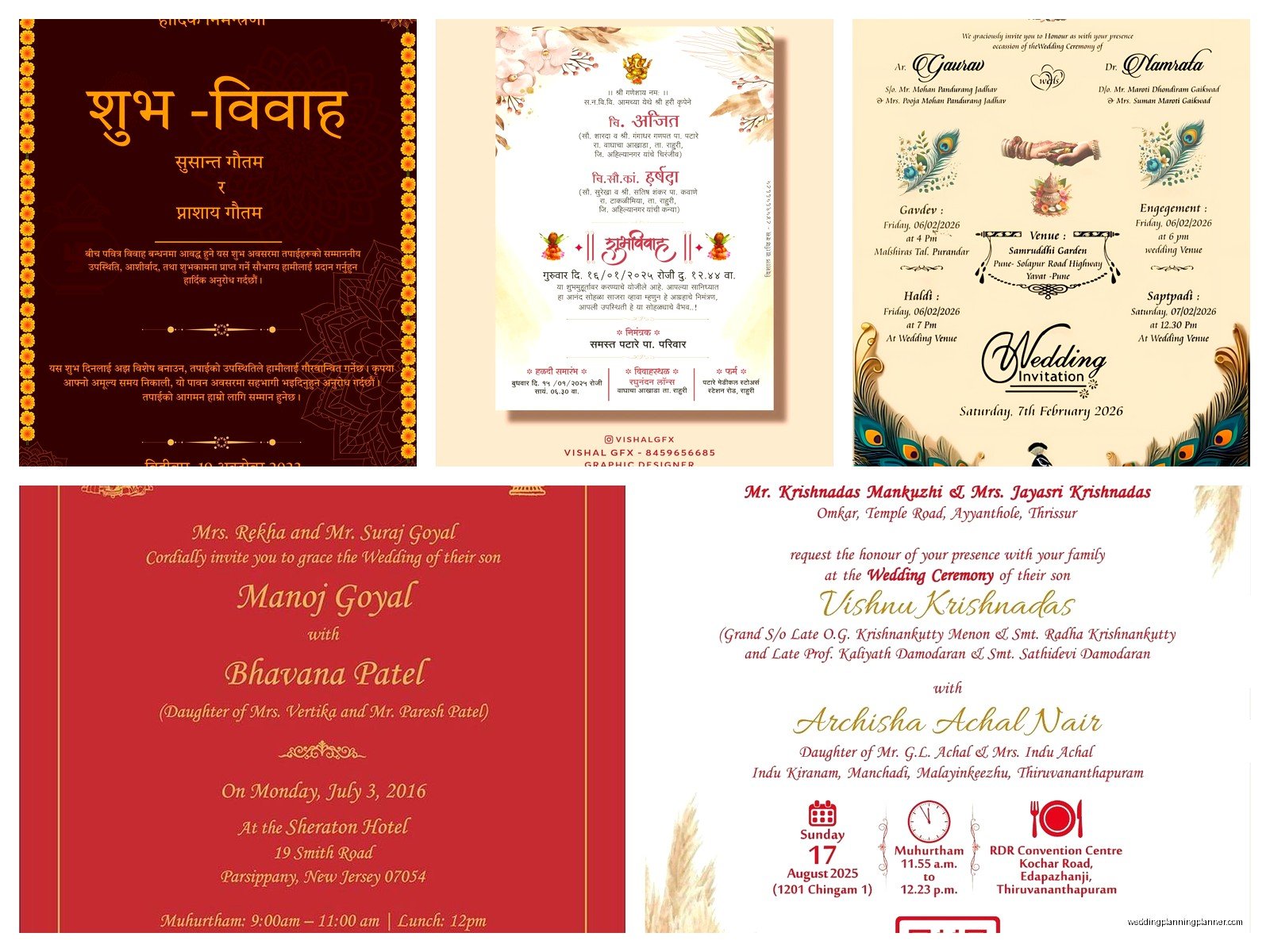
Here’s a sample structure that I use as a template:
Om Shri Ganeshaya Namah
Mrs. & Mr. Rajesh Kumar
request the honor of your presence
at the marriage ceremony of their son
Arjun
with
Priya
daughter of
Mrs. & Mr. Sanjay Sharma
Notice how the groom’s family is typically listed first because traditionally they’re hosting but this is changing and lots of families now do it differently or list both families equally. You gotta ask the family what they prefer because I’ve had situations where… let’s just say opinions were STRONG about whose name goes first.
Multiple Events = Multiple Cards or One Big Card
Hindu weddings usually have several events and you need to list them all. The main ones are usually Mehndi, Sangeet, Wedding Ceremony, and Reception but there might also be Haldi, Tilak, Garba night, and other regional ceremonies.
You’ve got two options here. Either create separate insert cards for each event (more expensive but cleaner looking) or list everything on the main invitation (economical but can look crowded). I usually recommend the insert card approach for weddings with more than 3 events.
Sample event listing:
Mehndi Ceremony
Friday, June 14th, 2024
4:00 PM onwards
Mehndiwala Lawn, Riverdale Community CenterSangeet Night
Saturday, June 15th, 2024
7:00 PM onwards
Grand Ballroom, Riverside HotelWedding Ceremony
Sunday, June 16th, 2024
10:00 AM (Baraat arrival at 9:30 AM)
Temple Gardens, 456 Sacred Street
See how specific you need to be? And note the Baraat arrival time because guests need to know when the groom’s procession is coming.
The Verse or Shloka Section
Many Hindu wedding invitations include a Sanskrit verse or shloka that talks about marriage as a sacred union. This is optional but adds a really nice traditional touch. The most common one I see is from the Rig Veda or a simplified blessing.
Sample verse:
“May the divine unite us in the sacred bond of marriage
May our union be blessed with love, prosperity, and eternal companionship”
Some families want the full Sanskrit version with English translation underneath which looks beautiful but takes up more space on your card. You’re gonna need to decide based on how much real estate you have.
RSVP Wording for Indian Weddings
This is different from Western weddings because honestly a lot of traditional Hindu families don’t even use RSVPs—they just expect everyone to come. But if you’re doing a formal headcount (which you should for catering purposes), you can word it like this:
Kindly respond by May 30th, 2024
Contact: Ravi Kumar
Phone: (555) 123-4567
Email: kumar.wedding@email.com
I had this one client in spring 2023 who insisted that asking for RSVPs was “not traditional” and then got upset when 50 more people showed up than expected and there wasn’t enough food, so yeah, maybe include the RSVP anyway.
Dress Code Mentions
You don’t always need to include this but it’s helpful for guests who aren’t familiar with Indian weddings. You can add a small line like:
Traditional Indian attire encouraged
Or if you want something more specific:
Mehndi: Casual Indian wear
Sangeet: Festive attire
Wedding: Traditional formal wear
Design Elements That Actually Matter
Beyond just colors you’ve got motifs and patterns that are traditional in Hindu wedding cards. Paisley designs, lotus flowers, peacocks, elephants, mandala patterns—these all show up constantly and for good reason, they’re gorgeous.
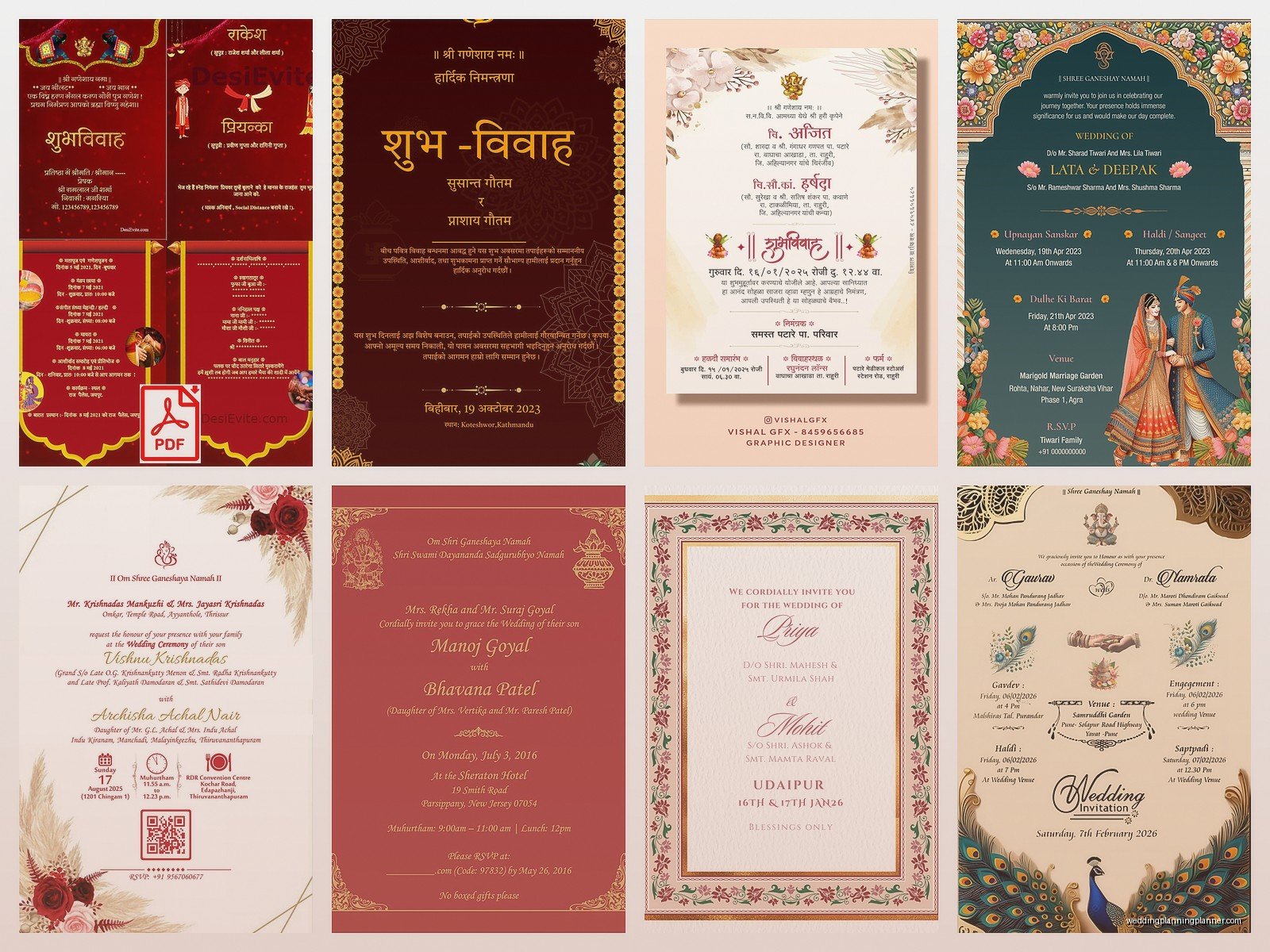
What works well:
- Intricate border designs in gold
- Paisley corner elements
- Lotus flower as a central motif (represents purity and beauty)
- Peacock illustrations (represents grace and beauty)
- Elephant motifs (represents wisdom and prosperity)
- Damask or brocade-inspired backgrounds
What doesn’t work: trying to cram all of these onto one card. Pick maybe two or three elements max or it looks like a design threw up on your invitation.
Regional Variations You Should Know About
Okay so “Hindu wedding card” is kinda a broad term because a Punjabi wedding card looks different from a Gujarati one which looks different from a South Indian one. The basic elements are similar but there are regional preferences.
North Indian cards tend to be more ornate with heavy gold work and bright colors. South Indian cards often include more temple motifs and might have simpler, more elegant designs. Gujarati cards sometimes include Swastik symbols (which is a sacred Hindu symbol, totally different from the Nazi appropriation) and specific Gujarati wording.
You really need to ask the family about their regional preferences because I’ve learned that what works for one family might not work for another even within the same religion.
Digital vs Physical Invitations
This is gonna be controversial but digital invitations are becoming more accepted even for traditional Hindu weddings. I still think physical cards are better for the main wedding ceremony invitation but you can definitely do digital versions for pre-wedding events or save-the-dates.
If you’re doing digital, you can create animated versions with the Ganesh symbol appearing first, then flower petals falling, then the text appearing. There are apps and websites specifically for Indian wedding e-invites now and some of them are actually pretty nice.
But for the main ceremony? I’d still recommend a physical card, especially if you have older relatives or traditional family members who would appreciate it.
Actual Sample Invitation Text
Let me give you a complete sample that you can adapt:
Om Shri Ganeshaya Namah
With the divine blessings of Lord Ganesha
and the love of our familiesMr. & Mrs. Prakash Mehta
joyfully invite you to celebrate
the wedding ceremony of their daughterKavya
with
Rohan
son of
Mr. & Mrs. Vikram PatelWedding Ceremony
Sunday, the Twenty-Third of June
Two Thousand Twenty-Four
at Ten O’Clock in the MorningShanti Banquet Hall
789 Celebration Avenue
Mumbai, MaharashtraReception to follow
Your presence will add joy to our celebration
and bless the couple as they begin their journey together
That’s a pretty standard format that works for most situations.
Insert Cards You Might Need
Beyond the main invitation, Hindu wedding card sets often include:
- Mehndi ceremony card
- Sangeet night card
- Reception card (if separate from ceremony)
- Accommodation card with hotel block info
- Direction/map card
- Gift registry information (though this is less common in traditional Indian weddings)
Each insert should coordinate with the main invitation design but doesn’t need to be identical. You can use the same color scheme and motifs but simplify the design.
Envelope Addressing Etiquette
For Hindu wedding invitations, you typically use more formal addressing. Instead of just “The Smith Family” you’d write out full names and titles. Also Indian families often invite extended family and family friends, so your guest list might be huge compared to Western weddings.
The outer envelope gets the formal address, and if you’re using an inner envelope (which is traditional but not required), that’s where you can be slightly less formal or indicate exactly who’s invited like “Mr. and Mrs. Patel and Family.”
Common Mistakes I See All The Time
Using too many fonts—stick to 2-3 max. Mixing traditional design with super modern fonts that clash. Forgetting to include the year in the date (yes, people do this). Not leaving enough time for printing because Indian wedding cards often have special finishes like foiling or embossing that take longer. Spelling mistakes in Sanskrit or Hindi text—always have someone who reads the language proofread it.
Also this thing where people try to make the card “match” their wedding colors exactly when really the invitation can have its own color scheme that just complements the wedding. Your card doesn’t need to be teal and orange just because those are your wedding colors, that’s gonna look weird.
Budget Considerations
Hindu wedding invitations can range from like $2 per card for simple printed ones to $50+ per card for heavily embellished boxes with multiple inserts and custom elements. Most people spend somewhere in the $5-15 range per invitation suite.
Ways to save money: skip the fancy box and use an envelope instead, reduce the number of insert cards, choose digital printing over letterpress, use standard sizes to avoid custom cutting fees, order in bulk (obviously), and consider doing digital invites for some of the pre-wedding events.
The things worth spending on: good quality paper (cheap paper looks cheap), at least some gold foiling or embossing, and professional printing. DIY printing rarely looks as good as you think it will trust me.