Planning Guides, Style Guide
Wedding Bulletin: Ceremony Program Church Order
Jun
Church Wedding Programs Are Way More Important Than People Think
Okay so wedding bulletins for church ceremonies – they’re basically your ceremony roadmap but honestly most couples don’t realize how much these little printed guides actually help your guests follow along. I learned this the hard way back in spring 2023 when I had this couple who insisted they didn’t need programs because “everyone knows what happens at a wedding” and then their ceremony included like three different readings, a unity candle AND a sand ceremony, plus hymns that nobody knew the words to. The guests were just sitting there looking confused and I was mentally face-palming from my spot in the back.
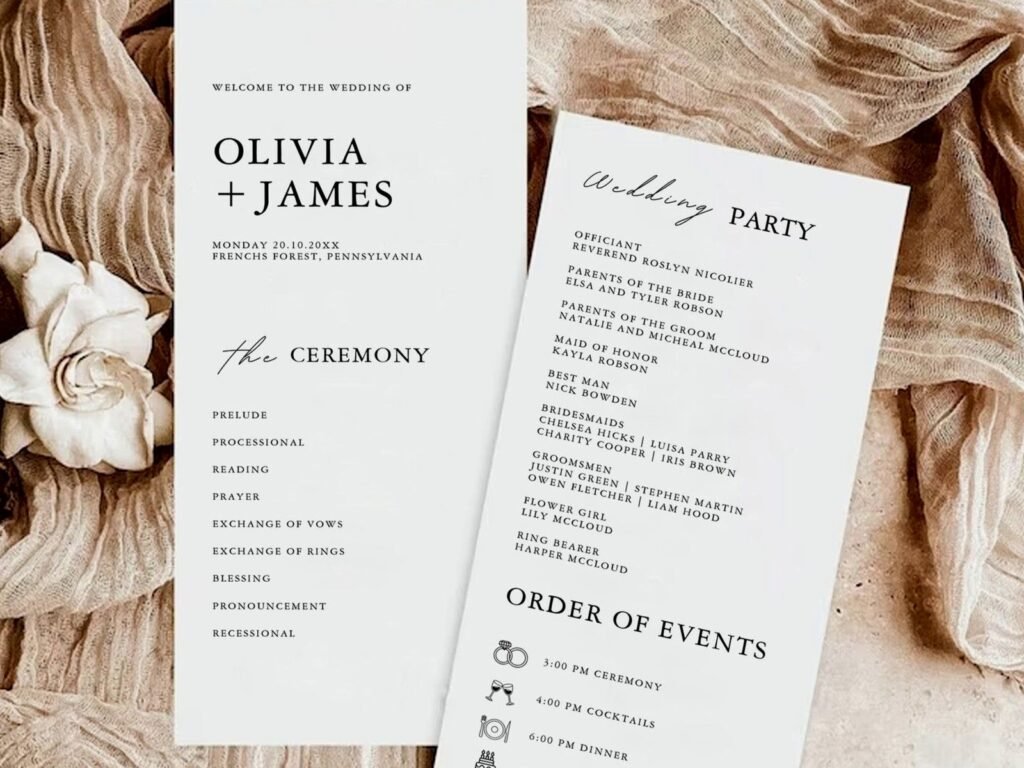
The church bulletin or ceremony program is basically your guide to what’s gonna happen during the service. It lists everything in order – who’s doing what, when to stand or sit, what songs you’re singing, all of that. For Catholic or Episcopal ceremonies especially, you need these because there’s a lot of standing and sitting and kneeling and if you’ve got guests from different faith backgrounds they’ll be totally lost without something to reference.
What Actually Goes In The Order Of Service
So here’s the thing – your program needs to match your actual ceremony order. Sounds obvious but you’d be surprised how many times I’ve seen programs that list things in the wrong sequence or forget entire elements. Start with the processional and work your way through chronologically.
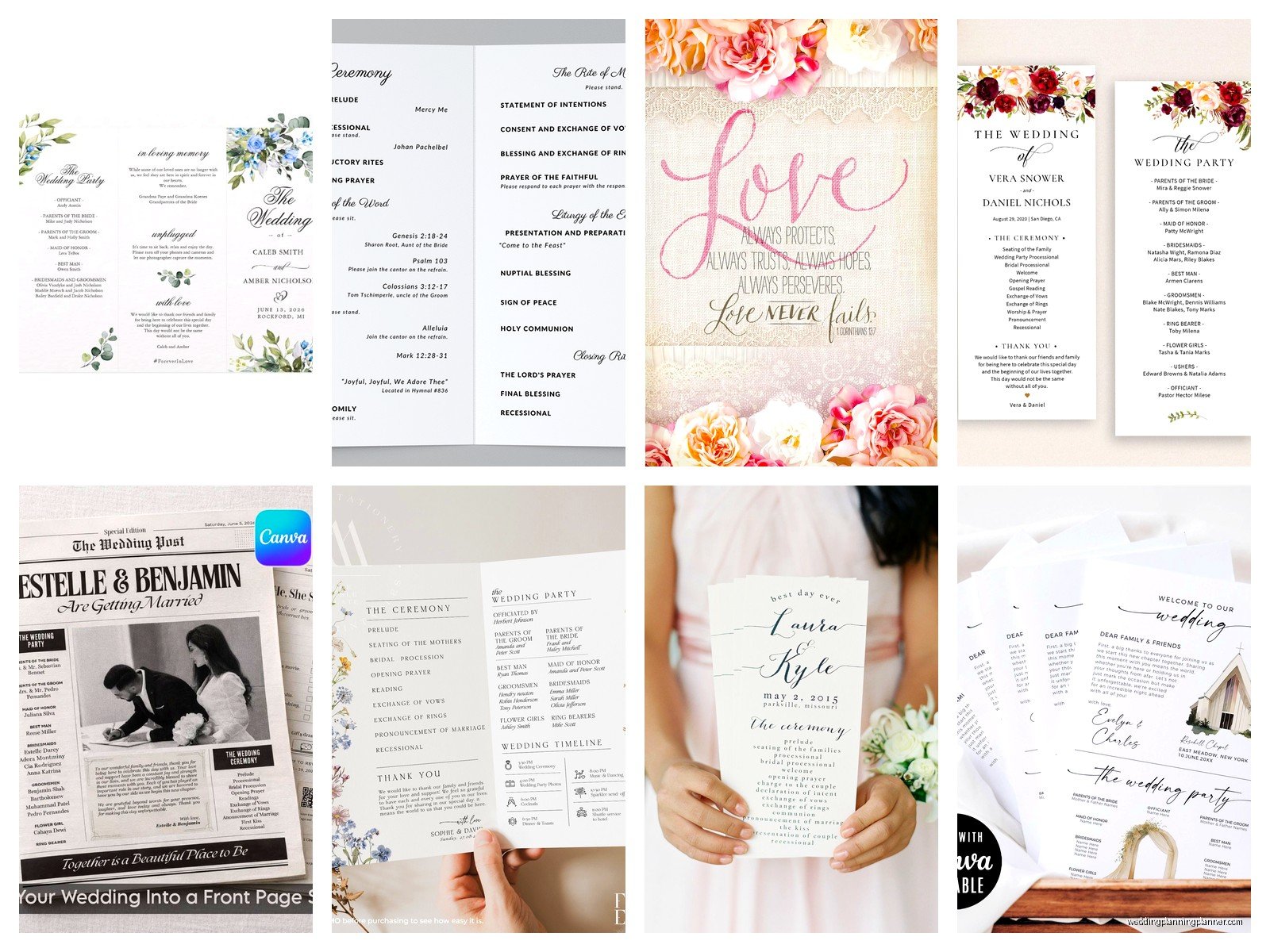
The basic structure usually looks like:
- Prelude music (optional to list but nice context)
- Processional – list who’s walking and in what order
- Opening words or welcome from officiant
- Opening prayer or invocation
- Scripture readings (list the actual passages)
- Homily or sermon
- Exchange of vows
- Exchange of rings
- Unity ceremony if you’re doing one
- Prayers or blessing
- Pronouncement
- First kiss (some people list this, some don’t)
- Recessional
But like… every church and every denomination does things differently so you gotta work with your officiant to get the exact order. Catholic masses include communion which adds a whole section. Jewish ceremonies have the ketubah signing and breaking the glass. Protestant services might have more congregational singing.
The Cover Information
Your front page needs the basics – bride and groom names (or bride and bride, groom and groom, you get it), the date, the church name and location, and maybe the time though honestly the time feels kinda redundant since everyone’s already there? But some people like it for the keepsake factor.
I usually suggest keeping the cover clean and simple. You can add a monogram or a simple graphic but don’t go overboard. This isn’t the place for your full engagement photo spread – save that for the cocktail hour display or whatever.
Writing Out The Actual Ceremony Elements
Here’s where it gets detailed. For each section you should include enough info that guests understand what’s happening but not SO much that they’re reading a novel instead of watching your ceremony.
For readings, list the passage reference AND the reader’s name. Like “First Reading: 1 Corinthians 13:4-8, read by Sarah Mitchell” – that way Aunt Sarah gets recognized and guests know where it’s from if they wanna look it up later. If you’re using a particularly meaningful translation or a non-biblical reading, you might wanna include a line or two of context.
Musical selections should include the song title and artist/composer. If it’s a hymn that you want guests to sing along to, you have options – either print the full lyrics (takes up space but super helpful) or just note “please join in singing” so people know they’re supposed to participate. There’s nothing worse than that awkward moment when guests don’t know if they should sing or just listen… actually wait, I take that back, the worst is when you print “please stand” in the program but forget to tell the officiant to actually invite people to stand and then everyone’s just sitting there while the couple expected them to be up.
The Wedding Party Roster
Most programs include a page listing everyone in the wedding party with their names and how they know you. This is honestly one of my favorite parts because it gives context – like “Best Man: Jake Peterson, groom’s brother” or “Maid of Honor: Rachel Kim, bride’s best friend since middle school.”
You can also list your parents, grandparents, officiant, musicians, and anyone else who has a special role. Some couples do a “In Memory Of” section for deceased loved ones though personally that section always makes me tear up during ceremonies and I’m supposed to be working not crying.
One thing that kinda annoys me is when couples list like twenty people in their wedding party but then don’t include last names. If you’re gonna recognize people, actually recognize them properly so guests know who they are. “Bridesmaid: Ashley” doesn’t help anyone when there are three Ashleys in attendance.
Formatting And Design Considerations
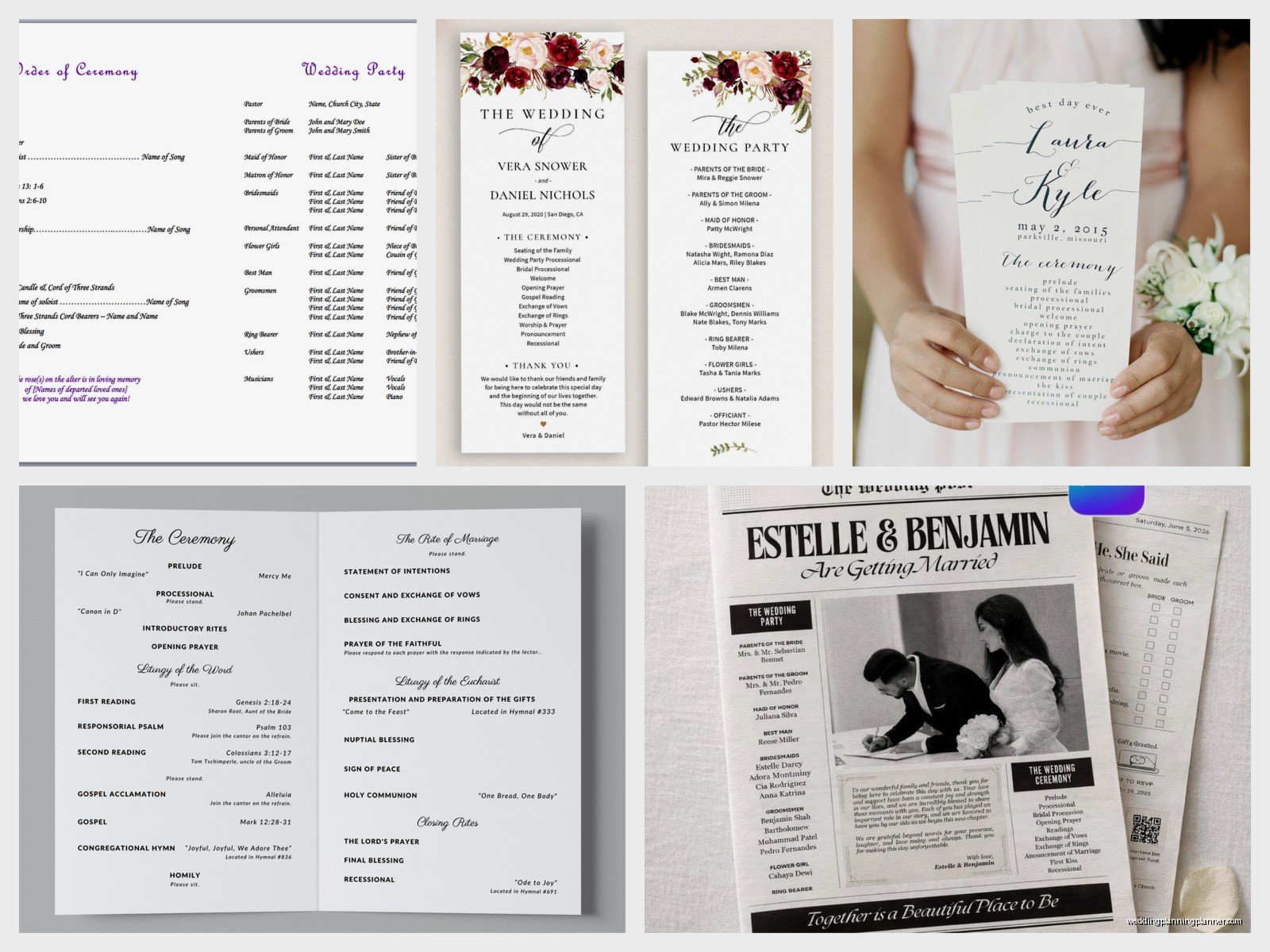
Size matters with programs. The standard is 5.5″ x 8.5″ which is a half sheet of regular paper – easy to print and hold. Some people do the fancy folded booklet style, others do a single sheet front and back, some go full booklet if it’s a long ceremony. Catholic mass programs are usually booklets because there’s just so much content.
My cat literally knocked over my coffee onto a stack of programs once during a final check the morning of a wedding and I almost had a breakdown… anyway, point being, print extras. Always. I tell couples to print at least 25% more than their guest count because people take them as favors, some get damaged, and you’ll want extras for your own keepsake box.
Font size needs to be readable – I’m talking at least 11 or 12 point font, bigger if you’ve got a lot of older guests. Your grandma shouldn’t need reading glasses to follow along. And please, for the love of all that is holy, don’t use more than two different fonts. One for headings, one for body text. That’s it. I’ve seen programs that look like ransom notes with six different fonts and it’s just… no.
Explaining Church Traditions
If you’re having a traditional church service with lots of liturgical elements, consider adding a small section that explains what things mean. Like if you’re doing a full Catholic mass, maybe include a brief note about communion and what guests who aren’t Catholic should do (usually stay seated or come forward for a blessing with arms crossed).
This is especially helpful for interfaith ceremonies or when you know a lot of your guests aren’t familiar with church services. You don’t need to write a theology lesson but a sentence or two explaining “During the Eucharist, the priest will consecrate the bread and wine” gives context.
Response Parts For Guests
Some ceremonies have parts where the congregation responds. If your ceremony includes these moments, definitely print the responses in the program. Common ones include:
- “And also with you” or “And with your spirit” (depending on which liturgy)
- Responses during prayers
- Sung responses like “Amen” or “Alleluia”
- The part where the officiant asks “Will all of you witnessing these promises do all in your power to uphold these two persons in their marriage?” and everyone says “We will”
Print these in bold or italics so they stand out. Nothing’s more awkward than guests mumbling because they don’t know what they’re supposed to say or when.
Special Ceremony Elements
Unity ceremonies need explanation. If you’re lighting a unity candle, include a brief description like “The mothers will light the two taper candles representing the bride and groom’s individual lives. The couple will then use these candles to light the center unity candle together, symbolizing the joining of their two lives and families.”
Same with sand ceremonies, handfasting, rose ceremonies, or whatever symbolic ritual you’re incorporating. Your college roommate from out of state doesn’t automatically know what the lasso ceremony means in a Catholic wedding or why you’re washing each other’s feet.
Oh and if you’re doing any cultural traditions – like jumping the broom, the seven blessings, tea ceremony elements, whatever – explain them. This is actually a beautiful way to educate guests about your heritage or traditions they might not be familiar with.
Practical Timeline Stuff
You need these printed and ready at least a week before the wedding. Ideally two weeks. Do NOT wait until the last minute because I promise something will go wrong – the printer will jam, you’ll notice a typo, someone will get divorced and you need to reword something… it happens.
Get your ceremony order finalized with your officiant at least a month out so you have accurate info. Some priests or ministers want to review your program before printing to make sure you’ve got the liturgy correct and haven’t accidentally written something that goes against church doctrine or whatever.
Proofread multiple times. Have someone else proofread. Then proofread again. Typos in wedding programs are permanent – people keep these things and you don’t want your ceremony program to forever say “ring bear” instead of “ring bearer” (yes I’ve seen this, yes it was hilarious, no the bride did not think it was funny).
Distribution Day-Of
Figure out how guests are getting programs. Usually you have ushers hand them out as people arrive, or you put them on a table at the church entrance. If you’re doing the table thing, put a sign so people actually see them. Can’t tell you how many times I’ve watched guests walk right past a beautifully displayed program table because there was no signage.
You need someone responsible for this. Designate an usher or family member or your coordinator (if you have one) to make sure programs are actually being distributed. I had a ceremony once where the ushers got so caught up in seating the mothers and grandmothers that they forgot to hand out programs and then halfway through the ceremony I’m trying to quietly pass them down the rows which was just a mess.
What You Can Skip
Not everything needs to be in your program. You don’t need to list every single song played during prelude. You don’t need to include your entire love story. You don’t need six pages of thank-yous – save that for your reception program or a sign at the venue.
If your ceremony is super short and straightforward – like a simple 20-minute service with no readings or special elements – you might not even need programs at all. Sometimes a simple single-sheet with just the wedding party names and a timeline is enough. Don’t create work for yourself just because you think you’re supposed to.
Also you don’t need to spend a fortune on these. Yes the fancy letterpress programs are gorgeous but honestly guests are gonna read it once and either leave it in the pew or stuff it in their bag. Save your budget for things that matter more. A well-designed program printed at home or through an online service works perfectly fine.
Digital Alternatives
Some couples are going digital with ceremony programs now – they’ll create a wedding website page with the ceremony order or even a QR code that links to the info. Personally I think this is kinda impractical because not everyone wants to pull out their phone during a ceremony and church lighting is usually terrible for reading screens but hey, if it works for your crowd, go for it. Just make sure older guests or anyone not super tech-savvy has a printed option.
The hybrid approach works too – print enough for like half your guest count and have the digital version as backup. But honestly if you’re having a church ceremony, just print the programs. It’s traditional, it’s tangible, and it actually helps people engage with what’s happening instead of zoning out during readings they can’t quite hear from the back rows.