Planning Guides, Style Guide
Invitation Calligraphy: Design & Ordering Guide
Jun
Okay so calligraphy invitations are having this huge moment right now
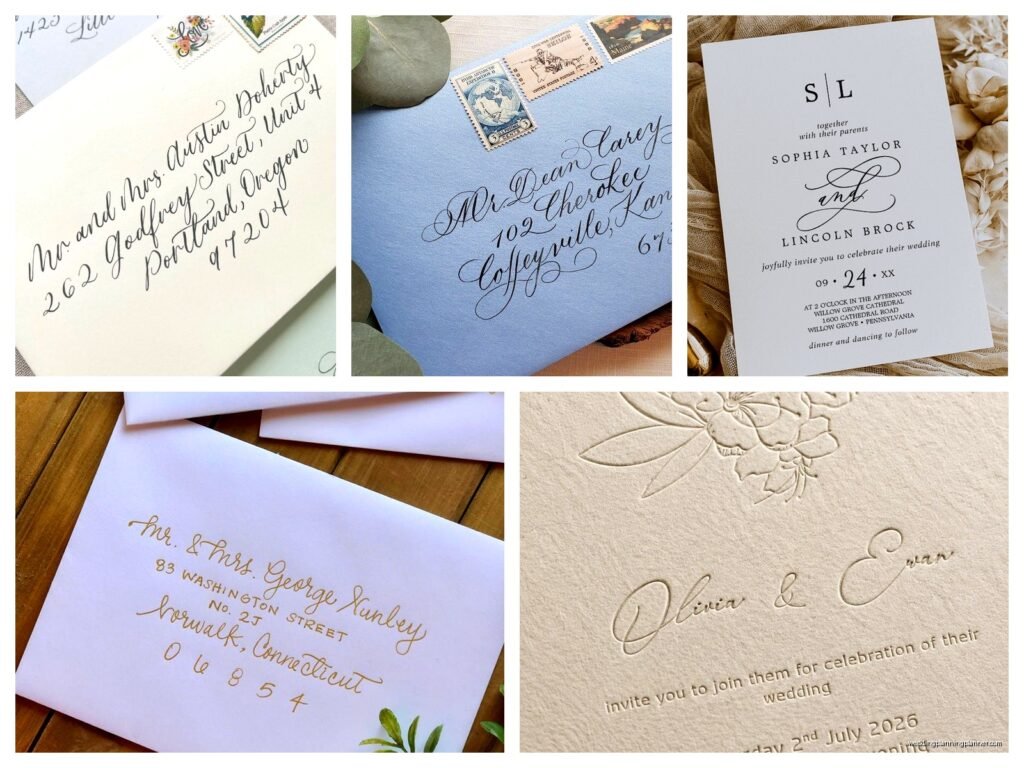
The first thing you gotta know is that “calligraphy” on wedding invitations can mean like three completely different things and vendors will use the same word for all of them which drives me absolutely INSANE. I had this bride in spring 2023 who kept saying she wanted “calligraphy invitations” and we went through two rounds of samples before I realized she meant she wanted a calligraphy-style font printed on the invitations, not actual hand-lettered envelopes. We’d been pricing out hand calligraphy at $4 per envelope and she nearly had a heart attack.
So let’s break down what people actually mean:
- Digital calligraphy fonts – These are just fancy fonts that look like calligraphy but they’re printed. Cheapest option.
- Digital calligraphy (hand-drawn but digitized) – An artist hand-letters your design, scans it, and then it gets printed. Middle price point.
- True hand calligraphy – Someone literally sits there with a pen and writes on each piece. Most expensive, obviously.
Figuring out your actual budget first
I’m gonna be real with you, calligraphy can eat your stationery budget alive if you’re not careful. For just the invitations themselves (not envelopes yet), here’s roughly what I see:
Printed calligraphy fonts on nice cardstock: $3-8 per invitation suite. You can get these from places like Minted, Zola, Paperless Post (well, they’re digital but whatever), or your local print shop. The quality difference between a $3 and $8 one is usually the paper thickness and any fancy additions like letterpress or foil.
Custom digital calligraphy that’s printed: $8-15 per suite. This is where you hire a calligrapher or stationery designer to create something specifically for you, then they send the files to a printer.
Fully hand-lettered invitations: umm honestly I don’t see this much anymore because it’s like $25-50+ per invitation and that’s just not realistic for most people inviting 100+ guests, but it exists.
The envelope situation is different though
This is usually where people actually spring for real calligraphy because it makes such a statement when your guests get that envelope in the mail. Hand-addressed envelopes typically run $2-6 per envelope depending on:
- How experienced the calligrapher is
- How complex the style is (simple modern calligraphy vs super ornate Spencerian script)
- How long the addresses are (someone with “1234 Main St” pays less than “The Residence of Mr. and Mrs. Jonathan Christopher Wellington-Smythe, 45678 Westminster Boulevard”)
- Rush fees if you’re doing this last minute
You can also do printed calligraphy on envelopes for like $0.50-2 per envelope which looks pretty good honestly, most guests won’t know the difference unless they’re really into stationery.
Choosing your calligraphy style (this is where it gets fun)
There are SO many styles and I feel like every calligrapher describes them differently but here’s my basic breakdown:
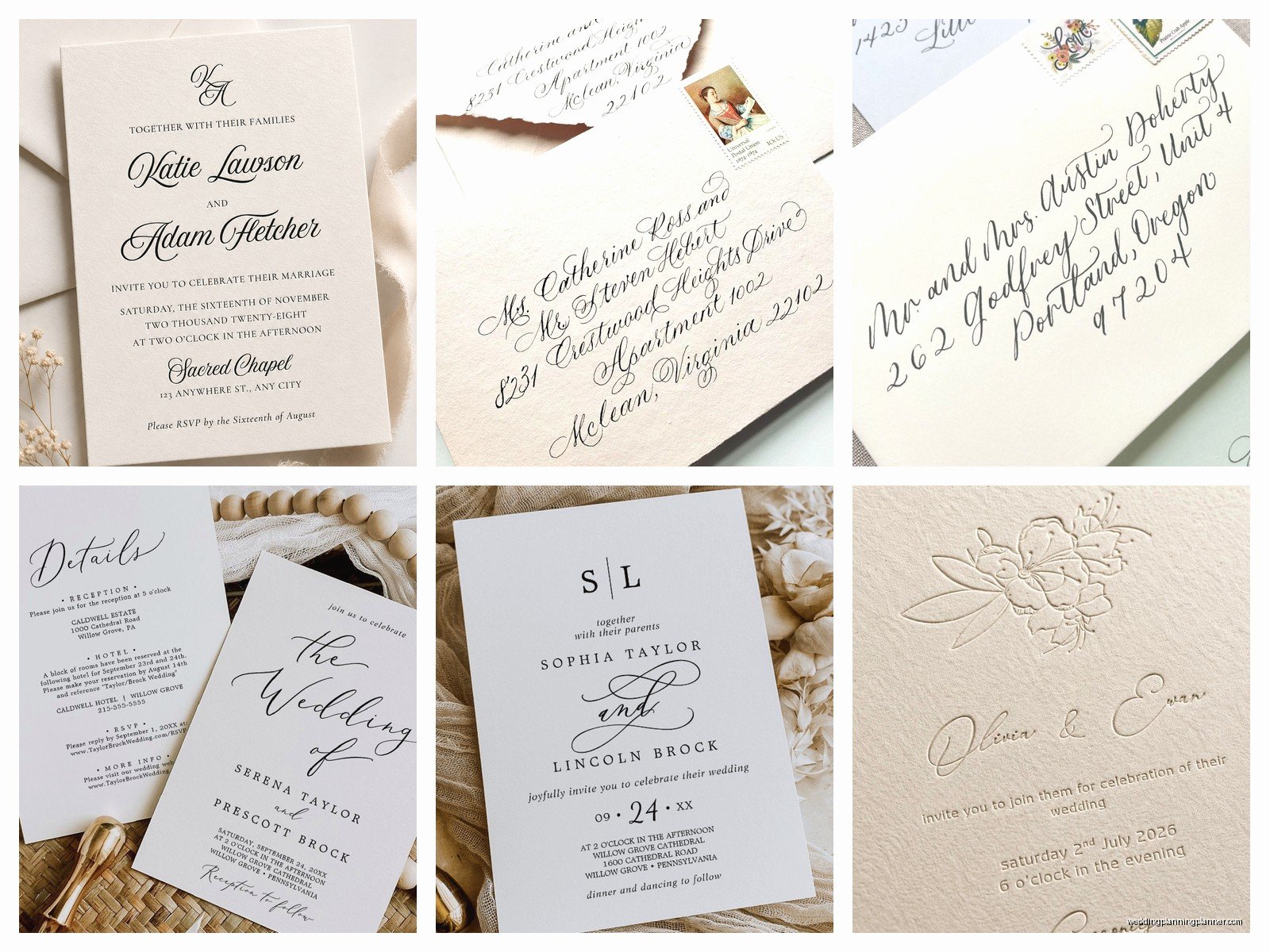
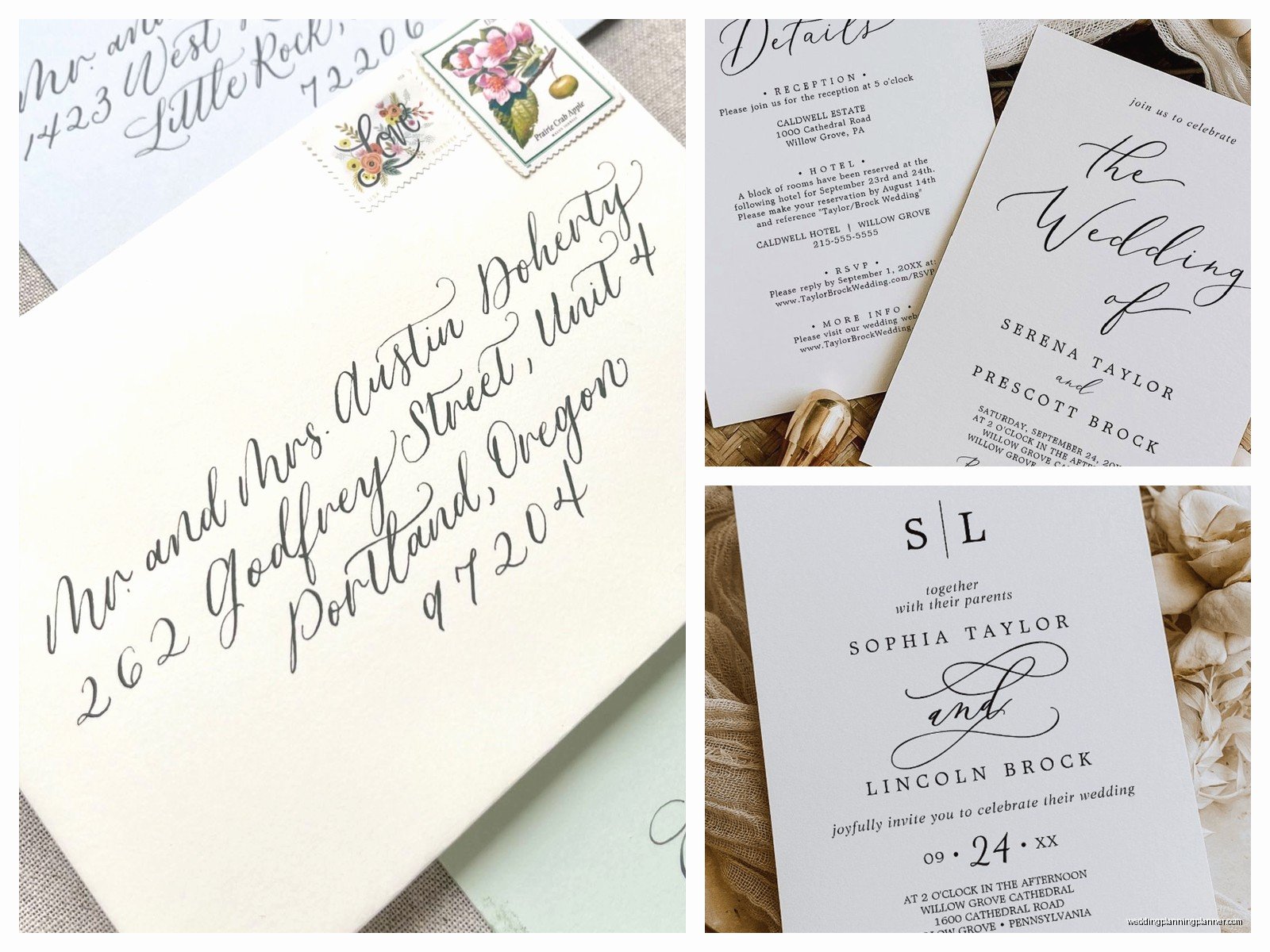
Modern calligraphy – This is what you see everywhere on Instagram. It’s got that flowy, organic look with lots of variation in thick and thin strokes. Some letters connect, some don’t. It feels casual but elegant at the same time. Works for almost any wedding style but especially good for garden weddings, bohemian vibes, or romantic settings.
Traditional/Copperplate/Spencerian – This is the old-school fancy calligraphy your grandmother would recognize. Very consistent, very formal, all the letters connect in a specific way. Perfect for black-tie weddings, classic ballroom receptions, or if you’re going for that timeless elegant vibe.
Gothic/Blackletter – That medieval-looking script. Honestly it’s having a weird resurgence? I see it mostly for Halloween weddings or couples who are really into fantasy stuff. My cat knocked over a sample of this style once and the ink went everywhere… anyway, it’s very dramatic and hard to read so use sparingly.
Brush lettering – Similar to modern calligraphy but usually bolder and more casual. Great for beach weddings or laid-back celebrations.
How to actually find and hire a calligrapher
Instagram is honestly your best bet for finding calligraphers. Search hashtags like #weddingcalligraphy #envelopeaddressing #moderncalligraphy plus your city name. Look through their portfolios and see whose style makes you go “YES that’s it.”
When you reach out, you need to have this info ready:
- Your wedding date (they book up FAST, like 6-8 months in advance isn’t unusual for popular calligraphers)
- How many envelopes you need addressed
- Whether you want just outer envelopes or inner envelopes too (inner envelopes are kinda old-fashioned but some people still do them)
- If you need the invitation design itself or just addressing
- Your color preferences – and be specific! “Burgundy ink” could mean 50 different shades
Most calligraphers will send you a sample first (sometimes for a small fee, sometimes free) so you can see their work in person before committing to the full order.
The timeline is trickier than you think
Okay so here’s what annoys me more than anything else about calligraphy orders – couples never factor in enough time and then they panic. Here’s a realistic timeline:
If you’re doing custom calligraphy design for your invitations: start 6-8 months before you need to mail them. The design process alone can take 3-4 weeks with revisions, then you need to get them printed (2-4 weeks depending on the printing method), then you need to assemble everything.
If you’re just doing calligraphy addressing on pre-designed invitations: you need your final guest list and addresses at least 6-8 weeks before your mail date. I know that sounds like forever but calligraphers can usually only do like 10-20 envelopes per hour depending on the style, so if you have 150 envelopes that’s… actually let me do the math… that’s gonna take them several dedicated work sessions.
And here’s the thing nobody tells you – you need to order extra envelopes. Like, 20-30% extra. Because mistakes happen. I once had a calligrapher spill coffee on a stack of envelopes the day before they were due to be shipped and thank GOD we had extras. Also you’ll inevitably get some addresses wrong or people will tell you their address changed or whatever.
DIY calligraphy: is it worth it?
Look, I’m gonna be honest with you. I’ve seen some beautiful DIY calligraphy and I’ve seen some… not beautiful DIY calligraphy. If you’re crafty and you have TIME (emphasis on time), you can learn basic modern calligraphy in a few months with practice.
What you need for DIY:
- A good oblique pen holder and nibs (Nikko G nibs are great for beginners) – around $25-40 to start
- Or brush pens if you want something easier – Tombow Dual Brush Pens are like $3 each
- Practice paper (lots of it)
- Good ink (Higgins Eternal is my go-to recommendation)
- Patience
- YouTube tutorials (there are thousands)
But real talk? If you’re inviting more than like 50 people, I don’t recommend DIY addressing unless you genuinely enjoy calligraphy as a hobby. It’s SO time-consuming and wedding planning is already stressful enough. During that spring 2023 wedding I mentioned earlier, the bride decided to DIY her envelopes to save money and she was up until 2am the night before they needed to be mailed, crying over smudged ink and cramped hands. Just… think about what your time is worth, you know?
Ordering printed calligraphy invitations (the easier route)
If you decide to go with printed invitations in a calligraphy style, here’s how to not mess it up:
Paper weight matters. You want at least 110lb cardstock for the main invitation. Anything thinner feels cheap. If you’re doing letterpress or foil, you might need even thicker paper like 220lb or cotton paper.
Get samples. Like actual physical samples that you can touch, not just looking at photos online. Colors look different in person and you need to feel the paper quality. Most online companies will send you sample packs for like $5-15.
Printing methods:
- Digital printing – Cheapest, looks fine, good for simple designs
- Letterpress – Creates an impression in the paper, super elegant, more expensive, works best with simple calligraphy designs
- Foil stamping – Shiny metallic finish, very fancy, moderate price point
- Engraving – The most formal traditional method, expensive, mostly for super formal weddings
Working with online companies vs local printers
Online companies like Minted, Zola, Paperless Post, Artifact Uprising, etc. are great because they have tons of templates and the ordering process is straightforward. You pick a design, customize the text, they print and ship. Easy. Prices are usually $300-800 for 100 invitations depending on what bells and whistles you add.
Local printers or independent designers give you more customization and the ability to see samples in person, but they’re usually pricier and the timeline is longer. You’re looking at $600-2000+ for 100 invitations typically. The advantage is you get something totally unique and you can have more back-and-forth on the design.
The actual ordering process step by step
Alright so once you’ve chosen your calligrapher or printer, here’s what happens:
Step 1: Finalize your wording. This takes longer than you’d think because you need to figure out who’s hosting (are your parents’ names on there?), how formal you’re being, what info you’re including. Look up examples of invitation wording online – there are like traditional formal versions and modern casual versions and everything in between.
Step 2: Get your proof. The calligrapher or printer will send you a digital proof or physical sample. Read it SO carefully. Check every single name, date, time, address. I cannot tell you how many times I’ve caught errors at this stage. One time a printer had the wedding at 5:00pm instead of 5:30pm and the couple didn’t catch it until I did on my third read-through.
Step 3: Request any changes. Most vendors include 2-3 rounds of revisions. Use them. Don’t be shy about asking for adjustments to spacing, font size, layout, whatever.
Step 4: Approve and pay. Once you approve, they’ll usually want the remaining balance (you probably paid a deposit when you first ordered).
Step 5: Production time. This is usually 2-4 weeks but can be longer during peak wedding season (basically May through October). Rush fees can sometimes speed this up but they’re expensive, like 25-50% extra.
Step 6: Receive and inspect. When your order arrives, open it immediately and check everything before the return window closes. Count the pieces, look for printing errors, make sure nothing got damaged in shipping.
The envelope addressing piece
If you’re having your envelopes calligraphed separately (like you ordered invitations from Minted but you’re hiring a local calligrapher for addressing), you need to coordinate the timeline carefully.
Send your calligrapher the envelopes as soon as you get them – don’t wait. Include a printed spreadsheet with all the addresses clearly formatted exactly how you want them to appear. Like this:
Mr. and Mrs. Jonathan Smith
1234 Oak Avenue
Chicago, Illinois 60601
Not like: “Jon & Sarah Smith, 1234 Oak Ave, Chicago IL 60601” – the calligrapher needs to see the formatting you want including line breaks.
Also tell them if you have any preferences like whether to abbreviate “Street” or spell it out, whether to use “and” or “&” between couple names, etc.
Common mistakes people make
Not ordering enough invitations – you’ll need extras for keepsakes, last-minute additions to the guest list, mistakes, etc. Order at least 10-15% more than your guest count.
Forgetting about inner envelopes, RSVP envelopes, detail cards, etc. when calculating quantities. If you need 100 invitation suites and each suite has 3 pieces plus 2 envelopes, you need to make sure all those quantities match up.
Not factoring in assembly time – putting together 150 invitation suites with multiple pieces, belly bands, wax seals, whatever… that’s gonna take you like 4-6 hours minimum. Recruit friends or family or just accept you’re gonna be watching a lot of Netflix while you do it (I rewatched all of Schitt’s Creek during one invitation assembly party).
Choosing a calligraphy style that doesn’t match your wedding vibe – like if you’re having a casual backyard BBQ wedding, super formal Copperplate calligraphy might feel weird? Or if you’re doing a glamorous ballroom wedding, super casual brush lettering might not fit.
Not considering readability – some calligraphy styles are HARD to read, especially for older guests or people who aren’t familiar with decorative fonts. Your Great Aunt Mildred should be able to read where and when the wedding is without needing a decoder ring.
Questions to ask before you order
What’s included in the base price? (Just the invitation or the whole suite with RSVP card, details card, envelopes, etc.?)
How many rounds of revisions do I get?
What’s the production timeline?
Can I order extras later if I need them? (And will they be the same price?)
What happens if there’s an error that’s your fault vs my fault?
Do you offer guest addressing? If so, what’s that process and cost?
What’s your cancellation or change policy?
Mixing calligraphy with other design elements
You don’t have to go full calligraphy on everything. Sometimes the prettiest invitations mix calligraphy with modern typography or other design elements. Like maybe your names are in calligraphy but the event details are in a clean sans-serif font. Or the envelope addressing is calligraphed but the invitation itself is minimalist and modern.
Wax seals look AMAZING with calligraphy envelopes by the way. You can get custom wax seals with your initials or monogram for like $30-60 and they add such a luxe touch. Just be aware they might require extra postage because they make the envelope thicker and they can sometimes… okay this is gonna sound weird but they can sometimes break off in the mail sorting machines, so you might want to hand-cancel your invitations at the post office which means you bring them to the counter and ask them to manually stamp them instead of running them through the machine.
Speaking of postage – get pretty stamps! If you’re going through all this effort for beautiful calligraphy, don’t slap a random flag stamp on there. USPS has vintage stamps, floral stamps, love stamps, all kinds of options. You can even get custom stamps with your photo on them through some services though honestly those kinda creep me out but some people love them.
The digital calligraphy option for some pieces
Here’s a money-saving trick: get hand calligraphy for your outer envelopes (the ones everyone sees) but use printed calligraphy fonts or digital addressing for your RSVP envelopes. Most guests won’t notice or care because they’re just gonna return those envelopes anyway, and you’ll save like $200-400 depending on your guest count.
Same thing with detail cards or accommodations cards – those don’t need hand calligraphy, a nice printed calligraphy font works fine and keeps costs down while still maintaining the overall aesthetic you’re going for with your invitation suite.