
Planning Guides, Style Guide
Marriage Reception Invitation Card: Design & Ordering Guide
Jun
Okay so reception invitations are actually trickier than people think
First thing you gotta understand is that reception invitations are NOT the same as wedding invitations even though half my clients in 2021 kept trying to use the same template for both and I was like no no no we need to rethink this. Reception cards have a totally different vibe and purpose and honestly the wording is where people mess up the most.
If you’re doing a private ceremony with just immediate family and then a bigger reception later, your invitation needs to make that crystal clear without sounding like people weren’t good enough for the ceremony. I’ve seen some really awkward wording over the years. The key is to focus on the celebration part, not what people are missing.
The wording situation
So traditional wording goes something like “request the pleasure of your company at a reception celebrating the marriage of” but honestly you can loosen that up depending on your crowd. I worked with this couple in spring 2023 who wanted to say “Let’s party because we got hitched!” and like, if that’s your vibe then go for it. Just make sure the essential info is there.
You need to include: whose reception it is, that it’s celebrating a marriage that already happened (or will happen at a different time/place), the date, time, location, and dress code if relevant. RSVP details obviously. What drives me absolutely crazy is when people forget to put an end time and then guests don’t know if this is a 2-hour cocktail thing or an all-night dance party.
Also if your ceremony is happening the same day but privately, you need to word it so people understand they’re invited to the reception only. Something like “Following a private ceremony, join us for dinner and dancing” works. I had a bride once who didn’t make this clear and like 30 people showed up at the church and it was SO awkward because it was supposed to be just parents and siblings.
Design choices that actually matter
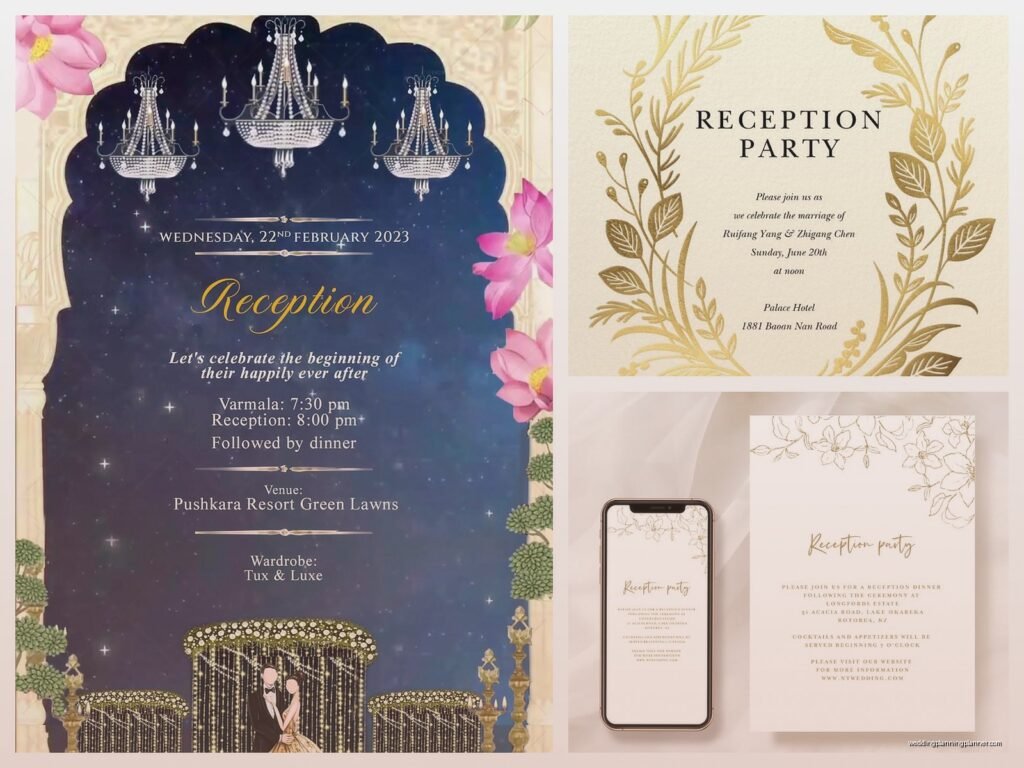
The design should match your wedding aesthetic but it doesn’t have to be as formal as a traditional wedding invite. You’ve got more freedom here. I usually tell people to think about whether this reception is gonna be fancy sit-down dinner vibes or more casual backyard BBQ energy because that should influence your design.
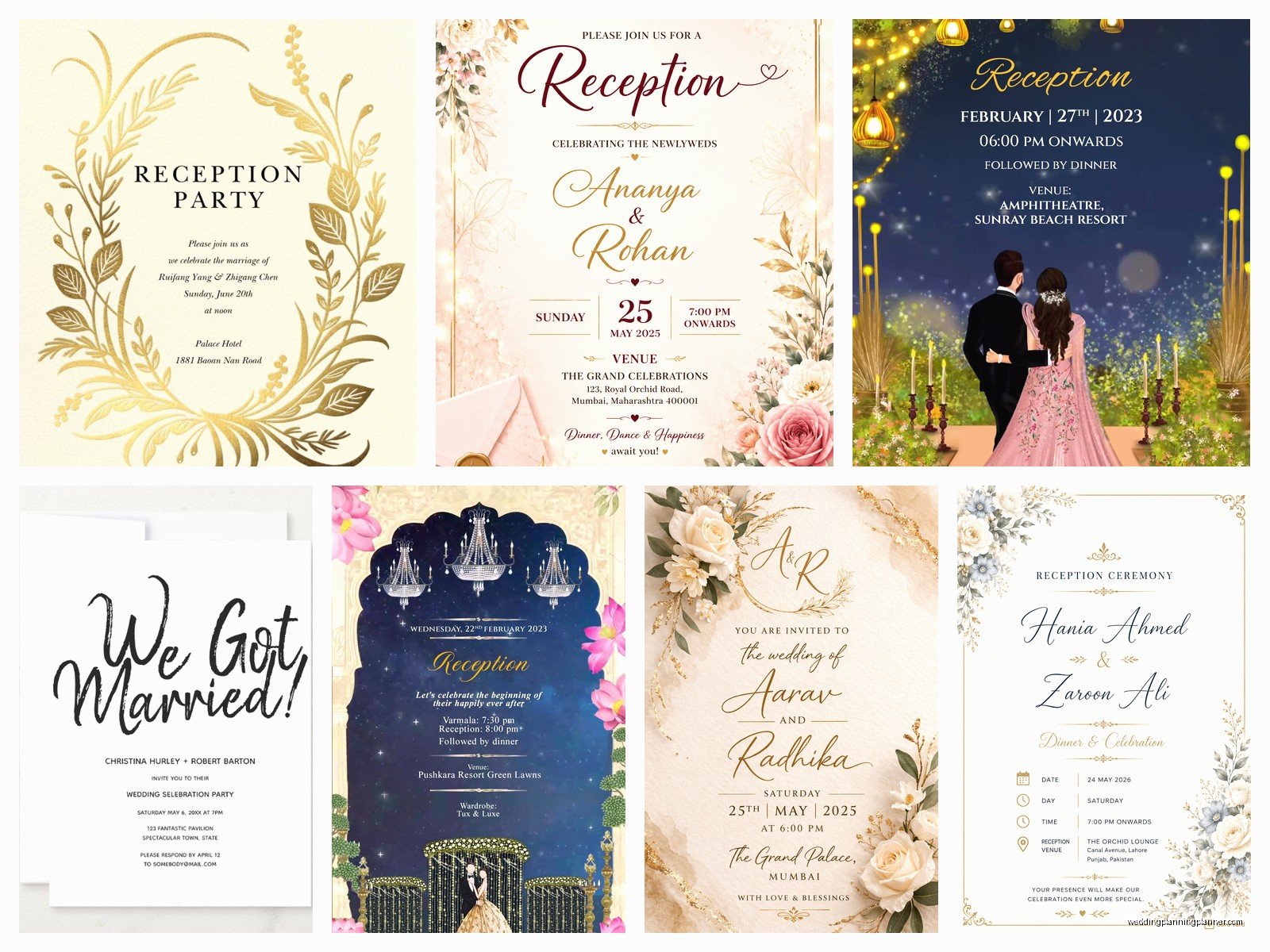
Paper weight matters more than you think. Anything under 100lb cardstock feels cheap in your hand. I recommend 110lb or 120lb for the main invitation. If you’re doing a postcard style RSVP (which I love for receptions because it’s more casual), 14pt or 16pt cardstock works great.
Color wise, you can go bolder with reception invites than traditional wedding invites. I’ve done reception cards in coral, navy, emerald green, even black with gold foil. The whole “must be ivory or white” rule doesn’t really apply here unless you want it to.
Digital vs printed and why I have opinions
Look, digital invites are fine for receptions. I said it. For a wedding ceremony I’m still kinda traditional and think you should send physical invites, but for a reception especially if it’s more casual, a really well-designed digital invitation is totally acceptable. My cat literally knocked over my coffee onto a stack of reception invites last month and I was like…you know what, maybe digital isn’t so bad.
That said, if you’re going digital, please use a proper platform like Paperless Post or Greenvelope, not just a Facebook event. I’ve seen people try to invite 100 guests to their reception via Facebook event and the RSVP tracking was a nightmare. Half the people didn’t see it, a quarter marked “maybe” which is useless, and—sorry I’m getting worked up but this actually happened to a client and it was stressful for everyone.
Ordering timeline breakdown
If you’re doing printed invites, here’s the timeline you’re looking at:
- 10-12 weeks before reception: finalize your design and wording
- 8-10 weeks before: place your order (add extra time if you’re doing custom printing or letterpress)
- 6-8 weeks before: invites should be in your hands, start addressing
- 6 weeks before: mail them out
- 3-4 weeks before: RSVP deadline
That’s for a normal situation. If you’re doing something custom or it’s during wedding season (May through October), add another week or two to printing time because printers get backed up.
Where to actually order them
Minted and Paperless Post are my go-to recommendations for most couples because they have good designs and the quality is consistent. Minted’s paper quality is really solid and they offer free recipient addressing which saves you SO much time. Their foil options are gorgeous too.
Zazzle and Vistaprint are cheaper options but the quality is more variable. I’ve had clients get beautiful stuff from both and I’ve also seen some questionable printing where the colors were way off. If you go this route, order samples first.
For higher-end stuff, Bella Figura and Crane’s are beautiful but you’re gonna pay for it. We’re talking $8-15 per invitation instead of $2-4. Worth it if you want letterpress or really unique paper textures.
Etsy is hit or miss. You can find amazing independent designers who’ll create custom work, but you need to check reviews carefully and communicate clearly. I worked with a bride who ordered from an Etsy seller and the proofs looked perfect but the final product was printed on completely different paper than what was discussed and there wasn’t time to reorder.
The quantity question
Order your guest count plus 15-20 extras. You WILL need them. People lose invites, you’ll think of someone you forgot, you’ll want to keep some for your own records. I cannot tell you how many times someone’s called me three weeks before their reception asking if we can rush order 10 more invitations because they forgot about their cousin’s new boyfriend or whatever.
Most printers have quantity breaks at 25, 50, 100, etc., so sometimes ordering 110 invites costs basically the same as ordering 100. Do the math.
What to include in your invitation suite
For a reception, you typically need less than a full wedding invitation suite. Usually you’ve got:
- The main invitation card
- RSVP card and envelope (or digital RSVP)
- Details card if you have a lot of info (hotel blocks, directions, parking, etc.)
- Outer envelope, maybe inner envelope if you’re being fancy
You probably don’t need a separate reception card since…the invite IS for the reception. You might not need a ceremony card for obvious reasons. Keep it simpler than a full wedding suite.
The envelope addressing situation
Okay so you can hand address them if you have nice handwriting and a lot of free time. I usually suggest this only if you’re inviting fewer than 50 people because otherwise it’s gonna take forever and your hand will cramp.
Printed addressing is totally fine and most people won’t even notice or care. Minted does it free, other companies charge $0.50-1.50 per envelope. Worth it in my opinion.
If you want a middle ground, you can print on clear labels and use nice fonts. Just make sure the labels are actually clear (not frosted or white) so they blend with the envelope.
Calligraphy is beautiful but expensive, usually $3-8 per envelope depending on the calligrapher and style. For a reception I think this is kinda overkill unless you’re doing a really formal event, but some people love it.
Wording examples because people always ask
Here are some templates I use all the time:
Formal reception after private ceremony:
Mr. and Mrs. Robert Chen
request the pleasure of your company
at a reception celebrating the marriage of their daughter
Jessica Chen
to
Michael Torres
Saturday, the fifteenth of June
two thousand twenty-four
at six o’clock in the evening
The Riverside Ballroom
123 Main Street, Portland, Oregon
Casual reception vibe:
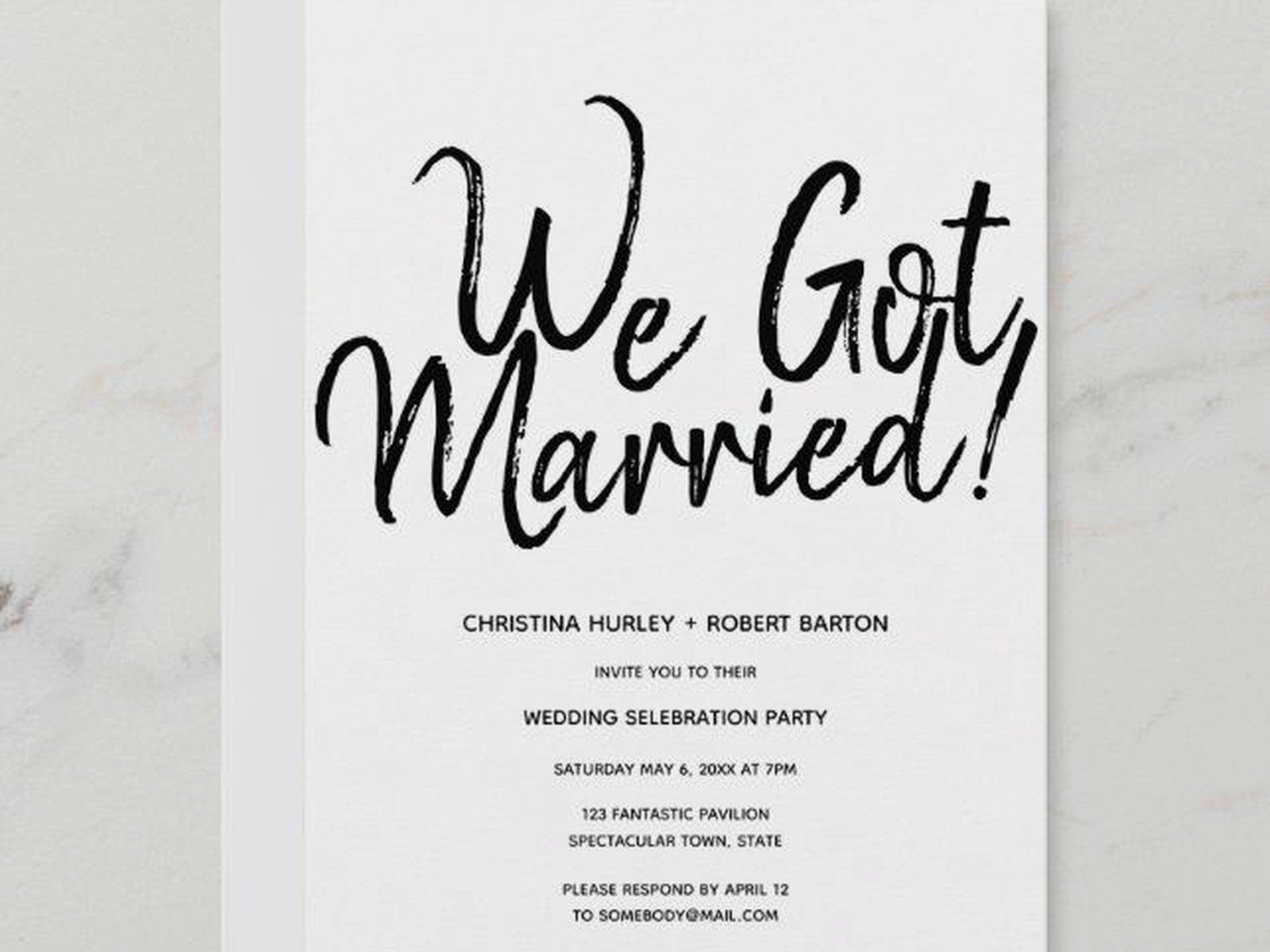
We did it!
Jessica & Michael got married
and we want to celebrate with you!
Join us for dinner, drinks & dancing
June 15, 2024 at 6:00 PM
The Riverside Ballroom, Portland
Couple hosting their own reception:
Jessica Chen and Michael Torres
invite you to celebrate their marriage[rest of details]
You can mix and match formality levels depending on what feels right. Just keep the essential info clear.
Details that people forget
Please put your wedding website on the invitation if you have one. I know some etiquette people say it should only go on details cards but honestly just put it on there so people can find it easily. Include the password if you’ve got one.
Dress code—if your reception is black tie or has a specific theme, SAY SO. People need time to figure out what to wear. If it’s casual, you can say “cocktail attire” or “dressy casual” or whatever. “Festive attire” is becoming popular and I kinda like it because it gives people permission to have fun with their outfit.
Food situation—if you’re doing a cocktail reception with appetizers only (not a full dinner), you should probably indicate that somehow. People will expect dinner if you’re starting at 6 or 7 PM. Something like “cocktails and hors d’oeuvres” or “light bites and beverages” sets expectations.
RSVP cards need thought too
Your RSVP card should have a clear deadline (3-4 weeks before your event), a way for people to indicate their meal choice if you’re doing plated dinner, and space for them to write their names. I always include a number line like “_____ of _____ guests will attend” where you fill in the second number with how many people from that household you’re inviting, because otherwise people will try to bring extra guests you didn’t invite.
Online RSVPs are easier to track than mail-in cards. I’m just gonna say it. You can see in real-time who’s responded, send reminders to people who haven’t, and you don’t have to decipher anyone’s handwriting. Plus people are more likely to actually respond when they can do it from their phone.
If you’re doing mail-in RSVP cards, include a pre-stamped envelope. Yes it costs more but your response rate will be way higher.
Proofing is where mistakes happen
Read your proof like seventeen times. Have other people read it. Check the date, the year (people mess up the year ALL THE TIME), the venue name and address, the time. Make sure AM/PM is correct. Verify that names are spelled right.
I had a client almost order 200 invitations with the wrong venue address because she was looking at two different locations and used the wrong one in the design. We caught it but only because her mom happened to notice. That would’ve been a disaster.
Check that your RSVP deadline makes sense and gives you enough time to get final counts to your caterer (usually they need numbers a week before).
Postage is more annoying than you think
A standard invitation might need extra postage if it’s heavy or oversized. Take a finished invitation to the post office and have them weigh it before you buy stamps. Square envelopes cost more to mail (they’re considered irregular). Wax seals are pretty but they can get damaged in mail sorting machines and they definitely require hand-canceling which means extra postage.
Forever stamps are your friend because then you don’t have to worry about postage rate changes between when you buy them and when you mail.
For RSVP envelopes, just use regular stamps. You’re already spending enough money.
Oh and mail one invitation to yourself first as a test to make sure everything arrives okay and nothing gets damaged in transit. That’s actually how I figured out that the wax seals on my friend’s invitations were getting smooshed—she mailed me a test one and it arrived looking rough.
Budget real talk
You can spend anywhere from $150 to $1500+ on reception invitations depending on quantity and quality. For 100 invitations, expect:
- Budget option (Vistaprint, Zazzle): $150-250
- Mid-range (Minted, Paperless Post printed): $300-500
- High-end (letterpress, custom design): $600-1200+
That includes basic postage but not extras like calligraphy or fancy envelope liners or whatever.
Digital invitations cost way less, usually $0-150 depending on the platform and how many you’re sending.
You can save money by doing postcard RSVPs instead of cards with envelopes, skipping envelope liners, choosing standard sizes and shapes, and doing your own assembly. Assembly parties with friends and wine can actually be fun, though by the time you’ve done 100 invitations you might disagree with me on that.