
Planning Guides, Style Guide
Christian Marriage Card: Design & Ordering Guide
Jun
Getting Your Christian Marriage Card Design Right
So the first thing you gotta know about Christian marriage cards is that they’re not just regular wedding invitations with a cross slapped on them. I learned this the hard way in summer 2021 when a client came back to me three times because the scripture verse I suggested didn’t match their denomination’s preferred translation and apparently that was a huge deal to her pastor.
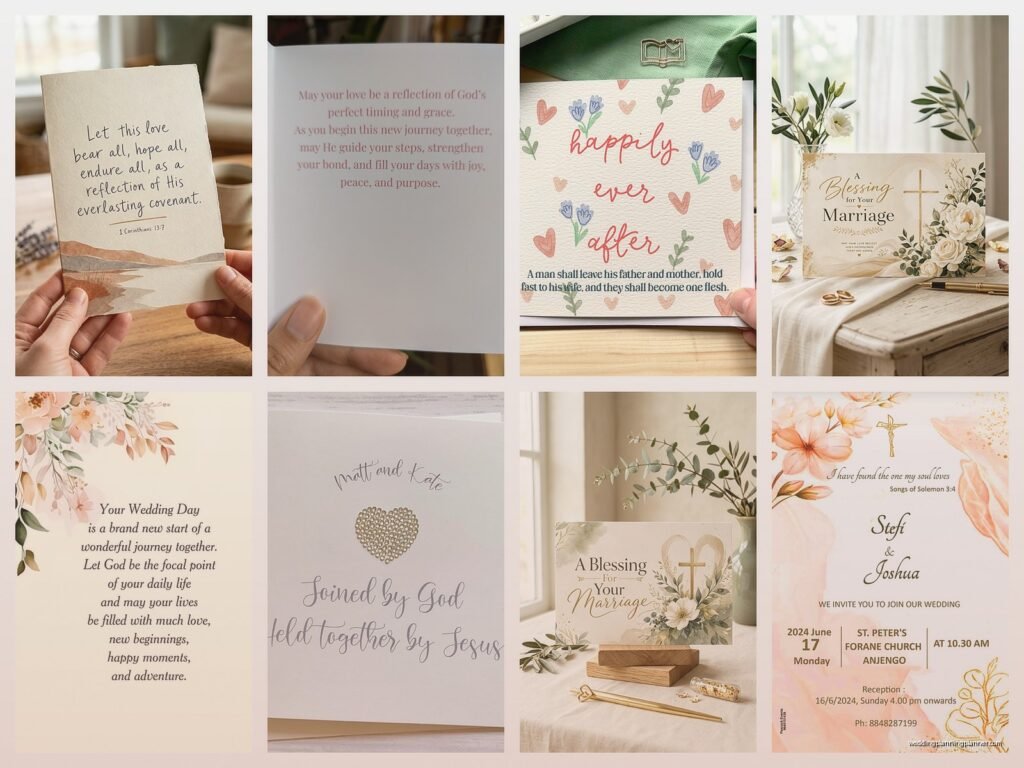
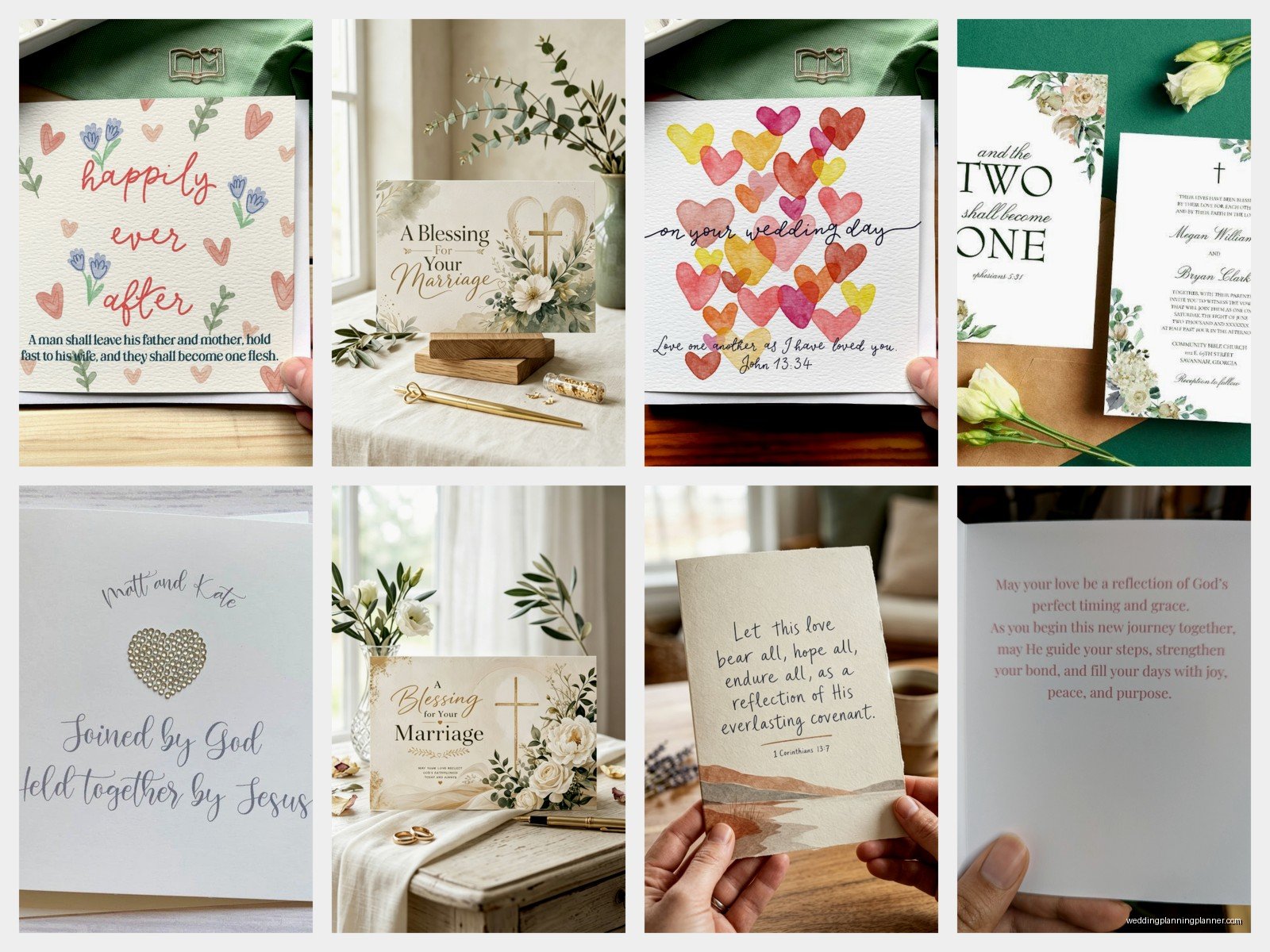
Start with figuring out what kind of Christian imagery you actually want. There’s crosses obviously but also doves, rings intertwined with scripture, praying hands, churches, Celtic knots if you’re going that route. I usually ask couples to send me examples of cards they like because “Christian themed” means wildly different things to different people. Some want subtle, like maybe just a verse at the bottom. Others want the whole card to look like it came straight from a church bulletin board.
Scripture Selection Is Where People Get Stuck
You’re gonna spend way more time on this than you think. The popular ones are 1 Corinthians 13:4-7, Ecclesiastes 4:9-12, Genesis 2:24, and Ephesians 5:25. But here’s what annoys me so much about scripture selection – everyone gravitates to the same five verses and then wonders why their card looks like every other Christian wedding card out there.
I keep a running list of lesser-known but equally beautiful verses. Song of Solomon has gorgeous passages if you pick carefully. Colossians 3:14 is short and sweet. Ruth 1:16-17 if you want something more narrative. Just make sure you check which Bible translation you’re using because the wording can be really different between NIV, KJV, ESV, NKJV, and others.
Also you need to confirm with your church or officiant if they have preferences about this. Some denominations are particular about which translations they consider appropriate for formal church documents, which technically your invitation kinda is since it’s inviting people to a religious ceremony.
Design Elements That Actually Matter
Colors matter more than you’d think. I usually steer people toward classic combinations – ivory and gold, white and silver, navy and blush. But if your church has specific colors or your ceremony has a theme, factor that in. Had a bride once who wanted purple everything because that was her church’s Lent color and she was getting married during Lent, which was… a choice, but we made it work.
Font selection is where people either nail it or make their cards look like a church PowerPoint from 2003. You want something readable but elegant. Script fonts are fine for names and maybe the verse, but don’t do the entire card in script unless you want your guests squinting. I usually combine a serif font for the main information with a script accent font for names or the verse.
The layout needs to flow logically. Typically I do: couple’s names at top, maybe a small cross or design element, then the invitation wording, ceremony details, scripture verse, and reception information. You can flip this around depending on what you want to emphasize, but that order makes sense to most people’s eyes.
Ordering Timeline And Quantities
Order your cards at least 4 months before the wedding, maybe 5 if you’re doing custom design work. This gives you time for proofs, revisions, printing, addressing, and mailing. You’re supposed to send wedding invitations 6-8 weeks before the wedding, so work backward from there.
For quantities, take your guest list and add 20-25 extra. You’ll mess up addressing some, you’ll want keepsakes, family members will ask for extras. It’s way cheaper to order extras upfront than to do a second print run. Trust me on this one.
Spring 2023 I had a couple who ordered exactly the number they needed with zero extras because they wanted to save money, then the groom’s mom wanted 10 copies to send to relatives who weren’t invited but “should know about it” and we had to do a rush reorder that cost triple the original price per card. Just order the extras.
Digital vs Print Shop vs Online Services
You’ve got basically three routes here. Local print shops give you the most hands-on help and you can see paper samples in person, which matters more than people think. The weight and texture of cardstock changes the whole feel of a card. 110lb cardstock is standard, 130lb feels more premium.
Online services like Minted, Shutterfly, Zazzle, or Etsy are gonna be cheaper usually and they have tons of Christian-specific templates. The downside is you can’t feel the paper quality beforehand and color matching can be weird. What looks ivory on your screen might print as straight up beige.
Digital invitations are becoming more acceptable even for church weddings, but honestly I still think a Christian wedding card should be physical. There’s something about holding a tangible invitation to a sacred ceremony that feels right, but maybe that’s just me being old-fashioned at 40… my cat knocked over my coffee while I was designing cards last week and I was more upset about the ruined paper samples than the coffee everywhere, so yeah, I care about physical cards maybe too much.
Customization Options To Consider
Foil stamping looks incredible on Christian wedding cards, especially for crosses or the couple’s monogram. Gold foil on navy or deep green cardstock is chef’s kiss. It does add cost though, usually $1-3 per card depending on how much foiling you do.
Letterpress is another option if you want that classic, traditional feel. The text is literally pressed into the paper so you can feel it. Very elegant, very traditional, very expensive. We’re talking $8-15 per invitation sometimes.
Ribbons, wax seals with cross stamps, vellum overlays – these all add to the cost but can make your invitations feel more special. Just don’t go overboard or your card starts looking like a craft store exploded on it.
Envelope liners are an underrated detail. You can get them printed with subtle scripture text, cross patterns, or even a favorite hymn’s sheet music as a background. It’s a nice surprise when people open the envelope.
Wording That Works
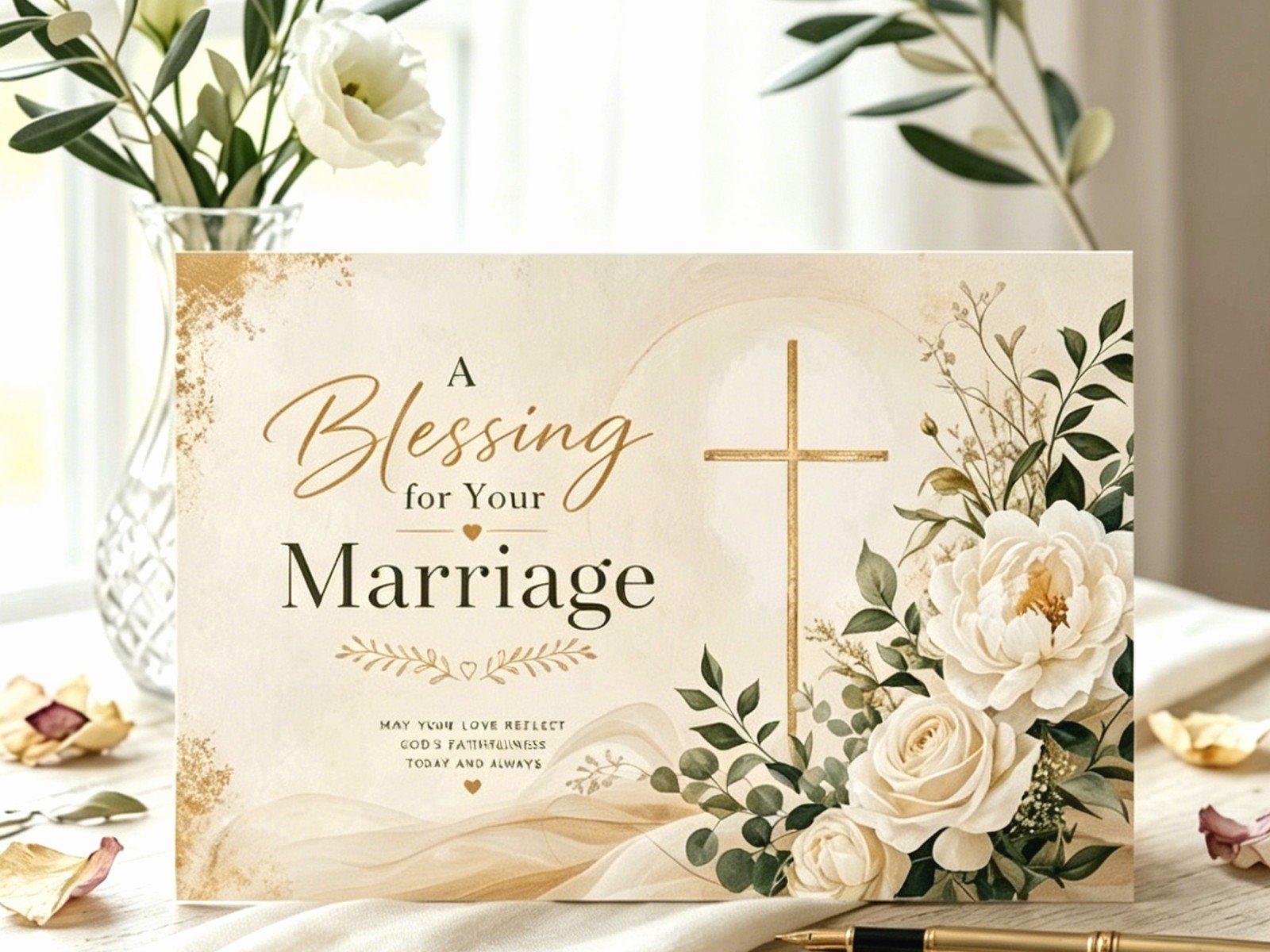
The traditional Christian wedding invitation wording goes something like: “Together with their families, [Bride] and [Groom] request the honor of your presence at their marriage ceremony as they unite in Christ…” but you can adjust this based on who’s hosting and your personal style.
If parents are hosting traditionally, it’s “Mr. and Mrs. [Parents] request the honor of your presence at the marriage of their daughter…” Some couples do “Together with their parents” to acknowledge both families without getting into complicated family situations.
You need to include: who’s getting married, who’s inviting people (if relevant), date, time, ceremony location with full address, reception information, and dress code if applicable. The scripture verse can go anywhere but I usually put it at the bottom or on the back of the card.
For the ceremony location, write it out fully: “First Baptist Church, 123 Main Street, Yourtown, State.” Don’t abbreviate unless you have serious space constraints. People are gonna be using this for GPS directions even though you’ll probably also include a details card.
The Insert Cards Situation
You’re probably gonna need insert cards and honestly this is where organization gets messy but bear with me. Most Christian wedding invitations include:
- Main invitation card
- Reception card (if ceremony and reception are different locations)
- Response card with stamped return envelope
- Details card (hotel information, website, parking details)
- Sometimes a map card though honestly everyone uses Google Maps now so this feels kinda outdated
The response card should have a deadline that’s at least 3-4 weeks before your wedding. Give people a pre-addressed, pre-stamped envelope or they won’t send it back, I promise you this.
Some couples include a card explaining the significance of their ceremony traditions, especially if they’re doing something like a unity candle or communion as part of the service. This helps guests who might not be familiar with Christian wedding traditions understand what’s happening.
Addressing And Mailing
Handwritten addresses look best but if your handwriting is terrible (no judgment, mine’s not great either), you can do printed labels or hire a calligrapher. There are also services that will print directly on envelopes in fonts that look handwritten.
Inner and outer envelopes are traditional for formal weddings. The outer envelope has the mailing address, the inner envelope has just the names and tells people exactly who’s invited. Like if you’re not inviting kids, the inner envelope only lists the parents’ names. This prevents confusion about whether kids are included.
Get your invitations weighed at the post office before you buy stamps. Once you add all the inserts and any ribbon or embellishments, you might need extra postage. Square envelopes cost more to mail than rectangular ones because they can’t go through automatic sorting machines. This is annoying but it’s USPS policy.
Mail invitations on a Monday or Tuesday so they don’t sit in a facility over the weekend. And mail yourself one first to make sure everything arrives intact and looking good.
Common Mistakes I Keep Seeing
Not proofreading enough. Have at least three different people read your proof before approving it for printing. I once had a couple approve a proof where the ceremony time said “4:00 MA” instead of “4:00 PM” because they read it so many times they stopped actually seeing the words.
Choosing fonts that are too small. If your older relatives need reading glasses, they definitely need readable fonts on your invitation. Nothing smaller than 10pt for body text.
Forgetting to include a wedding website. Even for traditional Christian weddings, a website is super helpful for FAQs, registry information, and updates. Put it on the details card, not the main invitation.
Not considering mail time for international guests or elderly relatives who might need extra time to make travel arrangements. If you’ve got guests who’ll need to travel far or book hotels, get those invitations out earlier.
Budget Breakdown Reality Check
For 100 invitations, you’re looking at roughly $200-400 for basic quality cards from online services, $400-800 for local print shop with decent paper and some customization, or $800+ if you want letterpress, foil stamping, custom illustration, the works.
Add in postage (figure $0.70-1.00 per invitation depending on weight), response card postage ($0.66 each), addressing services if you use them ($1-3 per envelope), and any ribbon or wax seals. It adds up faster than you expect.
You can save money by doing digital RSVPs through your wedding website instead of including response cards. Some people think this is too casual for a church wedding, but honestly it’s becoming pretty standard and it’s way easier to track responses.
Working With Designers
If you hire a stationery designer (hi, that’s literally my job), bring examples of what you like, your wedding colors, your venue photos if you have them, and the scripture verse you want to use. The more information upfront, the better.
Expect 2-3 rounds of revisions. First round is usually getting the overall design right, second is tweaking details and wording, third is final proofing. If you need more than three rounds, designers typically charge extra.
Ask to see their portfolio of Christian wedding work specifically, because designing for a Christian wedding does require understanding the symbolism and tone. You don’t want someone who’s gonna suggest something that feels more suited to a garden party than a church ceremony, or worse, someone who doesn’t understand why certain imagery matters to you.
Get everything in writing – timeline, number of revisions included, what happens if you need rush service, who handles printing. I usually provide design services and then send the final files to a printer I trust, but some designers handle the whole process.
Alright, I think that covers the major stuff you need to know about Christian marriage card design and ordering. There’s obviously more details depending on your specific denomination or family traditions, but this should get you started without making costly mistakes or ending up with invitations that don’t reflect the sacred nature of what you’re celebrating.