
Planning Guides, Style Guide
Invitation Card Muslim: Design & Ordering Guide
Jun
Understanding Muslim Wedding Invitation Requirements
So the first thing you gotta know about Muslim wedding invitations is that they’re not just pretty cards – they actually carry religious and cultural weight that varies depending on where the couple’s families are from. I learned this the hard way back in spring 2023 when I designed what I thought was a gorgeous invitation for a Pakistani couple and the groom’s mother nearly had a heart attack because I’d included imagery that was too ornate for their specific preferences.
Muslim wedding invitations typically need to include specific Islamic phrases and blessings. The most common one you’ll see is “Bismillah ir-Rahman ir-Rahim” which means “In the name of Allah, the Most Gracious, the Most Merciful.” Some families want this prominently displayed at the top, others prefer it smaller. You need to ask because assumptions will bite you.
Another phrase that shows up a lot is “Masha’Allah” (God has willed it) or verses from the Quran about marriage. The specific verse that gets used most often is from Surah Ar-Rum (30:21) about spouses being a source of tranquility for each other. But here’s where it gets tricky – some families want the Arabic text, some want transliteration, some want English translation, and some want all three which can make your layout…
Cultural Variations You Need to Know About
This is where I see people mess up constantly and it drives me absolutely nuts. Muslim isn’t a monolith. A Moroccan Muslim wedding invitation looks completely different from an Indonesian one, which looks nothing like a Turkish one.
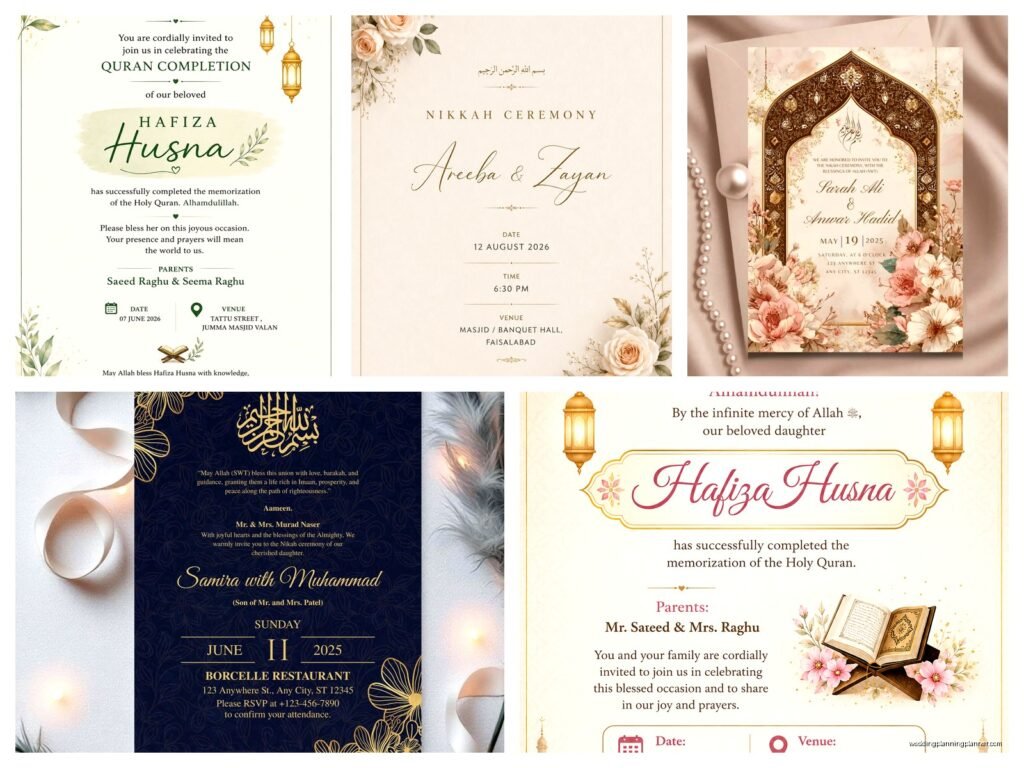
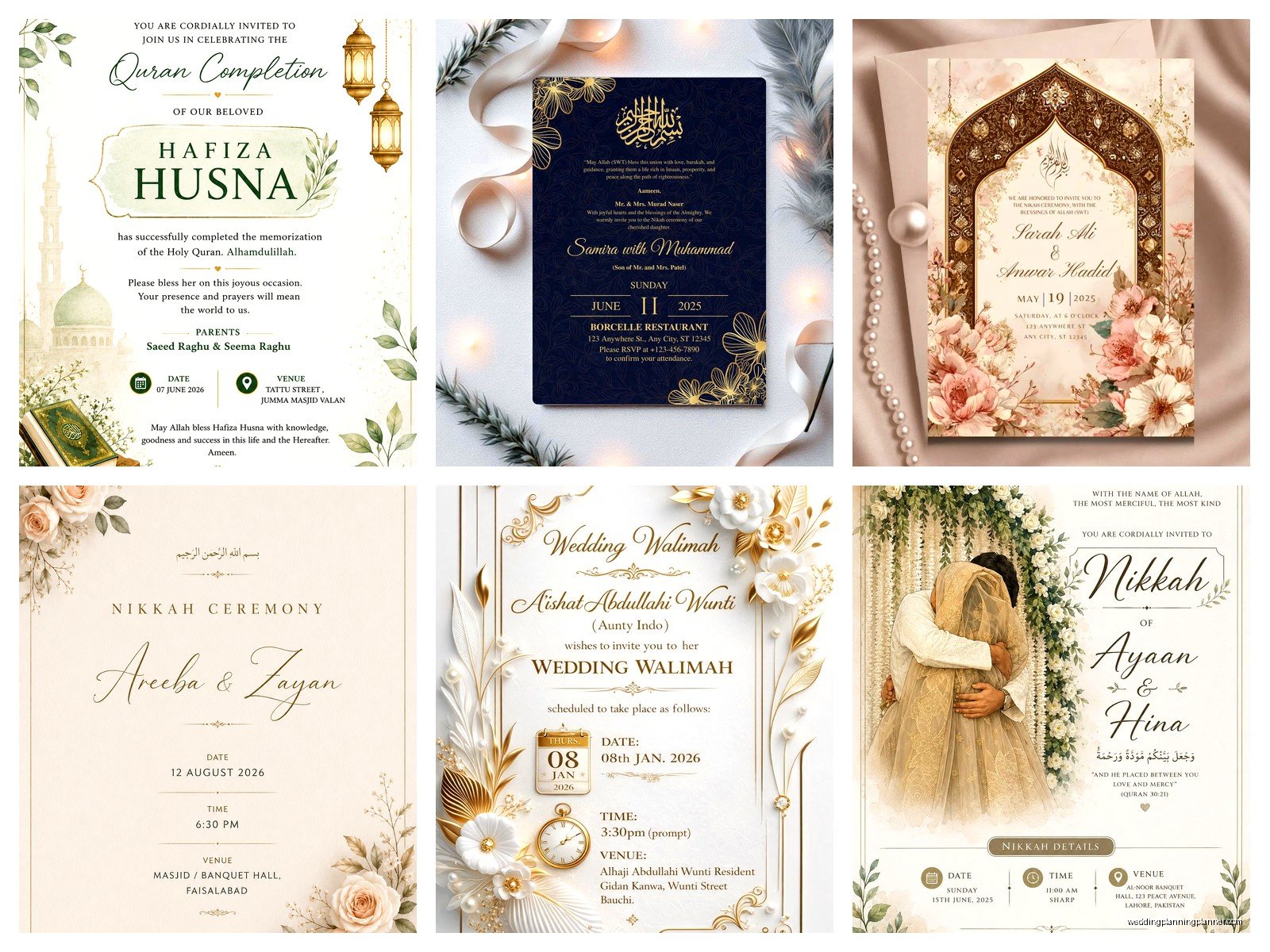
Pakistani and Indian Muslim invitations tend to be elaborate with lots of gold foiling, intricate borders, and sometimes they include multiple events – the Mehndi, Nikah, Walima – all on separate insert cards. These can get pricey because you’re basically ordering 3-4 different card designs in one suite.
Arab Muslim invitations (Lebanese, Egyptian, Saudi, etc.) often lean more minimalist with elegant calligraphy and less ornamentation. They focus heavily on the Arabic script being perfect and beautiful. I worked with a Lebanese bride once who rejected three rounds of proofs because the calligraphy wasn’t the right style even though it looked identical to me.
Turkish invitations sometimes incorporate traditional Ottoman designs and motifs. Indonesian and Malaysian ones might include batik patterns or specific color combinations that have cultural meaning.
You really need to have a proper conversation with the couple about their specific cultural background and what their families expect. Don’t just google “Muslim wedding invitation” and call it a day.
Design Elements That Actually Matter
Colors are a whole thing. While Western weddings default to white or pastels, Muslim invitations embrace rich jewel tones. Deep emerald green is super popular because it’s associated with Islam. Royal blue, burgundy, gold, and purple show up constantly. Some families have specific color preferences based on their region or just personal taste.
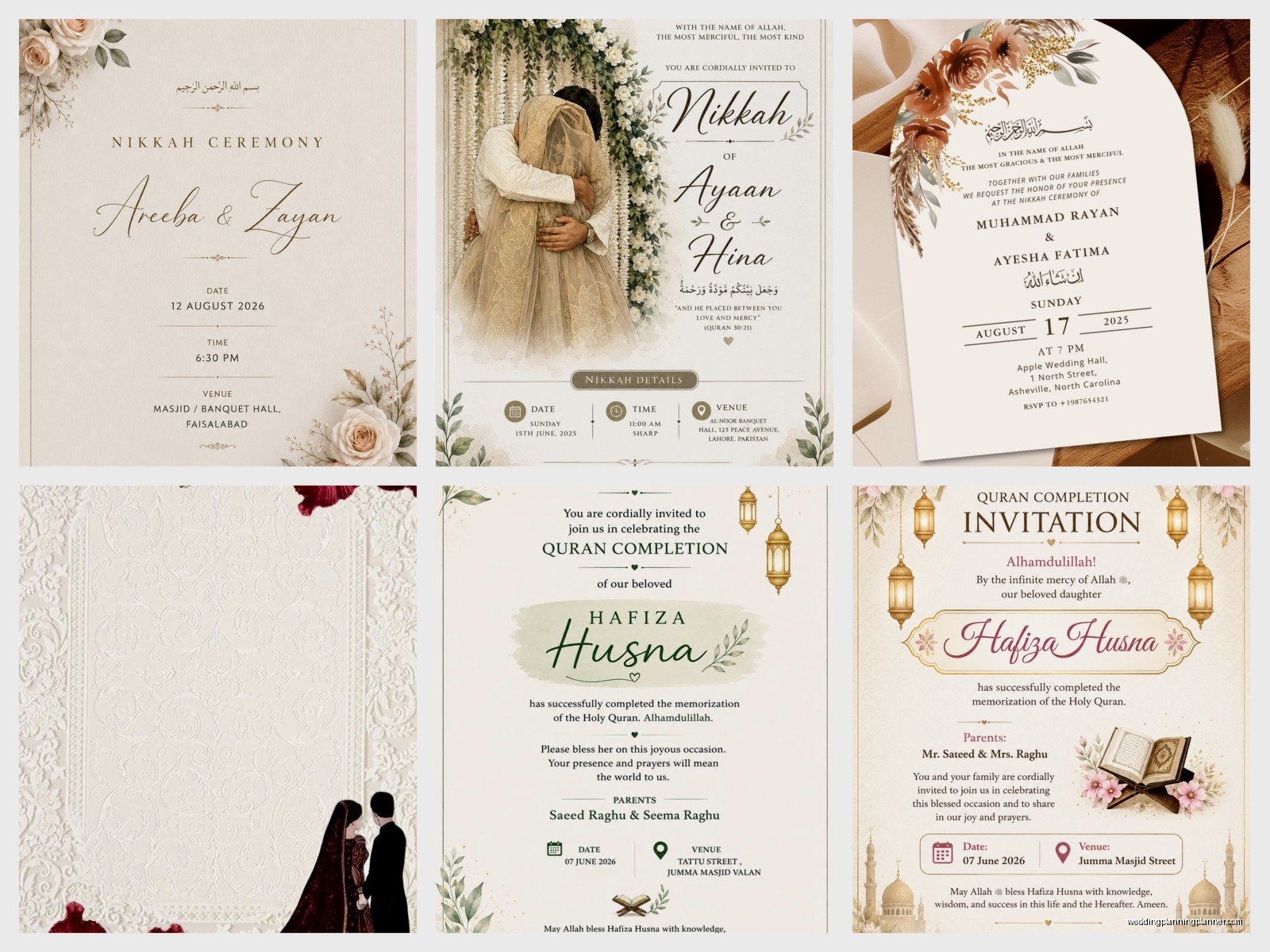
Imagery is where you need to be careful. Unlike Christian or Hindu weddings where you might include illustrations of the couple or religious symbols, many Muslim families prefer abstract designs. No images of people or animals in most cases. Geometric patterns, floral motifs, and arabesque designs are your safe bet. That said – and this is gonna sound contradictory – some modern Muslim couples are totally fine with illustrated portraits or photos on their invitations, especially for the Walima reception cards.
Calligraphy is non-negotiable for formal Muslim weddings. If you’re including Arabic text, you absolutely must hire someone who knows Arabic calligraphy or use a proper Arabic font. Google Translate and random fonts will produce gibberish or worse, accidentally offensive text. I’ve seen it happen and it’s mortifying for everyone involved.
What Information Goes On The Card
Standard info includes the couple’s names (sometimes the bride’s name comes first, sometimes the groom’s – ask about family preference), parents’ names, date, time, venue. But there are specific things to watch for.
The wording often includes phrases like “request the honor of your presence” or “invite you to share in their joy.” Some families use “With the blessings of Allah and our parents” as an opening line.
For the Nikah ceremony specifically, you might need to include whether it’s a women-only ceremony or mixed gathering. This matters because some guests need to know how to dress and whether male family members can attend.
Dress code is important to specify. If the family expects modest dress, it’s helpful to note “modest attire appreciated” or something similar. For the Mehndi, you might specify “traditional attire welcome” to encourage guests to wear cultural clothing.
RSVP information needs to be crystal clear because Muslim weddings often involve large guest counts and catering needs to be precise, especially if they’re serving halal meat which can’t be wasted.
Timing and Ordering Logistics
Muslim weddings don’t always follow the “Saturday evening” Western wedding formula. Nikah ceremonies can happen any day of the week, sometimes even on weekday afternoons. Friday holds special significance as the holy day, so some families prefer Friday evening celebrations.
You should order invitations at least 4-5 months before the wedding date. This gives you time for design, proofs, printing, assembly, addressing, and mailing with enough notice for guests to make travel arrangements. Muslim weddings often draw guests from across the country or internationally, so people need time to plan.
For the love of everything, build in extra time for approval rounds. I’ve had Muslim wedding invitation projects that went through 7-8 rounds of revisions because multiple family members needed to weigh in. The couple loves it, but then the parents want changes, then the aunties have opinions… it’s a process.
Printing Methods and Paper Quality
Thermography and foil stamping are popular for Muslim wedding invitations because they create that raised, luxurious effect that photographs well. Digital printing works fine for budget-conscious couples but won’t have the same tactile quality.
Letterpress is gorgeous but expensive and not always necessary unless the couple is going for a super high-end aesthetic. I usually recommend it only if the budget allows because the design can be stunning without it.
Paper weight matters more than you’d think. Go for at least 110lb cardstock for the main invitation. Anything thinner feels cheap and doesn’t hold up well if you’re doing foiling or embossing. Some families want the invitation to feel substantial in hand – it’s a respect thing.
Metallic papers and shimmery finishes are totally acceptable and actually pretty common. Don’t shy away from gold or silver cardstock if it fits the design.
Where to Actually Order These
Minted and Paperless Post have Muslim wedding invitation templates now, which is kinda helpful for basic needs but they’re pretty generic. You can customize them to an extent but you’re limited in how much you can personalize the Islamic elements.
Etsy has tons of designers who specialize in Muslim wedding invitations and understand the cultural nuances. I’ve worked with several Etsy sellers who are themselves Muslim and they just get it in a way that mainstream stationery companies don’t. Plus they’re usually more flexible with customization.
Local printers in areas with large Muslim populations often have experience with these invitations and might have sample books you can look through. They also tend to have connections with calligraphers and can handle Arabic text properly.
For high-end custom work, seek out stationery designers who list Muslim weddings in their portfolio. Check Instagram hashtags like #muslimweddinginvitations or #islamicweddinginvitations to find designers whose aesthetic matches what you’re going for.
Budget Considerations
Muslim wedding invitation suites can range from $3 per set for basic digital printing to $25+ per set for fully custom letterpress with foiling and multiple inserts. The average I see is around $8-12 per invitation suite.
Guest counts for Muslim weddings are often larger than typical Western weddings – I’m talking 200-400 guests regularly – so your invitation budget needs to account for volume. A $10 per invitation cost becomes $4,000 for 400 guests real quick.
Ways to save money: skip the envelope liners, use digital printing instead of letterpress, reduce the number of insert cards by putting multiple events on one card, or do a postcard style invitation for less formal events like the Mehndi.
One thing that annoyed me recently was a couple who wanted museum-quality invitations but had a $500 total budget for 300 invitations. The math just doesn’t work and I had to have an awkward conversation about expectations versus reality. My cat literally knocked over my coffee during that video call which somehow made it less tense but still.
Assembly and Addressing
Muslim wedding invitations often come with multiple pieces – the main invitation, RSVP card, details card, maybe separate cards for different events, and sometimes a map or accommodations card. You need a system for assembling these so nothing gets mixed up.
I recommend laying out all components in order and doing an assembly line process. Put the largest card on bottom, stack smaller cards on top, wrap with any belly bands or ribbons, then insert into the envelope.
For addressing, many Muslim families have specific preferences about titles. “Mr. and Mrs.” is standard but some families use “Dr.” or religious titles. Extended family often gets invited as whole family units – “The Ahmed Family” rather than listing each person’s name.
Inner envelopes aren’t always necessary but they’re traditional for very formal Muslim weddings. They protect the invitation and allow you to specify exactly who’s invited (“Mr. and Mrs. Rahman and family” on outer, “Sarah, Omar, and Layla” on inner so they know the kids are included).
Digital Invitations – Are They Okay?
This depends entirely on the family’s level of formality and tradition. Some families see physical invitations as non-negotiable – it’s a sign of respect and proper hospitality. Others, especially younger couples or those having smaller celebrations, are totally fine with digital invitations.
For the main Nikah ceremony, I usually recommend physical invitations unless budget is absolutely tight. For pre-wedding events like the Mehndi or post-wedding Walima, digital invites via email or WhatsApp are becoming more acceptable.
If you go digital, use a platform that allows for elegant design and proper display of Arabic text. Paperless Post works well, or you can create a custom PDF and send it via email. Just make sure any Arabic text displays correctly on different devices.
Common Mistakes to Avoid
Don’t assume all Muslim weddings are the same – I can’t stress this enough after that spring 2023 disaster I mentioned earlier.
Don’t use random Arabic text without having it verified by someone fluent. Seriously. Google Translate will betray you.
Don’t skip the proof reading stage. Muslim names can have multiple spellings in English and you need to confirm the exact spelling the family wants.
Don’t forget to account for international guests who might need extra time to receive physical invitations or arrange visas for travel.
Don’t cheap out on envelope quality if you’re doing foil or embossing on the invitation itself – the envelope is the first thing people see and it sets expectations.
Working With Vendors
When you contact invitation vendors, be specific about what you need. Say “I’m looking for Muslim wedding invitations with Arabic calligraphy and traditional Islamic design elements” rather than just “wedding invitations.” This helps them understand your needs from the start.
Ask to see samples of previous Muslim wedding work. If they don’t have any, that doesn’t automatically disqualify them but it means you’ll need to provide more guidance and references.
Discuss the approval process upfront. Make sure they understand that multiple family members might need to approve the design and that Arabic text needs to be verified by someone who reads Arabic fluently.
Get everything in writing – timeline, number of proof rounds included, exact quantities, pricing breakdown. Muslim wedding invitation projects can get complex and you don’t want surprises.
The whole process takes patience but when you get those invitations back from the printer and they’re perfect – with the calligraphy flowing beautifully and the colors exactly right – it’s sorta magical seeing something that honors both the couple’s faith and their personal style.
