Planning Guides, Style Guide
Wedding Invitation Card: Traditional Format Design Guide
May
The Outer Envelope First Because That’s What Everyone Sees
So the outer envelope is basically your first impression and you don’t want to mess this up. Traditional format means you’re going formal here—no nicknames, no abbreviations except for the usual ones like Mr., Mrs., Dr. The full name goes on there with their full address.
For a married couple with the same last name it’s “Mr. and Mrs. John Smith” if you’re going super traditional, but honestly in spring 2023 I had this bride who got SO upset when her future mother-in-law insisted on this format because the bride was like “I have a name too?” and yeah, I get it. You can also do “Mr. John Smith and Mrs. Sarah Smith” or even “Mr. and Mrs. John and Sarah Smith” which feels like a compromise.
Different last names? “Ms. Sarah Jones and Mr. Michael Brown” works perfectly fine. Alphabetical order or put the person you’re closer to first, whatever feels right.
The return address goes on the back flap, and here’s something that annoyed me for YEARS—people putting return address labels on formal invitations. Just no. Get it printed or hire a calligrapher or at minimum use a nice pen. Those Avery labels look cheap and this is your wedding invitation, not a utility bill.
Inner Envelope Is Where You Can Breathe a Little
The inner envelope is more casual (relatively speaking). This is where you’d put “Mr. and Mrs. Smith” or even just “John and Sarah” if you want. The inner envelope also tells people who exactly is invited—like if you’re inviting kids, their names go here. “Mr. and Mrs. Smith, Emma, and Lucas” makes it clear the whole family is coming.
If you’re NOT inviting kids, you just put the adults’ names. No “and family” because that’s vague and people will assume their kids are invited anyway and then you’ve got a mess on your hands.
The Actual Invitation Card Layout
Alright so the invitation itself follows a pretty specific order and format. Traditional invitations are usually 5×7 inches or 5.5×7.5 inches, printed on heavy cardstock—I’m talking 110lb cover weight minimum. Anything lighter feels flimsy.
The text layout goes like this from top to bottom:
Host Line: This is who’s hosting (usually who’s paying, let’s be real). Traditional format is the bride’s parents hosting so it reads “Mr. and Mrs. Robert Hart request the honour of your presence” but nowadays it might be both sets of parents, or the couple themselves, or some combination.
If both parents are hosting: “Mr. and Mrs. Robert Hart and Mr. and Mrs. James Mitchell request the honour of your presence”
If the couple is hosting: “Together with their families” or “Ms. Emma Hart and Mr. David Mitchell request the pleasure of your company”
One thing—it’s “honour” with a U for the ceremony and “honor” without for the reception, apparently, though I’ve seen people do it both ways and… honestly does anyone actually notice? Probably just me.
The Request Line
For a religious ceremony it’s “request the honour of your presence” and for a non-religious ceremony or reception it’s “request the pleasure of your company.” This is one of those rules that’s kinda outdated but traditional invitations still follow it.
The Couple’s Names
Bride’s name traditionally goes first (unless it’s two grooms or two brides, then alphabetical or whatever you prefer). Full names, no nicknames.
“at the marriage of their daughter Emma Louise Hart to David James Mitchell”
or if the couple is hosting:
“Emma Louise Hart and David James Mitchell request the pleasure of your company at their wedding”
Middle names are optional but they add formality. I had a groom once who didn’t have a middle name and he was so self-conscious about it, wanted to make one up for the invitation and I was like… nah, just use first and last, nobody’s gonna think it’s weird.
Date and Time
This is where it gets fussy. Everything gets spelled out, no numerals. “Saturday, the fifteenth of June two thousand twenty-four at half after five o’clock in the evening”
The year is actually optional on traditional invitations but most people include it. Time is never written as 5:30pm—it’s always “half after five” or “half past five” or “five-thirty.” And you don’t need “in the evening” if it’s obvious, but it doesn’t hurt.
Capitalize the day of the week and month. The “the” before the date and the “of” after it are optional—”Saturday, the fifteenth of June” or “Saturday, fifteenth of June” both work.
Location
Full name of the venue, no abbreviations. “Saint Mary’s Church” not “St. Mary’s.” Street address is optional if it’s a well-known venue, but city and state are required.
“Saint Mary’s Church, Boston, Massachusetts”
or with the address:
“The Grand Ballroom at The Plaza Hotel, 123 Main Street, New York, New York”
Reception Cards Are Separate Usually
If your reception is at a different location or significantly later, you need a separate reception card. This is smaller, usually 4×5 or thereabouts.
“Reception to follow at The Garden Estate, 456 Park Avenue, Boston”
or if it’s much later:
“Reception at seven o’clock in the evening, The Garden Estate”
If the reception immediately follows at the same place, you can just put on the main invitation “Reception to follow” or “Dinner and dancing to follow” at the bottom.
Response Cards Need Specific Info
The response card (RSVP card) should be simple and clear. Traditional format has a fill-in-the-blank style:
“The favour of a reply is requested by the twenty-fifth of May”
Then a blank line with “M_______” where guests write their names (the M is for Mr., Mrs., Ms., Miss).
“_____ accepts with pleasure”
“_____ declines with regret”
Some people do checkboxes instead which is honestly more clear. And you definitely want a line for number of guests attending if you’re doing plated dinner with meal choices.
Summer 2021 I had a client who didn’t put a date on their RSVP cards and people just… didn’t send them back? Or sent them back like two weeks before the wedding and she was losing her mind trying to get a final count to the caterer. Always put a date, and make it at least 3-4 weeks before the wedding.
The Response Card Envelope
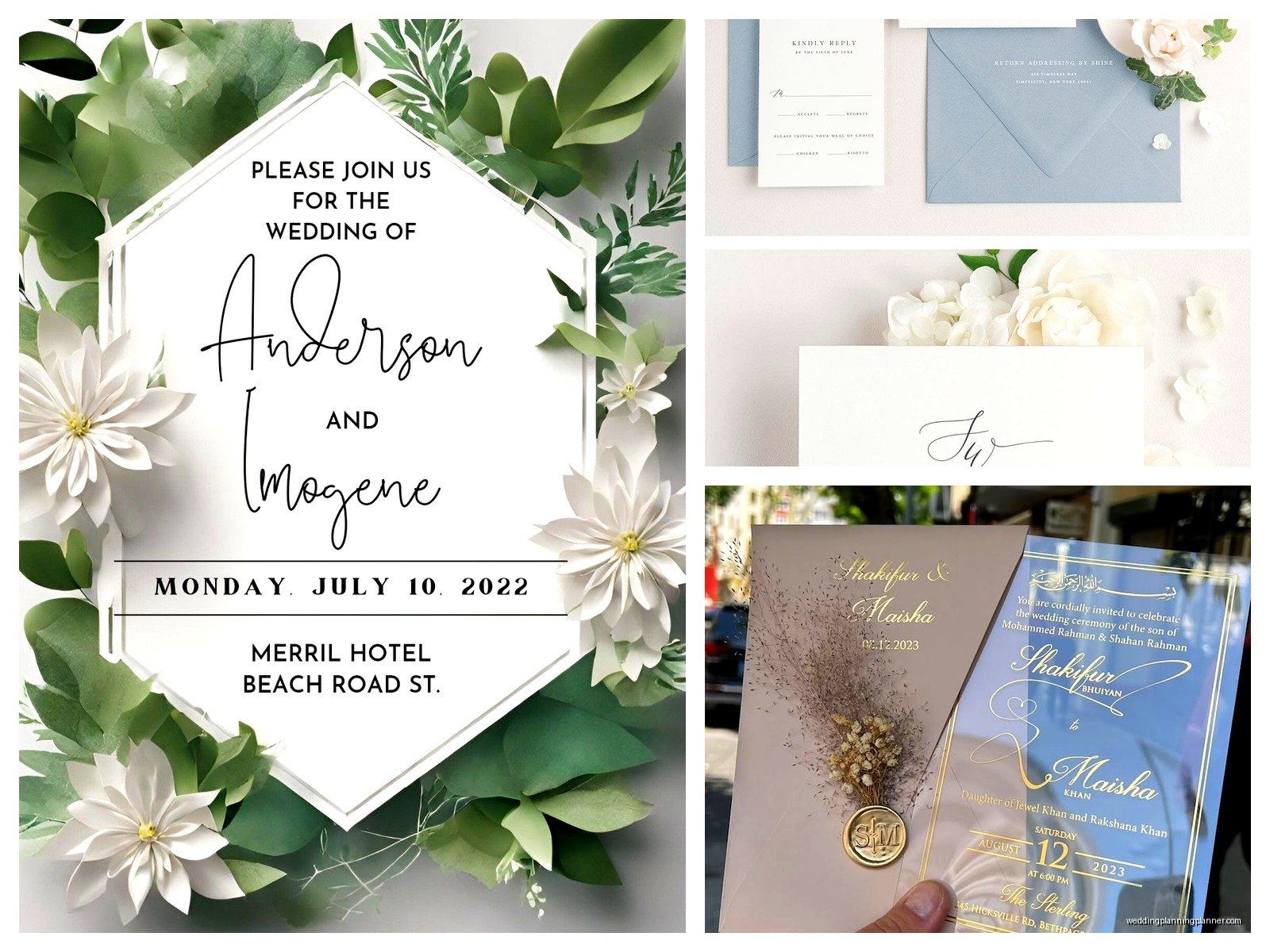
This comes pre-addressed and pre-stamped. You’re asking people to do you a favor by responding, so you pay for the postage. The envelope should have your address (or whoever’s collecting RSVPs) already printed on it.
Other Enclosure Cards You Might Need
Depending on your wedding you might have a bunch of other little cards in there. Keep them all smaller than the main invitation.
Directions card: With a simple map or just written directions. Though honestly with everyone using GPS now these feel sorta unnecessary? But traditional invitation suites include them.
Accommodations card: Lists hotels where you have room blocks, with booking codes.
Weekend events card: If you’ve got a welcome dinner, farewell brunch, whatever. List the events with times and locations.
Website card: This is newer obviously but even traditional invitations often include a small card with the wedding website URL now.
How Everything Goes Together Matters
There’s an actual order for stacking all these cards and it’s gonna sound ridiculous but here we go:
The invitation goes on the bottom, printed side up. Then the reception card goes on top of that (if you have one). Then any other enclosure cards in size order, largest to smallest. The RSVP card goes on top, tucked under the flap of its envelope (which should be face-down so you see the back of the envelope with the return address visible).
Some people use a ribbon or belly band to hold everything together which looks nice but isn’t required for traditional format.
All of this goes into the inner envelope with the printed side of the invitation facing the back flap—so when someone opens the envelope, they see the invitation text immediately.
Then the inner envelope goes into the outer envelope with the guests’ names facing the back flap—same idea, when they open it, they see their names first.
Wording for Different Family Situations
This is where things get complicated and I’m just gonna run through common scenarios:
Divorced parents hosting together: List them separately, mom first usually. “Mrs. Sarah Hart and Mr. Robert Hart request the honour of your presence”
Divorced and remarried parents: Gets messy. “Mrs. Sarah and Mr. Thomas Green and Mr. Robert and Mrs. Jennifer Hart” if both couples are hosting. Or just have the couple host it themselves to avoid the drama, which I recommended to a bride once and she almost cried with relief.
Deceased parent: You can honor them in the wording. “Emma Louise Hart, daughter of Mrs. Sarah Hart and the late Mr. Robert Hart” but honestly this isn’t required in the host line—you can mention them in the ceremony program instead.
Same-sex couples: Alphabetical order by last name, or whoever you’re closer to first. All the same rules apply otherwise.
Typography and Font Choices
Traditional invitations use serif fonts—think engraved-looking, elegant, formal. Script fonts for names, block serif for everything else is a classic combo. Fonts like Copperplate, Garamond, Baskerville, or Didot for the formal text.
Size matters here too. The couple’s names should be the largest text on the invitation, usually 16-18pt. Everything else ranges from 10-14pt depending on importance. Don’t make the font so small people need reading glasses—my cat knocked over a proof once and I didn’t notice the font size had changed to like 8pt until the client pointed it out, thank god before we printed 200 invitations.
Centered alignment is traditional. Everything centered on the page, no left-aligned text unless you’re doing a more modern traditional format (which is like… a contradiction but you know what I mean).
Paper Color and Printing Method
Traditional is white or ecru (that’s cream/ivory). No colors, no patterns on the invitation itself (the envelope liner can have pattern though). Smooth finish or a subtle texture like linen or cotton is good.
Printing method is usually engraving (expensive, creates an indent on the back of the paper), letterpress (pressed into the paper, looks amazing), or thermography (raised printing, more affordable). Flat printing is fine too but doesn’t have that traditional formal look.
Black ink is most traditional, but you can do navy, grey, or match your wedding colors if you want a little personality while staying formal.
Timing for Sending These Out
Mail formal invitations 8-12 weeks before the wedding. If you’ve got a lot of out-of-town guests or a destination wedding, go for 12 weeks or even longer. You want people to have time to make travel arrangements.
Order your invitations at least 4-5 months before you need to mail them. Printing takes time, especially if you’re doing engraving or custom work, and you need time to assemble everything and address envelopes.
Speaking of addressing—hire a calligrapher if your budget allows it. It makes such a difference and saves you hours of hand cramping. If you’re doing it yourself, use a nice pen and practice on scratch paper first. Print address labels are… look, they work, but they’re not traditional.
Assembly Takes Forever Just FYI
Set aside an evening (or three) for assembly. Put on a show or something because it’s tedious. Lay out all your materials in an assembly line—invitation, reception card, other cards, RSVP with envelope, inner envelope, outer envelope. Stack them in order for each guest.
Stuff the inner envelope first, then slide it into the outer envelope. Seal the outer envelope. Add postage—and get those stamps from the post office, make sure you have enough postage because invitation suites can be heavy. Take one fully assembled invitation to the post office to weigh it before you stamp all of them.
Hand canceling is worth asking about at the post office. It means they process your invitations by hand instead of running them through machines that might damage or smudge them. Some post offices do it, some don’t, but it doesn’t hurt to ask.