Planning Guides, Style Guide
Template For Vows: Free Download Files
Sep
Okay So You Need a Vow Template
Look, I’ve been helping couples write their vows since like 2015 and honestly the biggest problem isn’t that people don’t know what to say—it’s that they stare at a blank page for three weeks and panic. That’s where templates come in and I’m gonna give you some actual useful ones you can download.
The thing that really annoyed me about most vow templates online is they’re either SO generic that they sound like a greeting card or they’re weirdly specific like “I promise to always bring you coffee on Sunday mornings while wearing my blue robe” and I’m like… what if you don’t even drink coffee? Or own a blue robe?
Why Templates Actually Help
Back in spring 2023 I had this couple—super sweet, both teachers—and they were literally two days before the wedding with nothing written. The groom kept saying “I’ll just speak from the heart” and the bride was having a full meltdown because she’d written like eight drafts and hated all of them. I sat them down with templates and we had usable vows in 45 minutes. Templates give you structure so your brain stops spinning.
You don’t have to use every line. You don’t even have to use most of it. Think of it like… you know when you’re texting and your phone suggests the next word? Sometimes it’s perfect, sometimes you ignore it, but it keeps you moving forward.
The Basic Structure That Works
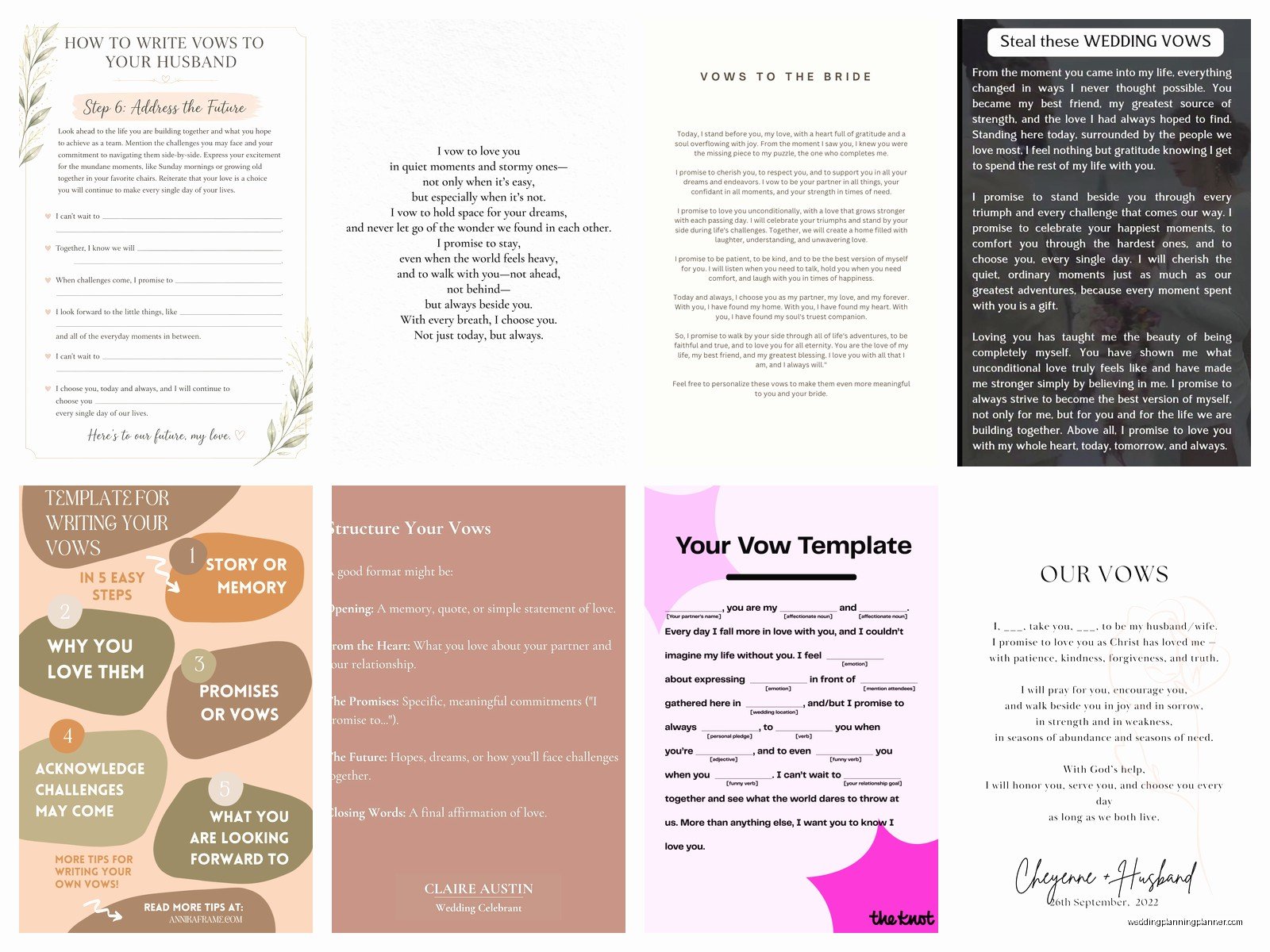
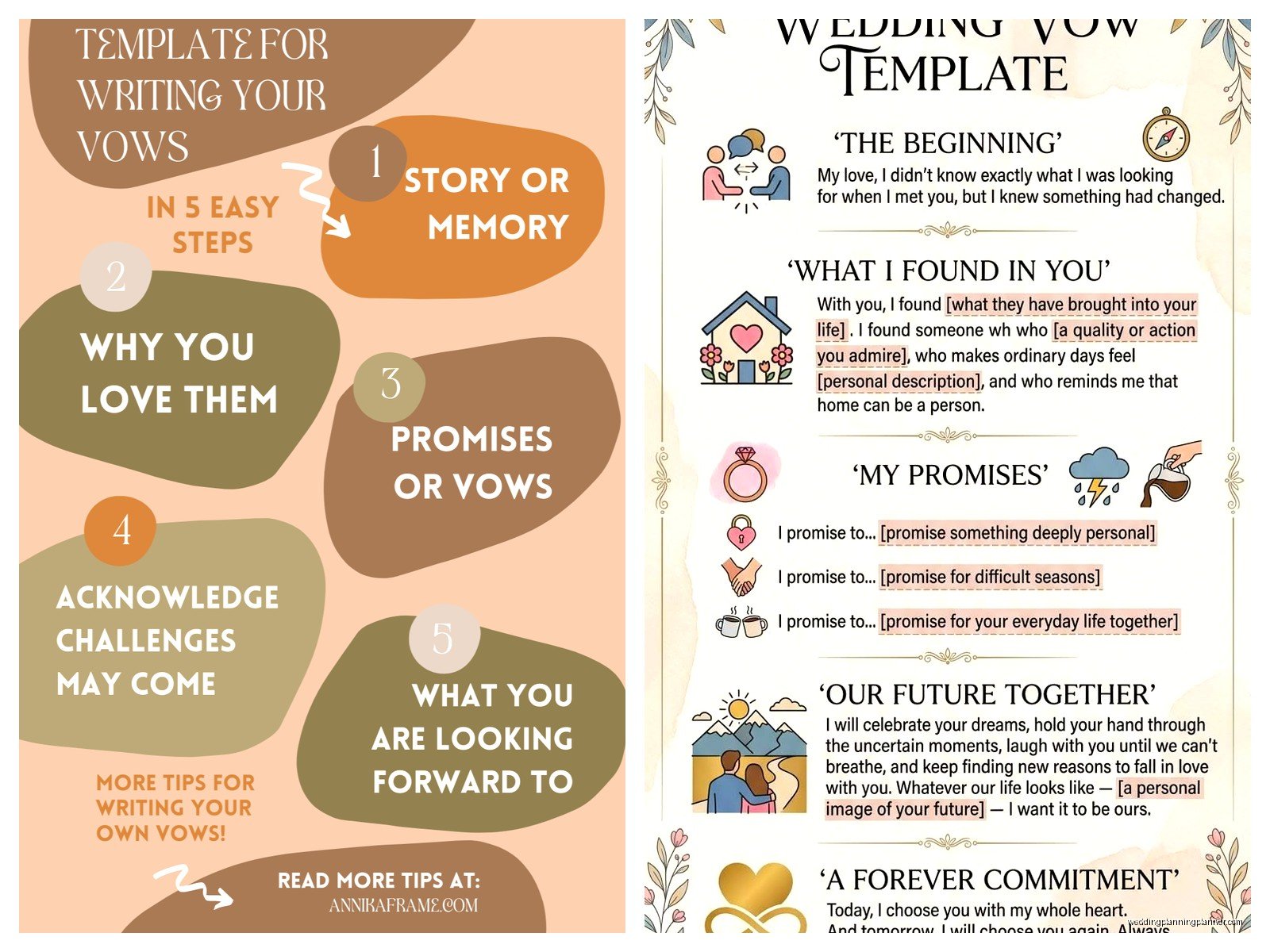
Most good vows follow this pattern and you can mix it up however you want:
- Opening statement (why you’re standing there)
- What you love about them or how they changed you
- Specific promises (the actual vow part)
- Future-looking statement
That’s it. You can do each section in one sentence or five sentences. I’ve seen beautiful vows that were 90 seconds and beautiful vows that were four minutes.
Template One: The Straightforward Classic
This is the one I give to people who just want something simple and heartfelt without getting too flowery. You can literally fill in the blanks:
[Partner’s name], today I marry my best friend.
From the moment [specific memory of when you knew], I knew you were special. You [quality about them], you [another quality], and you [third thing—can be serious or funny].
I promise to [first promise]. I promise to [second promise]. I promise to [third promise].
I will [action verb] you in [circumstance], [action verb] you in [circumstance], and [action verb] you in [circumstance].
I choose you today and every day forward. I cannot wait to [future thing you’re excited about].
See? Not fancy, but it works. The key is filling in those blanks with actual real things from your relationship, not generic stuff like “you make me laugh” unless you add WHY or HOW they make you laugh.
Template Two: The Storytelling Version
Some people are natural storytellers and they need more room to like, paint a picture. This template is looser:
I remember [specific early memory]. I didn’t know then that [what you know now].
You’ve taught me [lesson learned]. Before you, I [how you were before]. Now, I [how you are now].
Today I promise you [promise], even when [challenging circumstance]. I promise you [promise], especially when [challenging circumstance]. I promise you [promise], always.
We’ll [future activity], we’ll [another future thing], and we’ll [third thing]. Through all of it, [your commitment statement].
This one gives you more space to be specific. I had a bride use this template and she talked about how her now-husband taught her that asking for help wasn’t weakness and like… there wasn’t a dry eye because it was SO specific to them.
The Actual Free Downloads
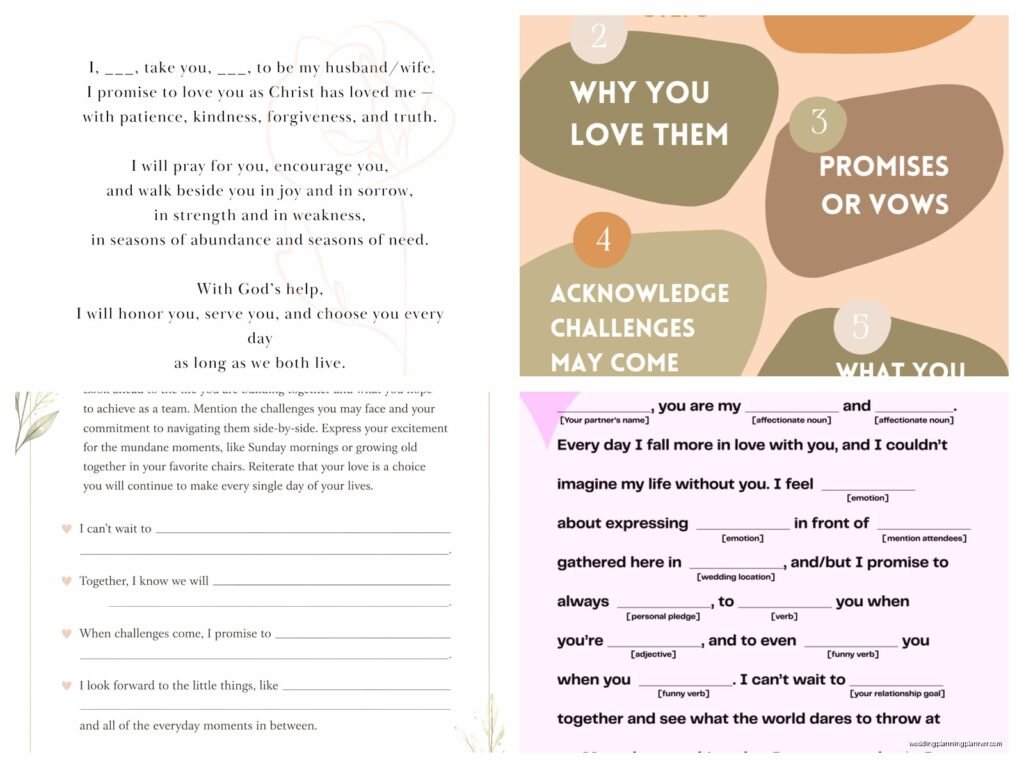
Alright so here’s what I’m giving you access to—these are the same templates I use with my actual clients and you can download them as PDFs or Word docs:
What’s In The Download Pack
- Five different vow templates (including the two above plus three more variations)
- A worksheet with prompts to help you fill in the blanks
- A timing guide so you know if your vows are gonna be 2 minutes or 10 minutes
- Examples of real vows from past weddings (with permission obviously—names changed)
- A “vow mistakes to avoid” checklist because trust me you need this
The files are formatted so you can type directly into them or print them out if you’re more of a handwriting person. I personally like writing the first draft by hand because it feels less… I don’t know, less formal? But that’s just me.
How To Actually Use These Templates
Don’t just download them and then ignore them for three weeks, okay? Here’s what actually works:
Step one: Read through all the templates first without trying to write anything. Just see which one feels most like how you talk.
Step two: Pick ONE template. Don’t try to combine them or use pieces from all five because you’ll just confuse yourself and it’ll sound disjointed.
Step three: Fill in the blanks with the most obvious answers first. Don’t overthink it. If the template says “you make me [emotion]” and the first thing you think is “laugh,” write laugh. You can make it fancier later if you want but probably you shouldn’t because “you make me laugh” is perfect.
Step four: Read it out loud. This is SO important and everyone skips it. If you stumble over a phrase or it sounds weird coming out of your mouth, change it. Your vows should sound like you, not like a poem you memorized in English class.
Step five: Let it sit for a day then read it again. You’ll catch things that don’t flow or promises that feel too generic.
The Prompts Worksheet Explained
The worksheet in the download has questions to help you get specific because that’s where the good stuff is. Questions like:
- What’s something they do that no one else notices?
- What’s a difficult time they supported you through?
- What do you want your life together to look like in 20 years?
- What’s a quirk of theirs that you actually love even though it might seem annoying?
- What did you learn about love from watching them?
You don’t have to answer all of them but answer like three or four and you’ll have material to pull from. My cat just knocked over my water bottle—hang on—okay I’m back.
Template Three: The Promises-Focused One
Some people want their vows to be mostly promises and less storytelling. That’s totally valid:
[Partner], today I vow to you:
I will [promise about daily life]. I will [promise about support]. I will [promise about communication].
When [challenging situation], I promise to [how you’ll handle it]. When [another situation], I promise to [your response]. When [third situation], I promise to [your commitment].
I promise to keep [specific thing that matters to your relationship]. I promise to never [something you’ll avoid]. I promise to always [something you’ll maintain].
These are my vows to you, today and all our days.
This format is good if you’re not comfortable with a lot of emotional vulnerability in front of people. The promises themselves are intimate but the structure keeps it contained, you know?
Common Mistakes People Make With Templates
Okay so here’s what drives me nuts when people use templates wrong:
They keep all the generic placeholder text. If your vow says “you are kind, generous, and loving” I’m gonna fall asleep. Those words mean nothing. Instead say “you always remember to text my mom on her birthday” or “you gave your jacket to a stranger at the bus stop last winter” or whatever the actual KIND thing is.
They try to make it sound like Shakespeare. Unless you normally talk like that, don’t do it. Your vows should sound like YOU. If you say “gonna” in real life, you can say “gonna” in your vows.
They write completely different vows than their partner. You don’t have to match exactly but if one person writes a 30-second simple vow and the other person writes a 5-minute epic poem, it’s gonna feel weird. Talk to each other about general length and tone.
They make promises they can’t keep. Don’t promise you’ll never argue or never go to bed angry or whatever. That’s not realistic. Promise things like “I’ll always listen to your side” or “I’ll work through disagreements with you” instead.
The Timing Guide Thing
In the download there’s a timing guide because this matters more than you think. Read your vows out loud at normal speaking pace (not rushed because you’re nervous) and time yourself. Here’s the breakdown:
- Under 1 minute: Probably too short unless you’re going for minimalist
- 1-2 minutes: Perfect sweet spot for most ceremonies
- 2-3 minutes: Still good but getting long
- 3-4 minutes: Only if you’re both doing this length and you’re confident speakers
- Over 4 minutes: Nah, cut it down
I had a groom in summer 2021 who wrote SEVEN MINUTES of vows and didn’t tell anyone. His bride had written 90 seconds. It was so awkward and she was trying not to cry but also kinda annoyed and you could see it on her face. Don’t be that guy.
Template Four: The Lighthearted But Still Meaningful
Not everyone wants super serious vows and that’s totally fine:
[Name], I’m standing here trying not to cry/laugh/pass out [pick one], but here goes:
You [funny or sweet thing they do]. You also [another thing]. Somehow you [achievement or quality] while also [endearing quirk].
I promise to [realistic promise with light humor]. I promise to [another promise]. And I absolutely promise to [third promise, can be funny or sweet].
I can’t promise everything will be perfect, but I can promise [your actual commitment]. Let’s do this.
This template works if your relationship has a lot of humor in it and you want that to come through. Just make sure there’s actual heart in there too—it shouldn’t be ALL jokes.
How To Personalize Any Template
The whole point of templates is they’re a starting point, not the ending point. Here’s how to make any template actually yours:
Add specific dates or places: Instead of “when we met” say “that Tuesday in March at the coffee shop on 5th Street”
Use your actual words: If you call your partner “babe” or “love” or their name or whatever, use that. Don’t switch to formal language that isn’t you.
Include inside jokes (carefully): One or two references that your guests might not get is fine. Seven references that only you two understand is too much—your guests will feel left out.
Reference real events: “Remember when we got lost in Portland and ended up at that weird diner” is so much better than “we’ve been through a lot together”
Change the order: If the template starts with promises but you wanna start with a memory, flip it around. The structure is a guide, not a rule.
Template Five: The Non-Traditional One
For people who want to skip the traditional format entirely:
Before you, [how life was]. With you, [how life is now].
You are [specific thing], [another specific thing], and [third thing].
I choose [what you’re choosing]. Not because [what it’s not about], but because [what it is about].
We’ll build [what you’re building together]. We’ll face [what you’ll face]. We’ll become [what you’ll become].
This is my promise: [your commitment in your own words].
This one is the most flexible and works if you really wanna do your own thing but still want some structure to start from.
What To Do The Week Before
You should have your vows done at least a week before the wedding. Not the night before, not the morning of—a week before. Here’s why:
You need time to practice saying them out loud multiple times. Not memorizing them word-for-word like a script, but getting comfortable with the flow. I usually tell people to practice in front of a mirror at least three times, then practice in front of one trusted person who will give you honest feedback.
Print them out or write them on a nice card. Even if you think you’ll memorize them, have them with you at the ceremony. Your brain will blank from nerves and that’s totally normal. I’ve seen it happen to the most confident people.
Some couples print them in a large font (like 16 or 18 point) so they’re easy to read if their hands are shaking. Smart move honestly.
Real Talk About Using Templates
Some people feel like using a template is cheating or less authentic and that’s just… not true. Writers use prompts. Musicians use chord progressions. Chefs use recipes and then make them their own. Templates are tools, and tools help you create something good instead of staring at a blank page having an existential crisis about love and commitment.
The best vows I’ve heard weren’t necessarily the most original—they were the most honest and specific. A template can help you get to that honesty faster by taking away the pressure of creating something from absolute scratch.
Also like, you’re already planning a whole wedding. You’re dealing with seating charts and vendor contracts and your aunt who won’t RSVP. Using a template for your vows isn’t taking the easy way out—it’s being smart with your energy so you can focus on making the actual words meaningful.
Where To Get The Downloads
You can find these templates on my website—I keep them updated with new versions based on feedback from couples. They’re actually free, not “free but give us your email and we’ll spam you forever.” Just download and use them however you need to.
I also have a version specifically for same-sex couples that removes gendered language, and versions in a couple different tones (formal, casual, poetic, straightforward). Pick whatever matches your vibe.
The files work on any device and you can edit them as many times as you want. Save multiple versions if you’re trying different approaches—sometimes you gotta write three bad drafts before you get to the good one and that’s completely normal.