Planning Guides, Style Guide
Muslim Invitation Card: Design & Ordering Guide
Jun
Getting Started With Muslim Wedding Invitation Cards
Okay so Muslim wedding invitations are actually kinda different from regular Western ones and I learned this the hard way back in spring 2023 when a client came to me literally three weeks before their Walima and I had NO idea about the specific terminology that needed to go on the card. Like, I’d done hundreds of weddings but this was my first proper Muslim ceremony and wow, there’s a lot more to consider than just slapping some pretty calligraphy on cardstock.
First thing you gotta know is that Muslim weddings usually have multiple events, so you’re probably not ordering just ONE invitation. You might need separate cards or at least different inserts for the Nikah (the actual marriage contract ceremony), the Walima (the reception that follows), and sometimes a Mehndi ceremony or other pre-wedding events. Some families combine everything on one card with multiple event details, but honestly, separate cards look more organized and less cluttered.
The Bismillah and Islamic Elements
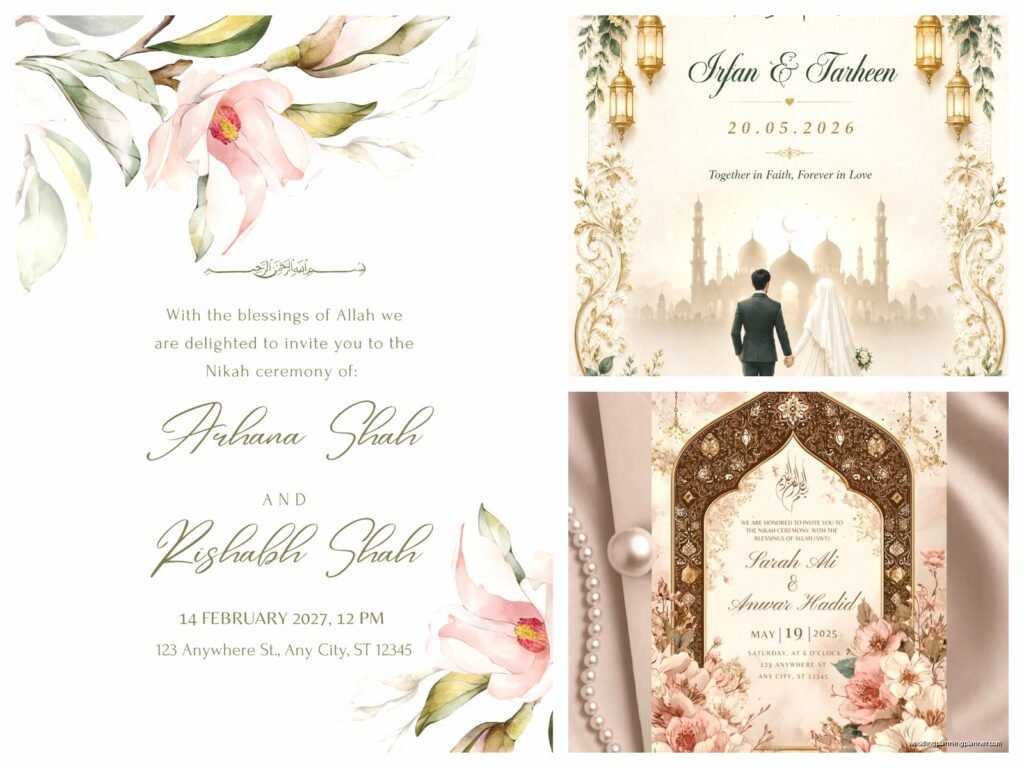
Most Muslim invitation cards start with “Bismillah ir-Rahman ir-Rahim” which means “In the name of Allah, the Most Gracious, the Most Merciful.” This goes at the very top, usually in Arabic calligraphy with or without the English translation underneath. You can also use other Islamic phrases like “Masha’Allah” or verses from the Quran, but Bismillah is pretty standard.
The Arabic calligraphy is gorgeous but here’s what annoyed me so much when I first started ordering these – SO many online designers get the calligraphy wrong or use decorative fonts that aren’t actual Arabic script. You need to verify with someone who can read Arabic that it’s correct, because printing 150 invitations with a misspelled Bismillah is… not great. I always ask clients now if they have a family member who can double-check before we go to print.
Wording Differences You Need To Know
The wording on Muslim invitations is different from Christian or secular ones. Instead of “request the honour of your presence,” you’ll typically see phrases like “request the honor of your presence at the Nikah ceremony of their children” or “invite you to share in their joy.” The word “children” is important here because traditionally, the parents are the ones extending the invitation, not the couple themselves.
For the Nikah ceremony specifically, you want to mention that it’s the Nikah. Don’t just say “wedding ceremony” because that’s vague. The format usually goes something like:
Mr. and Mrs. [Bride’s Parents’ Names]
request the honor of your presence
at the Nikah ceremony of their daughter
[Bride’s Name]
to
[Groom’s Name]
son of Mr. and Mrs. [Groom’s Parents’ Names]
Then you include the date, time, and venue. One thing that’s different is you might want to include the Hijri date alongside the Gregorian date, especially for more traditional families. There are online converters for this, just Google “Hijri date converter” and you’re good.
Design Elements and Color Choices
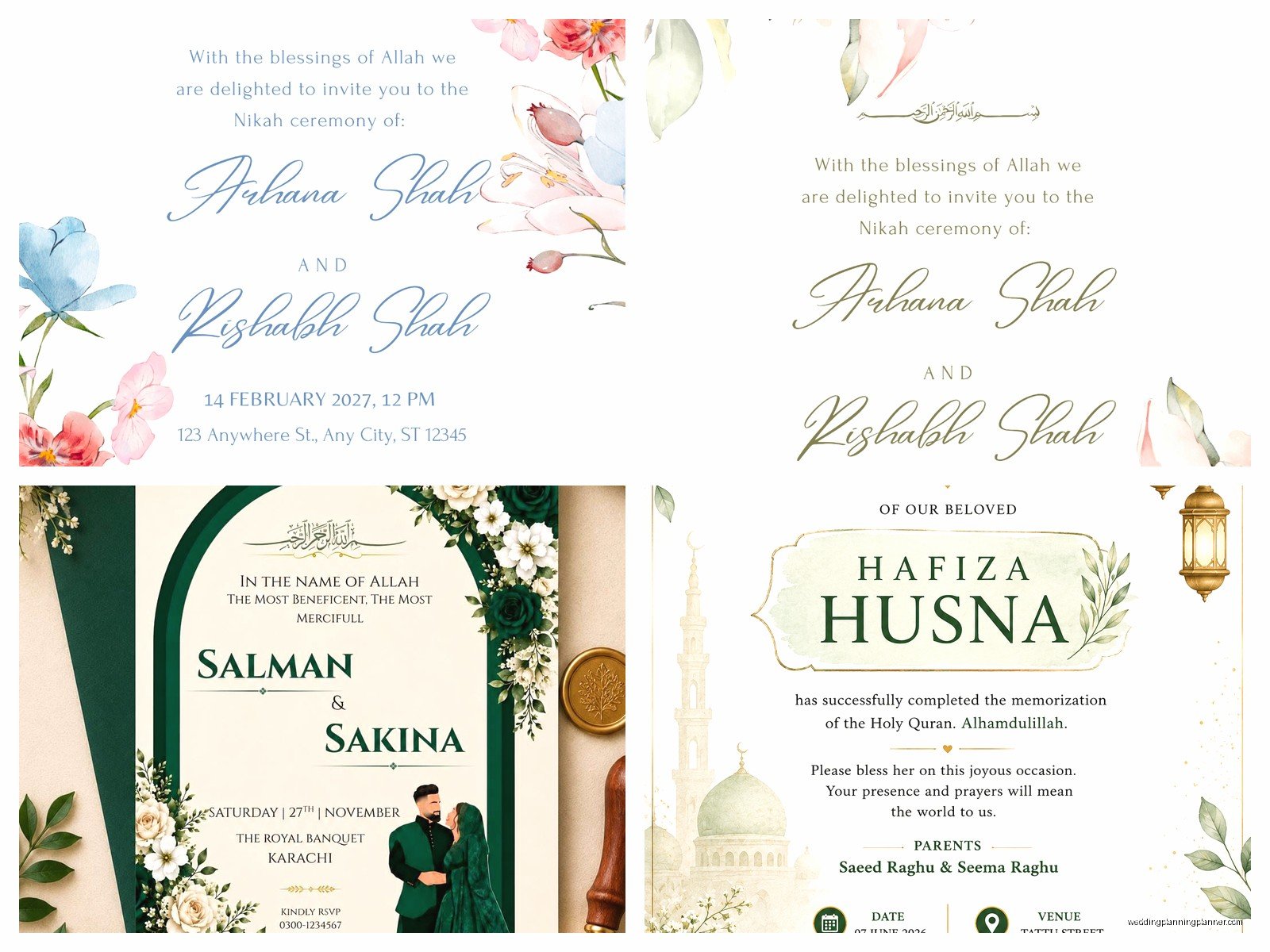
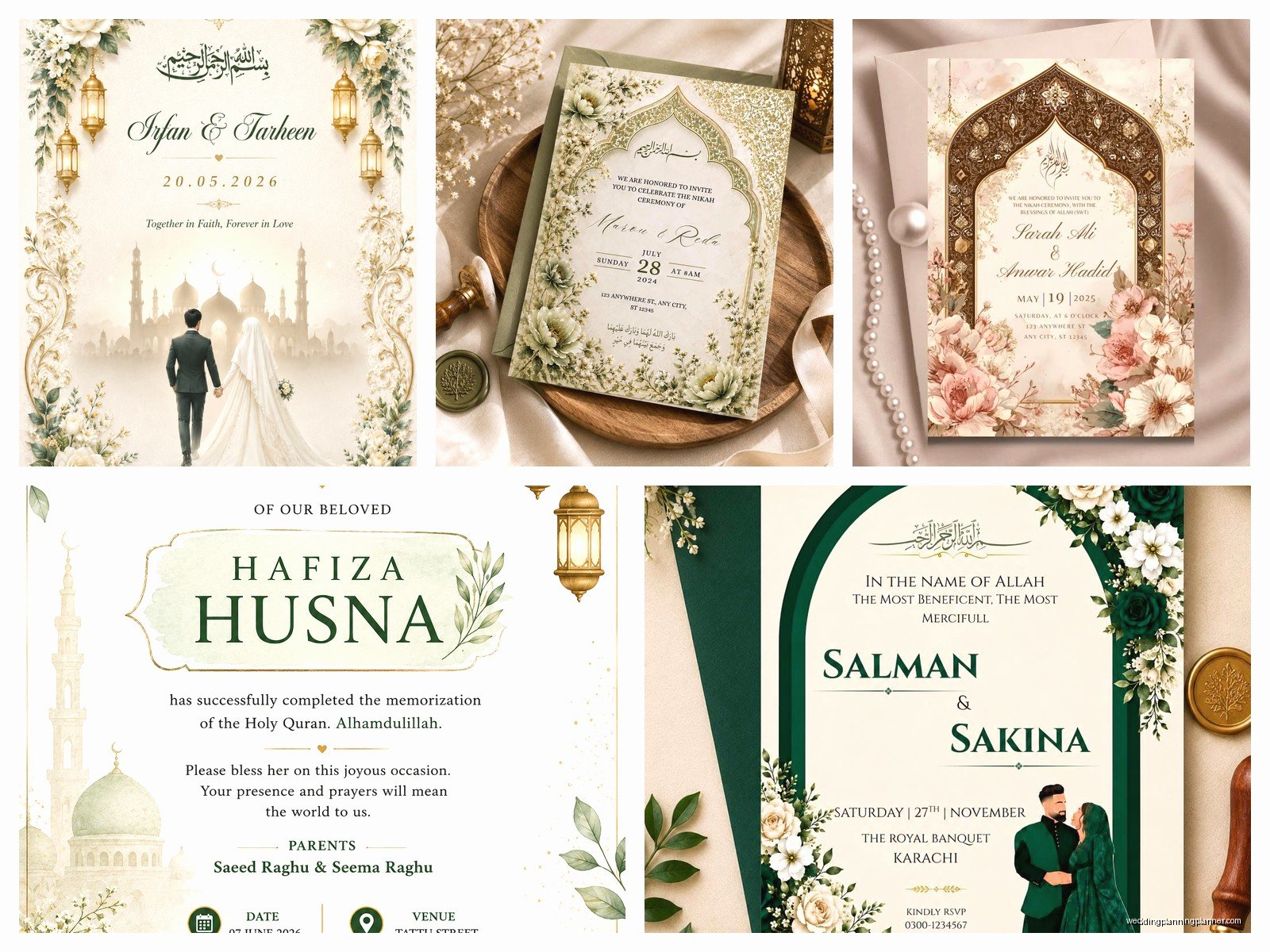
Color-wise, you see a lot of emerald green, gold, royal blue, burgundy, and cream in Muslim wedding invitations. Green is particularly significant in Islam, but honestly, you can use whatever colors match your wedding theme. I had a client who did a gorgeous dusty rose and gold combination that was absolutely stunning.
Design elements often include geometric Islamic patterns (arabesques), mosque silhouettes, crescent moons, or floral motifs. The geometric patterns are my favorite because they’re intricate but not overly religious if you’re going for something more subtle. You’ll also see a lot of mandala-style designs which work really well with the overall aesthetic.
Calligraphy is huge. Like, if there’s one place to splurge on design, it’s the calligraphy. Both Arabic and English calligraphy can be incorporated, and it just elevates the whole look. Some designers do this beautiful thing where they blend Arabic script with English in a way that flows together, and it looks like art.
Physical Card Options
You’ve got options ranging from simple flat cards to elaborate boxed invitations with multiple inserts. Here’s what I usually recommend based on budget:
- Budget-friendly: Flat 5×7 cards, single-sided or double-sided, with digital printing. You can get these for like $1.50-$3 per invitation including envelopes.
- Mid-range: Folded cards or pocket invitations with separate insert cards for different events. Maybe add some foil stamping or a belly band. Around $4-$7 per invitation.
- Luxury: Boxed invitations, laser-cut covers, velvet or silk fabric elements, wax seals, the whole nine yards. These can run $10-$30+ per invitation easily.
I once had a bride who wanted these incredible laser-cut mosque designs on the cover of each invitation and they were STUNNING but also like $18 each and she needed 200 of them, so… yeah, that added up fast. Her parents were happy to pay for it though, and honestly, guests kept those invitations because they were so beautiful.
Where To Actually Order These Things
Okay so where do you order from? You’ve got several options and I’ve tried most of them:
Minted and Zola: They have some Islamic-themed templates now, which is nice, but the selection is kinda limited. Good if you want something simple and you like their paper quality, which is excellent, not gonna lie.
Etsy: This is where I find the most variety. There are tons of designers who specialize in Muslim wedding invitations, and you can often work directly with them to customize everything. Just make sure to read reviews and check their turnaround times because some Etsy sellers are… optimistic about their timelines. I learned this when a designer promised 2-week delivery and it took 6 weeks, which was stressful.
Specialized Muslim wedding sites: There are websites specifically for Muslim wedding stationery like Niyah Cards or Shaadi Bazaar (though availability varies by region). These designers understand the cultural elements automatically, so you don’t have to explain what a Walima is or why you need the Bismillah at the top.
Local print shops: If you have a good relationship with a local printer and a designer, you can create something completely custom. This gives you the most control but also requires the most coordination on your end.
Vistaprint or similar: Nah, I wouldn’t go here for a wedding invitation. They’re fine for birthday parties or whatever, but the quality just isn’t there for something this important, and their templates aren’t really designed with Muslim weddings in mind.
Timeline For Ordering
You need more time than you think. Like, way more. Here’s a realistic timeline:
- 4-5 months before wedding: Start looking at designs and gathering wording details
- 3-4 months before: Finalize design and place order for samples
- 2.5-3 months before: Approve samples and place full order
- 2 months before: Receive invitations (hopefully), assemble if needed
- 6-8 weeks before wedding: Mail them out
Muslim weddings often have pretty long guest lists, so factor in assembly time if you’re doing anything with multiple inserts or embellishments. I spent an entire weekend in summer 2021 helping a client assemble 300 invitations with belly bands and wax seals while my cat kept trying to sit on the pile of envelopes, which was actually hilarious but also not helpful.
What Information Actually Needs To Be Included
Alright, so here’s what you need on the invitation itself or on insert cards:
- The Bismillah or other Islamic opening
- Parents’ names (both sets, usually)
- Bride and groom’s names
- Event type (Nikah, Walima, etc.)
- Date and time (consider including both Gregorian and Hijri dates)
- Venue name and address
- Dress code if there is one
- RSVP information
For multiple events, you can either do separate cards or have a main invitation with insert cards for additional events. I usually recommend the insert route because it keeps everything together and looks more cohesive.
Cultural Considerations and Variations
Muslim weddings vary SO much depending on cultural background. Pakistani weddings are different from Arab weddings are different from Indonesian weddings, and the invitations reflect this. Pakistani invitations often have more elaborate designs with truck art influences or henna patterns. Arab invitations might feature more calligraphy and traditional geometric patterns. South Asian weddings often include the Mehndi and Baraat events, which need their own details.
You should also think about whether your guest list includes non-Muslim guests who might not be familiar with the format. Some couples include a small insert card explaining what a Nikah ceremony is or what to expect, which I think is actually really thoughtful and prevents confusion.
Gender Separation and Event Details
This is something that catches people off guard sometimes – if your Nikah or Walima has separate spaces for men and women, you need to indicate this on the invitation. I’ve seen it worded as “Separate seating arrangements for men and women” or sometimes there are actually separate venue addresses if the events are held in different locations.
Also, prayer times matter. If your event is during a prayer time, some families will include a note about prayer facilities being available or a designated prayer space at the venue. This is especially important for longer events like a Walima that might span multiple prayer times.
Digital vs. Physical Invitations
Okay so I know digital invitations are trendy and environmentally friendly and all that, but for Muslim weddings, I still see mostly physical invitations being sent. It’s a cultural thing – there’s an expectation of receiving a physical invitation, especially from older family members. That said, you can definitely do digital save-the-dates or send digital invites to your younger friends while sending physical ones to family and older guests.
If you do go digital, there are services like Greenvelope or Paperless Post that have some Islamic-themed designs, though again, the selection is limited compared to what you’ll find for physical cards.
Envelope Addressing and Assembly
For addressing envelopes, you’ll probably have a lot of “and family” situations since Muslim weddings tend to include children. Traditional etiquette says to list everyone’s names, but honestly, if you’re inviting a family of six, “The Ahmed Family” is perfectly fine and saves you from trying to fit six names on one envelope.
Some people do calligraphy for envelope addressing, which looks gorgeous but adds cost and time. You can also print directly on the envelopes or use printed labels if you’re going for a more modern look. Just make sure whatever method you choose is legible because I’ve had situations where beautiful calligraphy was so fancy that the post office couldn’t read it and invitations got returned, which was a whole thing.
Assembly-wise, if you have multiple insert cards, the standard order is: main invitation on top, then reception card, then other event cards, then RSVP card with its envelope tucked underneath. All of this goes into the main envelope with the text facing the person opening it. Use a bone folder to crease things neatly if you’re doing folded cards – it makes a difference.
Common Mistakes To Avoid
Don’t forget to order extra invitations. You’ll always need more than you think for last-minute additions, keepsakes, and mistakes. Order at least 15-20 extra.
Double-check all names and dates before going to print. I cannot stress this enough. I once had to reorder an entire batch because the groom’s father’s name was spelled wrong and nobody caught it until after 200 invitations were printed.
Make sure your RSVP deadline is at least 2-3 weeks before the wedding, not like 3 days before. You need time to get final counts to your caterer and venue, and people are slow at responding anyway.
If you’re including a map or directions to the venue, test them. Make sure the address is correct in Google Maps and that your directions actually make sense, because I’ve seen some wild directions on invitation inserts that would’ve led guests to like… a completely different neighborhood.
Watch your postage. If your invitation is heavy or has a wax seal or is an unusual size, it’ll need extra postage. Take a fully assembled invitation to the post office and have them weigh it before you buy stamps for all of them. Nothing worse than having invitations returned for insufficient postage.
Budget Reality Check
Let’s talk actual numbers because this is where people get sticker shock. For 150 invitations, you’re looking at:
- Simple digital printing: $225-$450
- Mid-range with some special finishes: $600-$1,050
- Luxury with all the bells and whistles: $1,500-$4,500+
That’s just for the invitations themselves. Add in postage (currently 68 cents for a regular envelope, more for heavy ones), envelope addressing if you outsource it ($1.50-$3 per envelope for calligraphy), and any assembly costs if you’re not DIYing it.
Honestly though, you can save money by doing assembly yourself, using digital printing instead of letterpress or foil stamping, and keeping the design simpler. The most important thing is that the information is clear and the design is respectful – you don’t need gold-leafed edges to achieve that, even though they do look pretty amazing.
One last thing I’ll mention is that you should keep one invitation for yourself as a keepsake before you mail them all out, because I’ve had so many clients regret not keeping one and then trying to track down an extra from a guest who didn’t throw it away, which is just awkward for everyone involved