Planning Guides, Style Guide
Muslim Wedding Invitation Card Design: Design & Ordering Guide
Apr
The Basics You Actually Need to Know
Okay so Muslim wedding invitations are honestly their own category and if you’re ordering one without understanding the specific requirements you’re gonna run into problems. I learned this the hard way back in spring 2023 when a couple came to me three weeks before their nikah ceremony with printed invitations that had—I kid you not—included imagery that was completely inappropriate for their religious ceremony. They had to reorder everything and the stress was just… anyway.
First thing: Islamic wedding invitations typically need to include specific religious elements. You’ll want to start with “Bismillah” or “Bismillah ir-Rahman ir-Rahim” at the top, which means “In the name of Allah, the Most Gracious, the Most Merciful.” Some families prefer to use the full Arabic calligraphy, others want it transliterated. Ask your couple or your family which they prefer because this matters more than you think.
The wording structure is different from Western invitations. Instead of “Mr. and Mrs. Smith request the honor of your presence,” you’re looking at something like “With the blessings of Allah” or “By the grace of Allah.” The parents’ names usually come first, and there’s often a Quranic verse included—Surah Ar-Rum 30:21 is super popular because it talks about marriage and tranquility between spouses.
Design Elements That Actually Work
Islamic geometric patterns are your friend here. I’m talking about those intricate star patterns, arabesques, and mandala-style designs. They’re gorgeous and they’re culturally appropriate. What annoys me though is when designers just slap on any “Middle Eastern looking” pattern without understanding that some geometric designs have specific meanings or regional associations. Do a tiny bit of research or work with a designer who specializes in this.
Color choices matter culturally. Green is significant in Islam, gold represents prosperity, deep blues and purples are elegant choices. Red is common for South Asian Muslim weddings specifically. White can be tricky because it’s sometimes associated with mourning in some cultures, so—actually, you know what, just ask the family about color preferences because regional differences are huge.
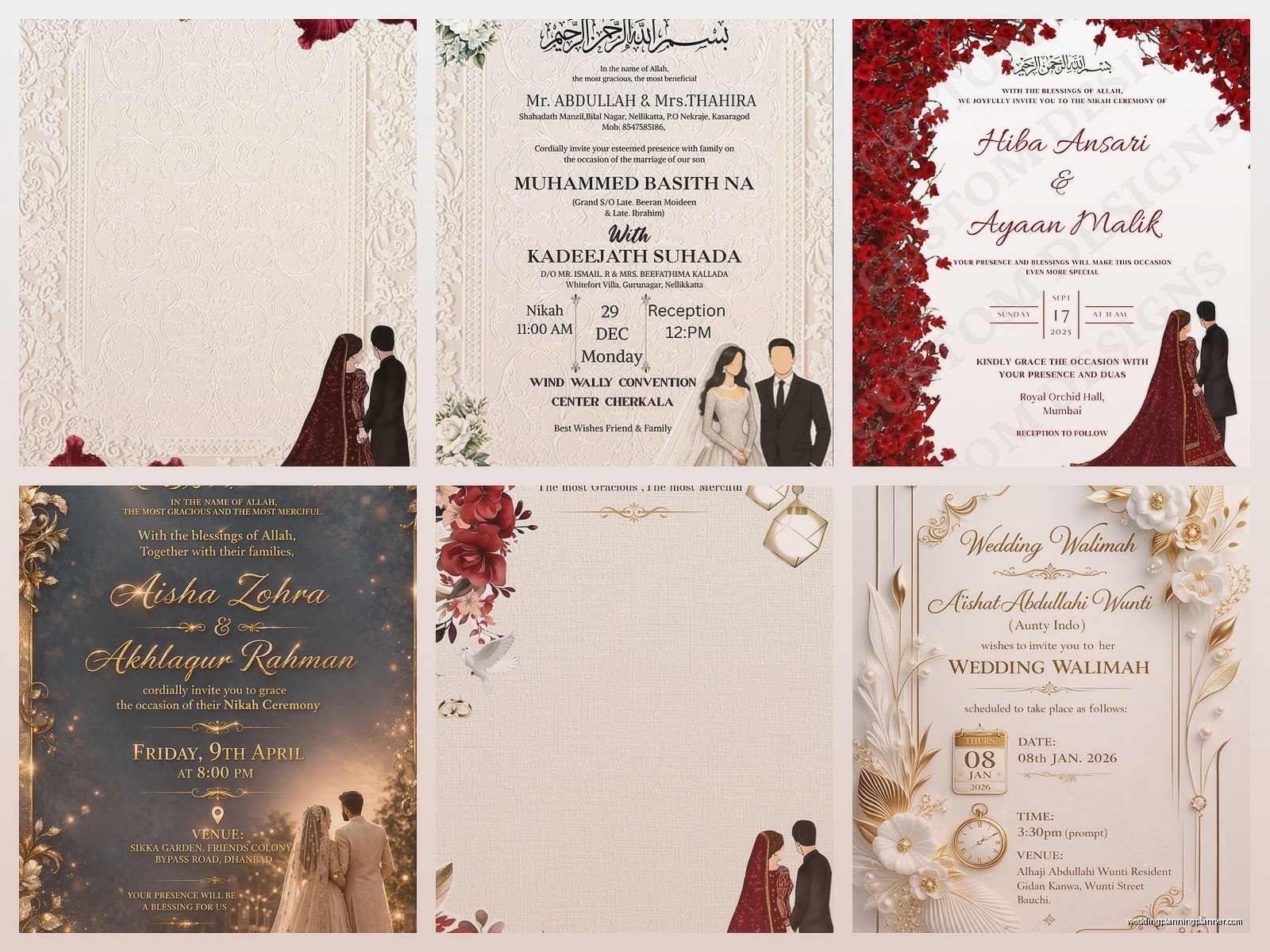
Calligraphy is everything. Arabic or Urdu calligraphy can be the centerpiece of your design. If you’re using calligraphy, please please please have someone who actually reads Arabic check it. I’ve seen invitations with backwards text or grammatically incorrect phrases and it’s embarrassing for everyone involved. There are amazing calligraphers on Instagram and Etsy who can create custom pieces.
What to Skip in Your Design
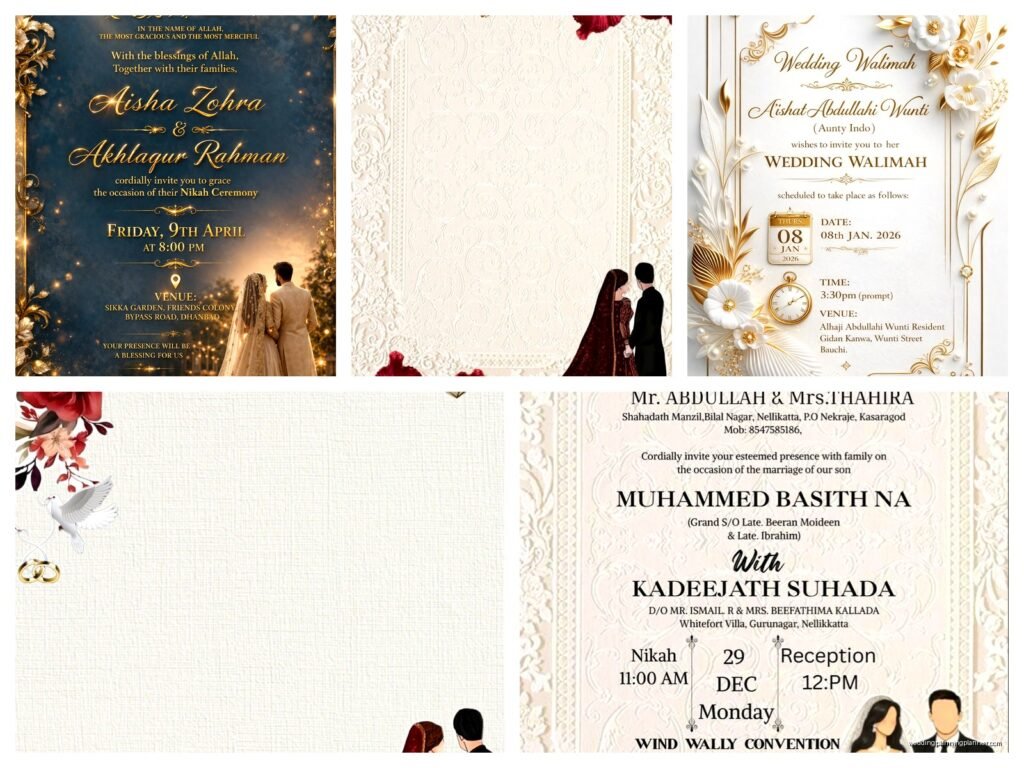
No images of people or animals. This is important. Islamic tradition generally avoids representational imagery of living beings in religious contexts. That means no illustrated couples, no doves, no butterflies as main design elements. Stick with floral patterns (flowers are fine), geometric designs, and calligraphy.
Skip the super minimalist trend if you’re going traditional. Muslim wedding invitations often embrace ornamentation and detail—that’s part of the aesthetic. The minimalist white-space-heavy designs that are trendy right now? They can work for more modern interpretations but traditional families usually want something that feels abundant and decorated.
The Information You Gotta Include
Okay so here’s where it gets specific. You need separate details for potentially multiple events. Many Muslim weddings have:
- Nikah ceremony (the actual religious marriage contract)
- Walima (the reception, usually hosted by the groom’s family)
- Mehndi (henna party, more common in South Asian traditions)
- Other cultural-specific events
Each event needs its date, time, and location clearly listed. The nikah ceremony time is crucial because it’s the religious component—guests need to know if they’re invited to just the walima or to both.
Prayer times matter. If your ceremony is during Jummah (Friday prayer) time, you might want to note that. Some families schedule around prayer times, others incorporate prayer time into the event. I had a wedding once where the invitation included a note about prayer space being available at the venue, which was actually really thoughtful.
Dress code information helps. “Modest attire requested” or “Traditional attire welcomed” gives guests guidance. Some invitations specify that a prayer room will be available so guests should bring appropriate covering if needed.
Format and Size Options
You’ve got options here. Traditional Muslim invitations tend to be more elaborate than typical Western ones. Boxed invitations are super popular—like actual boxes with the invitation inside along with dried dates, sweets, or small gifts. These are gorgeous but they’re expensive and heavy to mail.
Folded cards work well, especially gate-fold or tri-fold designs that create a sense of opening into something special. The unfolding motion kinda mimics opening a gift and gives you multiple panels for all your information.
Scroll invitations are traditional in some regions. They’re literally scrolls tied with ribbon, usually in a decorative box or tube. They’re stunning but not practical if you’re mailing internationally—my cat knocked over a whole batch of these once and they rolled everywhere, it was chaos.
Single-panel cards are fine for more modern or simple approaches. A 5×7 or 6×8 card with all the details can work if you’re not doing multiple events or if you’re sending separate invitations for each event.
Digital vs. Printed
Digital invitations are becoming more accepted, especially post-pandemic. WhatsApp is huge for Muslim communities globally, so sending a beautifully designed digital invitation via WhatsApp actually reaches people effectively. You can create animated designs with Arabic calligraphy that moves—there are templates on Canva specifically for this.
But printed invitations still carry weight for formal ceremonies. The physical invitation is often kept as a memento and there’s a respect factor with older generations who expect printed cards. My advice? Do both if budget allows. Printed for close family and VIPs, digital for extended guest lists.
Wording That Respects Tradition
The typical format goes something like this: Start with Bismillah, then the parents’ invitation line, then a Quranic verse or Islamic quote, then the couple’s names, then event details, then RSVP info. You’ll notice the couple’s names often come after the parents’ names because the family is hosting and honoring the union.
Some invitations use the phrase “request the honor of your presence at the Nikah ceremony of their children” rather than “son and daughter” depending on… actually it depends on regional and family preference, there’s no one right way.
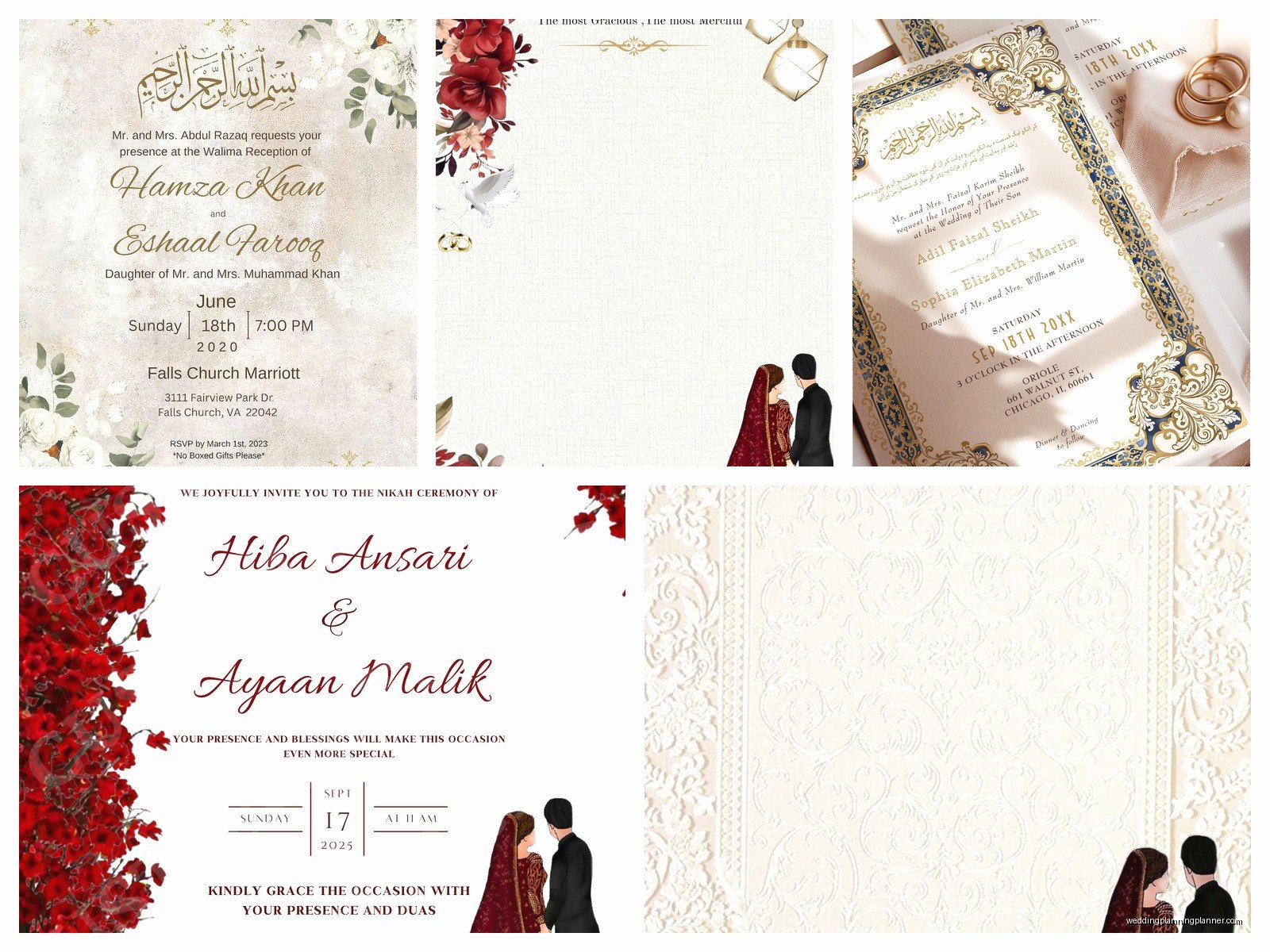
If the bride is taking the groom’s last name, you usually still list her with her maiden name on the invitation since that’s her identity at the time of the nikah. Some modern couples use “and” between their names, traditional invitations might format it differently.
The RSVP line might include “Kindly respond” or “Please confirm attendance” rather than the French “RSVP” because some families prefer English or Arabic phrasing throughout.
Printing and Paper Choices
Paper quality matters for Muslim wedding invitations because they tend to be ornate. You want something that can handle metallic inks, embossing, or foil stamping. I usually recommend at least 120lb cardstock, but 140lb feels more luxurious.
Textured papers work beautifully with Islamic designs. Linen finish, cotton paper, or even handmade papers with visible fibers add richness. Metallic papers in gold or champagne are popular but make sure your text is readable—dark ink on metallic paper needs good contrast.
Foil stamping in gold, rose gold, or copper is huge for Muslim wedding invitations. That metallic detail on the Bismillah or on the geometric borders creates elegance. It’s more expensive but the effect is worth it for formal weddings. Letterpress can also work but it’s less common because the tradition leans toward ornamental rather than minimal.
Envelope Considerations
Colored envelopes are totally fine—gold, burgundy, emerald green, navy. The envelope is your first impression so make it match your design aesthetic. Envelope liners with matching patterns tie everything together.
If you’re using Arabic or Urdu calligraphy on the envelope addresses, make sure your postal service can deliver them. In the US, you might need to add a clearly printed address label alongside the decorative calligraphy. I learned this in summer 2021 when half a batch got returned because the postal workers couldn’t read the addresses.
Wax seals are gorgeous on Muslim wedding invitations. Gold wax with a custom monogram or a stamp with Islamic geometric patterns seals the envelope literally and figuratively. Just know they add thickness and might require extra postage.
Working with Designers and Printers
Find a designer who has experience with Muslim weddings or at least shows cultural sensitivity. Look at their portfolio—do they understand the aesthetic? Do they use appropriate imagery? Can they work with Arabic text without it looking like random decoration?
Etsy has tons of designers who specialize in Islamic wedding invitations. Many offer customization of existing templates which saves money compared to fully custom design. Just read reviews and check their turnaround times because these detailed designs take longer to produce.
Local print shops might not have experience with the specific requirements. Online printers like Minted, Zazzle, or specialized sites like Zazzle actually have Islamic wedding categories now. But honestly the specialized boutique printers who focus on Muslim and South Asian weddings understand the nuances better.
Get a proof before full printing. This is non-negotiable. Check that all Arabic text is correct, that names are spelled right, that dates and times are accurate. I’ve seen too many couples skip this step and regret it.
Budget Reality Check
Basic printed invitations start around $2-3 per invitation for simple designs. Mid-range with some foiling or special finishes run $5-8 per invite. Luxury boxed invitations with multiple inserts and embellishments can hit $15-30 per invitation easily. And that’s before mailing costs.
Order extras. Like, order 10-15% more than you think you need. You’ll have addressing mistakes, last-minute additions to the guest list, and you’ll want keepsakes. Nothing’s worse than running out and having to do a small reorder that costs more per unit.
Assembly time is real if you’re doing boxed invitations or multiple inserts. Factor in time to stuff envelopes, tie ribbons, add embellishments. I usually tell couples to host an invitation assembly party with family—it becomes a fun pre-wedding activity and many hands make light work.
Timing Your Order
Order your invitations at least 3-4 months before the wedding. Design and proofing takes time, printing takes 2-3 weeks usually, and you need time to address and mail them. Muslim weddings often have international guests, so mailing 6-8 weeks before the wedding is common instead of the typical 6 weeks.
If you’re ordering during Ramadan or Hajj season, expect potential delays from designers and printers who observe these times. Plan accordingly—not as a complaint, just as a practical scheduling note.
Save-the-dates are less traditional for Muslim weddings but they’re becoming more common, especially for destination weddings or when you have guests traveling internationally. A simple card or digital save-the-date 4-6 months out helps people plan.
Insert Cards and Extra Details
You’ll probably need insert cards for: accommodation information, directions, gift registry details (though some families prefer not to include this), dress code clarification, and website information if you have a wedding website.
A small card with the transliteration and translation of common Arabic phrases used during the ceremony can be helpful for non-Muslim guests. It’s educational and welcoming without being preachy.
Some families include a small card explaining the significance of the nikah ceremony or the walima tradition. This is especially thoughtful if you’re having an interfaith guest list and want everyone to feel included and informed.