Planning Guides, Style Guide
Wedding Program Outline: Complete Guide
Jun
Okay so wedding programs are actually way more important than people think
Look, I’ve been doing this for almost two decades now and the number of couples who skip programs or throw them together last minute is… honestly it drives me nuts. A wedding program is basically your guest’s roadmap to your ceremony and it keeps everyone from being confused about what’s happening or who that random person walking down the aisle is.
So here’s the thing about programs – they can be super simple or really detailed, but you gotta hit certain points no matter what. I’m gonna walk you through exactly what needs to be in there and how to organize it so it actually makes sense.
The basics that literally every program needs
At the very minimum, your program should have:
- Your names (seems obvious but you’d be surprised)
- The date
- The location/venue name
- Order of ceremony events
- Wedding party names and their roles
That’s it. That’s the bare bones. But honestly most couples want to include more because it’s a nice keepsake and it helps guests feel more involved in what’s happening during the ceremony.
The cover section
Your cover is pretty straightforward. You want your names, the date, and the location. Some couples do “The Wedding of Sarah and Mike” or “Sarah Chen & Mike Rodriguez” or whatever format feels like you. I’ve seen couples use their monogram, a custom illustration, even a photo from their engagement shoot.
Spring 2023 I had this couple who insisted on putting their cat’s name on the cover as the “ring bearer” even though cats obviously don’t… anyway, their guests loved it and it became this whole conversation starter. Sometimes the quirky stuff works.
Format options for the cover
You can do:
- Formal: “The Marriage Celebration of [Full Names]”
- Casual: “Sarah & Mike are getting married!”
- Traditional: “[Your names] together with their families”
Just make sure the date and venue are clearly visible. I’ve seen programs where the date was in tiny font at the bottom and guests were confused about whether they were at the right wedding, which is kinda hilarious but also not great.
The ceremony order section (this is the important part)
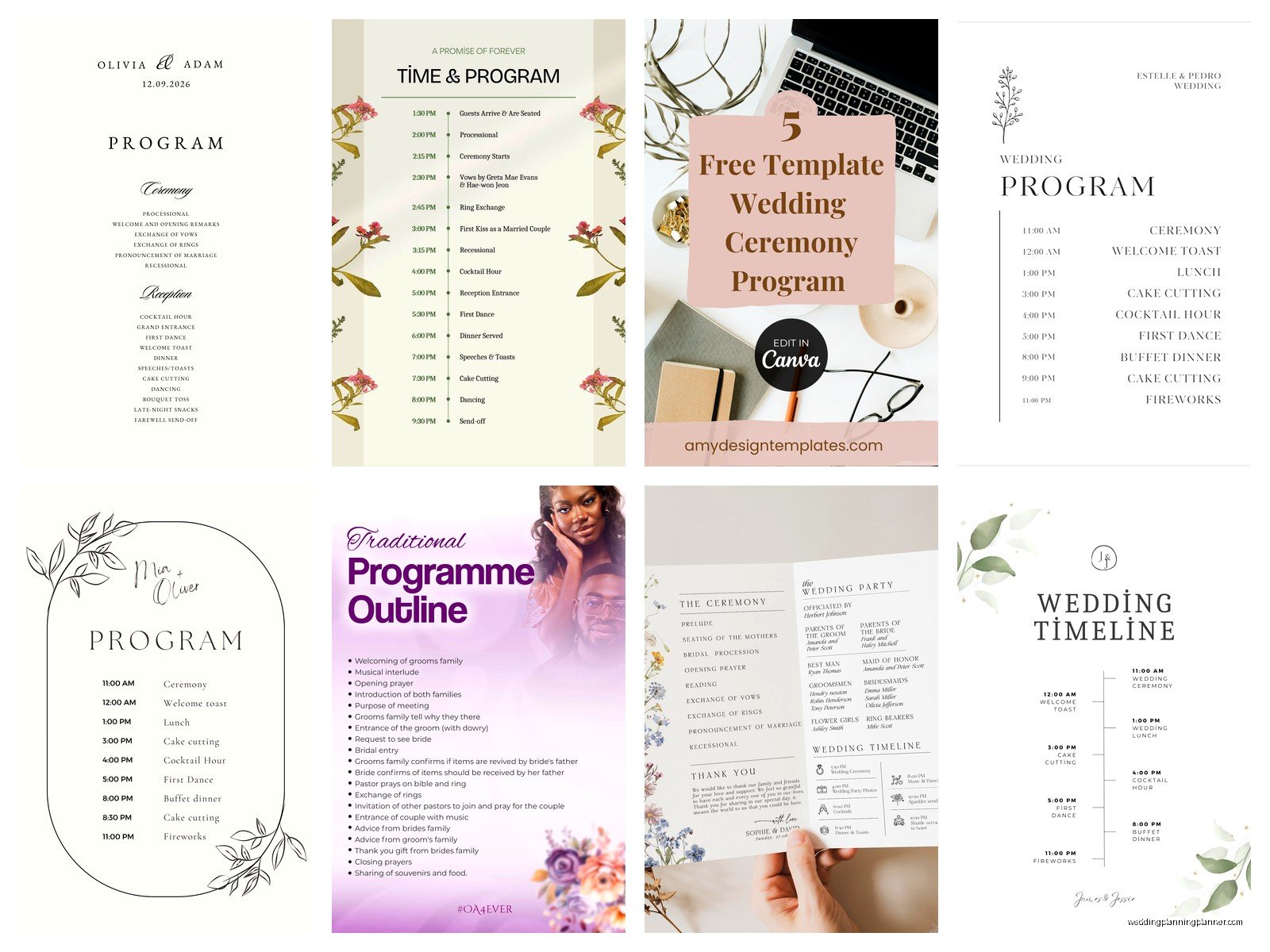
This is where you outline what’s actually happening during the ceremony. List everything in the order it occurs. Here’s a typical structure:
Processional – This is when the wedding party walks down the aisle. You can list the order here or just say “Processional” and let people watch it unfold.
Welcome/Opening Remarks – Usually the officiant welcomes everyone and maybe says a few words about marriage or love or whatever.
Reading(s) – If you have poems, scripture, or other readings, list them here with the title and who’s reading it. Like “Love Is Patient, Love Is Kind – 1 Corinthians 13, read by Sarah’s mom, Patricia Chen”
Vows – Just note whether you’re doing traditional or personal vows
Ring Exchange – Pretty self-explanatory
Unity Ceremony – If you’re doing a unity candle, sand ceremony, handfasting, or whatever else, explain it briefly here because not everyone knows what these are
Pronouncement – This is the “I now pronounce you married” moment
The Kiss – You can just write “The Kiss” or get creative with it, I’ve seen “The First Kiss” or “You may kiss!”
Recessional – When you walk back down the aisle as a married couple
Adding descriptions (and why you should)
Here’s what annoys me – when couples just list the ceremony parts without any explanation. Like if you’re doing a Jewish ceremony and half your guests aren’t Jewish, maybe explain what the chuppah is? Or if you’re breaking glass, tell people why? Same goes for any cultural or religious traditions that might not be familiar to everyone.
You don’t need paragraphs, just a sentence. “We will light a unity candle together, symbolizing the joining of our two families into one” – done, people understand what they’re watching.
The wedding party section
List your wedding party with their names and relationship to you. This is actually super helpful because guests are always wondering “who is that person” during the ceremony.
Parents of the Couple
- List both sets of parents
- Include stepparents if they’re involved
Officiant
- Name and title (Reverend, Rabbi, Justice of the Peace, your best friend who got ordained online, whatever)
Maid/Matron of Honor and Best Man
- Names and relationship (“Best Man: Jake Martinez, groom’s brother”)
Bridesmaids and Groomsmen
- List them all with their relationships
- You can do this in order of processional or just alphabetically
Flower Girl(s) and Ring Bearer(s)
- Names and who they belong to (“Ring Bearer: Tommy Chen, bride’s nephew”)
Some couples also include readers, musicians, or anyone else with a special role in the ceremony.
Optional sections that are actually kinda nice
So beyond the required stuff, there are sections you can add that make the program more personal and meaningful…
A welcome message
This is where you can thank guests for coming or say something about what the day means to you. Keep it short – like three sentences max. “Thank you for celebrating with us today. Your presence means the world to us as we begin this new chapter together.”
In memory of section
If you’ve lost important people who can’t be there, this is a respectful way to honor them. “In loving memory of [names]” – that’s all you need. Summer 2021 I had a bride who wanted to include her grandmother’s wedding photo in this section and it was so touching, half the guests were crying before the ceremony even started.
Thank you to parents
A brief acknowledgment of your parents or whoever raised you/supported you. “We are forever grateful to our parents for their love, guidance, and support.”
Explanation of traditions or symbols
If you’re incorporating specific cultural, religious, or family traditions, use a section to explain them. This is especially important for interfaith or multicultural weddings where guests might not be familiar with certain customs.
What happens after the ceremony
You can include a note about what’s next: “Please join us for cocktails and dinner reception immediately following the ceremony at [location]” or if there’s a gap, tell people what to do with themselves during that time.
Design and format stuff you should think about
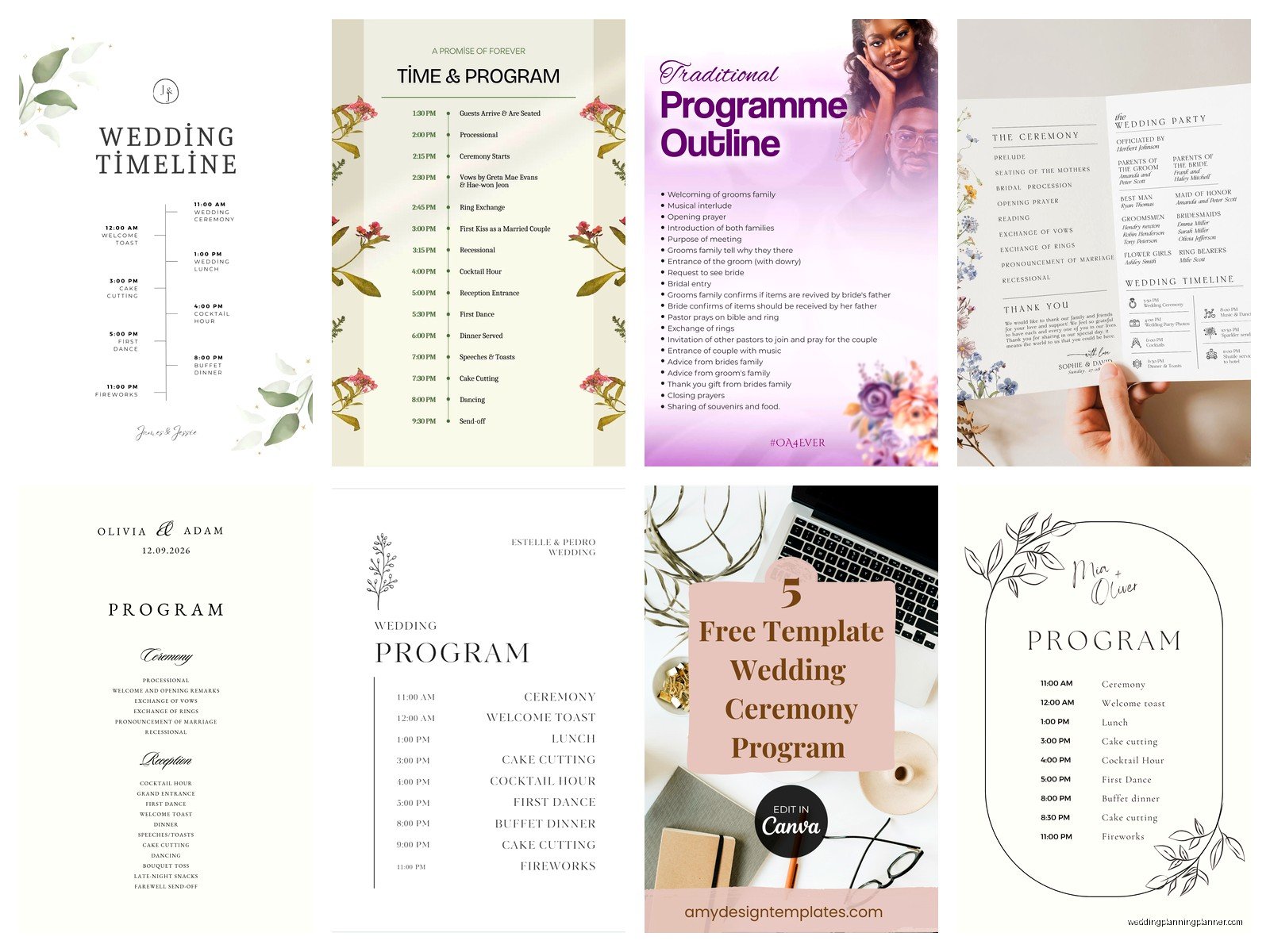
The standard program format is either a single sheet (front and back) or a folded booklet. Single sheets are cheaper and easier but booklets give you more room for content and feel fancier.
Single sheet programs: Put the cover info on one side, ceremony details on the other. Simple, cost-effective, gets the job done.
Folded programs (bifold): Cover on front, inside spread for ceremony order and wedding party, back panel for thank yous or additional info.
Multi-page booklets: For longer ceremonies or if you want to include lots of details, song lyrics, readings in full, etc.
Font and readability
Use a font size that older guests can actually read. I’m talking at least 11-point font, preferably 12. I cannot tell you how many times I’ve seen beautiful programs that no one over 50 could read without squinting. Your grandma should be able to read this thing.
Paper and printing
Cardstock is standard because it holds up better than regular paper. You can print them yourself if you’re crafty and want to save money, or order them through a stationer or online service. Minted, Etsy, and Zazzle all have templates you can customize.
Timing and quantity stuff
Order programs about 2-3 months before the wedding. You need time for design, proofing, printing, and any fixes if something’s wrong. And yeah, proofread them like five times because I’ve seen programs with misspelled names and wrong dates and it’s… not ideal.
For quantity, order one program per family or couple, not per person. So if you’re expecting 150 guests, you probably need 75-80 programs. Some people like to have one per person but that’s expensive and kinda wasteful since couples usually share anyway.
The actual content writing part
When you’re writing the content, keep your tone consistent with your wedding vibe. Formal wedding? Use formal language. Casual backyard wedding? You can be more relaxed and conversational.
And here’s something I learned the hard way during a stressful situation with a client in 2019 – always, ALWAYS double-check how you’re listing people’s names and titles. I had a bride who accidentally put her stepmom’s name but not her bio mom’s name in the parent section and it caused this huge family drama that I had to help navigate two weeks before the wedding. Just… be thoughtful about family dynamics when you’re deciding who to include and how.
Sample ceremony order you can steal
Here’s a basic order you can adapt:
- Prelude Music
- Processional
- Welcome and Opening Prayer/Remarks
- Giving Away of the Bride (if you’re doing this, though lots of couples skip it now)
- First Reading
- Second Reading (optional)
- Homily or Message from Officiant
- Declaration of Intent (“Do you take…”)
- Exchange of Vows
- Blessing of the Rings
- Exchange of Rings
- Unity Ceremony (optional)
- Pronouncement of Marriage
- The Kiss
- Presentation of the Couple
- Recessional
Digital programs are a thing now too
Some couples are doing digital programs instead of or in addition to printed ones. You can create a wedding website page with all the ceremony info, or even make a QR code that guests can scan to view the program on their phones. This works well if you’re trying to be eco-friendly or cut costs, but honestly I still think printed programs are nicer for the actual ceremony because people aren’t staring at their phones during your vows.
Hybrid approach
What’s becoming popular is doing a simple printed program with the basic order of events, then having detailed information (full text of readings, song lyrics, extended family acknowledgments) available digitally. Best of both worlds and you save money on printing.
Common mistakes people make
Waiting until the last minute to order them – printing takes time and if there’s an error you need time to fix it.
Forgetting to include key information like the venue name or what time the reception starts.
Making the font too small or choosing a decorative font that’s impossible to read.
Not having someone else proofread for typos and errors – you’re too close to it to catch everything.
Ordering way too many or way too few – do the math based on families/couples not individual guests.
Including information that’s gonna change – like if you’re not 100% sure who’s doing a reading, maybe just put “Reading” without the specific person’s name until you’re certain.
Fan programs for outdoor weddings
If you’re getting married outside in warm weather, consider making your programs into fans. Same content, but attached to a wooden stick so guests can fan themselves during the ceremony. It’s functional and cute, though it does cost more than regular programs.
You can order these online or DIY them if you’re handy with a glue gun. Just make sure the stick is attached securely because I’ve seen them fall apart mid-ceremony which is awkward.
Do you even need programs though
Honestly? It depends. For a very small intimate wedding with like 20 people, you probably don’t need them. Everyone knows everyone and the ceremony is short. But for a larger wedding, especially one with cultural or religious traditions, or if you have a long ceremony with multiple readings and rituals, programs are really helpful.
They also give guests something to do while they’re waiting for the ceremony to start, which is nice because people get antsy just sitting there. And they’re a keepsake – I still have the program from my sister’s wedding in 2015 tucked in a memory box somewhere.
The main thing is making sure whatever you include is accurate, readable, and actually helpful to your guests. Don’t just make a program because you think you’re supposed to – make it because it serves a purpose for your specific ceremony. But also don’t overthink it to the point where you’re stressed about choosing between two shades of cream cardstock, because at the end of the day people are there to watch you get married, not critique your paper choices